

At a glance: Commercial solar cost per watt currently runs about $1.77 to $2.40 per watt DC nationally before incentives, depending on the source. This guide explains why SEIA, DOE, and Berkeley Lab figures differ, what a Florida per-watt bid includes, how rooftop and ground-mount arrays compare, what changes on an occupied building, which state and federal provisions affect net cost, and a role-by-role checklist for comparing proposals before the December 31, 2027 placed-in-service date.
Commercial solar cost per watt is a reliable way to compare bids only when every bid prices the same scope, and in Florida the scope gap between a rooftop array and a ground-mount array is large enough to outweigh the headline number. National sources currently place commercial systems between about $1.77 and $2.40 per watt DC before incentives, depending on who measures and how. An owner who picks the lowest per-watt bid without checking roof condition, wind design, utility upgrades, and the December 31, 2027 federal placed-in-service date can pay for it later in a remove-and-reinstall, a change order, or a lost credit. This article explains what the figure contains and how the two mounting types differ; it does not quote Advanced Green Technologies pricing or determine any project’s tax position.
What Is the Current Commercial Solar Cost per Watt?
Commercial solar in the U.S. currently costs roughly $1.77 to $2.40 per watt DC before incentives, depending on the source. The SEIA and Wood Mackenzie Solar Market Insight Q3 2026 put the national commercial system price at $1.77 per watt in Q2 2026, and Berkeley Lab reports a $2.40 per watt median for 2025 non-residential systems above 100 kW.
The direction of the number matters as much as its level. pv magazine USA’s coverage of the same Wood Mackenzie pricing analysis reports that commercial pricing rose 5.6% year over year while distributed-market module prices fell 16% to $0.37 per watt, with structural-materials tariffs and freight costs, up about 15%, absorbing the module savings. Racking, electrical, labor, engineering, and utility work now account for most of the difference between Florida proposals. Wood Mackenzie also reports a 15% tariff with minimum import prices on key solar components taking effect December 4, 2026, which bidders may price into equipment ordered after that date.
The U.S. Department of Energy’s PV system cost benchmarks model a 250 kWdc rooftop system on a flat school roof at $1.95 to $1.98 per watt DC in 2024 dollars, a third reference point between the other two. The sources measure different things (Table 1), and Berkeley Lab’s Tracking the Sun 2024 executive summary states that its reported medians run higher than modeled benchmarks, which align more closely with its 20th-percentile prices. A bid near $1.77 per watt is not automatically cheap, and a bid near $2.40 is not automatically expensive.
| Benchmark | What it measures | Commercial figure ($/W DC, before incentives) | Date / dollar basis | Where it falls short |
|---|---|---|---|---|
| SEIA / Wood Mackenzie Solar Market Insight Q3 2026 | Modeled national average commercial system price | $1.77 | Q2 2026 | National average; no Florida wind, HVHZ, or interconnection detail |
| U.S. DOE PV system cost benchmarks | Modeled minimum sustainable (MSP) and market price (MMP) for a 250 kWdc rooftop on a flat school roof | $1.95 MSP / $1.98 MMP | 2025 Q1, 2024 dollars | One defined rooftop system; no ground-mount figure |
| Berkeley Lab Distributed Solar and Storage 2026 Data Update | Reported median price paid by host owners | $3.10 (100 kWDC or smaller); $2.40 (larger than 100 kWDC) | 2025 installs, 2025 dollars | Self-reported; can include ancillary roofing and electrical work; no Florida breakout in the report |
| Berkeley Lab Utility-Scale Solar 2026 Edition | Capacity-weighted installed cost of ground-mount plants larger than 5 MWAC | $1.31 ($1.69 per watt AC) | Projects online in 2025 | Utility scale; far larger than most commercial ground-mount systems |
What Does a Per-Watt Price Include on a Florida Commercial Project?
A per-watt price is the total contract price divided by the array’s DC nameplate capacity, so it includes whatever the contract includes. Two proposals for the same 500 kW array can differ by tens of cents per watt because one carries utility upgrades, roof repairs, or years of O&M and the other excludes them. Berkeley Lab’s Distributed Solar and Storage 2026 Data Update notes that reported prices can include ancillary electrical or roofing work, and it estimates that soft costs and other balance-of-system costs together make up roughly 80% of the median installed price.
DC and AC ratings are a second source of confusion. Modules are rated in watts DC; inverters and utility interconnection limits are rated in watts AC. Arrays are routinely built with more DC than AC capacity, so the same price yields a lower per-watt-DC figure. Berkeley Lab’s Utility-Scale Solar 2026 Edition shows the gap for the same 2025 projects: $1.69 per watt AC and $1.31 per watt DC. Every bid should state its basis.
Table 2 lists the scope lines that most often explain a per-watt gap between Florida commercial bids. Each line is set during design, which is why the commercial solar engineering process comes before a fixed price.
| Scope line | Rooftop array | Ground-mount array | Why it moves the per-watt figure |
|---|---|---|---|
| Structure | Rails and roof attachments, ballasted or mechanically attached | Driven piles or other foundations with fixed-tilt racking | Florida design wind loads set attachment count, pile embedment, and steel weight |
| Site work | Roof protection, walkway pads, crane picks | Clearing, grading, stormwater controls, access road, fencing | Ground-mount site work follows land condition, not array size |
| Electrical | Conduit to the main switchgear, often across the roof | Trenching; medium-voltage equipment on larger sites | Distance to the point of interconnection drives conductor and trenching cost |
| Roof scope | Condition survey; repair or re-roof before installation | Not applicable | A roof near end of life adds a remove-and-reinstall later |
| Engineering and permits | Structural review of the existing building; fire-access pathways | Geotechnical report; land-use and environmental review | Fixed per-project costs weigh more heavily on small systems |
| Utility | Application, study fees, any service upgrade | Same, often with longer runs and transformer work | Upgrade scope comes from the utility’s study, not the installer |
| After commissioning | Monitoring and O&M term, if included | Monitoring, mowing, vegetation control, fence upkeep | Some bids include years of O&M; others exclude it |
Rooftop vs Ground-Mount Solar Cost: Which Is Lower per Watt?
At similar sizes, a rooftop array and a ground-mount array usually price close to each other per watt, and the site decides which is lower. The most recent national laboratory benchmark that modeled both side by side, the Q1 2021 PV and storage cost benchmark published through DOE’s Office of Scientific and Technical Information, put a 200 kWdc commercial rooftop system at $1.56 per watt DC and a 500 kWdc commercial ground-mount at $1.64 per watt DC in 2020 dollars. Those levels are five years old and below today’s market, so treat the small gap between them as the useful finding and the levels as dated.
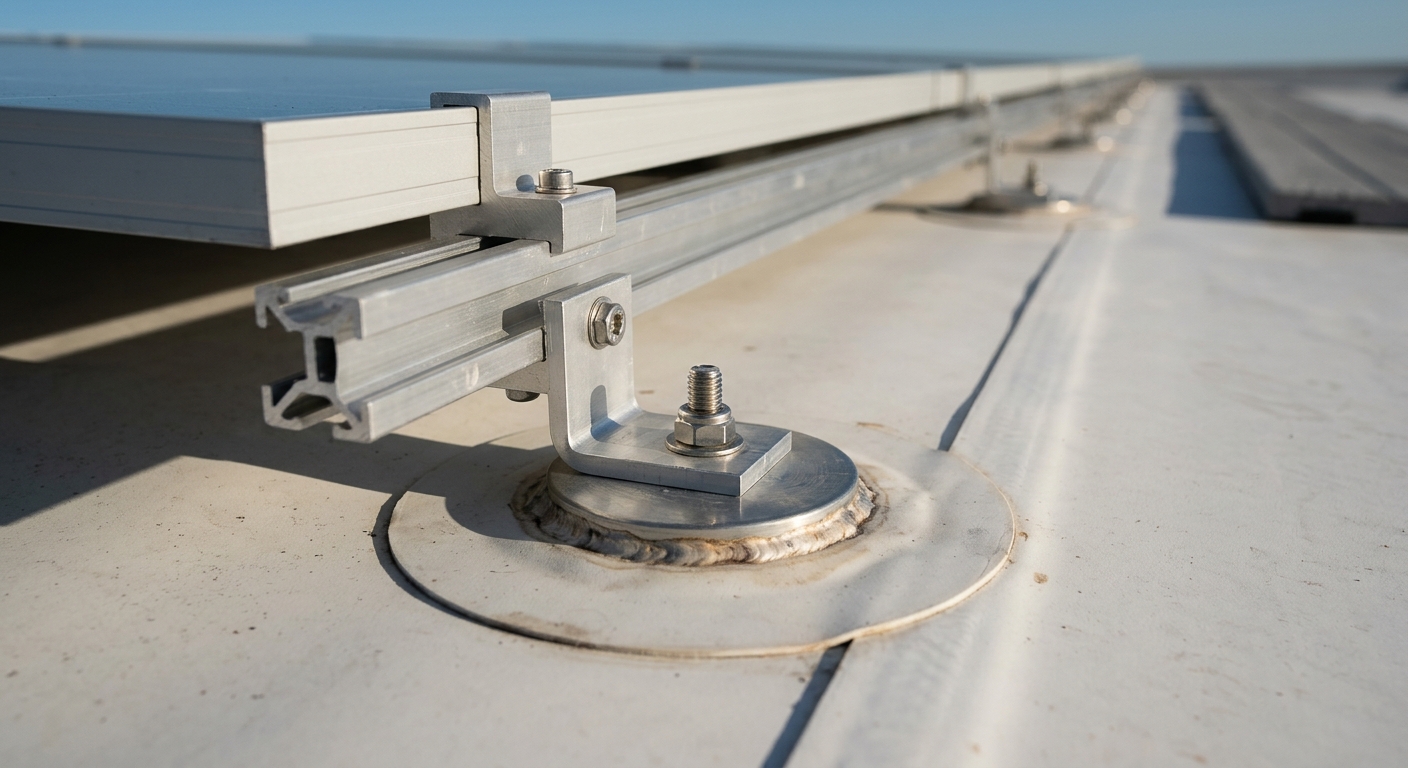
A commercial rooftop solar installation avoids land, foundations, and fencing, and the building’s electrical service is usually close by. Rooftop cost rises with roof complexity: rooftop equipment that breaks up the array, structural limits that rule out ballast, fire-access pathways, and a roof that needs work first. A ground-mount solar farm installation removes roof risk and can be laid out for ideal tilt and row spacing, but it carries geotechnical uncertainty, stormwater permitting, fencing, and longer electrical runs. Shallow rock or a high water table found in the geotechnical report can change pile design, so that report belongs ahead of a fixed price; our solar farm site selection checklist covers the screening.
Neither type is the better buy in general. A warehouse with a sound roof and a short run to the switchgear will often price lower on the roof, while a campus with open, buildable land and an aging roof may price lower on the ground once the roof work is counted. Solar carports are a third option priced on different terms, covered in our commercial solar carport cost guide for Florida.
| Factor | Rooftop | Ground-mount | Where it falls short |
|---|---|---|---|
| Cost advantage | No land, foundations, or fencing; short electrical run | Ideal tilt and spacing; no roof work | Rooftop loses it when the roof needs replacement; ground-mount loses it when soil, drainage, or distance add scope |
| Capacity limit | Roof area, setbacks, and rooftop equipment | Buildable land, wetlands, and setbacks | Neither fixes a site that is too small for the load |
| Wind exposure | Attachments and roof deck carry Florida design wind loads | Piles and racking carry design wind loads in open exposure | Arrays are designed to rated pressures; storms can exceed them, and warranties carry wind-speed limits |
| Roof interaction | Shares the roof’s service life and warranty terms | None | An aging roof means a remove-and-reinstall during the array’s life |
| Operations and maintenance | Roof access, cleaning, inverter service | Mowing, vegetation, fence, and access-road upkeep | O&M is often left out of the quoted per-watt price |
| Permitting | Building permit with structural and fire review | Building permit plus land-use, stormwater, and environmental review | Ground-mount approvals can take longer before construction starts |
What Moves the Commercial Solar Price per Watt in Florida?
Six variables explain most of the spread between Florida bids.
- System size. Berkeley Lab’s 2025 medians are $3.10 per watt at 100 kWDC or smaller and $2.40 above it, as fixed design, permitting, and mobilization costs spread over more watts.
- Storage. The same data update reports median premiums of $2.0 per watt (small) and $1.3 per watt (large non-residential) for paired PV and storage over stand-alone PV, stated per watt of PV. A bid with a battery is not comparable with one without.
- Wind design and attachment. The engineer of record sets attachment density, ballast limits, and pile embedment under the Florida Building Code; Miami-Dade and Broward projects follow High-Velocity Hurricane Zone provisions.
- Interconnection. Under Florida PSC Rule 25-6.065, systems above 100 kW and up to 2 MW are Tier 3, for which utilities may charge an interconnection study fee; upgrades the study identifies are generally assigned to the customer under the utility’s tariff. Our guide to common Florida commercial solar interconnection delays lists where schedules slip.
- Scope inclusions. Roof work, permit fees, monitoring, O&M years, and performance guarantees are included in some bids and excluded from others.
- Timing. Equipment ordered after the December 4, 2026 tariff date and schedules compressed toward the 2027 placed-in-service date both carry cost.
What Changes the Cost on an Occupied Florida Building?
On an occupied building, the schedule is built around the people inside it, and that schedule is part of the price. Rooftop installs on retail, office, school, and healthcare buildings are sequenced so crane picks happen outside business hours where the site allows and staging stays clear of entrances and fire lanes. The electrical tie-in usually requires a planned shutdown of the main service, set with the facility manager in advance and often scheduled on a weekend or overnight at premium labor rates.
Ground-mount projects on an operating campus or industrial site have their own constraints: construction traffic separated from employees and deliveries, dust and stormwater controls during clearing and grading, and trench routes that avoid active utilities. Summer afternoon lightning stops roof and field work, and from June through November the project manager plans material storage and temporary tie-down before a named storm approaches. The commercial solar installation timeline shows where those windows fall.
Roof condition is the Florida cost line most often missed. A rooftop array and the roof under it share a service life; if the membrane has a few years left, the owner is budgeting for a remove-and-reinstall mid-life. AGT was founded by Advanced Roofing, and where a roof needs work first, Advanced Roofing’s re-roofing team can sequence the roof ahead of the array. Our article on keeping roof warranty coverage when solar goes on covers the warranty side.
Which Incentives and Deadlines Change the Net Cost per Watt?
Benchmarks are quoted before incentives. As of November 2026, the One Big Beautiful Bill Act terminates the Section 48E clean electricity investment credit for solar facilities that begin construction after July 4, 2026 and are placed in service after December 31, 2027, as IRS Notice 2025-42 summarizes. A project starting now has about 13 months to reach placed-in-service status, including permitting and interconnection. Whether a project qualifies, including any beginning-of-construction position for earlier work, is a determination for your tax advisor; our commercial solar tax credit deadline guide lists the questions to bring.
Florida adds two state provisions. Section 212.08(7)(hh), Florida Statutes, exempts solar energy systems and their components from sales and use tax, as the Florida Department of Revenue explains, and Section 196.182 exempts 80% of the assessed value of a qualifying renewable energy source device taxed as tangible personal property. The property appraiser and your tax advisor determine how either applies. Net metering terms follow PSC rules and each utility’s tariff; our Florida net metering guide for commercial customers explains how FPL credits exports and bills demand.
The Florida Building Commission’s 2026 code work plan sets December 31, 2026 as the effective date of the 9th Edition (2026) Florida Building Code. The permit application date generally determines which edition governs; the building official decides.
How Should You Compare Commercial Solar Bids per Watt?
Each item below is assignable to a named role, and a commercial solar feasibility study organizes most of the inputs before bidding.
- Owner or CFO: require every bidder to state price per watt DC and AC, DC and AC nameplate, and module and inverter models.
- Facility manager: give every bidder the roof’s age, warranty, and latest condition report, or the site survey and flood-zone information for a ground-mount.
- Roof consultant: confirm remaining roof service life before a rooftop bid is accepted.
- Structural or geotechnical engineer: confirm structural capacity or the pile design basis before a fixed price.
- Utility: confirm interconnection tier, study fees, required upgrades, and who pays for them.
- Tax advisor: confirm credit eligibility and placed-in-service timing against December 31, 2027.
- Procurement: list every exclusion side by side, including roof work, utility upgrades, permit fees, monitoring, O&M years, and guarantees.
- Project manager: provide a schedule showing permit, utility, and shutdown milestones against the placed-in-service target.
Frequently Asked Questions
How much does commercial solar cost per watt in Florida?
National sources place commercial systems at about $1.77 to $2.40 per watt DC before incentives: $1.77 in the SEIA and Wood Mackenzie Q2 2026 benchmark and $2.40 as Berkeley Lab’s 2025 median for non-residential systems larger than 100 kW. None publishes a Florida commercial figure, so read a Florida bid against its scope, mounting type, and wind design.
Is ground-mount solar more expensive than rooftop solar per watt?
Not by much at similar sizes. The Q1 2021 national laboratory benchmark modeled a 500 kWdc ground-mount at $1.64 per watt DC and a 200 kWdc rooftop at $1.56 in 2020 dollars. Site conditions decide the difference: roof replacement raises rooftop cost, and soil, drainage, fencing, and long electrical runs raise ground-mount cost.
What is a good price per watt for commercial solar?
A good price covers the full scope your site needs at a level consistent with current benchmarks. A bid well below $1.77 per watt DC should be checked for excluded roof work, utility upgrades, or O&M. A bid above Berkeley Lab’s $2.40 median may still be sound if it includes storage, re-roofing, or High-Velocity Hurricane Zone structure.
Does the price per watt include interconnection and roof work?
Only if the contract says so. Utility study fees and service or transformer upgrades are set by the utility’s study and are often listed as exclusions or allowances. Roof repair or replacement is usually a separate scope. Ask each bidder to list inclusions and exclusions on one page.
How does the federal tax credit deadline affect commercial solar cost?
Under the One Big Beautiful Bill Act, solar facilities that begin construction after July 4, 2026 must be placed in service by December 31, 2027 to claim the Section 48E credit. A compressed schedule can raise cost through expedited procurement and labor, and missing the date changes the net cost per watt. Your tax advisor determines eligibility for a specific project.
Do larger commercial solar systems cost less per watt?
Generally yes. Berkeley Lab’s 2025 data show a $3.10 per watt median for non-residential systems of 100 kWDC or smaller and $2.40 for larger systems, because engineering, permitting, mobilization, and interconnection costs are spread over more watts. Utility-scale plants above 5 MWAC averaged $1.31 per watt DC for 2025 projects.
Reading Commercial Solar Cost per Watt Against the Scope
Current benchmarks describe a range of about $1.77 to $2.40 per watt DC for commercial systems, with the spread explained by method, size, and scope. Rooftop and ground-mount arrays land close together per watt at similar sizes, and roof condition, wind design, soil, distance to interconnection, and contract scope decide which is lower on a Florida site. With modules getting cheaper and balance-of-system costs rising, the lines outside the modules now decide most bids. An owner who compares DC with DC, lists every exclusion, and settles roof condition, utility scope, and the 2027 date before signing is comparing like with like.
Written by The Technical Team at Advanced Green Technologies. Founded in 2007, Advanced Green Technologies is 100% employee-owned and has installed more than 380 megawatts of rooftop and ground-mount solar for Florida clients; Solar Power World’s 2026 Top Solar Contractors list ranked AGT #1 among Florida commercial and industrial EPC contractors.
To get a scoped proposal that states price per watt DC and AC with every inclusion and exclusion listed, request a commercial solar quote or call (888) 735-2641.