

At a glance: The July 4, 2026 begin-construction date for the federal Section 48E solar credit has passed, and a commercial project that missed it must now be placed in service by December 31, 2027. This guide shows which deadline governs each project, how a June 2026 court ruling and the 2026 foreign-sourcing rules affect eligibility, why battery storage follows a different clock, which Florida incentives stand apart from the federal date, and what each role should confirm.
The commercial solar tax credit deadline that drove most Florida project schedules in 2026, the July 4 begin-construction date, has passed. The federal Section 48E credit remains available to commercial solar on a narrower path: a project that did not begin construction by July 4, 2026 must be placed in service by December 31, 2027, while a project that began construction in time keeps a longer runway. An owner who reads the wrong clock loses the credit outright, because an array energized in January 2028 on the late-start path earns nothing. This article sets out the deadlines that remain as of October 1, 2026, the foreign-sourcing rules that now sit beside them, and the Florida incentives that never depended on the federal calendar. It does not decide whether any building qualifies; that determination belongs to the owner’s tax advisor.
What changed for commercial solar incentives under the 2025 tax law?
The One Big Beautiful Bill Act, signed July 4, 2025 as Public Law 119-21, put an end date on the commercial solar investment credit for wind and solar facilities. As the IRS explains in Notice 2025-42, the law terminates the Section 48E credit for a solar facility placed in service after December 31, 2027 when its construction began after July 4, 2026, the date twelve months after enactment. Solar projects that began construction on or before that date sit outside the new termination and follow the earlier placed-in-service rules.
The structure of the credit stayed in place. The IRS page on the clean electricity investment credit describes a 6 percent base credit that rises to as much as 30 percent for facilities meeting prevailing wage and registered apprenticeship requirements, with increases of 10 percentage points available for qualifying domestic content and for projects located in an energy community. That page was last updated in January 2026 and still describes the pre-2025 phase-out schedule, so owners should read it for how the credit is calculated and read the Treasury notices for when it ends.
SEIA’s summary of the 2025 tax law lists what the law left alone: no phase-down of the credit percentage for projects that qualify, no ban on third-party leases or power purchase agreements, unchanged transferability, and no placed-in-service deadline for energy storage. The same summary notes that the residential Section 25D credit ended December 31, 2025, a homeowner rule that does not govern a warehouse or a school.
Which commercial solar tax credit deadline applies to your project?
As of October 1, 2026, a commercial solar project that did not begin construction by July 4, 2026 must be placed in service by December 31, 2027 to claim the Section 48E credit. Projects that began construction in time generally have until the end of the fourth calendar year after the start year. Storage is exempt from that date.
Beginning of construction is a tax test with a defined meaning. Under the IRS beginning-of-construction notices, construction begins when physical work of a significant nature starts, such as installing racking on site or manufacturing components off site under a binding written contract. Notice 2025-42 lists activities that do not count, including design, permitting, securing financing, and clearing a site. A project that cleared that test must also keep construction moving; the continuity safe harbor treats that requirement as met when the facility is placed in service within four calendar years after the year construction began.
| Project situation | Deadline that governs | Source | Status as of Oct. 1, 2026 |
|---|---|---|---|
| Solar that began construction in 2025 | Placed in service by Dec. 31, 2029 to use the continuity safe harbor | Continuity safe harbor, restated in IRS Notice 2025-42, sec. 4.04 | Open; the build schedule must hold |
| Solar that began construction Jan. 1 to July 4, 2026 | Placed in service by Dec. 31, 2030 to use the continuity safe harbor | Continuity safe harbor, restated in IRS Notice 2025-42, sec. 4.04 | Open; start-date evidence must survive review |
| Solar that had not begun construction by July 4, 2026 | Placed in service by Dec. 31, 2027 | Public Law 119-21, as described in IRS Notice 2025-42 | Open for about 15 months |
| Battery storage (energy storage technology) | The solar placed-in-service date does not apply | SEIA summary of the 2025 tax law | Open; foreign-sourcing rules apply |
Placed in service is also a tax determination, and the owner’s tax advisor decides which records establish the date. Owners should expect utility permission to operate, commissioning reports, and close-out documents to form part of that file. A late-start project that finishes installation in December 2027 but waits on the utility into January 2028 is exposed.
How do the remaining paths to the credit compare?
Owners still weighing solar in late 2026 have four realistic paths, and each carries a condition that can defeat it. The comparison below is written for a taxable owner of a commercial building in Florida; tax-exempt owners have an additional route described after the table.
| Path | Fits when | Where it falls short |
|---|---|---|
| Rely on a construction start made by July 4, 2026 | Physical work or, where it applied, the 5% safe harbor was documented before the deadline | The start-date evidence must hold up on review, and the method rules were in litigation in 2026 |
| Build to a Dec. 31, 2027 placed-in-service date | Roof, structure, equipment, and interconnection can all be ready within about 15 months | No grace period for weather or utility delay is written into the statutory date |
| Add or lead with battery storage | Demand charges or backup needs justify storage on their own | Storage does not pay back on every tariff, and it carries a stricter foreign-sourcing threshold |
| Proceed without the federal credit | Energy savings and depreciation justify the project alone | Payback lengthens, and the owner carries more of the equipment cost |
The first path needs a note. Notice 2025-42 made physical work the only beginning-of-construction test for solar facilities above 1.5 MW AC and kept the 5% cost safe harbor only for smaller systems. On June 6, 2026, the U.S. District Court for the District of Columbia vacated that notice in Oregon Environmental Council v. IRS, which restored the 5% safe harbor as an argument for projects that relied on it before the deadline. An appeal or new Treasury guidance could change that result, so any owner whose start date rests on the 5% method should have tax counsel confirm the position before claiming the credit.
Schools, municipalities, houses of worship, and other tax-exempt owners can use elective pay, which the IRS treats as a payment of tax and refunds as an overpayment; taxable owners without enough tax liability can transfer the credit to a buyer for cash. Both routes require IRS pre-filing registration. AGT’s pages on federal funding for public-sector solar and commercial solar financing options cover how ownership structure changes who can use the credit.
A small, simple rooftop system may not need a statewide EPC contractor, and the lowest bid for that job may come from a smaller installer. The deadline belongs to the project regardless of who builds it.
What drives the value of the credit and the build schedule?
The credit percentage and the schedule move on different variables. The table lists the federal variables that change the credit amount or eligibility, each tied to its source.
| Variable | Effect | Source, date |
|---|---|---|
| Prevailing wage and registered apprenticeship | Raises the credit from the 6% base toward 30% | IRS clean electricity investment credit page, Jan. 2026 |
| Domestic content | Adds up to 10 percentage points | IRS clean electricity investment credit page, Jan. 2026 |
| Energy community location | Adds up to 10 percentage points | IRS clean electricity investment credit page, Jan. 2026 |
| Prohibited foreign entity cost ratio | Below the threshold, no credit: 40% for generating facilities and 55% for storage that begin construction in 2026 | IRS Notice 2026-15, Feb. 2026 |
| Bonus depreciation | 100% first-year bonus depreciation for qualified property acquired after Jan. 19, 2025 | SEIA depreciation summary, 2026 |
| Elective pay or transfer | Requires IRS pre-filing registration before the return is filed | IRS elective pay page, June 2026 |
The foreign-sourcing rule is the newest variable and the easiest to miss. IRS Notice 2026-15 explains that a generating facility or storage system that begins construction after December 31, 2025 cannot claim the credit if its material assistance cost ratio, the share of manufactured-product cost that did not come from a prohibited foreign entity, falls below the threshold for its construction-start year. The thresholds rise each year, and the notice applies the pre-2025 beginning-of-construction rules to this test.
Depreciation changed as well. SEIA’s depreciation summary reports that the 2025 law restored 100 percent bonus depreciation for qualified property acquired after January 19, 2025. Published summaries disagree on how the law changed the recovery class for solar property, so that question goes to the tax advisor and this article takes no position on it.
On the schedule side, the long-lead items are utility interconnection review, equipment delivery, permitting, and any roof work that has to finish first. A schedule built for a fixed deadline starts from the placed-in-service date and works backward, so ask each bidder to show that sequence; AGT’s commercial solar engineering process describes where design and permitting fall in it.
What changes on an occupied Florida building racing a 2027 date?
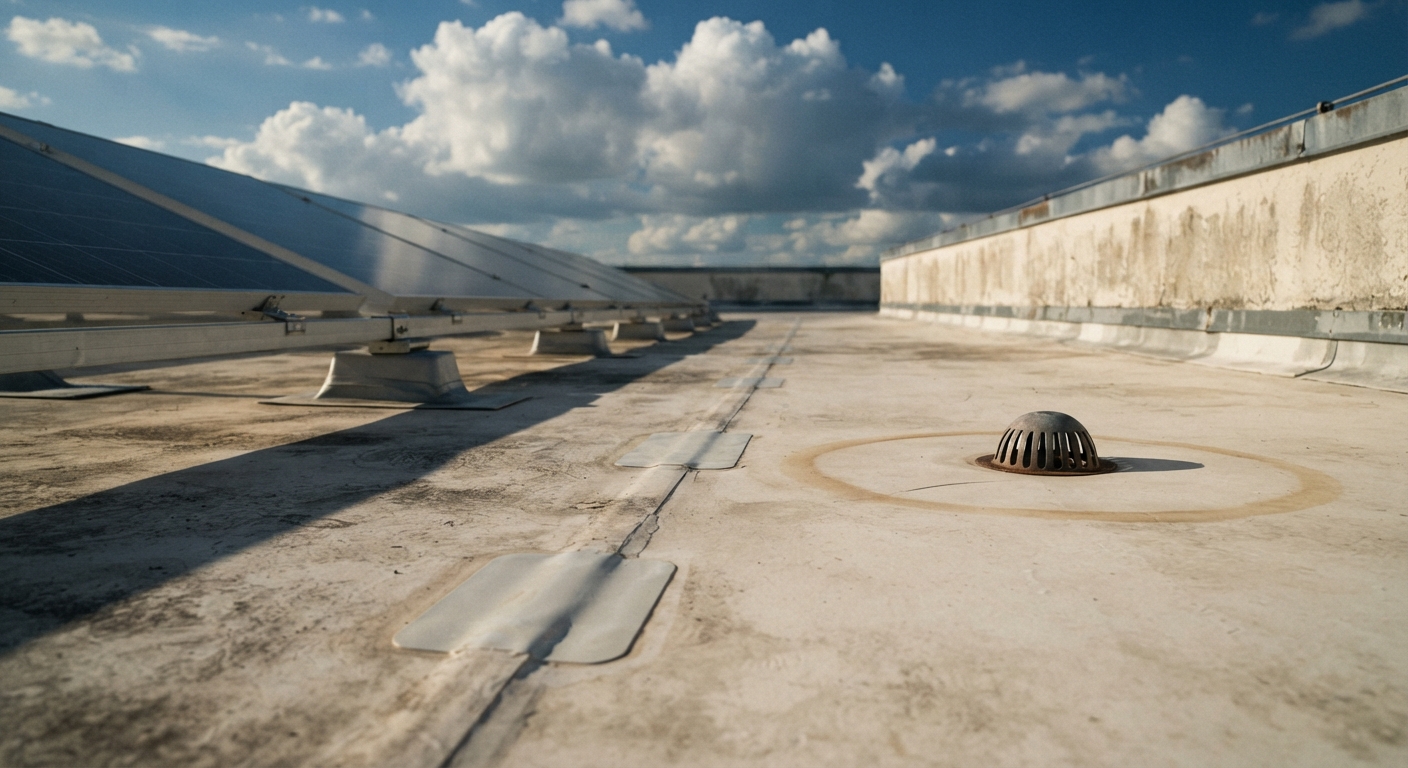
A rooftop array shares the roof’s service life, and the 2027 date compresses the decision about which comes first. If the membrane under a planned rooftop solar installation has only a few years left, the owner either re-roofs before installation or budgets for a remove-and-reinstall later in the array’s life. Re-roofing first adds months to a schedule that has about fifteen to spare. Advanced Green Technologies was founded by Advanced Roofing, and the sister company’s commercial re-roofing services can be scheduled ahead of an array so the two scopes do not wait on separate contractors. Where the roof cannot carry the schedule, a parking canopy may, and the tradeoffs are covered in AGT’s guide to commercial solar carports in Florida.
The 2027 Atlantic hurricane season runs June 1 through November 30, which places the final months before the deadline inside the season. The December 31, 2027 date is a statutory placed-in-service date, and nothing in the guidance reviewed for this article extends it for weather. The excusable-disruption list in Notice 2025-42, which includes severe weather, addresses the continuity requirement for projects that already began construction.
The Florida Building Code, 9th Edition (2026), is scheduled to take effect December 31, 2026, and the permit application date generally determines which edition governs; in Miami-Dade and Broward, High-Velocity Hurricane Zone product approval also applies to solar attachments. The engineer of record and the building official decide what applies to a given building.
On an occupied building, crane picks are scheduled outside business hours where the site allows, and electrical tie-ins that require a shutdown are announced to the property manager before the window opens. Each coordination step takes calendar time that a late-2027 schedule cannot recover.
Which Florida incentives do not depend on the federal deadline?
Florida’s property tax treatment of solar runs on its own calendar. Under section 193.624, Florida Statutes, 80 percent of the just value attributable to a renewable energy source device on nonresidential property may not be considered in determining assessed value, for devices installed on or after January 1, 2018, and its note states that those provisions expire December 31, 2037. Several installer pages describe the exclusion as complete; for commercial property, it is 80 percent.
As of October 1, 2026, net metering is the other state-level variable. Florida Public Service Commission Rule 25-6.065 governs interconnection and metering of customer-owned renewable generation, and each utility’s tariff sets the terms a customer actually receives. Those terms can change through PSC proceedings, so a proposal’s savings estimate should name the tariff it assumed and the date it was read.
Commercial solar tax credit deadline checklist by role
- Owner or CFO: Decide whether the project makes sense without the federal credit, then treat the credit as upside the schedule has to earn.
- Tax advisor: Confirm which clock applies, how the beginning-of-construction position is documented, and whether the project uses the credit, elective pay, or a transfer.
- Facility director: Get the roof condition report and the electrical service capacity in hand before design starts.
- Procurement lead: Require each bidder to state its supplier certifications for the foreign-sourcing cost ratio and its domestic content position, if claimed. AGT’s guide on how to select a solar contractor lists further bid questions.
- Project engineer: Build the schedule backward from the placed-in-service date, with utility interconnection, permitting, and roof work shown as separate critical-path items.
- Energy lead: Run the case for commercial battery storage on its own merits using interval data; AGT’s article on peak shaving with solar and battery storage covers when a battery pays and when it does not.
- Property manager: Plan tenant notices for crane picks and shutdown windows before the contract is signed.
Frequently Asked Questions
Is the commercial solar tax credit still available after July 4, 2026?
Yes, on a narrower path. A commercial solar project that did not begin construction by July 4, 2026 can still claim the Section 48E credit if it is placed in service by December 31, 2027. Projects that began construction by July 4, 2026 generally have until the end of the fourth calendar year after construction began. Eligibility, credit amount, and documentation are determinations for the owner’s tax advisor.
What happens if a solar project is placed in service after December 31, 2027?
If the project did not begin construction by July 4, 2026, a placed-in-service date after December 31, 2027 ends its eligibility for the Section 48E credit under the 2025 law, as described in IRS Notice 2025-42. Bonus depreciation and Florida’s property tax treatment do not depend on that date. Owners on the late-start path should build float into the schedule for interconnection and permitting delays.
Does battery storage have the same tax credit deadline as solar?
No. SEIA’s summary of the 2025 law notes that the solar placed-in-service deadline does not apply to energy storage. Storage that begins construction in 2026 does face a stricter foreign-sourcing test, with a 55 percent material assistance cost ratio threshold under IRS Notice 2026-15. Whether storage pays back depends on the tariff, demand charges, and backup needs.
What are the FEOC rules for commercial solar starting construction in 2026?
For facilities that begin construction after December 31, 2025, the credit is unavailable if too much of the manufactured-product cost comes from prohibited foreign entities. IRS Notice 2026-15 sets the 2026 threshold at 40 percent for generating facilities and 55 percent for storage, rising in later years. Supplier certifications support the calculation, and the tax advisor confirms it.
Can a nonprofit, school, or city use the commercial solar tax credit?
Tax-exempt and governmental entities can use elective pay, which the IRS treats as a tax payment and refunds as an overpayment. The entity must complete IRS pre-filing registration before filing, and the same placed-in-service deadlines and sourcing rules apply to the underlying project. Elective pay can carry reduced credit amounts in some cases, so the entity’s advisor should review the IRS rules.
Does Florida’s solar property tax exclusion depend on the federal deadline?
No. Section 193.624, Florida Statutes, excludes 80 percent of the just value attributable to a renewable energy source device on nonresidential property from assessed value, for devices installed on or after January 1, 2018. The statute’s note says those provisions expire December 31, 2037. The county property appraiser applies the exclusion, and the owner’s advisor should confirm the current text.
Where the December 31, 2027 date leaves Florida owners
The commercial solar tax credit remains available to Florida buildings after July 4, 2026. The start-date path closed on that date, and the placed-in-service path now runs to December 31, 2027. Owners who began construction in time need records that prove it. Owners who did not need a schedule that can absorb a roof decision, a hurricane season, and a utility interconnection, and every owner now needs a supplier file that satisfies the foreign-sourcing test. Florida’s 80 percent property tax exclusion and the restored bonus depreciation sit outside that clock. Advanced Green Technologies was ranked the #1 commercial and industrial EPC solar contractor in Florida on Solar Power World’s 2026 Top Solar Contractors list, as documented in AGT’s 2026 ranking announcement. The tax determinations stay with the owner’s advisor; the engineering and the schedule are where a contractor can help.
Written by The Technical Team at Advanced Green Technologies. Founded in 2007, Advanced Green Technologies is 100% employee-owned and designs, procures, and builds commercial solar for clients in Florida and the Caribbean.
Plan your schedule against the 2027 date. Call (888) 735-2641 or request a free quote from our team.