

At a glance: A commercial solar carport in Florida costs more per watt than a rooftop array because the price carries engineered steel, foundations, and parking-lot work. This guide shows where carport money goes, what the published cost numbers measure and miss, how FPL’s October 2026 tariffs and Florida net metering rules set payback, which federal and state incentives reach the canopy structure, and what a capital request should contain before a board approves it. It quotes no price and makes no tax determination.
The commercial solar carport cost Florida owners should budget is set by steel, foundations, and the calendar more than by panels. A canopy is permitted as a structure over occupied parking, so it prices above a rooftop array of the same size, and its payback rests on three Florida-specific questions most cost guides skip: how much of the structure sits inside the tax incentives, how the utility tariff values each kilowatt-hour, and whether the project can be placed in service by the federal credit’s December 31, 2027 date. An owner who budgets from a residential price-per-watt figure and assumes a full credit on the whole structure can approve a project whose real payback runs years longer than the board was told. This article quotes no price for any site and makes no tax determination; it lays out where the money goes, what the published numbers show, and what a defensible budget has to contain.
Why is the commercial solar carport cost Florida owners face different in late 2026?
The federal clock changed the math in July. Under IRS Notice 2025-42, a solar facility that began construction after July 4, 2026 loses the Section 48E clean electricity investment credit if it is placed in service after December 31, 2027. The notice treats design, permitting, financing, and soil test drilling as preliminary activities, and for a carport those are the long-lead steps: geotechnical work, stamped structural drawings, a building permit, and custom steel fabrication all come before the first column is set.
Two other changes landed the same year. The Section 30C credit for EV chargers, a common add-on described on AGT’s commercial EV charging stations page, covers business property placed in service through June 30, 2026, according to the IRS page on the alternative fuel vehicle refueling property credit. Florida Power & Light’s business rate sheet effective October 2026 also reset the charges a carport offsets, so a budget built from a 2025 proposal needs to be rerun.
Where does the money go in a commercial solar carport?
A commercial solar carport in Florida costs more per watt than a rooftop array because the price includes engineered steel, drilled foundations, and parking-lot site work. A 2020 evaluation for the Rhode Island Office of Energy Resources measured that structural premium at about $0.70 to $1.48 per watt over ground-mounted solar. Florida wind design, soils, and lot phasing set the local number.
Modules and inverters cost about the same on a canopy as on a roof. The structure is the difference. Berkeley Lab’s August 2026 distributed solar and storage data update reports that soft costs and balance-of-system costs make up roughly 80 percent of the median non-residential installed price, with a $1.7 per watt spread in median price across system sizes. A carport adds a heavy structural line to that side, so a canopy over a dozen stalls prices very differently from a 1 MW canopy over a distribution center lot.
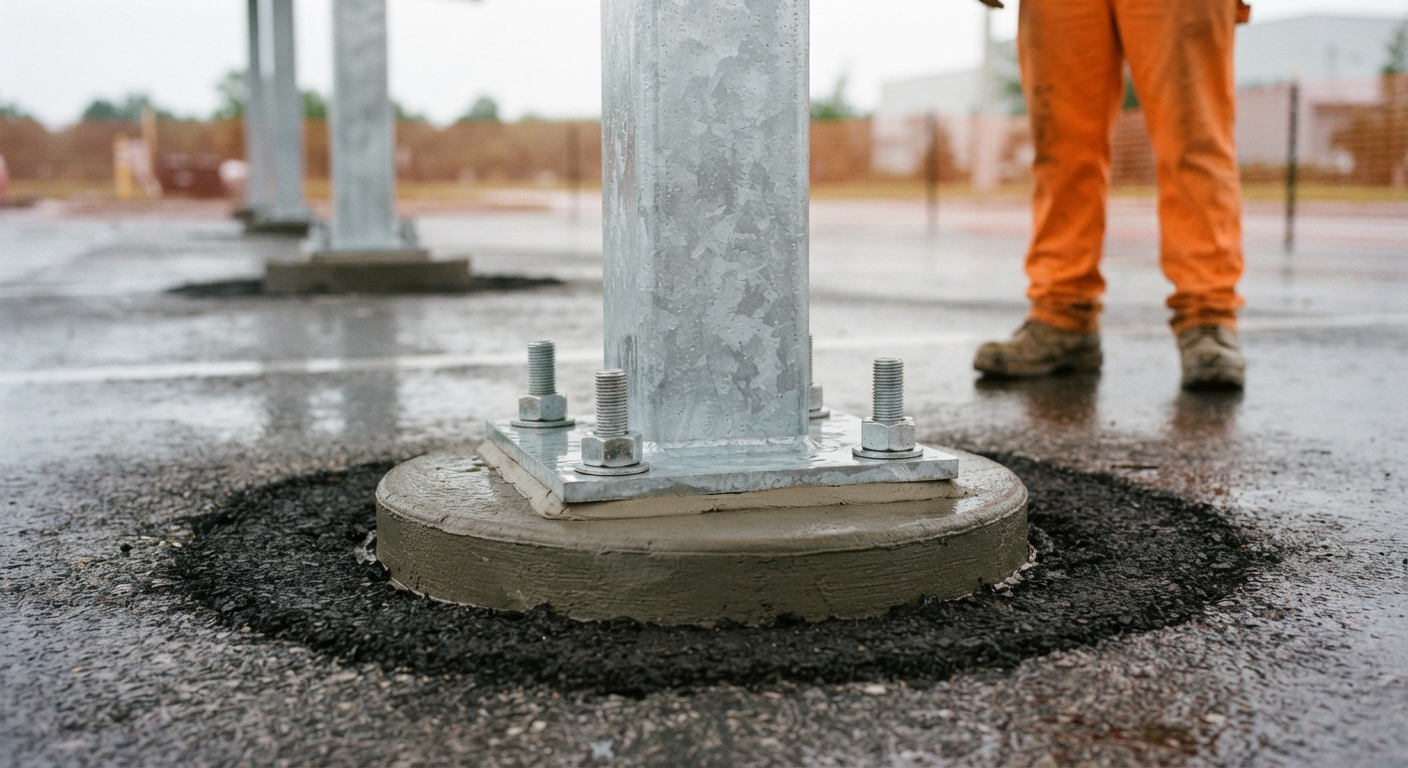
In Florida the steel is designed for hurricane wind loads over people and vehicles, with High-Velocity Hurricane Zone provisions in Miami-Dade and Broward. Advanced Green Technologies states that its commercial solar carports are built to resist wind speeds up to 180 mph; the engineer of record sets each site’s design wind speed, and a storm can exceed it.
| Cost line | What moves it | Florida factor | What the bid should show |
|---|---|---|---|
| Modules and inverters | System size (kW DC), module wattage, inverter type | Supplier sourcing for the 2026 foreign-entity test | Equipment list with supplier certifications |
| Structural steel and fabrication | Span, clearance height, single or double cantilever, steel prices | Hurricane wind design; HVHZ product approval in Miami-Dade and Broward | Stamped structural drawings and design wind criteria as a line item |
| Foundations | Soils, water table, pier depth and diameter | Sandy or high-water-table sites can deepen piers | Geotechnical report referenced; foundation type stated |
| Site and civil work | Trenching, drainage under the canopy, restriping, lot closures | Afternoon storm runoff concentrated at canopy drip lines | Civil scope and parking-zone phasing plan |
| Electrical and interconnection | Distance to service, service upgrades, utility review | Utility interconnection tier and fees | Interconnection path and any upgrade priced, not assumed |
| EV make-ready and lighting | Conduit, panel capacity, under-canopy LED fixtures | Section 30C no longer applies to new chargers | Make-ready scope priced even if chargers come later |
| Design, permitting, engineering | Structural, electrical, and civil design; permit review | Permit application date sets the code edition | Design and permit fees and schedule shown separately |
How do the published solar carport cost numbers compare?
No public dataset isolates Florida commercial carport prices as of October 2026, and the numbers that circulate come from sources built for different questions. Each is useful for one thing and misleading for another, and a budget memo should say which one it relied on.
| Source | What it measures | Useful for | Where it falls short |
|---|---|---|---|
| Berkeley Lab distributed solar data (Aug. 2026) | Gross installed prices of non-residential PV, before incentives | Price trends and the effect of system size; non-residential prices were flat from 2024 to 2025 | Does not separate carports from rooftop and ground-mounted systems |
| Rhode Island carport evaluation (Oct. 2020) | Developer survey, interviews, and program bid data on carport cost premiums | The structural premium of a carport over ground-mounted solar | 2020 dollars, New England snow loads, and a three-project bid sample |
| Residential carport price guides | One- and two-car canopies sold through consumer marketplaces | Little for a commercial budget | Residential scale, residential tariffs, and often no stated assumptions |
| Engineered site estimate | Priced drawings, geotechnical data, and the utility interconnection path | The number a board actually approves | Costs engineering time before a decision is made |
The Rhode Island Renewable Energy Growth Program carport evaluation is the most carport-specific public record. Developers’ stated premium over ground-mounted solar ran $0.84 to $1.20 per watt, while bid data from three projects showed a weighted $723 per kW, a sample the authors called small. Florida has no snow load but adds hurricane wind design, so treat the premium as a reference point.
A carport is also not the cheapest path to the same kilowatt-hours. Where a roof is sound with years of life left, a rooftop array usually costs less, as AGT’s guide to commercial solar carports in Florida explains. A single-row canopy loses most of the scale benefit, and a statewide EPC contractor may not be the lowest bid for that job.
What sets the payback period and ROI of a Florida solar carport?
Payback compares net installed cost with the value the canopy returns each year, and the value side is where most published estimates go wrong. Commercial demand accounts pay for energy and peak demand separately. On FPL’s General Service Demand (GSD-1) rate effective October 2026, the per-kWh base energy, environmental, and fuel charges add to about 6.3 cents before taxes and fees, and the base demand charge is $12.70 per kW. On General Service Large Demand (GSLD-1), the per-kWh charges add to about 5.6 cents and the base demand charge is $15.12 per kW, according to the same FPL rate sheet.
A carport reliably offsets the per-kWh charges. It cannot be counted on to lower the monthly billing demand, because a passing cloud can drop output during the interval that sets the peak. Holding that peak down is a storage job, and AGT’s article on peak shaving with solar and battery storage covers when a battery earns its cost and when it does not.
Sizing changes the value of each kilowatt-hour. FPL’s net metering guidelines require a customer system to be estimated to produce less than 115 percent of the account’s annual consumption, and under Florida PSC Rule 25-6.065 excess energy carries forward as a credit, with unused credits paid at the utility’s avoided-cost rate at year end. A canopy sized to the building’s daytime load usually earns more per kilowatt-hour than one sized to fill the lot.
| Payback variable | How it moves the result | Source, date |
|---|---|---|
| Net installed cost after incentives | The structural share of cost and how much of it reaches credit basis | IRS Notice 2026-15, Feb. 2026 |
| Per-kWh value by rate class | About 6.3 cents (GSD-1) and 5.6 cents (GSLD-1) per kWh before taxes and fees | FPL business rates, Oct. 2026 |
| Share of output used on site | Exported surplus is trued up at avoided cost at year end | PSC Rule 25-6.065; FPL net metering guidelines |
| System size relative to load | Must be estimated below 115% of annual consumption | FPL net metering guidelines |
| Production at canopy tilt and azimuth | Lot orientation, light poles, and trees shade a canopy more than a roof | Site model from the bidder |
| Storage paired with the canopy | Adds a median $1.3 to $2.0 per watt for paired systems; targets demand charges | Berkeley Lab data update, Aug. 2026 |
Simple payback is the figure boards ask for and the weakest one. A CFO should see after-tax cash flows with the credit, depreciation, inverter replacement, and operations and maintenance costs in the years they occur, and with shade and EV readiness valued separately so the energy case stands alone. AGT’s solar financing options page lays out ownership structures; the tax position behind each is the advisor’s call.
What changes when the canopy goes over an open Florida parking lot?
A carport is built in the middle of the property’s daily traffic. Foundations are drilled into the lot, steel is set by crane, and conduit trenches cross drive aisles, so the work is phased by parking zone, each fenced, built, restriped, and returned before the next closes. Property managers need the closure map before the contract is signed, because lost stalls affect tenants and, on some sites, required parking counts.
Crane picks are scheduled outside business hours where the site allows, with loads never swung over occupied vehicles or pedestrians. Where roof work shares the capital plan, Advanced Roofing’s crane division can coordinate picks for both scopes, and shutdowns for electrical tie-ins are announced before the window opens.
The calendar adds a Florida constraint. The 2027 Atlantic hurricane season runs June 1 through November 30, which places the final months before the December 31, 2027 credit date inside the season. Steel erection and module installation stop for high winds, and a schedule that leaves inspection and utility permission to operate for December has no room for a storm delay.
Which Florida carport incentives apply as of October 2026, and to which parts of the structure?
Every incentive in a carport budget applies to a defined set of equipment, and the canopy steel sits on the boundary of most of them. The table summarizes the federal and state items as of October 6, 2026; each needs a publish-day re-check, and none is a determination for any project.
| Incentive | What it covers | The carport question | Source |
|---|---|---|---|
| Section 48E credit | Qualified property used as an integral part of the facility, not including a building or its structural components | How much of the canopy steel and foundations is in credit basis | IRS Notice 2026-15, restating 48E(b)(2) |
| Section 48E placed-in-service date | Solar that began construction after July 4, 2026 must be in service by Dec. 31, 2027 | Whether permit and steel lead times fit | IRS Notice 2025-42 |
| Foreign-entity sourcing test | Cost-ratio thresholds of 40% (generation) and 55% (storage) for 2026 starts; structural steel and iron disregarded | Supplier certifications for modules, inverters, and batteries | IRS Notice 2026-15 |
| Bonus depreciation | 100% for qualified property acquired after Jan. 19, 2025 | How each part of the structure is classified | SEIA depreciation summary, May 2026 |
| Florida sales tax exemption | Solar energy systems and certified components, including module mounting and structural support other than a roof | Whether canopy columns and beams fall within the certified list | F.S. 212.08(7)(hh); DOR TIP 19A01-09 |
| Florida property tax exclusion | 80% of just value attributable to a renewable energy source device on nonresidential property | Integral structural supports count; structures required without the device do not | F.S. 193.624 |
| Section 30C charger credit | Business property placed in service Jan. 1, 2023 through June 30, 2026 | New chargers under the canopy do not qualify | IRS 30C page, May 2026 |
The structural question moves a carport budget most. Section 48E excludes a building or its structural components from qualified property, as IRS Notice 2026-15 restates, and canopy columns hold up modules while also sheltering cars. How much of their cost belongs in credit basis is for the tax advisor to settle before the pro forma is built. Depreciation follows separate rules, summarized in SEIA’s depreciation summary.
Florida’s exemptions raise the same boundary. The Department of Revenue’s certified list for the solar sales tax exemption and section 193.624, Florida Statutes both reach structural supports, but the statute excludes structures that would be required without the device; the Department, the property appraiser, and the tax advisor decide. Tax-exempt owners use IRS elective pay, covered on AGT’s federal funding for public-sector solar page, and deadline detail sits in AGT’s guide to the commercial solar tax credit deadline.
The Florida Building Code, 9th Edition (2026), is scheduled to take effect December 31, 2026, according to the Florida Building Commission’s 2026 code update materials, and the permit application date generally determines which edition governs a canopy.
Solar carport cost checklist for the capital request
- Owner or CFO: State the goal (energy savings, shade, EV readiness, resilience) and the hurdle rate, then require the energy case to clear it without counting shade.
- Tax advisor: Decide how canopy steel, foundations, and electrical work are allocated between credit basis and other property, and confirm depreciation treatment, before bids are compared.
- Facility director: Pull 12 months of interval data and confirm the rate class, so every proposal values energy at the October 2026 tariff.
- Structural and geotechnical engineers: Set the design wind criteria, foundation type, and any HVHZ product approval needs from the site’s soils and the governing code edition.
- Procurement lead: Require modules, steel, foundations, civil, electrical, EV make-ready, and interconnection as separate bid lines, with supplier certifications for the sourcing test. AGT’s guide on how to select a solar contractor lists further bid questions.
- Property manager: Approve the parking-zone phasing plan, crane schedule, and tenant notices before the contract is signed.
- Project engineer: Build the schedule backward from December 31, 2027, with permits, steel fabrication, inspection, and utility permission to operate shown as critical-path items; AGT’s commercial solar engineering process shows where design and permitting fall.
Frequently Asked Questions
How much does a commercial solar carport cost in Florida?
No public dataset publishes Florida commercial carport prices as of October 2026, so a reliable number comes only from an engineered site estimate. Berkeley Lab’s national data show non-residential solar prices fall sharply with system size, and a 2020 Rhode Island program evaluation put the carport premium over ground-mounted solar at roughly $0.70 to $1.48 per watt. Steel, foundations, wind design, and lot phasing set the Florida figure.
Why does a solar carport cost more than rooftop solar?
A carport has to build the structure a roof already provides. The price includes engineered steel columns and beams, drilled foundations, trenching across the lot, drainage and lighting under the canopy, and phased parking closures. In Florida the structure is designed for hurricane wind loads over people and vehicles, with High-Velocity Hurricane Zone requirements in Miami-Dade and Broward. Where a roof is sound, a rooftop array is usually the lower-cost path to the same output.
What is the payback period for a commercial solar carport in Florida?
Payback depends on the net installed cost after incentives, the per-kWh value of the account’s rate class, how much of the output the building uses itself, and production at the canopy’s tilt and orientation. On FPL demand rates effective October 2026, the per-kWh charges are about 5.6 to 6.3 cents before taxes and fees. A payback figure that does not state those assumptions is not one a board should rely on.
Does the federal tax credit cover the carport structure?
Section 48E covers qualified property used as an integral part of the generating facility and excludes a building or its structural components, as IRS Notice 2026-15 restates. Canopy steel holds up modules and also shelters vehicles, so how much of its cost belongs in credit basis is a determination for the owner’s tax advisor. Projects that began construction after July 4, 2026 must be placed in service by December 31, 2027.
Do Florida sales and property tax exemptions apply to solar carports?
Florida exempts solar energy systems and certified components from sales tax, and the certified list includes module mounting and structural support other than a roof. Section 193.624, Florida Statutes, excludes 80 percent of the just value of a renewable energy source device from nonresidential assessments, but not structures that would be required without the device. How each treats canopy steel is for the Department of Revenue, the property appraiser, and the tax advisor.
Can a new solar carport still meet the December 31, 2027 credit deadline?
It can, if the schedule is built backward from that date. A carport needs a geotechnical report, stamped structural drawings, a building permit, custom steel fabrication, foundations, and utility permission to operate, and the 2027 hurricane season overlaps the final months. IRS Notice 2025-42 sets the deadline for projects that began construction after July 4, 2026; whether a specific project qualifies is the tax advisor’s determination.
What a defensible Florida carport budget contains
A Florida solar carport is a structure first and a generator second, and its budget should read that way. The defensible version starts from an engineered site estimate, values each kilowatt-hour at the account’s October 2026 tariff, sizes the canopy to the building’s own load, and shows the tax advisor’s allocation of the canopy steel before anyone counts a credit. It also runs backward from December 31, 2027 through a hurricane season. A budget that skips those points tends to overstate the return.
Advanced Green Technologies ranked first among Florida commercial and industrial EPC contractors and third overall in Florida on Solar Power World’s 2026 Top Solar Contractors list, as documented in AGT’s 2026 ranking announcement. Carport design, metal fabrication, and construction run through the same in-house team.
Written by The Technical Team at Advanced Green Technologies. Founded in 2007, Advanced Green Technologies is 100% employee-owned and designs, procures, and builds commercial solar, including solar carports, for clients in Florida and the Caribbean.
Get a site-specific carport estimate. Call (888) 735-2641 or request a free quote from our team.