

At a glance: A Florida commercial solar schedule is set mostly by clocks outside the construction crew’s control: building-permit review, the utility’s interconnection screening and agreement, equipment delivery, and the final inspection and meter set. This article walks each phase from signed contract to power-on, cites the published review clocks in Florida rule and statute, compares rooftop, re-roof-first, and carport schedules, and closes with a 30-day checklist an owner can assign. The December 31, 2027 federal placed-in-service date makes the order of these steps a financial decision.
A commercial solar installation timeline in Florida is governed less by the weeks a crew spends setting modules than by clocks other parties hold: plan review at the building department, interconnection review and the meter set at the utility, and electrical equipment deliveries. The stake is sharper through 2027, because a solar project that began construction after July 4, 2026 receives no federal Section 48E credit if it is placed in service after December 31, 2027, as the IRS instructions for Form 3468 state. This article walks the schedule from signed contract to power-on and names who controls each phase. It does not estimate any project’s duration or decide credit eligibility; those belong to the contractor’s written schedule and the owner’s tax advisor.
Why does the commercial solar installation timeline matter more in 2026 and 2027?
Two federal dates now sit over every new commercial solar contract in Florida. The One Big Beautiful Bill Act, enacted July 4, 2025, ended the Section 48E credit for solar facilities placed in service after December 31, 2027 when construction begins after July 4, 2026. Projects that began construction by July 4, 2026 follow a different rule: IRS Notice 2025-42 describes a continuity safe harbor of up to four calendar years after the year construction began. Whether construction began in time, and when a project counts as placed in service, are determinations for the owner’s tax advisor, confirmed in writing before the schedule is baselined.
Most contracts signed from late 2026 onward fall in the first group, which turns the last step of the schedule into the deadline, and that step belongs to the utility. Florida Public Service Commission Rule 25-6.065 gives an investor-owned utility 30 calendar days from a completed application to execute an interconnection agreement, or 90 days when a Tier 3 system needs a study, and 30 calendar days from the customer’s signed agreement to finish inspections. The rule, last amended April 7, 2008, covers systems up to 2 MW, and a 2019 PSC staff recommendation notes that most of it applies only to investor-owned utilities.
A building-code date arrives first. The Florida Building Commission has set December 31, 2026 as the effective date of the 9th Edition (2026) Florida Building Code, as of November 2026. A permit set submitted in late December and one submitted in early January can be reviewed under different editions, which changes what the engineer of record draws. Ask the building official which edition will govern before the permit drawings are finalized.
What happens between a signed contract and power-on?
A commercial solar project passes through six phases between contract and power-on, and construction is only one of them. The table below lists each phase, who holds the clock, the published review period where one exists, and what commonly stretches it. Phases without a published clock are governed by the contract schedule, which is why the contract schedule should show each one as a dated line.
| Phase | Who holds the clock | Published clock (source) | What stretches it |
|---|---|---|---|
| 1. Site verification and design | Contractor and engineer of record | None published; set by contract | Roof condition findings, unknown electrical service capacity, owner changes to array layout |
| 2. Utility pre-application and screening | Utility | FPL Tier 3: Fast Track screen results within 10 business days of a completed application (FPL Tier 3 page, accessed Nov. 4, 2026) | Incomplete application; failed screens lead to an interconnection study ($2,000 study fee at FPL) |
| 3. Building permit | Local building department | 60 business days after a complete application for nonresidential buildings under 25,000 sq ft (F.S. 553.792, 2026) | Plan review comments, revision cycles, HVHZ product approval documents in Miami-Dade and Broward |
| 4. Procurement | Contractor and manufacturers | None published | Switchgear and transformer lead times, equipment substitutions that change the utility application |
| 5. Installation | Contractor | None published | Weather, roof access, shutdown windows on an occupied building |
| 6. Inspection, agreement, meter set | Building department and utility | Agreement within 30 calendar days, or 90 days with a Tier 3 study; utility inspections within 30 calendar days of the signed agreement (Rule 25-6.065) | Utility-side upgrades, missing insurance certificate, final permit not uploaded |
The utility steps exist because of physics on the distribution feeder. An exporting array raises voltage at the point of connection and adds fault current, and the feeder and service transformer must absorb both without tripping protection. FPL’s Tier 3 interconnection agreement describes Fast Track screens that test for this; a system that fails moves to a study, and the customer pays for the upgrades it identifies. FPL’s Tier 3 application steps place this screening before installation: the system is installed after successful screening results, and parallel operation waits until the bi-directional meter is installed.
How long commercial solar takes in Florida is the sum of design, permit review, utility screening and agreement, equipment delivery, installation, and final inspection with the meter set. The permit and utility steps carry the published clocks, and those clocks start only when an application is complete, so most of the schedule is decided in the first weeks.
AGT’s own portfolio shows the pattern. AGT’s project page for The Fort pickleball facility in Fort Lauderdale records that AGT completed its contract scope on schedule, while delivery and installation of a transformer outside AGT’s scope postponed final commissioning by roughly three months, and utility interconnection approval was still pending when the page was published. The utility-side causes are covered in more detail in our post on common commercial solar interconnection delays in Florida.
How do rooftop, re-roof-first, and carport projects compare on schedule?
The system type changes which phases grow, and none of the three common approaches is the fastest in every case. The comparison below covers schedule effects only; cost and production belong to a separate analysis.
| Approach | Schedule effect | Best fit | Where it falls short |
|---|---|---|---|
| Rooftop array on the existing roof | Fewest trades and inspections; permit and utility steps unchanged | Roofs whose remaining service life matches the array’s | If the roof needs replacement during the array’s life, the owner pays for a remove-and-reinstall later |
| Re-roof, then rooftop array | Adds a roofing permit and roofing work ahead of solar; utility review can run in parallel | Roofs near the end of their service life | Longest on-site duration; roof and solar warranties have to be coordinated |
| Solar carport | Adds foundations, structural steel, and structural plan review; HVHZ product approval in Miami-Dade and Broward | Aging or crowded roofs; large surface parking | Construction takes parking out of service in phases; wind design adds engineering and inspection steps |
| Ground-mount | Adds site work and, depending on the parcel, land-use and stormwater review | Campuses and industrial sites with open land | Civil and environmental review can exceed the electrical schedule |
A rooftop solar installation on a sound roof usually has the simplest schedule because it adds the fewest reviews. A rooftop array and the roof under it share a service life, so when the roof consultant reports less remaining life than the array’s, the honest schedule includes the re-roof. Our sister company Advanced Roofing re-roofs occupied commercial buildings, so both sequences can be planned as one job, though the re-roof still adds weeks the owner should see before signing.
Commercial solar carports avoid the roof question and add a structural one. Columns need foundations, the canopy has to be engineered for the site’s design wind speed, and in the High-Velocity Hurricane Zone the attachment and component approvals add documents to the permit set. Advanced Green Technologies is also not the right fit for every job: a contractor organized for multi-megawatt and occupied-building work may not offer the lowest bid or the quickest mobilization on a small, simple rooftop, and our guide on how to select a commercial solar contractor covers the questions to ask any bidder.
What moves a commercial solar project schedule?
Six variables account for most of the difference between a short and a long Florida schedule, and most of them are visible before the contract is signed. Each row below carries its source.
| Driver | Effect on the schedule | Source (date) |
|---|---|---|
| System size against the tier lines (10 kW, 100 kW, 2 MW AC) | Tier 3 systems pay an application fee, go through Fast Track screens, and can trigger a study with a 90-day agreement window. FPL computes AC rating as DC rating times 0.85 | Rule 25-6.065 (amended Apr. 7, 2008); FPL net metering guidelines (accessed Nov. 4, 2026) |
| Electrical service capacity | Systems above 90% of the existing service capacity may incur additional expense, including utility upgrades the customer pays for | FPL net metering guidelines (accessed Nov. 4, 2026) |
| Application completeness | The utility’s clocks start at a completed application; the utility has 10 business days to identify deficiencies | Rule 25-6.065(7)(b) |
| Permit completeness | The building department has 5 business days to flag missing information; after a written deficiency notice, the applicant has 10 business days to revise | F.S. 553.792 (2026) |
| Serving utility | Investor-owned utilities follow Rule 25-6.065; municipal utilities and cooperatives set their own procedures | PSC staff recommendation, Sept. 20, 2019 |
| Project size nationally | Median application-to-PTO time for 1 to 5 MW solar projects was 45 months for 2020 to 2025 in the 15 states with data, which exclude Florida | Lawrence Berkeley National Laboratory, Sept. 2026 |
The national figure and the Florida rule clocks point in different directions. The Berkeley Lab interconnection timelines report of September 2026 draws its time-to-operation data from 15 states, and Florida is not among them. Rule 25-6.065 caps review periods for systems up to 2 MW but not the time to build upgrades a study identifies, so read the national number as a warning about upgrades and the Florida rule as the floor on paperwork time. The Berkeley Lab 2026 distributed solar data update also found permit timelines notably longer for non-residential systems above 100 kW than for smaller ones.
What changes on an occupied Florida building?
On an occupied building, the solar schedule is built around the tenants and the electrical shutdown. The tie-in at the main switchgear usually de-energizes part or all of the building, so the property manager approves the window, tenants get written notice, and the work falls outside business hours where the operation allows. Crane picks are scheduled the same way, with the lift area barricaded and staging fenced away from entrances and fire lanes.
Roof work on an occupied building runs on safety rules that set its pace. Walkway paths and fire-code setbacks stay clear, staged materials are secured each evening, and daily cleanup keeps debris off drains. Hurricane season runs June 1 to November 30, so a schedule carrying roof work through summer should show weather days and a plan for securing material ahead of a named storm. Expect photo progress reports and a weekly look-ahead listing every shutdown, lift, and inspection.
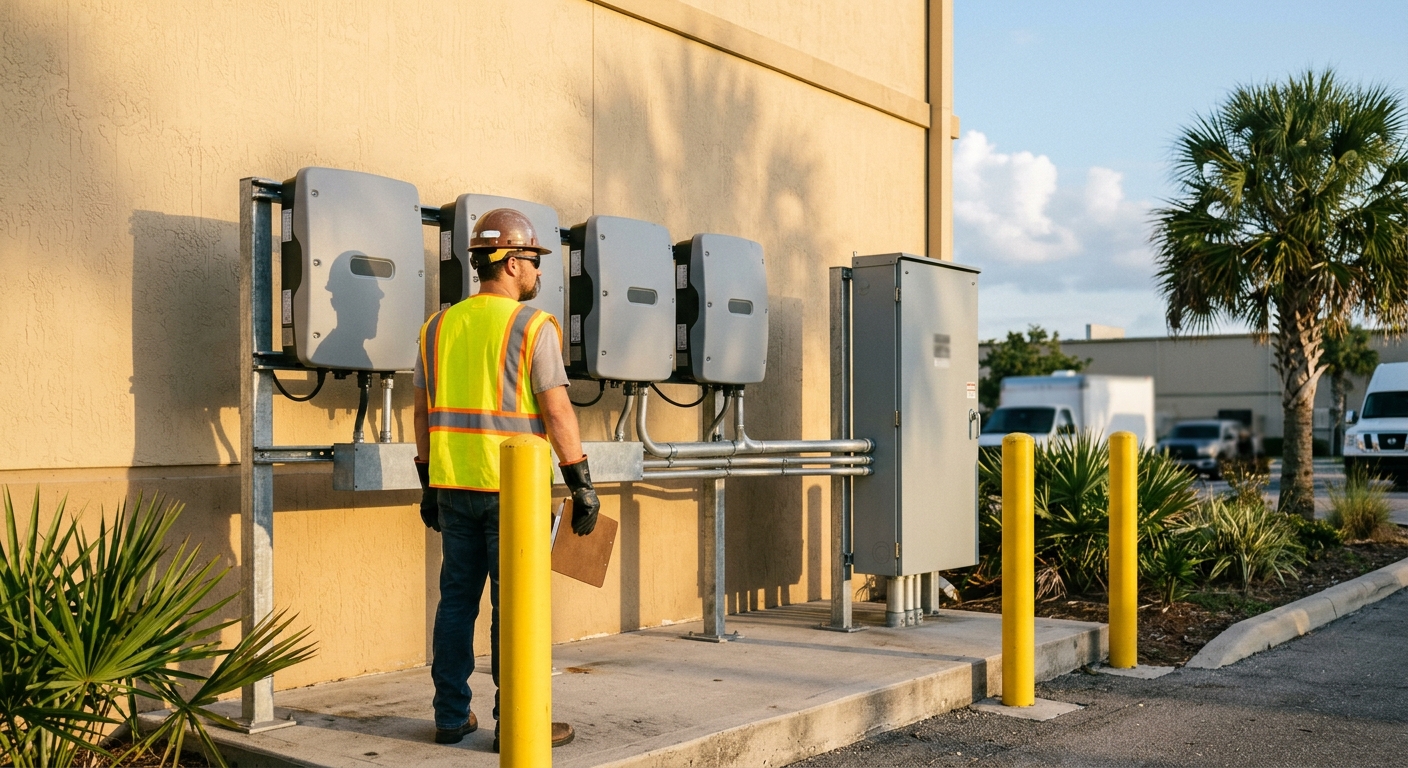
Commissioning and handover is the easiest place to lose a month. The final electrical inspection has to pass, the approved permit has to reach the utility, and the insurance certificate has to list the service address; FPL’s Tier 3 steps require liability coverage of no less than $2 million and hold parallel operation until the bi-directional meter is installed. Schedule close-out documents, as-built drawings, and the handoff to commercial solar operations and maintenance in the same week.
Which dates should a 2027 solar schedule be built around?
Four dated items govern Florida commercial solar schedules as of November 4, 2026, and each should be re-checked on the day a schedule is baselined.
- December 31, 2026: the 9th Edition (2026) Florida Building Code takes effect, per the Florida Building Commission.
- December 31, 2027: the Section 48E credit ends for solar placed in service after this date when construction began after July 4, 2026, per the IRS Form 3468 instructions.
- Rule 25-6.065: 10 business days to confirm a complete application, 30 calendar days to execute the agreement (90 with a Tier 3 study), and 30 calendar days for inspections after the customer signs.
- F.S. 553.792: permit review periods, which local ordinances can shorten.
Systems above 2 MW AC fall outside Rule 25-6.065 and follow the serving utility’s separate generator interconnection procedures, which carry their own studies and timelines. Battery storage changes the review as well: FPL’s guidelines state that storage paired with a Tier 3 system is reviewed in the Fast Track study, so storage should be in the first application, not added later. Financing structure does not change the utility’s clock; our article on how a PPA, lease, and cash purchase compare in Florida covers the ownership questions separately.
What should be decided in the first 30 days after the contract?
The first month after signing sets the dates that every later phase depends on. Each item below has an owner.
- Tax advisor: confirm in writing which credit path applies and which milestone the advisor will treat as placed in service.
- Contractor project manager: issue a dated schedule that shows each external clock (permit review, utility screening, agreement, inspection, meter set) as its own line with float.
- Facility manager: provide 12 months of utility bills, the utility account number, and the legal name and tax ID on the account, which FPL’s application requires to match.
- Electrical engineer: confirm the service rating, whether the design exceeds 90% of it, and whether a transformer upgrade is likely.
- Roof consultant: report the roof’s remaining service life before the array layout is frozen.
- Contractor: submit the utility pre-application in parallel with the permit set, not after permit issue.
- Owner: freeze equipment selections. FPL’s Tier 3 agreement requires a new application 30 days before any modification that increases the system’s rating.
- Property manager: approve shutdown windows, staging areas, crane dates, and the tenant notice plan.
- Insurance broker: issue the liability certificate the utility requires, with the service address listed.
- CFO: decide in writing what the organization does if the meter set slips past a tax date.
Owners who want the design questions answered before the contract can review AGT’s commercial solar engineering process, which lists what the design phase produces.
Frequently Asked Questions
How long does commercial solar take in Florida from contract to power-on?
The duration is the sum of six phases: design, permit review, utility screening and agreement, procurement, installation, and final inspection with the meter set. Florida rule and statute publish maximum review periods for the utility and permit steps, but no source publishes a statewide total, and Berkeley Lab’s national data exclude Florida. Ask the contractor for a dated schedule that shows each external clock separately.
What is the longest step in a commercial solar installation timeline?
The step most likely to run long is utility interconnection, when screening identifies upgrades. Rule 25-6.065 caps the time to execute an agreement at 90 days with a Tier 3 study, but it does not cap the time to build the upgrades a study identifies. Transformer delivery and permit revision cycles are the other common long poles.
How long does FPL take to approve a Tier 3 commercial solar interconnection?
FPL’s Tier 3 process returns Fast Track screening results within 10 business days of a completed application. Under Rule 25-6.065, the agreement is executed within 30 calendar days of a completed application, or within 90 days if a study is needed, and utility inspections follow within 30 calendar days of the customer’s signed agreement. Upgrade construction is separate.
Can a commercial solar system turn on before the utility approves it?
A grid-tied system cannot begin parallel operation before the utility’s approval. FPL’s Tier 3 instructions tell customers not to begin parallel operation until the bi-directional meter is installed, and Rule 25-6.065 requires the customer to return the signed agreement at least 30 calendar days before parallel operation begins.
Does a project signed in 2027 still have time to meet the December 31, 2027 credit date?
That depends on the project’s size, the utility, the permit path, equipment delivery, and whether upgrades are required, and only a tax advisor can say which milestone counts as placed in service. A project signed in 2027 should have its utility pre-application and permit set submitted in the first weeks so the external clocks start early.
Will the 2026 Florida Building Code change my solar project schedule?
It can. The 9th Edition (2026) Florida Building Code takes effect December 31, 2026, according to the Florida Building Commission. A permit set prepared under the 8th Edition and submitted after the change may need revisions. Ask the building official which edition will govern before the engineer finalizes the drawings.
Why the first month decides the power-on date
A Florida commercial solar schedule is won or lost on paperwork that starts before the first module arrives. The evidence points the same way at every phase: the published clocks in Rule 25-6.065 and F.S. 553.792 start only when an application is complete, utility upgrades and transformer deliveries carry no published cap, and the Section 48E date makes the final meter set the financial deadline for projects that began construction after July 4, 2026. Construction is the phase owners can see and the one least likely to set the date. Assigning the ten checklist items in the first 30 days protects most of the schedule, and the risk that remains with the utility and the equipment market belongs in the schedule as named lines.
Written by The Technical Team at Advanced Green Technologies. Founded in 2007, Advanced Green Technologies is 100% employee-owned and ranked #1 among Florida commercial and industrial EPC contractors on Solar Power World’s 2026 Top Solar Contractors list, as reported in AGT’s 2026 ranking announcement.
Planning a project against a 2027 date? Request a commercial solar quote or call (888) 735-2641 to get a dated schedule for your building.