

At a glance: Florida’s interconnection rule gives utilities defined review clocks, and those clocks start only when an application is complete. This guide covers the commercial solar interconnection Florida delays an owner can control: FPL’s Tier 2 and Tier 3 requirements, the service-capacity, three-phase, and 115 percent sizing limits that trigger upgrades or studies, account and insurance mismatches, tie-ins at occupied buildings, the dates that apply as of October 2026, and a checklist that assigns each item to a named role.
The commercial solar interconnection Florida delays an owner can prevent are set in the design phase, months before anyone at the utility opens the file. Florida’s interconnection rule gives the utility short, defined review clocks, and those clocks start only when an application is complete, while the conditions that make an application incomplete or force a study, such as service capacity, phase configuration, account ownership, and production sizing, are fixed by decisions the owner’s team makes early. For a project that began construction after July 4, 2026, a late permission to operate can push the array past the federal placed-in-service date and put the credit at risk. This article covers the delays the owner controls; it does not predict FPL’s workload or determine any project’s tax position.
Why do commercial solar interconnection delays carry more risk for Florida owners in late 2026?
Florida’s interconnection framework for customer-owned solar comes from two primary sources. Section 366.91 of the Florida Statutes required each investor-owned utility to offer a standardized interconnection agreement and net metering, and it directs municipal utilities and cooperatives to set their own programs. For investor-owned utilities, Florida Administrative Code Rule 25-6.065, last amended in April 2008, sorts customer-owned renewable systems into three tiers by gross AC rating: Tier 1 at 10 kW or less, Tier 2 above 10 kW through 100 kW, and Tier 3 above 100 kW through 2 MW.
The same rule sets the utility’s response clocks. Within 10 business days of receiving an application, the utility must confirm it is complete or identify deficiencies, and it must execute the agreement within 30 calendar days of a complete application, or 90 days when a Tier 3 study is needed. The rule sets no clock for the owner’s side. Missing documents, redesigns, and service upgrades run on the project’s time.
Two dates raise the cost of that slippage this year. As IRS Notice 2025-42 describes the One Big Beautiful Bill Act, the clean electricity credits end for solar facilities placed in service after December 31, 2027 unless construction began by July 4, 2026. A federal district court vacated that notice on June 6, 2026 in Oregon Environmental Council v. IRS, which reopened beginning-of-construction questions without changing the statutory dates, as of October 15, 2026. Separately, the Florida Building Commission has set December 31, 2026 for the 9th Edition of the Florida Building Code, and the permit application date generally decides which edition governs. Our post on the commercial solar tax credit deadline covers the tax side.
What actually holds up an FPL solar interconnection application?
Commercial solar interconnection in Florida is delayed most often by incomplete applications and by designs that exceed the existing service. The usual causes are an unpaid application fee, an account-name mismatch, a one-line diagram that does not match the inverter specification sheet, a system above 90 percent of the service rating, and a Tier 3 system that fails FPL’s Fast Track screens.
| FPL tier | System AC rating | FPL application fee | Liability insurance | Review path before installation |
|---|---|---|---|---|
| Tier 1 | 10 kW or less | None listed | Not required by the rule | Online pre-approval; inspection documents and meter after install |
| Tier 2 | Above 10 kW to 100 kW | $400 | $1 million minimum | Online pre-approval with one-line diagram and inverter specification sheet |
| Tier 3 | Above 100 kW to 2,000 kW | $1,000 | $2 million minimum | Fast Track screening, results within 10 business days; study at an additional fee if screens fail |
Figures come from FPL’s net metering tier requirements and Rule 25-6.065, accessed October 15, 2026. The rule converts an inverter-based array’s DC nameplate to a gross AC rating with a 0.85 factor, and that AC rating, summed across every system connected to one FPL meter, sets the tier.
Payment is the first stall point. FPL states that an application will not be reviewed until the invoiced fee is paid, so a 30-day payables cycle can consume a month. The second is identity. The application requires the FPL account number and a Social Security or Employer Identification Number that matches the name on the account. In a leased building the account often belongs to a tenant, and the entity paying for a rooftop solar installation may not be the account holder, which holds the file until the right party signs.
The third is document consistency. Reviewers compare the one-line diagram against the inverter specification sheet and the equipment list, so an inverter substituted during procurement, a changed string count, or a relocated disconnect produces a deficiency notice. Insurance certificates are rejected when the installation address is missing or the limit is below the tier minimum, and closeout requires permit documentation showing approved electrical and mechanical inspections. A disciplined commercial solar engineering process carries these items as controlled documents from the first design review onward.
How should an owner handle a design that outgrows the existing electrical service?
The service limits in FPL’s net metering guidelines decide whether a project interconnects as designed or waits on utility work. Generation is limited to 90 percent of the FPL service capacity, and systems above that threshold may incur additional expense, with FPL upsizing its facilities at the customer’s expense. The array must be estimated to produce less than 115 percent of the account’s annual consumption, which catches buildings whose load dropped after a tenant left. Any system of 50 kW or larger must interconnect at 120/208-volt or 277/480-volt wye three-phase service, and FPL does not permit interconnection at the utility transformer or inside the meter can.
| Option | What it solves | Where it falls short |
|---|---|---|
| Size the array to the existing service | Keeps the system within 90 percent of the service rating and avoids utility facility upsizing | Leaves roof or canopy area unused and lowers annual production and savings |
| Upgrade the service or convert to three-phase wye | Allows the full array; required when a system of 50 kW or more sits on a service FPL will not accept | Adds utility design time, equipment lead time, a planned outage, and costs the owner pays |
| Hold the system at or below 100 kW AC (Tier 2) | Removes the Fast Track step and halves the insurance minimum | Rarely matches the load of a large building; FPL counts every system on one meter together |
| Add battery storage behind the meter | Moves solar output into the evening and can reduce billed demand | Battery energy cannot be exported under FPL’s guidelines; Tier 3 storage is reviewed in the Fast Track study |
No option on this list is correct for every building. Sizing to the existing service is often the faster path for a warehouse with a large, lightly loaded service, while a retail center on a small single-phase service may have no commercial-scale path without an upgrade. Shifting part of the array to solar carports changes structure and cost, and it does not change the service limit if the canopy ties into the same meter.
Storage deserves the same scrutiny. FPL’s guidelines require behind-the-meter batteries to carry UL 1741 certification or be DC-coupled behind a UL 1741 listed device, require a placard at the meter enclosure, and bar export from the battery to the grid. Commercial battery storage pays back on some tariffs and not others, as our analysis of peak shaving with solar and battery storage explains, and adding it to a Tier 3 file adds review items to the Fast Track screening.
How long does commercial solar utility approval take in Florida, and what moves the date?
No published source gives an FPL-wide median for commercial approval, so the schedule is best built from the defined steps and the owner-side work between them. The table lists each step with its source.
| Step | Clock or condition | Source (accessed October 15, 2026) |
|---|---|---|
| Application acknowledged | Complete, or deficiencies listed, within 10 business days | Rule 25-6.065(7) |
| Tier 3 Fast Track screening | Results within 10 business days of a complete application; install only after passing | FPL net metering tiers page |
| Failed screens | Study at an additional fee; FPL publishes no fee or duration | FPL net metering tiers page |
| Agreement executed by utility | 30 calendar days from complete application; 90 days if a Tier 3 study is needed | Rule 25-6.065(7) |
| Signed agreement returned | At least 30 calendar days before parallel operation | Rule 25-6.065(7) |
| Utility inspection | Within 30 calendar days of the signed agreement | Rule 25-6.065(7) |
| Bi-directional meter and permission to operate | No published duration; no parallel operation before the meter is set | FPL tiers and guidelines pages |
For context, the U.S. Department of Energy’s distributed energy resource interconnection roadmap, published in December 2024, sets a 2030 target of a median under 75 days from interconnection request to executed agreement for systems between 50 kW and 5 MW, and calls for public queue data in every state. The target describes a national goal and should not be read as a measured or promised FPL timeline.
The application fee and insurance are fixed by tier, and the Tier 3 study fee is not published. Service upgrades, three-phase conversions, and any utility-side work identified in a study are priced by the utility for the specific site and paid by the owner, which is why they belong in the capital request as a priced line rather than an assumption.
What changes when the interconnection work happens at an occupied Florida building?
The final tie-in at an occupied building is an outage, and it is scheduled around tenants. Landing the solar conductors in the main switchgear, or replacing a service to add capacity, usually requires de-energizing the building, so the work is sequenced for nights or weekends, coordinated with FPL where a utility disconnect is needed, and preceded by written notice to tenants. Hospitals, cold storage, and data rooms need temporary generation or a transfer plan reviewed by the engineer of record.
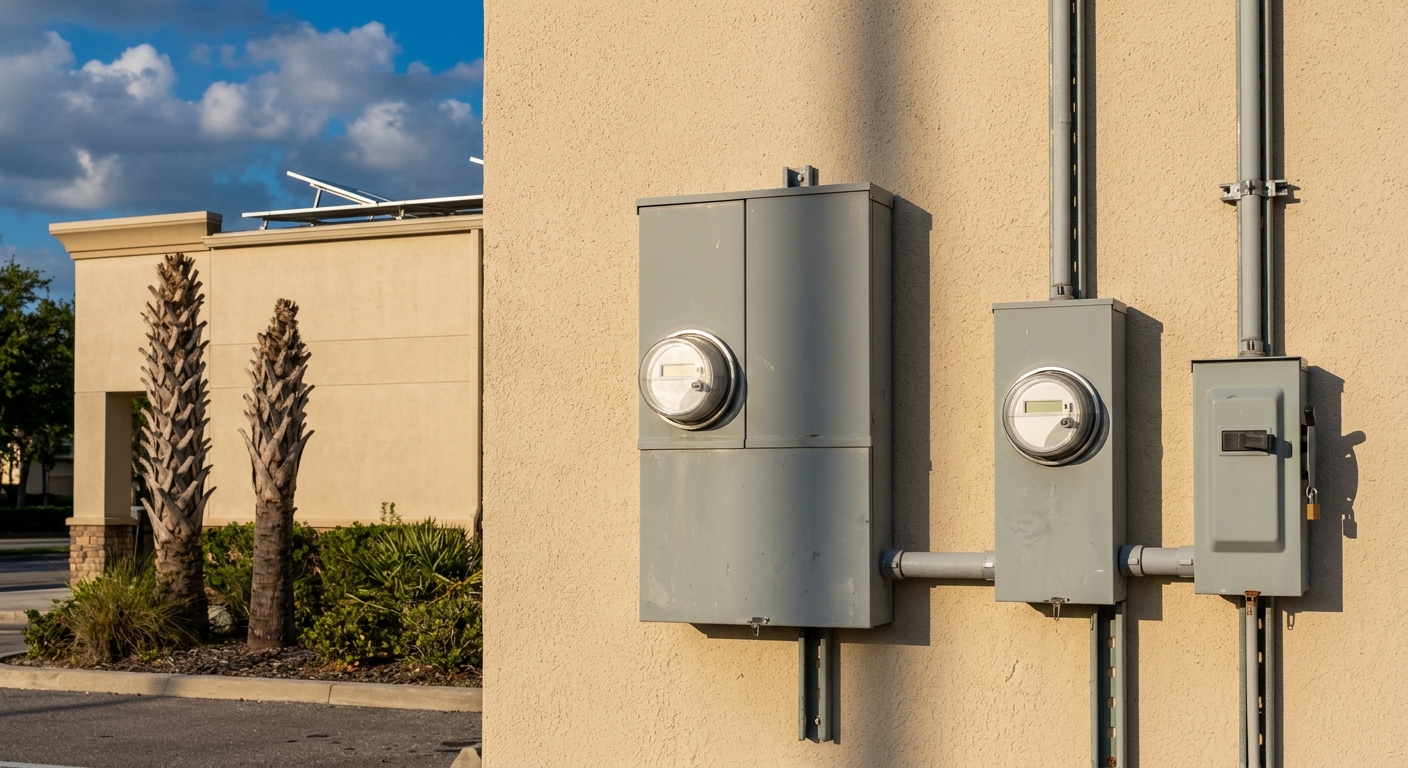
The disconnect location can create a conflict with building security. For Tier 2 and Tier 3 systems, FPL requires a visible load-break manual disconnect mounted separately from but adjacent to the meter socket, readily accessible to FPL, lockable in the open position with a single FPL padlock, and kept out of locked meter rooms. Retail centers and medical offices that keep meters behind secured doors need a remote location approved by FPL before the design is final.
Multi-tenant buildings raise a metering question that should be answered before layout. An array offsets only the account behind the meter it connects to, so a roof over six tenant-metered suites does not reduce six bills. Roof condition belongs in the same review, because an aging membrane means a remove-and-reinstall later, as our guide to detaching and resetting solar panels for a roof replacement explains.
Which Florida rules and dates apply to interconnection as of October 2026?
Rule 25-6.065 names IEEE 1547 (2003), IEEE 1547.1 (2005), and UL 1741 (2005) as the technical standards for interconnected equipment. IEEE has since published IEEE 1547-2018, which it lists as the active edition. The utility’s current agreement decides what a reviewer checks, so confirm it with FPL before inverters are purchased.
The rule’s net metering terms carry excess energy forward as a credit for up to 12 months and pay unused credits at an average annual rate based on the utility’s COG-1 as-available energy tariff, while customer and demand charges still apply. The Florida Public Service Commission and each utility’s tariff set those terms, and they can change. Federal credit timing depends on facts only a tax advisor can evaluate. Municipal utilities and cooperatives set their own interconnection terms under Section 366.91(6), so owners outside FPL territory should request that utility’s agreement at the start of design.
Commercial solar interconnection Florida checklist, by role
- Owner or CFO: Confirm which entity holds the FPL account at the array’s meter, and resolve any tenant mismatch before filing.
- Owner or CFO: Budget the fee, insurance, a possible study, and any service upgrade as separate lines.
- Facility manager: Pull 12 months of billing data to test the production estimate against the 115 percent limit.
- Facility manager: Identify meter access and the outage windows tenants can accept.
- Electrical engineer of record: Confirm voltage, phase, wye configuration, and the 90 percent limit before fixing array size.
- Electrical engineer of record: Set the point of interconnection and disconnect location, and confirm which standard editions FPL checks.
- Solar project manager: Freeze the equipment list before submission and notify FPL in writing of any change.
- Solar project manager: Get the insurance certificate with the site address, and pay the FPL invoice promptly.
- FPL representative: Confirm the tier, the meter arrangement, the Fast Track result, and the meter-set date.
- Tax advisor: Determine what records establish placed-in-service status and which date the schedule must protect.
Ask each bidder who prepares the utility application and answers deficiency notices, using our guide on how to select a commercial solar contractor. Advanced Green Technologies, founded in 2007 and 100% employee-owned, has installed more than 380 megawatts of rooftop and ground-mount solar, according to the company. A statewide commercial contractor will not be the lowest bid on every small Tier 2 job, and after energization the same documents support commercial solar operations and maintenance.
Frequently Asked Questions
How long does FPL take to approve a commercial solar interconnection?
Under Rule 25-6.065, the utility must confirm a complete application or list deficiencies within 10 business days and execute the agreement within 30 calendar days of a complete application, or 90 days when a Tier 3 study is needed. No published clock covers the meter set and permission to operate, so the total depends on how complete the file is.
What is the difference between FPL Tier 2 and Tier 3 interconnection?
Tier 2 covers systems above 10 kW AC through 100 kW AC, with a $400 application fee and at least $1 million in liability coverage. Tier 3 covers systems above 100 kW AC through 2 MW, with a $1,000 fee, at least $2 million in coverage, and a Fast Track screening before installation, per FPL’s tier page as of October 2026.
Can construction start before FPL approves a commercial solar application?
FPL’s tier page directs Tier 2 owners to obtain online pre-approval before installing and tells Tier 3 owners to install only after successful Fast Track results. No system may operate in parallel with the grid until FPL installs the bi-directional meter.
What happens if a solar system fails FPL’s Fast Track screens?
FPL states that a Tier 3 system that does not pass the Fast Track screens may require an interconnection study at an additional fee, and the rule extends the agreement deadline to 90 days when a study is needed. FPL’s page does not publish the study fee or its duration, and a study can identify utility-side upgrades.
Does FPL permission to operate decide when a solar project is placed in service for tax purposes?
No. Placed-in-service status is a tax determination that belongs to the owner’s tax advisor. Utility permission to operate and commissioning reports are records an advisor is likely to review, so a project relying on the December 31, 2027 date should treat utility approval as a critical-path item.
Who pays for utility upgrades needed for commercial solar interconnection in Florida?
Section 366.91(8) of the Florida Statutes requires a contracting renewable energy producer to pay the actual cost of interconnecting with the distribution system, and FPL’s guidelines state that systems above 90 percent of the existing service capacity may incur additional expense, with facilities upsized at the customer’s expense.
The interconnection file is the first schedule document
Florida’s rule gives the utility short clocks that begin with a complete application, FPL publishes the requirements that decide completeness, and the federal placed-in-service date leaves late projects little room for a deficiency cycle or an unplanned study. The delays owners experience most often trace back to account ownership, service capacity, phase configuration, document mismatches, and unplanned tie-in outages, and each can be checked before design is final. Treating the utility file as a design input from the first meeting is the most reliable way to keep permission to operate on the date the project needs.
Written by The Technical Team at Advanced Green Technologies. Advanced Green Technologies ranked #1 among Florida commercial and industrial EPC contractors on Solar Power World’s 2026 Top Solar Contractors list, announced August 2026.
Planning a rooftop or carport array behind an FPL meter? Request a quote or call (888) 735-2641 to review service capacity, tier, and schedule before the design is final.