

At a glance: When a commercial roof wears out before the rooftop array on it, the array has to come off before the roof can be replaced, and that removal is a construction project with electrical, permitting, utility, warranty, and tax consequences. This guide explains what happens to an array during a reroof, compares partial lifts, full removal, repowering, and relocation, lists what drives cost and downtime, covers occupied-building logistics in Florida, flags the code, utility, and IRS items to confirm, and closes with a checklist by role.
Solar panel removal for roof replacement is a planned construction project, and owners who treat it as a quick detach-and-reset take on risks the original solar proposal never priced. When a low-slope roof fails under an array that still has years of production left, the array has to be de-energized, documented, removed, stored, reinstalled on new attachments, re-inspected, and returned to service with the utility. Skipping any of those steps can mean broken modules, a voided roof or module warranty, a failed electrical inspection, or months of lost production. This guide covers existing arrays on Florida commercial roofs; it does not decide tax, code, or interconnection questions, which belong to your tax advisor, building official, and utility.
Why are Florida owners facing solar panel removal for roof replacement now?
Many commercial rooftop arrays in Florida were installed on roofs that will not last as long as the modules. a 2017 technical article in NRCA’s Professional Roofing magazine, by the National Roofing Contractors Association’s then vice president of technical services, recommended that the roof under a photovoltaic (PV) system have an expected service life equal to or greater than the system’s, and warned that unanticipated PV removal and replacement is costly and interrupts the generation and savings the owner was counting on. The same article cited an industry study putting the average U.S. commercial low-slope roof at about 17.4 years.
The U.S. Department of Energy reports, citing a Berkeley Lab survey of solar industry professionals, that the average expected operational life of a solar panel rose from about 20 years in 2007 to 25 to 35 years in 2025. The figures come from different studies and neither describes a specific building, but the gap explains the problem: an array placed on a ten-year-old roof in the mid-2010s now sits on a roof near the end of its life.
The Florida Building Code, 9th Edition (2026), is scheduled to take effect December 31, 2026, and as of October 1, 2026 the Florida Building Commission lists a second round of glitch amendments with comments due October 8. Permit application timing generally determines which edition governs, so owners planning winter work should ask the building official which edition will apply before drawings are final.
What happens to a rooftop array during a reroof?
A rooftop array cannot simply be switched off and carried away, because modules produce voltage whenever light reaches them. Opening the AC disconnect stops export, but DC conductors between modules and inverters stay energized in daylight until strings are opened under a written procedure. The crew records string and inverter performance, labels every string and module position, and photographs the wiring so the array can be rebuilt as designed.
The mechanical work follows. Modules come off the rails and go to a protected staging area, rails and attachments are removed, and conduit runs on the roof are lifted or rerouted. Once the reroof is complete, new attachments are installed and flashed into the new membrane, the racking is rebuilt, and the modules are reinstalled and reconnected. Each phase leaves a record the owner should keep, because the roof manufacturer, module manufacturer, and inspector will ask for it.
| Phase | What happens | Record the owner keeps | Who signs off |
|---|---|---|---|
| Pre-removal baseline | Performance readings, thermal scan, and inventory of modules, inverters, and racking | Baseline report with photos and string data | Solar contractor; owner’s representative |
| De-energize and document | System shut down per its design, strings opened, wiring labeled and photographed | Shutdown log and labeled layout drawing | Licensed electrical contractor |
| Remove and store | Modules, rails, attachments, and rooftop conduit removed; modules stored protected | Storage location, count, and condition log, including any broken modules | Solar contractor |
| Reroof | Tear-off or recover per the roof scope, with new flashings at future attachment points | Roof permit, inspection records, and manufacturer warranty documents | Roofing contractor; building official |
| Reinstall | New attachments flashed into the new membrane, racking rebuilt, modules reinstalled | Attachment details approved by the roof manufacturer | Solar contractor; roof manufacturer |
| Recommission | Electrical testing, inspection, utility coordination, and performance check against the baseline | Inspection approval and post-reinstall performance report | Electrical inspector; utility; solar contractor |
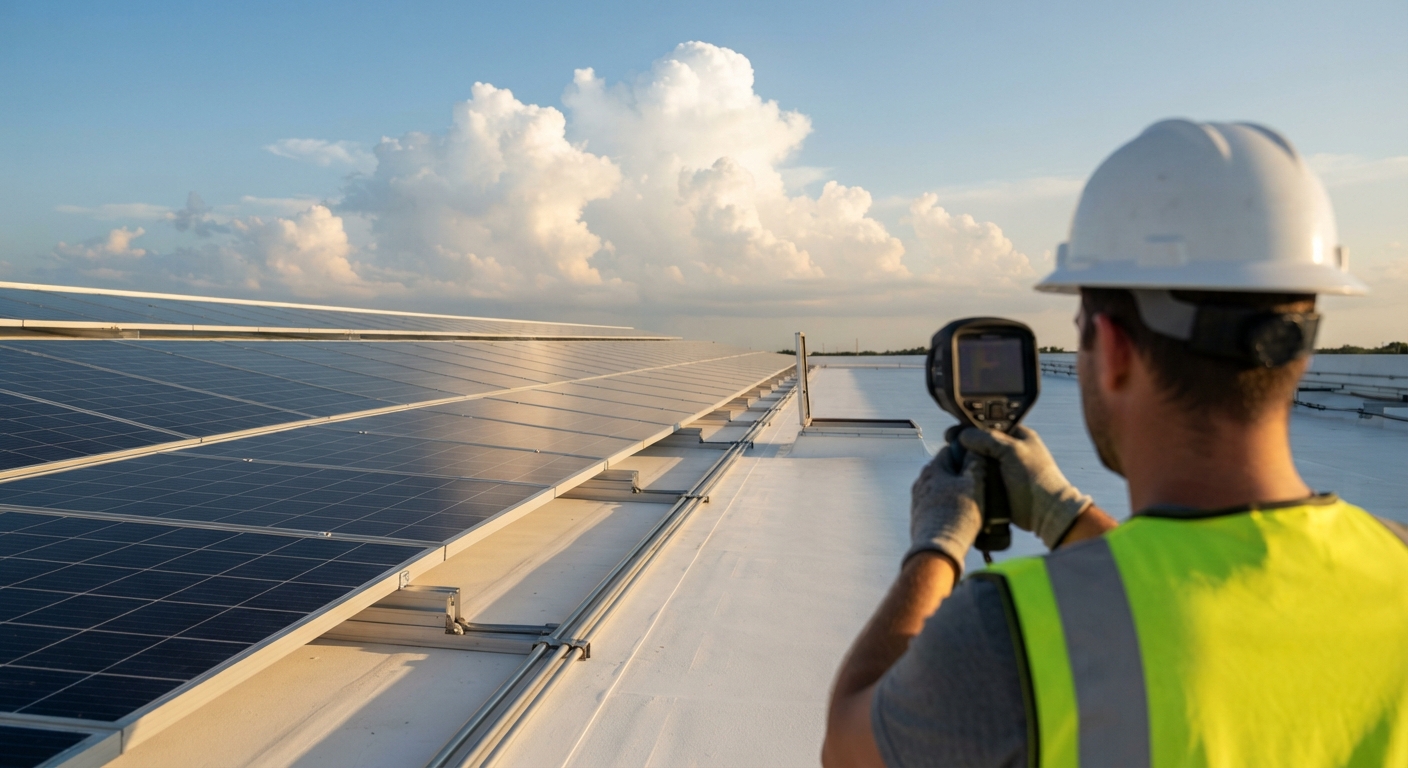
The baseline at the top of that table is the step most often skipped, and it is the one that protects the owner. Without it, a module cracked in storage looks the same as one that was already failing. AGT’s roof and solar drone surveys use thermal imaging that can identify hotspots and underperforming modules before removal, and the same imagery documents the roof condition the reroof is meant to fix.
Partial lift, full removal, or repower: which option fits the building?
The right way to handle an array during a reroof depends on the roof scope, the condition of the modules, and how long the owner plans to keep the system.
| Option | When it fits | Budget effect | Where it falls short |
|---|---|---|---|
| Remove and reinstall the full array | Modules and inverters in good condition with years of production left; full tear-off planned | Removal, storage, reinstallation, and recommissioning added to the roof budget | Longest production outage; older equipment may need upgrades to pass current electrical inspection |
| Phased partial lift by roof section | Roof replaced in sections on an occupied building; array layout allows sections to be isolated | Similar labor to full removal, spread across phases | More mobilizations and shutdowns; each phase needs its own electrical isolation plan |
| Remove and repower with new modules | Modules degraded, damaged, or no longer supported, or the owner wants more capacity on the new roof | New equipment cost replaces reinstallation labor for those components | Becomes a new design and permit; may change interconnection paperwork and the tax picture |
| Relocate generation off the roof | Roof or structure cannot support the array for its remaining life | Canopy or ground-mount structure and foundations added | Needs parking or land and its own permitting; existing racking may not transfer |
| Repair the roof around the array | Localized defects on an otherwise dry, sound roof with years of life left | Lowest immediate cost | Defers the problem; repairs under modules are slow and the array still comes off later |
Repowering deserves a serious look when modules are near the end of their warranty or the original inverters have been discontinued, because reinstalling aging equipment on a new roof can set up a second removal. In that case the commercial solar engineering process starts from the new roof’s drawings, and a commercial rooftop solar installation sized to the building’s current load may use the new roof better than the original layout.
Commercial solar carports in Florida put generation over parking and leave the new membrane untouched, at the cost of structural steel and foundations. A full removal is also more work than some buildings need: a small array on a roof with only localized defects may be better served by a targeted repair now and a planned removal later.
What drives the cost and downtime of removing and reinstalling an array?
Published per-panel removal prices describe residential systems and do not transfer to a commercial roof with hundreds of modules, crane access, and occupied space below. These variables set cost and outage length, and each belongs on its own proposal line:
- Array size and layout. Module count, number of strings, and inverter type (string, central, or module-level electronics) set the electrical labor and the labeling effort.
- Attachment type. Penetrating attachments must be removed and replaced with new flashed attachments; ballasted racks shift the work toward ballast handling and load checks.
- Access and lifting. Crane picks, hoists, and roof staging areas depend on building height, site access, and how much roof can hold stored material.
- Storage and breakage. On-roof versus ground storage, weather protection, and a unit price for replacing modules found broken or defective.
- Electrical upgrades at reconnection. The inspector may require equipment changes if the jurisdiction applies current code to the reinstalled system.
- Permits and utility steps. Roofing, electrical, and possibly structural permits, plus any notice or approval the interconnection agreement requires.
- Production outage. Every week the array is off is lost generation, and in Florida the loss is larger during the long, sunny months that also suit roofing work.
Pricing the roof and the array together removes the cost of coordinating two contractors under two contracts, each able to blame the other for a damaged module or a leaking attachment. The array’s long-term value still depends on the utility tariff, demand charges, and the building’s consumption profile.
What changes when the building stays occupied?
On an occupied building, the reroof and the array work form one project with two crews, and tenants experience both. The sequence that works isolates one roof section at a time: the solar crew de-energizes and removes that section’s modules, the roofing crew tears off only what can be dried-in the same day, and the solar crew follows with new attachments while roofing continues elsewhere. Crane picks are scheduled around deliveries and business hours, and the property manager receives written notice of every restricted area and electrical shutdown.
Rooftop safety is planned before the first module comes off. OSHA’s construction fall protection standard, 29 CFR 1926.501 requires fall protection for employees on low-slope roofs with unprotected sides or edges 6 feet or more above a lower level, using guardrails, safety nets, personal fall arrest, or warning lines combined with other measures. Stacked modules and loose rails are wind-borne debris risks during the June 1 to November 30 hurricane season, so the staging plan should state how stored material is secured and when it comes down ahead of a storm. AGT’s guide to commercial solar hurricane preparedness covers securing an installed array before a storm.
Miami-Dade and Broward add a layer. Both counties sit in the High-Velocity Hurricane Zone, where the new roof system and the new solar attachments each need approvals that match the installed components, through Florida Product Approval or a Miami-Dade Notice of Acceptance, and the two approvals have to be compatible with each other. Approved roofs and attachments are designed and tested to rated pressures; storms can exceed them, and roof and module warranties carry wind limits and exclusions.
Which permits, utility rules, and tax items apply to solar panel removal for roof replacement?
Four sets of rules apply, each with a different owner. The reroof is permitted work under the Florida Building Code, and the building official decides which edition applies and what the reinstalled attachments must meet. Electrical work on the array falls under NFPA 70, the National Electrical Code, whose rapid-shutdown requirements in Article 690 have changed across recent editions; whether a reinstalled system must be brought up to the edition currently enforced is the electrical inspector’s call, and owners should ask before the proposal is priced.
Utility interconnection in Florida is governed by Florida Public Service Commission Rule 25-6.065 and by each utility’s tariff and interconnection agreement. Read the agreement for any notice required when the system is disconnected or reconnected, and confirm with the utility before work starts.
Two federal items deserve a call to the tax advisor. The IRS instructions for Form 4255 (revised December 2025) describe recapture of investment credits when credit property is disposed of or stops qualifying before the end of 5 full years after it was placed in service, with the recapture percentage stepping down from 100% to 0% over that period. Whether a temporary removal, a repower, or a relocation has any effect on a specific project is a determination for the tax advisor. Separately, modules damaged during removal need a disposal plan: EPA’s guidance on end-of-life solar panels notes that some panels are hazardous waste and some are not, even within the same model, and that EPA is developing a rule to add solar panels to the universal waste regulations.
Solar panel removal for roof replacement checklist, by role
- Facility manager: assemble the array’s as-built drawings, interconnection agreement, equipment warranties, and roof warranty, and give the package to both contractors.
- Solar contractor: capture a pre-removal performance baseline and thermal scan, and deliver a labeled layout before any module is moved.
- Roofing contractor: confirm the roof scope and phasing, and design flashings for the new attachment points before tear-off begins.
- Roof manufacturer: approve the new solar attachment details in writing so the new roof warranty stays in force.
- Electrical inspector: confirm which code edition the reinstalled system must meet, including rapid shutdown.
- Utility: confirm the notice and reconnection steps required under the interconnection agreement.
- Tax advisor: review whether removal, repowering, or relocation affects any credit claimed on the system.
- Property manager: issue tenant notices for crane picks, restricted roof areas, and electrical shutdowns.
- Owner or asset manager: decide between reinstalling and repowering based on module condition and the new roof’s expected life.
Monitoring and inspection records from solar operations and maintenance make the baseline faster to assemble, and AGT’s guide on how to select a solar contractor lists qualifications to confirm when comparing bids.
Frequently Asked Questions
Do solar panels have to be removed to replace a commercial roof?
Usually, yes. Roofers need access to the membrane, insulation, and deck under the array, and new attachments must be flashed into the new roof. A phased partial lift can keep part of the array producing while other sections are reroofed, and localized repairs can sometimes be made around an array. A full tear-off requires the modules and racking in that area to come off first.
How long does it take to remove and reinstall a commercial solar array?
It depends on array size, attachment type, roof access, the roofing schedule, permits, and the utility’s reconnection steps. The array is offline from shutdown until it passes inspection and is returned to service, which includes the full roofing phase for that section. Ask for a schedule that shows removal, reroofing, reinstallation, inspection, and utility steps as separate durations.
Does removing solar panels void the warranty?
It can if the work does not follow the manufacturer’s requirements. Module and inverter warranties often carry installation and handling conditions, and NRCA notes that roof warranties can be voided by alterations, including attachments, made without the roof manufacturer’s prior approval. Get written confirmation from each manufacturer before removal starts, and keep the baseline and reinstallation records.
Does a reinstalled solar array have to meet the current electrical code?
The electrical inspector decides. NFPA 70 rapid-shutdown requirements have changed across recent editions, and some jurisdictions apply the currently enforced edition when a system is reinstalled under a new permit. Ask the inspector before pricing the job, because upgrades to shutdown equipment or wiring can change both the budget and the schedule.
Should I reinstall my old solar panels or replace them during a reroof?
Reinstall when the modules and inverters are in good condition with years of production left. Consider repowering when modules are degraded or damaged, inverters are discontinued, or the owner wants more capacity on the new roof. A repower becomes a new design and permit, and may change interconnection paperwork, so compare both options with the baseline data in hand.
Can removing solar panels affect the federal tax credit?
Possibly, and only a tax advisor can say for a specific project. IRS Form 4255 instructions describe credit recapture when investment credit property is disposed of or stops qualifying within 5 full years after it was placed in service. Ask your tax advisor how a temporary removal, a repower, or a relocation applies before work is scheduled.
Plan the array’s return before the first module comes off
When the roof fails first, an array’s value depends on how carefully it is taken down and put back. NRCA’s service-life standard, module lifespans that now run past the average commercial roof, and the cost of an unplanned removal all point the same way: treat solar panel removal for roof replacement as one project with a baseline, a labeled teardown, approved attachments, and a documented return to service. The code edition, the interconnection agreement, and any tax effect each have an owner, and confirming them before the contract is signed keeps the outage short.
Written by The Technical Team at Advanced Green Technologies. Founded in 2007 by Advanced Roofing, Advanced Green Technologies is 100% employee-owned and was ranked #1 among Florida commercial and industrial EPC contractors, and #3 overall in Florida, on Solar Power World’s 2026 Top Solar Contractors list (read the announcement).
To plan the roof and array sequence before you sign a reroof contract, request a quote from Advanced Green Technologies or call (888) 735-2641. For the roofing scope, see Advanced Roofing’s commercial re-roofing services.