At a glance: Most rooftop arrays that fail in hurricane winds fail at loose clamp hardware, a finding FEMA documented after Hurricanes Irma and Maria. This guide explains how commercial arrays fail, why removal before a storm rarely makes sense while a planned shutdown does, what drives repair cost and downtime, and what changes on an occupied Florida building. It closes with the codes that govern 2026 storm repairs and a checklist assigned by role, so the plan can be handed to the people who carry it out.
Commercial solar hurricane preparedness is decided months before a storm forms, by the torque on the clamps and by a written plan for who shuts the system down and who turns it back on. An array that has not been torque-checked this year, photographed, and assigned a restart owner can lose modules it was designed to keep, and a single detached module can puncture the roof below and take a building’s roof, tenants, and solar production out of service for the rest of the season. This guide covers Florida commercial rooftop and carport systems during the remaining weeks of the 2026 season and after any storm that reaches your site. It does not replace an engineer’s wind assessment, your insurer’s claim process, or the electrical determinations that belong to a licensed contractor on site.
Why does commercial solar hurricane preparedness still matter in late September?
The Atlantic hurricane season is past its statistical peak at the end of September but not past its active period. NOAA’s National Hurricane Center climatology places the peak of the season on September 10 and reports that most activity falls between mid-August and mid-October. In the average 1991 to 2020 season, the sixth hurricane forms around October 15 and the seventh around November 15, and the official season runs through November 30. As of September 26, 2026, more than nine weeks of official season remain.
The time available once a storm is named is shorter than most maintenance schedules assume. The National Weather Service issues a hurricane watch 48 hours before it expects tropical-storm-force winds and a hurricane warning 36 hours before, because preparation may not be safe once winds reach tropical storm force. Two days is enough to clear a roof and shut a system down in a planned sequence. It is not enough to torque every clamp on a large rooftop array, schedule a crane, or bring in a roof consultant.
The most useful federal reference for existing arrays came out of the 2017 storms. FEMA’s Recovery Advisory 5, Rooftop Solar Panel Attachment: Design, Installation, and Maintenance (April 2018, revised August 2018), was written after Hurricanes Irma and Maria in the U.S. Virgin Islands. It recommends that owners have maintenance staff or a contractor check bolted connections with a torque wrench every year, covering 100% of panel clamps and spot-checking the bolts that tie rails to clips or posts. It also recommends that owners of existing systems hire a qualified architect or engineer for a wind vulnerability assessment.
How do rooftop solar arrays fail in hurricane winds?
A rooftop array usually fails at its connections, well before the module glass or the rail gives way. FEMA’s assessment team found that at most of the failed panel clamps it examined, the T-bolt nuts could be spun freely. Clamps typically hold the edges of two adjacent modules, so when one module leaves the array, its neighbor loses part of its restraint and becomes easier to lift.
Position on the roof matters, but it does not predict every failure. The design references FEMA cites treat array edges as more flexible and easier for wind to peel upward, yet the same advisory documents interior panels that detached, which it attributes to inadequate wind resistance at those specific panels. Wind-borne debris is a separate mechanism. FEMA notes that none of the codes and standards it reviewed carry debris-impact requirements for solar modules, and it recommends modules with a very severe hail rating under FM 4478 in hurricane regions while cautioning that the hail test does not represent large debris.
| Failure mode | What FEMA’s 2018 advisory observed or recommends | What the owner can do before the next storm |
|---|---|---|
| Loose panel clamp hardware | At most failed clamps, T-bolt nuts could be spun freely | Torque-check 100% of clamps each year to the racking manufacturer’s values |
| Shared-clamp cascade | A missing panel can leave the adjacent panel’s clamps disengaged | Replace or temporarily secure any missing module before the next storm |
| Interior panel loss | Interior panels detached, not only edge and corner panels | Inspect the whole array; keep walkways that allow access between rows |
| Wind-borne debris | No debris-impact requirement for modules in the codes reviewed | Clear loose objects from the roof and grounds; record module condition |
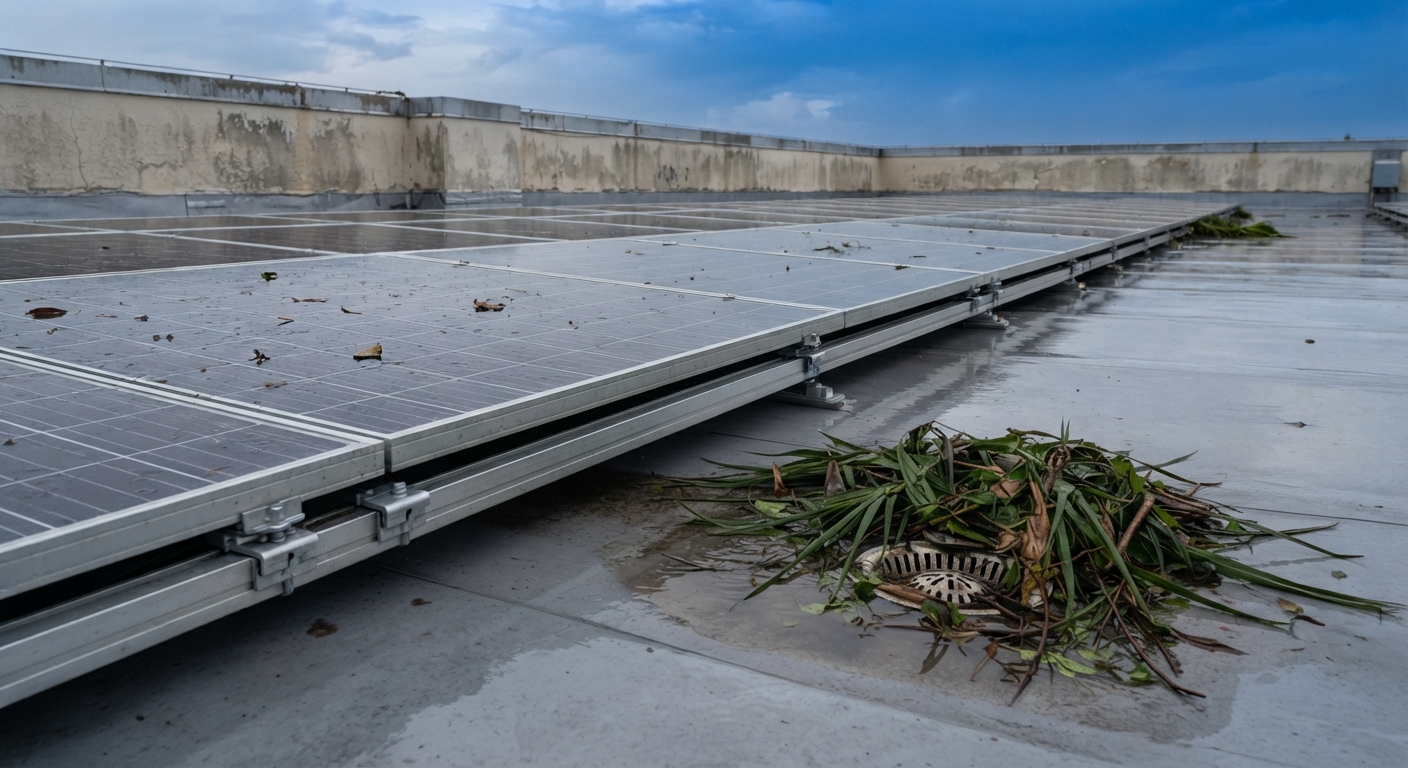
| Blocked drainage under the array | Recommends panels not be installed over roof drains | Clear drains, scuppers, and gutters before landfall |
| Water entry through conduits | Recommends pull boxes and conduits installed to inhibit leakage | Inspect conduit fittings and seals at building entry points |
Nearly every item in that table can be checked on a dry day in October. FEMA’s summary of FM Global Data Sheet 1-15 adds one more item to the annual inspection: connections should be checked at least annually for corrosion as well as loosening, which matters on coastal Florida roofs where salt air attacks hardware.
Should you remove, secure, or shut down a commercial array before a storm?
Removing a commercial array ahead of a hurricane is rarely the practical choice, and a planned shutdown is almost always part of the plan. On a commercial roof with hundreds or thousands of modules, removal inside a 48-hour watch window means crews and lifts on a roof as winds build, attachment points and flashings left open, and hardware that must be reinstalled and inspected before the system returns to service.
Shutdown does not make the roof electrically safe. A PV module produces voltage whenever light reaches it, so opening the AC disconnect or losing utility power leaves the DC conductors between the modules and the inverter energized in daylight. The rapid shutdown function required for building-mounted systems under NFPA 70, Section 690.12 reduces that voltage for emergency responders; how far it reaches depends on the system design and the code edition the system was permitted under. A documented shutdown by a qualified technician, and a restart only after inspection, is the safer sequence.
| Approach | What it does | Where it falls short |
|---|---|---|
| Annual torque check and documentation | Addresses the fastener loosening FEMA observed; creates a dated condition record | Needs walkway access between rows; tightly butted arrays are hard to check |
| Pre-landfall roof clearing and spot check | Removes debris sources and clears drainage, per FEMA’s pre-landfall list | Limited by the watch window; cannot cover a large array fully |
| Planned system shutdown | Stops inverter operation while the site is unattended | Does not de-energize module-side DC conductors in daylight |
| Temporary module removal | Takes modules off the roof | Crew and lift time in the watch window, open attachments, full reinstall and inspection afterward |
| Engineered wind assessment and retrofit | Addresses design-level attachment weaknesses, as FEMA recommends | Takes weeks to months; not an option once a storm is named |
What drives the cost and downtime of a storm-damaged array?
The cost of a damaged array is driven less by module price than by what the damage does to the roof and the schedule. A module that detaches can puncture or tear the membrane beneath it, and FEMA specifically recommends checking the roof covering for damage from wind-borne panels after a storm. At that point the repair becomes a roofing project with a solar remove-and-reinstall inside it. Four variables move the budget and the timeline:
- Roof damage under the array. Punctures and flashing damage at attachments turn a solar repair into a roof repair, and the roof manufacturer’s warranty terms govern who may perform it.
- Access and lifting. Arrays above occupied space, behind parapets, or on tight sites need cranes or lifts and scheduled roof access.
- Documentation. Dated pre-storm photographs, torque records, and production data let the owner, contractor, and insurer separate storm damage from existing conditions faster.
- Monitoring. An array without working alerts can sit offline for days after grid power returns before anyone notices.
AGT’s operations and maintenance program covers the monitoring and connection checks on that list, with real-time production monitoring, verification of wiring, inverters, and batteries, and 24/7 emergency solar support in Florida. The J.J. Taylor Distributing project shows the scale a storm loss can reach. After Hurricane Irma damaged the distributor’s original rooftop array, AGT re-installed a rooftop system of more than one megawatt to meet the owner’s FM Global requirements, completed, per the project page, in the fall of 2018.
What changes for commercial solar hurricane preparedness on an occupied Florida building?
On an occupied building, the preparedness plan runs around the tenants. A retail center, clinic, or school may stay open until an evacuation order, so roof work in the watch window competes with the building’s own shutdown checklist. The sequence that works is set in writing before the season: who authorizes roof access, which technician performs the shutdown, which areas below the work are kept clear while crews are overhead, and who tells the property manager the system is offline.
Safety after the storm follows the same logic. OSHA’s hurricane response and recovery guidance organizes recovery work by activity and its hazards, and a storm-damaged roof combines several of them: damaged structure, fall exposure, and energized equipment. Staff should stay off the roof and away from inverter pads and combiner equipment until a qualified contractor has walked the site. A drone can do the first survey with no one on the roof; AGT’s roof and solar drone surveys capture thermal and high-resolution imagery that maps damaged modules and hot spots across a large array.
Florida adds conditions most national checklists skip. In Miami-Dade and Broward, the High-Velocity Hurricane Zone governs attachment products, and replacement components need approvals that match the installed system; AGT’s commercial rooftop solar page for Miami describes the product-approved racking and engineered attachments those projects require. Solar carports are open structures with their own structural design, and AGT states that its carports are rated to withstand wind speeds up to 180 mph, a company rating for its engineered designs that does not describe carports in general. Sites with battery storage need their own line in the plan: an enclosure that takes water or impact damage is evaluated under the manufacturer’s instructions and NFPA 855, and the local fire marshal and building official decide when it returns to service.
Which codes and Florida rules apply to storm repairs in 2026?
Storm repairs are permitted work, and the code edition in force changes this year. The Florida Building Commission’s 2026 code update brings the Florida Building Code, 9th Edition, into effect on December 31, 2026, replacing the 8th Edition (2023). Permit application timing generally determines which edition governs, so as of September 26, 2026, a repair permitted in October or November will generally follow the 8th Edition and one permitted in January will follow the 9th. The building official makes that determination for each permit.
Replacement racking and attachments need Florida Product Approval or, in Miami-Dade, a county Notice of Acceptance that matches the installed system. Insurance runs on a separate track. Under section 489.147(2)(d), Florida Statutes (2025 text), a contractor may not interpret policy provisions, advise an insured on coverage, or adjust a claim unless licensed as a public adjuster. AGT can document damage and scope repairs; coverage questions go to your insurer, a licensed public adjuster, or your attorney.
Commercial solar hurricane preparedness checklist, by role
- Facility manager, before mid-October: schedule a torque check of 100% of panel clamps and spot checks of rail-to-post bolts, recorded against the racking manufacturer’s torque values.
- Facility manager: photograph the array, the roof beneath it, inverters, and combiner equipment, and store the dated set off site.
- O&M contractor: confirm monitoring alerts reach two named people and that a written shutdown and restart procedure exists for this specific system.
- Roof maintenance lead: clear drains, scuppers, and gutters, and remove loose objects from the roof and grounds, following FEMA’s pre-landfall list.
- Property manager: agree on the notice tenants receive when the system is shut down and when roof access is restricted.
- Owner or asset manager: commission a wind vulnerability assessment from a qualified engineer if the array has never had one, and budget corrective work for the off-season.
- Risk manager: ask your insurer, before a storm, what documentation it expects for a solar claim.
- Everyone, after the storm: no one goes on the roof until a qualified contractor clears it, the system restarts only after inspection, and a follow-up torque check is scheduled within a few months, as FEMA recommends.
Frequently Asked Questions
Should I remove commercial solar panels before a hurricane?
In most cases, no. Removing a commercial array inside the 48-hour watch window puts crews and lifts on a roof as winds build, leaves attachment points and flashings open, and requires a full reinstall and inspection afterward. The protective work happens earlier: an annual torque check of every panel clamp, a clear roof, and a planned shutdown.
How often should the bolted connections on a rooftop array be checked?
FEMA’s Recovery Advisory 5 recommends checking the tightness of bolted connections with a torque wrench every year, covering 100% of panel clamps and spot-checking the bolts that connect rails to clips or posts. It also recommends a check before landfall if time allows and another after a severe windstorm, which can be scheduled a few months after the event.
Does turning off the inverter make a solar array safe to touch?
No. A PV module produces voltage whenever light reaches it, so turning off the inverter or losing utility power does not de-energize the DC wiring between the modules and the inverter in daylight. Rapid shutdown under NFPA 70 Section 690.12 reduces that voltage on building-mounted systems, depending on the system design.
Who should inspect a commercial solar array after a hurricane?
A qualified solar contractor should clear the array before anyone else goes on the roof, check for loose or missing modules, damaged conductors, and water entry, and restart the system only after that inspection. If modules came loose, a roofing contractor should also inspect the membrane and flashings beneath the array.
Can a solar contractor help with my insurance claim?
A contractor can document damage and prepare a repair scope, but under section 489.147, Florida Statutes, a contractor may not interpret policy provisions, advise you on coverage, or adjust a claim unless licensed as a public adjuster. Coverage questions belong with your insurer, a licensed public adjuster, or your attorney.
Does the new Florida Building Code affect solar repairs after a storm?
It can. The Florida Building Code, 9th Edition, is scheduled to take effect on December 31, 2026. Permit application timing generally determines which edition governs a repair, so work permitted before that date will generally follow the 8th Edition. Your building official makes that determination for a specific permit, and replacement components need product approvals that match.
Torque, documentation, and a restart plan decide how an array comes through the season
The evidence from the 2017 storms points to maintenance and workmanship as the deciding factor for most arrays that lost modules, with storm intensity setting the load they had to resist.Loose clamp hardware, shared clamps that fail in sequence, and debris sources left on the roof are conditions an owner can find and correct in the weeks that remain in the 2026 season. A planned shutdown protects the site while it is unattended, and an inspected restart protects the people who return to it. Florida’s code change on December 31, 2026 and its limits on contractor involvement in insurance claims shape how repairs proceed, which makes dated records and clear roles as valuable as any hardware on the roof.
Written by The Technical Team at Advanced Green Technologies. Founded in 2007 by Advanced Roofing, Advanced Green Technologies is 100% employee-owned and ranked #1 among Florida commercial and industrial EPC contractors, and #3 overall in Florida, on Solar Power World’s 2026 Top Solar Contractors list (read the announcement).
To schedule a pre-storm torque check or a post-storm assessment of your array, request a quote from Advanced Green Technologies or call (888) 735-2641. For roof damage beneath an array, see Advanced Roofing’s hurricane season resources.