

At a glance: Florida law treats a company that sells electricity to a customer as a public utility, so the per-kilowatt-hour solar power purchase agreement used in other states is generally unavailable for an on-site commercial system here. This guide explains the statute and the Public Service Commission orders behind that rule, how a fixed-payment lease differs, who claims the federal credit under each structure, what the 2027 placed-in-service date changes, and what each decision-maker should confirm before signing.
Most searches for a commercial solar PPA Florida owners can sign end in the same place. Florida law treats a company that sells electricity to a customer as a public utility, so the per-kilowatt-hour solar power purchase agreement common in other states is generally unavailable for an on-site system here, and the practical choice narrows to a fixed-payment equipment lease or ownership through cash or a loan. The stake is concrete: a contract that bills by output can draw the provider into utility regulation, and a structure chosen without the tax and roof facts can leave the federal credit with the wrong party or the array on a roof that fails first. This article compares the three structures for Florida commercial buildings. It does not decide which structure an owner’s attorney, tax advisor, or utility will accept for a specific building.
Commercial solar PPA Florida rules: what the statute and the PSC have decided
In Florida, a third-party solar PPA that sells on-site electricity to the building owner by the kilowatt-hour is generally treated as a retail sale of electricity, which brings the seller within the statutory definition of a public utility. A fixed-payment equipment lease, a loan, and a cash purchase are the structures Florida commercial owners use instead.
The definition sits in section 366.02, Florida Statutes, which in its 2026 text (subsection 8) covers every person or entity supplying electricity to or for the public within the state. In 1988 the Florida Supreme Court applied that language in PW Ventures v. Nichols, upholding the Public Service Commission’s view that a company planning to build a cogeneration plant and sell its electric output to a single industrial customer would be a public utility. The court read the phrase to reach a sale to any member of the public, which is why one building and one buyer are enough.
Leasing took a different path. In PSC Order PSC-2018-0251-DS-EQ the Commission declared that Sunrun’s residential solar equipment lease was not a sale of electricity, and in PSC Order PSC-2019-0065-DS-EQ it summarized its position: it lacks jurisdiction over a company offering residential solar leases when the lease payments do not vary based on generation. Both orders rest on Rule 25-6.065, Florida Administrative Code, which allows the customer to contract with a third party for the purchase, lease, operation, or maintenance of an on-site system on terms that do not include the retail purchase of electricity from that third party. The orders addressed residential leases, and the Commission limited each declaration to the facts in the petition, so a commercial lease is a question for the owner’s attorney.
As of October 21, 2026, the Legislature has not changed the definition. The 2021 bill that would have allowed third-party solar arrangements for schools, Senate Bill 1718, died in committee, and a 2020 University of Central Florida study counted Florida among seven states with legal barriers that effectively prohibit solar PPAs. The federal calendar adds pressure: under IRS Notice 2025-42, a solar project that did not begin construction by July 4, 2026 must be placed in service by December 31, 2027 to claim the Section 48E credit, which AGT’s guide to the commercial solar tax credit deadline covers in detail.
How do a PPA, a lease, and a cash purchase move money and risk?
Each structure answers four questions differently: what the customer pays for, who owns the equipment, who claims the tax benefits, and who carries the risk that the array produces less than the proposal predicted. The table sets the three side by side for an on-site commercial system.
| Structure | Customer pays for | Owner of the array | Federal credit claimed by | Production risk carried by | Florida status, Oct. 2026 |
|---|---|---|---|---|---|
| Third-party PPA | Each kWh the array delivers, at a contract rate | Developer or investor | Owner of the array | Developer, because payment falls with output | Generally treated as a retail sale under s. 366.02 and PW Ventures (1988) |
| Fixed-payment lease | Use of the equipment, at a scheduled payment | Lessor | Lessor, as owner of the array | Customer, because payment does not fall with output | PSC orders (2018, 2019) found residential fixed-payment leases outside its jurisdiction |
| Cash or loan purchase | The system, up front or through debt service | Customer | Customer, subject to eligibility | Customer | Available; customer-owned generation net meters under Rule 25-6.065 |
The physical mechanism behind production risk is ordinary. Modules lose a small share of output each year, salt film and pollen soil the glass between cleanings, and a new rooftop unit or a growing tree can shade a string and drag down the whole circuit. Under a PPA the provider absorbs that loss because the bill shrinks with the meter. Under a Florida lease the payment stays fixed, and the fixed payment is the feature that keeps the arrangement outside PSC jurisdiction, so the customer absorbs the loss.
Maintenance follows ownership unless the contract says otherwise. An owner who buys the system decides how it is monitored, cleaned, and repaired, often through an operations and maintenance agreement. A lessor usually maintains its own equipment, and the lease defines response times, access, and what happens after a storm. Net metering works the same way in both cases: the Tesla order notes that lease customers take service, interconnection, and net metering from their own utility.
Which financing structure fits which Florida building owner?
The right structure depends on whether the owner can use the federal credit, how long the owner will hold the building, and how much risk the owner will carry on production. AGT’s page on commercial solar financing options describes the direct purchase and lease paths it arranges; the table below states where each one falls short.
| Option | Fits when | Where it falls short |
|---|---|---|
| Cash purchase | Owner has capital, tax liability to use the credit, and a long hold period | Ties up capital; owner carries all production, repair, and storm risk |
| Loan-financed purchase | Owner wants ownership benefits without the full outlay | Debt service is due regardless of output; lender adds underwriting and lien terms |
| Fixed-payment lease | Owner lacks tax appetite or capital and wants a scheduled cost | Lessor keeps the credit; payments do not fall if output does; escalators and buyout terms add cost |
| Ownership with elective pay | School, city, county, or nonprofit wants the credit without tax liability | Requires IRS pre-filing registration; the same placed-in-service deadline applies |
| Third-party PPA | Project sits in a state that permits third-party sales | For an on-site Florida system, generally treated as a retail sale of electricity |
A taxable owner with enough federal tax liability usually captures the most value by owning, because the credit, the depreciation, and the full energy savings stay with the building. The IRS clean electricity investment credit page describes a 6 percent base credit that rises to 30 percent for projects meeting prevailing wage and apprenticeship requirements, with bonus amounts for domestic content and energy community locations. An owner without that tax appetite can lease from a lessor that claims the credit and prices it into the payment.
Tax-exempt owners have a route that removes much of the original case for a PPA. Under elective pay, a school district, municipality, or nonprofit can own the system and receive the credit as a payment from the IRS. AGT’s article on cooperative purchasing for schools and municipalities explains how public owners can procure the project itself.
A lease carries a cost a purchase does not. Over a 15- to 20-year term, the term range AGT’s financing page describes, the lessor’s return, any annual escalator, and the end-of-term buyout price are paid by the customer. For an owner who can use the credit, the lease is the more expensive path to the same array.
What moves the cost and value of each structure?
The value of a commercial solar financing structure moves with a short list of variables, and each belongs to a named professional. None of them is a price; AGT does not publish pricing, and a proposal should state its own assumptions in writing.
| Variable | Effect on the decision | Who confirms it | Source, date |
|---|---|---|---|
| Federal credit percentage | 6% base, up to 30% with wage and apprenticeship rules, plus bonus amounts | Tax advisor | IRS 48E page, accessed Oct. 21, 2026 |
| Construction start and placed-in-service dates | Late-start projects must be in service by Dec. 31, 2027 | Tax advisor | IRS Notice 2025-42, Aug. 2025 |
| Owner’s tax appetite | Decides whether ownership or a lease captures the credit | CFO and tax advisor | Owner’s own tax position |
| Lease term, escalator, buyout | Sets total lease cost and end-of-term options | Attorney and CFO | Lease contract |
| Utility tariff and net metering terms | Set the value of each kWh produced and exported | Utility and energy lead | Rule 25-6.065 and the utility’s tariff |
| Remaining roof service life | Decides whether a remove-and-reinstall falls inside the term | Roof consultant | Core samples and moisture survey |
Two of these variables are settled before financing is priced. A commercial solar feasibility study establishes roof life, structure, interconnection capacity, and the tariff, and those findings decide how large the array can be and what each kilowatt-hour is worth under any structure.
What changes when the array sits on an occupied Florida building?
A rooftop array and the roof under it share a service life, and a lease writes that overlap into a contract. If the membrane has eight years left and the lease runs twenty, the owner is agreeing to a remove-and-reinstall in the middle of the term, and the lease should say who pays for it, who performs it, and whether payments pause while the array is off the roof. Advanced Roofing, the sister company that founded AGT, offers commercial re-roofing that can be sequenced ahead of an array, and AGT’s article on keeping the commercial solar roof warranty in force covers the attachment side.
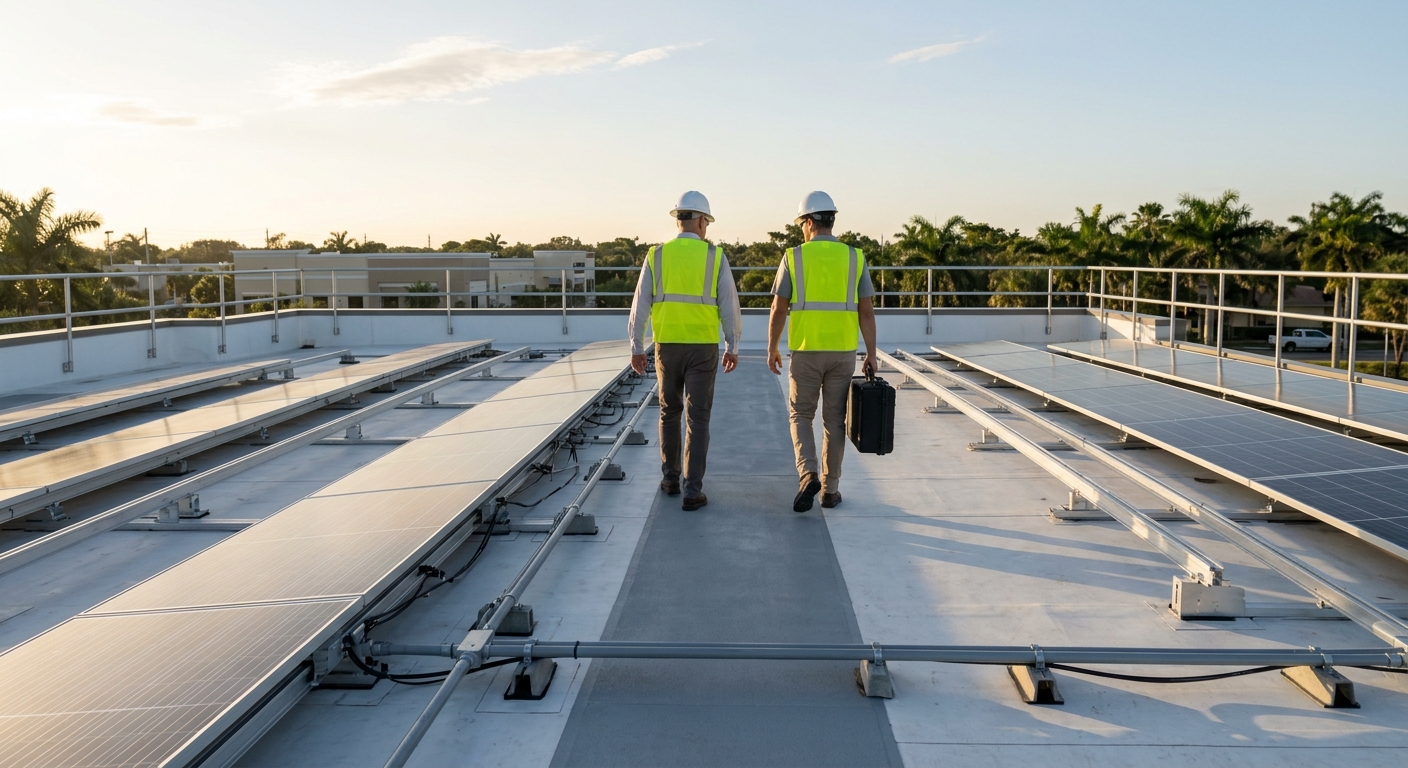
Tenants change the arithmetic. On a retail center or office building where tenants pay their own electric bills, the savings land on the tenant meters while the lease payment or loan lands on the landlord, so the owner’s attorney should confirm how the tenant leases allocate rooftop use and energy costs before the solar contract is signed.
Storms and insurance belong in the same review. AGT’s solar FAQ advises owners to expand property coverage to include the value of the photovoltaic system; under a lease, the contract should state whether the lessor or the building owner insures the array and who repairs it after a hurricane. Electrical tie-ins that require a shutdown are scheduled with the property manager before the window opens, and the utility review described in AGT’s article on commercial solar interconnection in Florida runs the same way whoever owns the array.
Which dates and rules should be rechecked before signing?
Five items change on their own schedules, and each should be read again on the day a contract is signed.
- Section 366.02, Florida Statutes, and any bill in the 2027 session that would authorize third-party solar sales.
- The Section 48E placed-in-service date of December 31, 2027 for projects that began construction after July 4, 2026, and the litigation over Notice 2025-42 that AGT’s tax-credit guide describes.
- IRS pre-filing registration for elective pay or a credit transfer, which must be completed before the return is filed.
- Rule 25-6.065 and the utility’s net metering tariff, which the PSC and the utility can revise.
- The Florida Building Code, 9th Edition (2026), scheduled to take effect December 31, 2026; in Miami-Dade and Broward, High-Velocity Hurricane Zone product approval also applies to solar attachments.
Decision checklist: who confirms what before a Florida solar financing contract is signed
- CFO or owner: Decide whether the building can use the federal credit and how long it will be held, then compare a purchase and a lease over the same term.
- Tax advisor: Confirm credit eligibility, the construction-start position, and whether ownership, a lease, elective pay, or a transfer fits the owner.
- Attorney: Review any lease or service agreement for a payment, true-up, or guarantee that varies with output, and confirm how tenant leases treat rooftop use.
- Roof consultant: Report remaining roof life before the term is set, so a remove-and-reinstall is priced in the contract.
- Energy lead: Name the tariff and net metering terms the savings estimate assumes, with the date they were read.
- Property manager: Plan tenant notices for crane picks and electrical shutdown windows.
- Procurement lead: Ask every bidder to state who owns the array, who claims the credit, and who maintains it, using AGT’s guide on how to select a solar contractor.
Frequently Asked Questions
Are solar power purchase agreements legal in Florida for commercial buildings?
A third-party PPA that sells on-site solar electricity to a Florida building owner by the kilowatt-hour is generally treated as a retail sale, which makes the seller a public utility under section 366.02, Florida Statutes, as the Florida Supreme Court applied it in PW Ventures v. Nichols (1988). Owners use fixed-payment leases or ownership instead. Whether a specific contract crosses the line is a question for the owner’s attorney.
What is the difference between a solar lease and a PPA in Florida?
Under a PPA the customer pays for each kilowatt-hour the array delivers, so payments fall when output falls. Under a Florida equipment lease the customer pays a scheduled amount for use of the equipment, and the PSC has found residential leases outside its jurisdiction when payments do not vary based on generation. The lease shifts production risk to the customer in exchange for that status.
Can a Florida business lease a solar system and still use net metering?
Rule 25-6.065 allows a customer to contract with a third party to purchase, lease, operate, or maintain an on-site system, provided the terms do not include a retail purchase of electricity from that third party. The PSC’s 2019 Tesla order notes that lease customers take interconnection and net metering from their own utility. The utility’s tariff sets the credit terms.
Who claims the federal solar tax credit under a commercial solar lease?
The owner of the equipment claims the Section 48E credit, and under a lease that is the lessor. The lessor may reflect some of that value in the lease payment. An owner that buys the system claims the credit itself, subject to eligibility, wage and apprenticeship rules, and the December 31, 2027 placed-in-service date for late-start projects. The owner’s tax advisor confirms eligibility.
Can a Florida school or city get the benefits of a PPA without signing one?
Tax-exempt and governmental owners can buy the system and claim the Section 48E credit through elective pay, which the IRS treats as a payment of tax. That route requires IRS pre-filing registration and the same deadlines as any other project. AGT’s federal funding page and its cooperative purchasing article explain how public owners procure and pay for the work.
Is buying a commercial solar system better than leasing in Florida?
Buying usually returns more over the system’s life for an owner that can use the federal credit and will hold the building, because the credit, depreciation, and full savings stay with the owner. Leasing fits an owner without tax appetite or capital, at the cost of the lessor’s return, escalators, and buyout terms. The CFO and tax advisor should compare both over the same term.
Where the PPA question leaves Florida commercial owners
The PPA question in Florida has a settled answer for most on-site commercial systems: a third party that sells the electricity by the kilowatt-hour steps into the statutory definition of a public utility, and the PSC has drawn its line at lease payments that do not vary with generation. The decision that remains is between leasing and owning, and it turns on tax appetite, hold period, roof life, and the 2027 placed-in-service date. Advanced Green Technologies was named the #1 commercial and industrial EPC solar contractor in Florida on Solar Power World’s 2026 Top Solar Contractors list, as documented in AGT’s 2026 ranking announcement. The legal and tax determinations stay with the owner’s attorney and tax advisor; the engineering, the schedule, and the build are where a contractor helps.
Written by The Technical Team at Advanced Green Technologies. Founded in 2007, Advanced Green Technologies is 100% employee-owned and designs, procures, and builds commercial solar for clients in Florida and the Caribbean.
Compare financing structures for your building. Call (888) 735-2641 or request a free quote from our team.