

At a glance: A cooperative contract lets a Florida school district, city, or county buy solar under a master agreement another public agency already competed. This guide explains how cooperative purchasing solar works, where Florida law still applies (F.S. 255.20, Rule 6A-1.012, F.S. 1013.45), how it compares with an RFP or a performance contract, what changes on an occupied school or civic building, the federal credit dates to calendar, and a checklist assigning each approval step to a named role.
Cooperative purchasing solar lets a Florida school district, city, or county buy a rooftop or carport system under a master agreement that a lead public agency has already competitively solicited, which can remove months from the front end of a public project. The contract carries over the lead agency’s competition. Your own obligations stay with you: your purchasing rules, Florida’s construction bidding statutes, the terms of the piggybacked agreement, and the federal credit calendar all still apply. Errors here cost real money; in September 2025 the Palm Beach County Office of Inspector General questioned $98,386.43 a town paid under an electrical services piggyback that did not follow the source contract’s terms. This article does not argue that a cooperative contract beats an RFP for every project, and it makes no legal or tax determination for your agency.
Why are Florida schools and cities using cooperative purchasing for solar now?
Public owners are turning to cooperative contracts for solar because the procurement calendar and the federal credit calendar now overlap. Energy is a large, recurring line in a public budget: the U.S. Department of Energy’s Better Buildings program states that K-12 school districts spend nearly $8 billion a year on energy, their second-largest expense after teacher salaries. Solar on a school roof, a library, or a public works parking lot is one of the few capital projects that can reduce that line for decades, and the reduction depends on the utility tariff, the building’s load profile, and the system design.
Public owners can also capture a federal credit that used to reach only taxable companies. The IRS lists states, political subdivisions, and their agencies and instrumentalities as applicable entities for elective pay, and the Clean Electricity Investment Tax Credit (Section 48E) is on its list of elective-pay-eligible credits. Elective pay requires pre-filing registration with the IRS before the return that claims it, and the entity must use its own EIN.
The time pressure comes from the One Big Beautiful Bill Act. IRS Notice 2025-42 states that the credit termination applies to wind and solar facilities whose construction begins after July 4, 2026; for those facilities, no credit is allowed if the system is placed in service after December 31, 2027. A project that starts construction this fall has about fifteen months to be designed, approved, permitted, built, inspected, and interconnected. Whether a specific project qualifies is a determination for your tax advisor.
How does a cooperative purchasing solar contract work?
A cooperative purchasing solar contract is a master agreement that a lead public agency awarded through its own competitive solicitation and made available to other public entities. A school district or city that joins the cooperative issues its own agreement or purchase order under those terms, after confirming that its procurement rules allow it and that the project fits the awarded scope.
AGT’s cooperative vehicle is the Equalis Group contract for commercial solar, COG-2143A. The Cooperative Council of Governments (CCOG) in Ohio served as lead agency and issued RFP #COG2143 for Alternative and Renewable Energy Solutions on February 10, 2023. Equalis Group’s contract record lists the term as May 1, 2023 through April 30, 2027, renewable through April 30, 2028, covering design, procurement, and installation of rooftop, carport, and ground-mounted solar. AGT’s contract page states that any public sector organization in the country can join Equalis Group with no membership fee.
Florida gives school districts an explicit path. State Board of Education Rule 6A-1.012 allows district school boards, in lieu of requesting competitive solicitations from three or more sources, to purchase at or below the prices in contracts awarded by other city or county agencies, other school boards, federal agencies, or public agencies of any state. Cities and counties rely on their own charters and purchasing ordinances, most of which include a cooperative or piggyback clause with conditions attached.
| Step | Who does it | What the file should show |
|---|---|---|
| 1. Confirm authority | Purchasing director and agency attorney | The code section or rule that permits piggybacking, and any limits on construction |
| 2. Review the source solicitation | Purchasing | Lead agency, RFP number, evaluation and award record, current term and renewals |
| 3. Match scope | Purchasing and facilities | Each element (rooftop, carport, storage, EV charging) appears in the awarded scope |
| 4. Site-specific proposal | Contractor and owner’s engineer | Design basis, structural review, interconnection tier, schedule, pricing tied to the contract structure |
| 5. Price reasonableness | Purchasing and finance | Independent estimate or comparison showing why the price is fair for this site |
| 6. Board approval | Board or commission | Agenda item citing contract number, authority, scope, funding source, and schedule |
The step most often skipped is the fifth. A cooperative contract documents that a competition happened; price reasonableness for your specific roof is a separate finding your file needs. The Palm Beach County OIG review of the Town of Jupiter (report CA-2024-0049) found that the town piggybacked a school board’s pre-qualified electrical vendor pool, then sent work to one vendor without the per-project competition the source contract required, and could not document why. On a solar project, follow the source agreement’s ordering procedure.
Cooperative contract, own solicitation, or performance contract: which procurement route fits?
Florida public owners have four practical routes to an owned solar system, and each one solves a different problem.
| Route | Florida basis | Best fit | Where it falls short |
|---|---|---|---|
| Cooperative contract (piggyback) | Agency purchasing code; Rule 6A-1.012 for school boards | Schedule-driven projects with a defined scope that fits an awarded master agreement | Pricing follows the master agreement and is not competed for your site; construction bidding statutes may still apply; contract term limits the window |
| Agency’s own ITB or RFP | F.S. 255.20 (local governments); F.S. 1013.45 (school boards) | Large or unusual projects; owners who want site-specific price competition | Months of solicitation, protest exposure, and staff time before design starts |
| Design-build or construction management | F.S. 1013.45; F.S. 287.055; F.S. 255.103 | Multi-site programs that combine roofing, carports, and storage | Qualifications-based selection and negotiation; still a full procurement cycle |
| Guaranteed energy performance savings contract | F.S. 489.145 | Bundling solar with HVAC, lighting, and water measures under a savings guarantee | Investment grade audit required; term up to 20 years; the guarantee shapes and can narrow the scope |
Construction bidding law is the question to settle first. F.S. 255.20 requires counties, municipalities, and special districts to competitively award construction projects estimated above $300,000 and electrical work above $75,000, with listed exceptions (2026 Florida Statutes). A rooftop solar system is both construction and electrical work. Whether your cooperative contract satisfies that requirement, or whether one of the statute’s exceptions applies, is a question for your agency attorney before the agenda item is written. School boards contract for educational facilities under F.S. 1013.45, which lists competitive bids, design-build, construction management, and program management.
Performance contracting is the route when solar is one measure among several. F.S. 489.145 allows the state, municipalities, political subdivisions, county school districts, and institutions of higher education to enter guaranteed energy, water, and wastewater performance savings contracts that include renewable energy systems, with a written guarantee that annual savings meet or exceed the amortized cost of the measures. The audit and guarantee add time and cost.
A cooperative contract is not the right answer for every project. A single small array on a maintenance building may draw better pricing from a local competitive quote. A district planning dozens of sites over several years may get more value from its own solicitation or a design-build program. AGT is built for multi-megawatt and occupied-building work, and a large statewide EPC contractor is not always the lowest bid on a small, simple job. Some schools host solar through utility programs instead; AGT installed solar canopies at more than 100 Florida public schools for a privately owned utility’s five-year pilot authorized by the Florida Public Service Commission, and in that model the program terms set who owns the system. For a broader framework, see how to evaluate a commercial solar contractor.
What drives the cost and schedule of a public cooperative purchasing solar project?
These variables move budget and schedule regardless of procurement route, so each belongs in the site-specific proposal.
- System type. Rooftop solar installation depends on roof structure and condition; solar carports add structural steel, foundations, and parking-lot phasing, and they leave the roof alone.
- Roof condition. A rooftop array shares the roof’s service life. If the membrane has less life left than the array is expected to produce, the owner is budgeting for a remove-and-reinstall; the sister company’s commercial re-roofing service can replace the roof before the array goes on.
- Structural and wind design. Attachments and carport structures are designed to Florida Building Code wind requirements, and Miami-Dade and Broward follow High-Velocity Hurricane Zone provisions with product approval rules. The engineer of record makes those determinations.
- Interconnection tier. Florida PSC Rule 25-6.065 sets three tiers for customer-owned renewable generation: Tier 1 at 10 kW or less, Tier 2 above 10 kW through 100 kW, and Tier 3 above 100 kW through 2 MW. Expedited interconnection under the rule is limited to 2 MW and to 90% of the customer’s utility distribution service rating; the utility’s tariff governs the rest.
- Board calendar. Most boards and commissions meet monthly, and agenda deadlines fall weeks before the meeting. One missed agenda can move construction start by a month or more.
What changes when the building is an occupied Florida school or city hall?
An occupied public building sets the schedule, and the contractor builds around it. On a school, summer break is the main window for roof work over classrooms. Crane picks for modules and racking are scheduled before arrival, after dismissal, or on weekends, and laydown areas are fenced away from bus loops, car lines, and playground paths. The electrical tie-in usually requires a short planned outage, which the district schedules after hours with notice to the principal and the IT department.
Schools add a screening requirement that municipal projects do not. F.S. 1012.465 requires level 2 background screening for noninstructional contractors who have access to school grounds when students are present. Exemptions in F.S. 1012.468 depend on the circumstances, and the district’s screening office decides. Badging every crew member before mobilization keeps the start date intact.
Civic buildings stay open to the public. AGT’s array at the South Dade Regional Library for Miami-Dade County, 246.2 kW DC on the roof, was celebrated in May 2025, shortly before the library closed for a separate interior renovation. On a building that stays open, the public entrance and accessible parking stay clear, and the building manager receives the staging plan before mobilization.
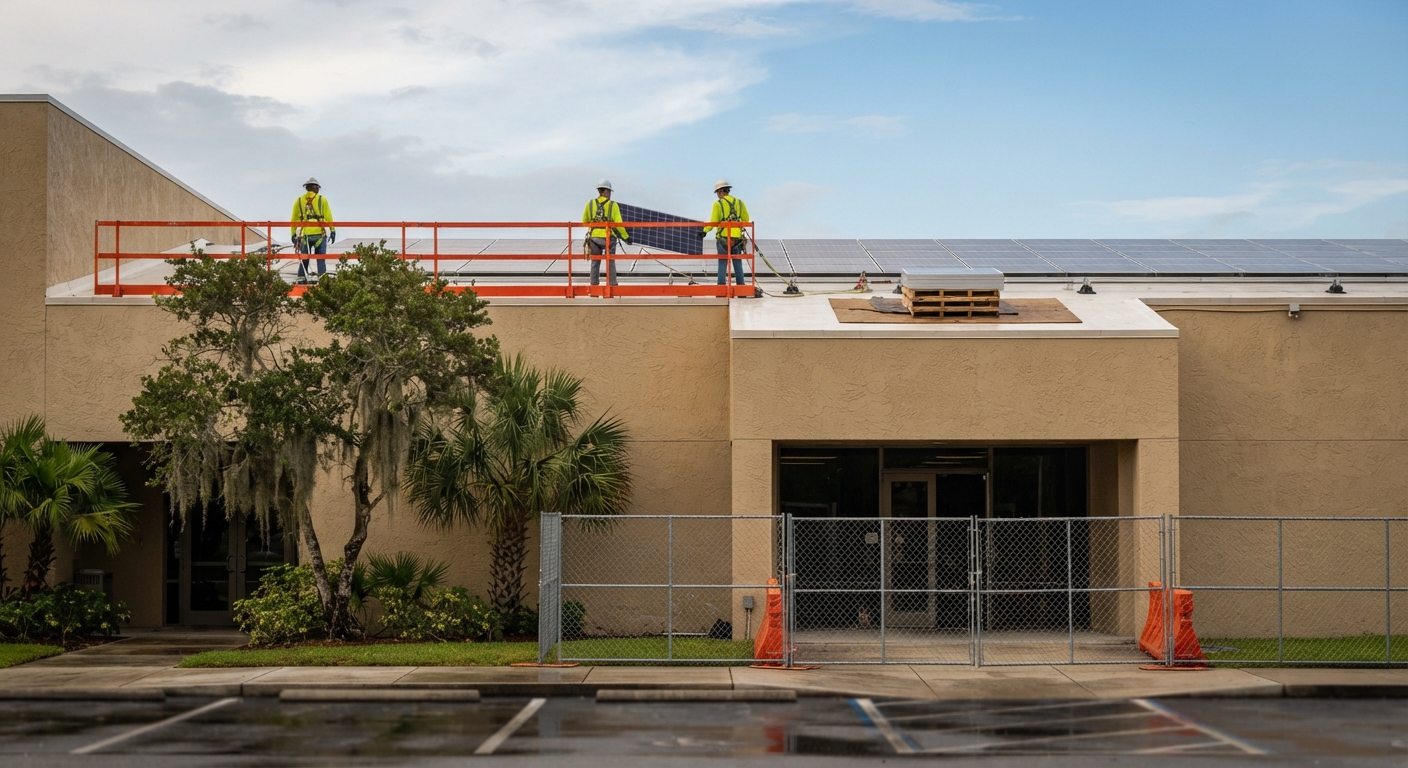
Design decisions made early reduce disruption later. A roof and drone solar survey establishes roof condition and obstructions before layout. AGT’s solar engineering and safety process sets fire-code setbacks and walkway paths so maintenance staff can still reach rooftop equipment. After commissioning, an operations and maintenance program keeps production monitored and keeps warranty conditions in force.
Which deadlines should the board calendar reflect, as of October 1, 2026?
Each dated item below can change and carries a re-check with the professional who owns it.
- Federal credit (Section 48E). For solar facilities whose construction begins after July 4, 2026, Notice 2025-42 requires placement in service by December 31, 2027. Beginning of construction is measured by physical work of a significant nature; planning, permitting, and surveys do not count. The same law added foreign-entity-of-concern restrictions. Your tax advisor confirms eligibility.
- Elective pay registration. The IRS requires pre-filing registration for each project before the return that makes the election.
- Florida Building Code. The 9th Edition (2026) takes effect December 31, 2026; the permit application date generally determines which edition governs. Confirm with the Florida Building Commission and your building official.
- Interconnection and net metering. Rule 25-6.065 and the serving utility’s tariff set the terms, and the PSC can change them.
- Cooperative contract term. COG-2143A runs through April 30, 2027, renewable through April 30, 2028.
Board and procurement checklist for cooperative purchasing solar
A procurement officer can attach this list to the agenda packet and mark each line with the document that satisfies it.
- Agency attorney: confirm piggyback authority under the purchasing code or Rule 6A-1.012, and whether F.S. 255.20 or F.S. 1013.45 applies to this construction scope.
- Purchasing director: obtain the lead agency’s solicitation, evaluation, award, and current term and renewal status.
- Purchasing director: confirm every scope element (rooftop, carport, storage, EV charging) is inside the awarded scope.
- Finance director: document price reasonableness with an independent estimate or comparison.
- Tax advisor: confirm elective pay eligibility, complete IRS pre-filing registration, and map the placed-in-service date.
- Facilities director: obtain a roof condition assessment and remaining service life before array design.
- Engineer of record: complete structural and wind design, including HVHZ product approvals in Miami-Dade and Broward.
- Facilities director: file the utility interconnection application and confirm the tier.
- Risk manager: collect insurance and bond certificates and, for schools, the screening plan.
- Board clerk: list the contract number, authority, scope, funding, and schedule in the agenda item.
Frequently Asked Questions
Can a Florida school district buy solar through a cooperative purchasing contract?
Yes, when the district’s purchasing rules allow it. State Board of Education Rule 6A-1.012 lets district school boards purchase from contracts awarded by other public agencies in lieu of their own three-source solicitation. Because a solar system is construction, the district attorney should also confirm how F.S. 1013.45 applies to the scope before the board votes.
Does a cooperative contract satisfy Florida’s competitive bidding law for construction?
It depends on the agency and the project. F.S. 255.20 requires local governments to competitively award construction above $300,000 and electrical work above $75,000, with listed exceptions. Whether a piggybacked master agreement meets that requirement for a specific project is a determination for the agency attorney.
Is Equalis Group membership free for public agencies?
AGT’s Equalis Group contract page states that any public sector organization in the country can join with no membership fee or commitment. Membership gives access to contract COG-2143A, which Equalis lists as running through April 30, 2027, renewable through April 30, 2028.
Can a school district or city still get the federal solar tax credit?
Public entities can receive the Section 48E credit as a payment through IRS elective pay, after pre-filing registration. Under IRS Notice 2025-42, solar facilities that begin construction after July 4, 2026 must be placed in service by December 31, 2027. A tax advisor confirms eligibility for each project.
How long does a cooperative purchasing solar project take?
The cooperative route removes the solicitation phase, so the schedule is driven by board approval, design, permitting, equipment lead times, construction windows, and utility interconnection. On schools, summer break usually sets the construction window. The contractor’s site-specific proposal should include a dated schedule tied to the placed-in-service deadline.
What should the board see before approving a piggyback solar contract?
The agenda item should cite the contract number and lead agency, the authority that permits the piggyback, confirmation that the scope matches the award, a price reasonableness finding, the funding source, the roof condition assessment, and the schedule against the federal placed-in-service date.
A cooperative contract shortens the solicitation; the diligence stays with the owner
Cooperative purchasing solar is a legitimate way for a Florida school district, city, or county to reach construction faster, and under the December 31, 2027 placed-in-service date that speed has real value. The lead agency’s competition transfers. The owner’s file still has to show authority, scope match, price reasonableness, roof condition, and a schedule the tax advisor has reviewed.
Written by The Technical Team at Advanced Green Technologies. Advanced Green Technologies, a 100% employee-owned commercial solar contractor founded in 2007, has installed more than 380 megawatts of solar for Florida clients and ranked #1 among Florida commercial and industrial EPC contractors on Solar Power World’s 2026 Top Solar Contractors list (2026 Top Solar Contractors recognition).
Reviewing a project for the Equalis Group contract? Request a commercial solar quote or call (888) 735-2641.