

At a glance: Adding solar to a warranted commercial roof keeps the roof warranty in force when the owner follows the roof manufacturer’s published solar procedure, which typically covers advance notice, accepted attachment and flashing details, an authorized roofing applicator, fees, and a post-installation inspection. This guide explains where rooftop arrays expose the membrane, compares ballasted, attached, hybrid, and manufacturer-supplied mounts, lists what drives cost and schedule, covers occupied-building work and Florida code and tax dates, and closes with a checklist by role.
A commercial solar roof warranty stays in force under a rooftop array when the roof manufacturer has approved the attachments, inspected the finished work, and received the forms and fees it requires, in the order its published procedure sets out. Owners who leave that sequence to closing day risk paying out of pocket for leaks on a roof they believed was covered, or paying to remove and reinstall the array long before its modules wear out. This article walks a Florida facility team through where solar work exposes the membrane, how the main mounting approaches compare for solar panel roof waterproofing, and which professional signs off at each step. It does not decide whether any specific warranty survives a specific installation, because that answer comes from the roof manufacturer in writing, and the code and structural answers come from the engineer of record and the building official.
Why is the commercial solar roof warranty a live question on Florida rooftops in 2026?
A commercial solar roof warranty remains valid after a rooftop array goes on when the roof manufacturer is notified in advance, accepts the attachment and flashing details, has an authorized applicator flash every penetration, collects any required fee, and inspects the finished work. Manufacturers treat solar as an alteration to a warranted roof.
Carlisle SynTec’s April 2025 TecTopics guidance on solar installations on warranted roofs requires the building owner to return Carlisle’s Letter of Compliance before installation and states that roof penetrations or anchors must be installed or flashed by a Carlisle authorized applicator. GAF’s commercial solar roofs guidance points owners to its Photovoltaic Installations Guide and Photovoltaic System Registration Form, and recommends that the roof guarantee roughly match the solar warranty in duration and terms.
Service life is the second pressure. The National Roofing Contractors Association’s July 2025 white paper on PV-ready roofs recommends roofing materials and systems whose service lives match or exceed that of the PV installation, installed by qualified roofing contractors and licensed electricians. A roof with eight years of remaining life under an array expected to produce for decades sets up a mid-life detach and reset, the project AGT covers in its guide to solar panel removal for roof replacement. Because AGT was founded by Advanced Roofing, the sister company’s commercial re-roofing team can replace a roof before the array goes on when the numbers point that way.
Florida adds timing. As of October 15, 2026, the Florida Building Code 8th Edition (2023) is in effect and the 9th Edition (2026) takes effect December 31, 2026, according to the Florida Building Commission’s 2026 code development page, and the permit application date generally determines which edition governs. Federal credit dates add schedule pressure as well, and compressed schedules are where warranty steps get skipped.
How does a rooftop array put solar panel roof waterproofing at risk?
A rooftop array affects the roof membrane in three physical ways: it adds openings, it adds load and abrasion, and it adds construction traffic. Each structural attachment needs a cut through the membrane, the insulation, and sometimes the deck, and every cut becomes a flashing detail that has to stay watertight through years of thermal cycling. SPRI’s November 2022 white paper on rooftop equipment attachment notes that structurally attached supports cut through the roof system and must be waterproofed afterward, leaving a direct water path into the building if the seal fails.
Load and abrasion work more slowly. Ballast blocks and racking feet bear on the membrane at small contact points, and wind movement and thermal expansion can scuff the sheet unless protection pads approved by the roof manufacturer sit underneath. Racking also changes how water and debris move toward drains. Leaves, sand, and cleaning residue collect along rail lines, and a drain hidden under an array is a drain no one checks. During Florida’s summer rains, a partially blocked drain means ponding, and ponding accelerates membrane aging.
Construction traffic is the exposure owners underestimate. Installers carry modules, roll carts, drop fasteners, and stage material on the membrane for weeks. The SPRI checklist calls for a loading, travel, and protection plan for the membrane before work starts, along with a check of the roof’s compressive strength. Damage found later generally has to be repaired before a manufacturer accepts warranty continuation, and Carlisle’s 2025 guidance states this directly.
| Exposure point | Physical mechanism | Control that protects the warranty |
|---|---|---|
| Structural attachment penetrations | Membrane and insulation cut at each post; the seal must survive thermal movement and wind load | Manufacturer-accepted attachment and flashing detail, flashed by an applicator the roof manufacturer authorizes |
| Attachments welded or adhered to the membrane | Wind uplift on the array transfers into the sheet | Confirm acceptance first; Carlisle (April 2025) does not accept attachments that rely on a weld or adhesion directly to its membrane |
| Ballast and racking feet | Point loads and movement scuff the membrane | Manufacturer-approved protection pads; structural review of added dead load |
| Installer foot traffic and staging | Punctures, dropped fasteners, cart damage | Walkway routes, protection boards, end-of-shift membrane walk |
| Drains and scuppers near or under the array | Debris collects along rails; water ponds | Clear drain access in the layout; cleaning on the maintenance schedule |
| Future roof repairs | Membrane under modules cannot be reached without removal | Service aisles and a written plan for repairs under the array |
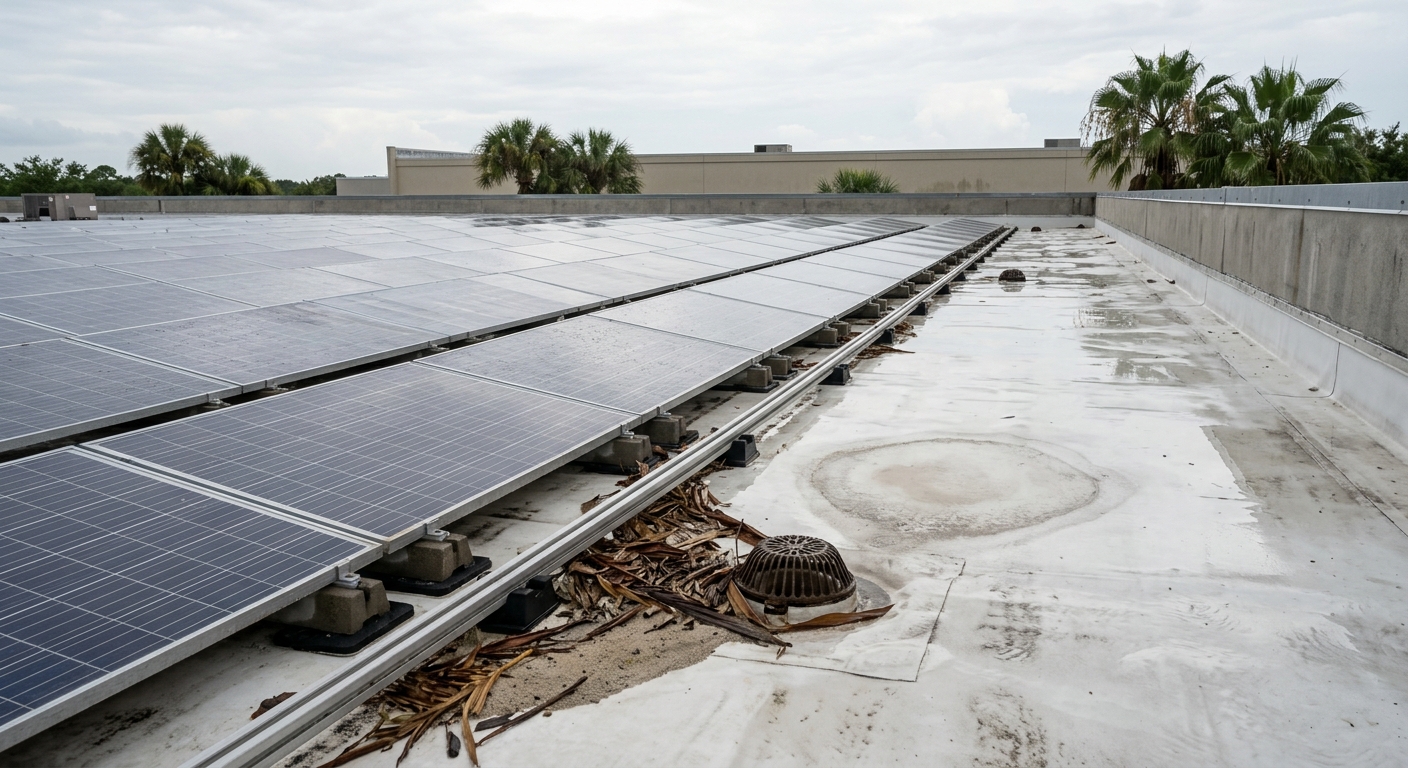
Ballasted, attached, or hybrid: which solar mounting roof protection approach fits the roof?
Solar mounting roof protection starts with how the array holds itself down, and no single approach suits every Florida roof. Ballasted systems rely on weight, attached systems rely on fasteners into the structure, and hybrid systems combine fewer attachments with less ballast. The engineer of record sets the design wind pressures and decides whether an approach meets the Florida Building Code for that building, and the roof manufacturer decides whether the details are acceptable under its warranty.
| Approach | How it holds the array | Where it fits | Where it falls short |
|---|---|---|---|
| Ballasted (non-penetrating) | Weight of concrete blocks in the racking | Roofs with confirmed structural capacity for added dead load, where the engineer accepts ballast for the design wind pressures | Adds dead load; SPRI (2022) notes ballast does not meet ASCE 7’s “positively fastened” requirement and lists it as unsuitable for mechanically attached roofs because of flutter; protection pads still required |
| Structurally attached | Posts or anchors fastened to the deck or framing, flashed through the membrane | High-wind exposures where the engineer requires a direct load path to the structure | Every attachment is a flashing detail; Carlisle requires its authorized applicator to install or flash penetrations |
| Hybrid | Reduced ballast plus a limited number of attachments | Roofs where load capacity limits ballast and the owner wants fewer penetrations | Carries both sets of risks; needs structural and manufacturer review of each |
| Manufacturer-supplied mounts | Mounts made with the roof manufacturer’s own membrane and listed in its warranty program | Roofs from that manufacturer within its approved system list | System-specific; GAF lists its Rooftop Equipment Mount 100 and 240 as eligible for its Diamond Pledge NDL guarantee, while Carlisle refuses attachments that rely on adhesion to its membrane |
Acceptance is manufacturer-specific, so a detail one roof manufacturer lists as warranty-eligible can be one another manufacturer refuses. The roof manufacturer’s written acceptance settles the question, whatever racking the installer prefers. AGT’s rooftop solar installation page states that it works with roofing manufacturers to meet their warranty requirements, and the commercial solar engineering process is where the attachment detail, wind design, and manufacturer submittal come together, supported by AGT’s in-house design, metal fabrication, and construction divisions. Where a roof cannot carry an array on acceptable terms, a canopy may fit better, a trade-off AGT lays out in parking lot solar vs rooftop solar.
What drives the cost, schedule, and warranty outcome of a rooftop solar install?
Six variables decide whether keeping the roof warranty adds a small administrative cost or forces a larger change in scope. Each depends on the owner’s warranty certificate and the manufacturer’s current solar documents.
| Driver | What it changes | Source and date |
|---|---|---|
| Roof age at installation | Roofs under one year old: inspection by a Carlisle Field Service Representative before and after solar, plus a warranty fee. Older roofs: post-installation inspection only | Carlisle SynTec TecTopics, April 2025 |
| Manufacturer inspection fee | $0.05 per square foot of roof, $500 minimum, paid before the inspection is scheduled (Carlisle, existing roofs) | Carlisle SynTec TecTopics, April 2025 |
| Remaining roof service life | Whether reroofing first costs less than a later detach and reset of the array | NRCA PV-ready roofs white paper, July 2025 |
| Structural capacity | Whether ballast is possible and how many attachments are needed; GAF states structural evaluations should be done by a licensed structural engineer | GAF commercial solar roofs page, accessed Oct 15, 2026 |
| Puncture coverage | GAF states its coverage does not extend to accidental punctures unless additional puncture resistance coverage is obtained | GAF commercial solar roofs page, accessed Oct 15, 2026 |
| Damage found at inspection | Repairs required before warranty continuation is accepted | Carlisle SynTec TecTopics, April 2025 |
Fees and procedures change, and the figures above are as each manufacturer published them on the dates shown. The owner’s own warranty certificate governs, and a roof installed under an older program may carry different terms.
What changes when solar goes on an occupied Florida building?
On an occupied building, solar work is scheduled around the tenants and around the roof. Crane picks that lift modules and racking are planned outside business hours where the site allows, with the lift zone barricaded and loading docks kept clear. Material is staged on protection boards in areas the roofing contractor approves, away from drains. The property manager receives notice of every crane day and every electrical shutdown window before it starts, because interconnection usually requires a brief power interruption at the service.
The roof needs its own daily routine. A membrane walk at the end of each shift catches dropped fasteners and scuffs before the next rain, and any open penetration is dried in the same day. Florida’s afternoon storms make that rule practical, since a cut left open at 2 p.m. can let water into an occupied space by 4 p.m. Fall protection follows OSHA’s duty to have fall protection standard, 29 CFR 1926.501, and crews keep fire-code setbacks and walkway paths clear to roof edges and equipment.
Hurricane season runs through November 30. Staged modules, racking, and ballast are secured or removed when a storm is forecast, because a half-attached array is a wind-borne debris hazard. FEMA’s April 2018 recovery advisory on rooftop solar panel attachment design, installation, and maintenance, written after Hurricane Maria damaged arrays in the U.S. Virgin Islands, is a useful reference for attachment and maintenance plans in high-wind regions. After installation, AGT’s roof and drone solar surveys, which use thermal imaging and LIDAR mapping, give the facility team a documented baseline of the roof and array to compare against after storms.
Which Florida code, product approval, and tax dates touch a rooftop solar project?
Three sets of rules affect timing, and each belongs to a different professional. The Florida Building Code governs solar attachments and their wind design, and a permit submitted near December 31, 2026 should be designed to the edition the building official will apply. In the High-Velocity Hurricane Zone of Miami-Dade and Broward counties, roofing and attachment components need Florida Product Approval or a Miami-Dade Notice of Acceptance, and the engineer of record and the building official make those determinations.
The federal clean electricity investment credit under Section 48E also sets dates. As of October 15, 2026, under the One Big Beautiful Bill Act, solar projects that begin construction after July 4, 2026 must be placed in service by December 31, 2027, and IRS Notice 2025-42 sets the beginning-of-construction rules, which litigation has affected. AGT does not determine credit eligibility; the owner’s tax advisor decides how the dates apply.
Commercial solar roof warranty checklist by role
Each step below has an owner. Facility teams can forward this list to the roofing contractor, the solar contractor, and the engineer before contracts are signed.
- Facility director: Pull the roof warranty certificate, manufacturer, system type, installation date, and term, and include them in the solar request for proposal.
- Facility director: Request the roof manufacturer’s current solar procedure, forms, and fee schedule from its warranty department in writing.
- Roofing contractor: Core and moisture-survey the roof, report remaining service life and any wet insulation, and confirm authorization to flash new penetrations on that system.
- Structural engineer: Confirm dead-load capacity for ballast and design the attachment load path to the wind pressures of the governing code edition.
- Solar contractor: Submit racking, attachment details, protection pads, walkway layout, and drain access to the roof manufacturer for written acceptance before mobilization.
- Solar and roofing contractors: Agree in writing who installs and flashes each penetration, who walks the membrane daily, and who repairs damage.
- Property manager: Issue tenant notices for crane days and electrical shutdowns, and name a leak-response contact for the duration of the work.
- Roof manufacturer and owner: Complete the required post-installation inspection and file the continuation letter or registration with the warranty records.
- Tax advisor: Confirm how Section 48E dates apply before the schedule is fixed.
- Facility director: Add the array to the roof maintenance plan and keep inspection reports, since some extensions, such as GAF’s WellRoof program, require annual inspections.
Frequently Asked Questions
Does installing solar panels void a commercial roof warranty?
Installing solar panels does not automatically void a commercial roof warranty, but unapproved work can. Roof manufacturers publish procedures for adding solar to a warranted roof, typically including advance notice, accepted attachment details, flashing by an authorized applicator, a fee, and a post-installation inspection. Skipping those steps gives the manufacturer grounds to exclude damage tied to the array. Only the roof manufacturer can confirm in writing that a specific warranty stays in force.
Who should flash solar mounting penetrations on a warranted roof?
Penetrations on a warranted roof should be installed or flashed by a roofing contractor the roof manufacturer authorizes for that system. Carlisle SynTec’s 2025 solar guidance states this requirement for its roofs, and other manufacturers publish their own rules. On many projects the solar contractor sets the racking while the authorized roofer flashes each attachment, and the contract should say who does each task and who answers for leaks.
Is a ballasted solar array safer for the roof warranty than an attached one?
A ballasted array avoids penetrations, yet it carries its own warranty risks. Ballast adds dead load the structure must carry, can abrade the membrane without approved protection pads, and may not satisfy the wind design an engineer requires on a Florida building. SPRI’s 2022 white paper lists ballast as unsuitable for mechanically attached roofs because of membrane flutter. The engineer and the roof manufacturer decide which approach fits.
How much does a roof manufacturer charge to keep a warranty in force after solar?
Fees vary by manufacturer and by roof age. Carlisle SynTec’s April 2025 guidance lists an inspection fee of $0.05 per square foot with a $500 minimum for existing roofs, paid before the inspection is scheduled, and a warranty fee for roofs less than one year old. Other manufacturers set their own fees, so the owner should request the current schedule in writing before budgeting.
Should an older commercial roof be replaced before solar goes on?
An older roof is often replaced before solar goes on when its remaining service life falls well short of the array’s expected life. NRCA’s 2025 white paper on PV-ready roofs recommends roof systems whose service lives match or exceed the PV installation. Core samples and a moisture survey show whether the roof can carry an array, and the owner then weighs reroofing now against a later detach and reset.
Who is responsible for a roof leak under a solar array?
Responsibility for a leak under a solar array depends on the cause and on the contracts and warranties in place. A failed manufacturer-accepted flashing detail installed by an authorized applicator may fall under the roof warranty, while damage from racking, foot traffic, or unapproved work may fall to the installer. Clear scope language and inspection records settle most disputes, and the roof manufacturer and the owner’s attorney decide contested cases.
Put the roof warranty on the solar schedule before the first attachment
A rooftop array and the roof under it share a service life and, in practice, a warranty file. The owner who requests the manufacturer’s solar procedure early, settles the attachment approach with the engineer and the roof manufacturer, assigns flashing to an authorized applicator, and closes out with a post-installation inspection keeps the roof warranty in force on documented terms. The owner who leaves those steps to the end carries the leak risk alone. The code edition change on December 31, 2026, hurricane season, and federal credit dates all tighten schedules, which is why the warranty steps belong in the first proposal. Once the array is energized, its inspection records belong in the same maintenance plan as the roof, and AGT’s commercial solar operations and maintenance service covers the array side of that plan.
Written by The Technical Team at Advanced Green Technologies. Founded in 2007 by Advanced Roofing, Advanced Green Technologies is 100% employee-owned and was ranked #1 among Florida commercial and industrial EPC contractors on Solar Power World’s 2026 Top Solar Contractors list.
To plan a rooftop array around your roof warranty, request a free quote or call (888) 735-2641.