

At a glance: A commercial solar feasibility study decides whether a Florida project can be built, financed, and finished in time. This guide covers the five tests a study should run (energy use and tariff, sun and shade, roof life, structure and wind, and electrical service and interconnection), how desktop screens, contractor assessments, and engineering evaluations differ, what moves the budget and schedule, how studies work on occupied buildings, the dated code, utility, and tax items for late 2026, and a checklist by role.
A commercial solar feasibility study in Florida is the document that decides whether a project is buildable, bankable, and finished in time, and most of its value lies in the findings that can stop a project before money is committed. That means testing roof life, structural capacity for wind uplift, the electrical service and interconnection path, the utility tariff, and the federal credit calendar on one building before anyone prices modules. A thin study shows its cost later, as a second roof under an array in its eighth year or a utility study that pushes completion past a credit deadline. This article covers what a study should evaluate, how study types differ, and what owners should require in writing. It makes no credit, code, or interconnection determination for any building; those belong to the owner’s tax advisor, building official, engineer, and utility.
Why does a commercial solar feasibility study in Florida carry more weight in late 2026?
The federal credit calendar now runs through the feasibility schedule. Under IRS Notice 2025-42, a solar facility that begins construction after July 4, 2026 is eligible for the Section 48E clean electricity investment credit only if it is placed in service by December 31, 2027. The same notice lists planning and designing, engineering studies, mapping and modeling to assess a resource, and test drilling to determine soil condition as preliminary activities that do not count as beginning construction. A study started in October 2026 starts no credit clock; it uses part of a window of roughly 14 months in which design, permitting, construction, inspection, and utility approval must all finish. Eligibility for any project is a question for the owner’s tax advisor.
The code calendar moves at the same time. Miami-Dade County’s permitting notice on the 9th Edition code states that the 9th Edition (2026) Florida Building Code becomes effective December 31, 2026, and that permit applications submitted on or after that date must comply with it. A study should name the code edition its structural and electrical assumptions follow.
Electricity prices set the stakes. EIA’s 2024 Florida electricity profile puts the statewide average retail price at 12.53 cents per kWh across all sectors, a figure that hides wide variation by utility and rate class. The Florida Solar Energy Center’s 2019 solar feasibility assessment of 17 New Smyrna Beach city facilities shows a public-sector baseline for scope: on-site measurement of orientation, shading, and usable roof area, PVWatts sizing estimates, and analysis of the facilities’ own utility bills. A private owner’s study should meet that bar and add structural, roof-life, and interconnection tests.
What does a commercial solar site assessment evaluate?
A commercial solar site assessment is the field and records review that tests five things on one building: how the building uses and pays for power, how much sun reaches the usable area, how long the roof will last, what the structure can carry, and how the array connects to the utility. Each test can end the project on its own. Advanced Green Technologies’ commercial solar engineering process treats sun exposure, shadow analysis, and structural review as one site assessment, and its roof and solar drone surveys produce orthomosaic maps and 3D models that measure obstructions and usable area.
| Test | What it measures | Data the owner supplies | What can stop the project | Who confirms |
|---|---|---|---|---|
| Energy use and tariff | Interval load profile, rate schedule, demand charges, hours of operation | 12 months of bills and 15-minute interval data | Savings too small on the actual rate to support the capital | Owner, utility account representative |
| Sun and shade | Usable area, orientation, shading from parapets, units, trees, and neighbors | Site plan, planned rooftop equipment changes | Shade or setbacks that cut usable area below the target size | Solar designer |
| Roof life | Membrane age and condition, wet insulation, deck condition, warranty terms | Roof warranty, maintenance records, prior core reports | Remaining roof life shorter than the array’s service life | Roof consultant or roofing contractor |
| Structure and wind | Capacity for added dead load and uplift at the site design wind speed; HVHZ status | Structural drawings, prior alterations | Reinforcement cost or an attachment method the roof cannot accept | Structural engineer of record |
| Electrical service and interconnection | Service rating, spare capacity, switchgear condition, point of interconnection, utility tier | One-line diagram, switchgear records | System size above the expedited limit, or upgrades that break the budget | Electrical engineer, utility |
Roof life is the test owners most often skip. Writing in NRCA’s Professional Roofing magazine in 2017, the National Roofing Contractors Association’s vice president of technical services advised that a roof under a PV system have an expected service life equal to or greater than the system’s, and cited a 2003 industry study putting the average U.S. commercial low-slope roof at about 17.4 years. The U.S. Department of Energy reports, citing a Berkeley Lab survey, that expected solar panel life rose to 25 to 35 years in 2025. The figures come from different studies, but the gap is why a study should core the roof, scan for wet insulation, and state remaining roof life in years. Advanced Roofing’s commercial roof management program keeps records that feed that test, and our guide to solar panel removal for roof replacement shows what the skipped test costs later.
The structural test is a wind test in Florida. The same NRCA article cautions that ballasted racks concentrate loads that can exceed the compressive strength of membrane and insulation. FEMA’s Recovery Advisory 5 on rooftop solar panel attachment, issued after Hurricanes Irma and Maria, recommends engineered attachment design and at least annual inspection of rooftop solar assemblies. In Miami-Dade and Broward, High-Velocity Hurricane Zone product approvals apply to the attachments, and the engineer of record sets design wind pressures for the address; the ASCE Hazard Tool returns site design wind speeds by ASCE 7 edition. Systems resist rated pressures, storms can exceed them, and warranties carry wind limits and exclusions.
The electrical and fire tests set the size ceiling. Florida PSC Rule 25-6.065 limits expedited interconnection to systems whose gross power rating does not exceed 90% of the customer’s utility distribution service rating, and the adopted rule text calculates that rating for inverter-based systems as DC nameplate capacity multiplied by 0.85. Each utility adds its own limits; FPL’s net metering guidelines cap estimated annual production below 115% of the account’s annual consumption and require three-phase wye service for systems of 50 kW or more. NFPA 1, the base of the Florida Fire Prevention Code, sets rooftop access pathways and smoke-ventilation areas for PV on commercial buildings in Section 11.12, and the local fire official can modify them. A study that sizes the array before applying them overstates production.
Desktop screen, contractor assessment, or solar engineering evaluation: which study does the building need?
Feasibility studies come in four depths, and the right one depends on how close the owner is to a capital decision. Each step adds verification, cost, and time, as the table shows.
| Study type | What it delivers | When it fits | Where it falls short |
|---|---|---|---|
| Desktop screen | Satellite layout, rough size, bill-based savings estimate | Ranking a portfolio of buildings before site visits | No roof, structural, or electrical verification; numbers move a lot after a site visit |
| Contractor site assessment | Roof walk, drone survey, shade study, preliminary layout and production model | A single building moving toward a proposal | Prepared by a firm that hopes to build the project; owner must check every assumption |
| Solar engineering evaluation | Stamped structural and electrical analysis, one-line concept, utility pre-application review | Older roofs or structures, large systems, Tier 3 interconnection | Engineering fees and weeks of schedule before any construction contract |
| Owner’s engineer study | Independent review or full study by an engineer working only for the owner | Board, lender, or public-procurement decisions | Highest cost and longest timeline; still depends on the building’s own records |
A contractor assessment, including one from Advanced Green Technologies, comes from a firm that hopes to build the project. The owner should check that every assumption is stated and every input is the building’s own data. Owners financing a large system, spending public money, or presenting to a board often pay for an independent review of the contractor’s study. The review costs fees and weeks; a smaller building with a new roof and a clear service entrance may not need one.
Ground-mount and canopy options belong in the same study when the roof fails a test. See our comparison of parking lot solar vs rooftop solar and the solar carport site assessment guide, which this article does not repeat. Buildings with an older array need the same tests before a repower; AGT’s 2.2 MW DC repowering at the Orange County Convention Center, completed in April 2026 with SolarEdge, is the company’s most recent example, delivered from its Orlando commercial solar office.
What moves the budget, schedule, and production estimate?
Roof life, structure, service capacity, interconnection, and tariff move a budget more than module choice. A study should price or schedule each as its own line, with its source, so the owner can see which assumption carries the payback.
| Driver | How it moves the project | Source and date |
|---|---|---|
| Roof replaced before installation | Adds roof cost now; avoids removing and reinstalling the array mid-life | Roof cores and moisture survey; NRCA, Professional Roofing, Sept. 2017 |
| Structural reinforcement | Steel or attachment changes add cost and engineering time | Structural engineer of record; site design wind speed (ASCE Hazard Tool) |
| Service capacity | Expedited interconnection limited to 90% of the service rating; larger systems need upgrades or another path | PSC Rule 25-6.065(4)(a), effective Apr. 7, 2008 |
| Interconnection tier | Tier 3 (over 100 kW to 2 MW) may need a utility study; agreement due within 90 days of a complete application if so | PSC Rule 25-6.065(4)(d) and (7)(c) |
| Liability insurance | Utility may require up to $1 million (Tier 2) or $2 million (Tier 3) | PSC Rule 25-6.065(5)(e) |
| Demand charges | Net metering does not remove the customer charge or the demand charge for peak measured demand | PSC Rule 25-6.065(8)(h) |
| Excess energy | Credits carry forward up to 12 months; unused credits paid at the utility’s as-available energy rate | PSC Rule 25-6.065(8)(e)-(f) |
| Shade and fire setbacks | Remove modules from the layout and lower annual kWh | Shade study; NFPA 1 Section 11.12 as applied by the local fire official |
The demand-charge line deserves attention in a Florida payback. Rule 25-6.065 requires a net-metered customer to keep paying the applicable customer charge and the demand charge for the maximum measured demand in each billing period, so a building whose bill is driven by a short afternoon peak may save less than a kilowatt-hour model predicts. A study should model savings from 15-minute interval data on the building’s actual rate schedule, and treat storage, covered on our commercial battery storage solutions page, as a separate case with its own assumptions.
None of these lines is a price, and a cost estimate is only as reliable as the scope printed next to it. Ownership structure changes which incentives apply; the commercial solar financing options page outlines cash, loan, and third-party paths to review with a tax advisor.
What changes when the study is done on an occupied Florida building?
Feasibility work happens on buildings that stay open. AGT’s survey page notes that drone flights capture roof data without closing the building. Roof cores and moisture scans need a roofer on site, a patch for every core, and a dry forecast. On a hospital or school, the property manager should approve core locations.
The electrical review needs the most coordination. Checking switchboard ratings, spare capacity, and infrared images under load can require panel covers to come off energized equipment. Those tasks belong to a licensed electrician working under written shutdown or energized-work procedures, scheduled outside business hours where tenants require it. Interval data, as-built drawings, and the one-line diagram should be requested before the visit.
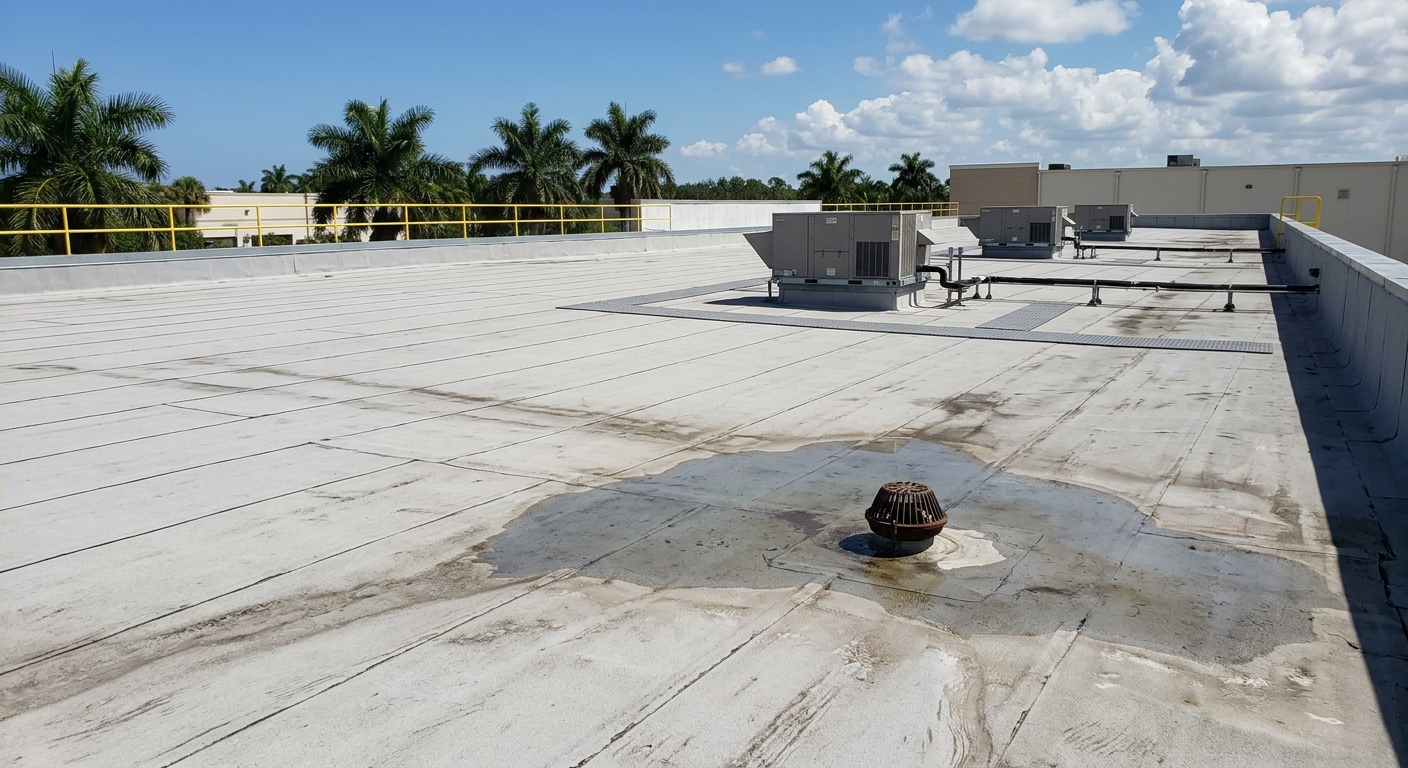
Field crews on roofs work under OSHA’s construction fall protection standard, 29 CFR 1926.501, which requires protection on low-slope roofs with unprotected edges six feet or more above a lower level. During hurricane season, June 1 to November 30, a study completed before a named storm affects the area should be re-verified by drone.
Which code, interconnection, and tax dates should the study carry?
As of October 15, 2026, four dated items belong on every feasibility study’s assumptions page. The 9th Edition Florida Building Code takes effect December 31, 2026, and the International Code Council’s published preface to that edition lists the 2023 National Electrical Code among its model codes. Rule 25-6.065, last amended effective April 7, 2008, sets the tiers, the 2 MW expedited ceiling, and the net metering credit rules, while each utility’s tariff and interconnection agreement carries the fees and forms. Under Notice 2025-42, a solar facility beginning construction after July 4, 2026 must be placed in service by December 31, 2027, and only low-output facilities of 1.5 MW AC or less could use the 5% safe harbor to establish an earlier start. The study should date each assumption for re-check with the building official, utility, and tax advisor before a contract is signed. Our post on the commercial solar tax credit deadline tracks the federal side.
Commercial solar feasibility study checklist: what to require before you sign
- Owner or CFO: state the decision the study must support and the expected hold period for the building.
- Facility manager: supply 12 months of bills and 15-minute interval data, the one-line diagram, structural drawings, and the roof warranty before the site visit.
- Roof consultant or roofing contractor: report remaining roof life in years from cores and a moisture survey.
- Structural engineer: confirm capacity for the proposed racking and attachments at the site design wind speed, with HVHZ status stated.
- Electrical engineer: confirm the service rating, spare capacity, point of interconnection, and the size limit under Rule 25-6.065.
- Utility: confirm the interconnection tier, fees, and whether a Tier 3 study is likely.
- Fire official: confirm pathways and setbacks before the layout is final.
- Tax advisor: confirm credit timing for the chosen ownership structure against the December 31, 2027 placed-in-service date.
- Contractor: deliver the production model inputs, shade losses, and every assumption on one dated page.
Frequently Asked Questions
What is a commercial solar feasibility study?
A commercial solar feasibility study is a pre-design evaluation that tests whether a specific building or site can host a solar array that makes financial sense. It reviews energy use and the utility tariff, measures usable area and shade, checks roof life and structural capacity, and confirms the electrical service and interconnection path. A good study ends with a go or no-go recommendation and dated assumptions.
How much does a commercial solar feasibility study cost?
There is no single price. Contractor site assessments are often included with a proposal, while stamped engineering evaluations and owner’s engineer studies are billed by scope. Cost rises with building count, structural depth, roof coring, and utility review. Ask every provider for the scope in writing so studies can be compared line by line.
How long does a commercial solar site assessment take in Florida?
Field work for a single roof is often short, because drone surveys capture geometry and thermal data in one visit. The schedule is usually set by records and outside parties: interval data from the utility, roof cores and lab results, structural review, and any utility pre-application response. Supplying records before the visit shortens the process.
Does a feasibility study count as beginning construction for the solar tax credit?
No. IRS Notice 2025-42 lists planning and designing, engineering studies, resource mapping and modeling, and test drilling to determine soil condition as preliminary activities, which do not count as beginning construction. A study started now does not start a credit clock. Whether a project qualifies for any credit is a determination for the owner’s tax advisor.
How many years should my roof have left before installing solar?
NRCA’s technical guidance holds that the roof under a solar array should have an expected service life equal to or greater than the array’s. The U.S. Department of Energy, citing a Berkeley Lab survey, reports expected panel life of 25 to 35 years in 2025. A roof that cannot match that span is usually replaced first.
What size solar system can a Florida business net meter?
Florida PSC Rule 25-6.065 covers customer-owned renewable systems up to 2 MW at investor-owned utilities, in three tiers: 10 kW or less, over 10 kW to 100 kW, and over 100 kW to 2 MW. For expedited interconnection, the system’s gross power rating cannot exceed 90% of the customer’s utility distribution service rating. Each utility’s tariff and agreement set the fees and forms.
Fund the study that can say no
The value of a commercial solar feasibility study lies in its ability to stop a project that would fail later. Roof life, structural capacity, service rating, interconnection tier, and tariff each decide whether a Florida array gets built, and the federal placed-in-service date and the December 31, 2026 code change leave little room to learn those answers during construction. A study that dates its assumptions and names who confirms each one gives a board, lender, or procurement officer a document they can test.
Written by The Technical Team at Advanced Green Technologies. Founded in 2007, Advanced Green Technologies is 100% employee-owned and ranked #3 overall in Florida, the highest-ranked commercial and industrial EPC on the state list, in Solar Power World’s 2026 Top Florida Solar Contractors (read the announcement).
To scope a feasibility study for your building, request a commercial solar quote or call (888) 735-2641.