

At a glance: Florida’s investor-owned utilities net meter commercial solar under PSC Rule 25-6.065, unchanged since 2008. Exports earn a kilowatt-hour credit against energy charges for up to 12 months; December balances are paid at an avoided-energy rate, and demand and customer charges stay on the bill. This article covers how FPL applies the rule in 2026, how municipal and co-op export credits differ, the Tier 3 size, fee, insurance, and schedule rules, what changes on an occupied building, and a checklist for the proposal.
Florida net metering commercial rules give a business on FPL, Duke Energy Florida, or Tampa Electric service a kilowatt-hour credit for solar exported to the grid, carried forward up to twelve months, and very little beyond that. The rule does not reduce the demand charge, the customer charge, or a minimum charge, and any credit left in December is paid at the utility’s avoided energy cost instead of the retail rate. A commercial array sized to the roof instead of to the building’s annual consumption, or a pro forma that books demand savings the tariff never grants, can miss its projected payback by years. This article explains how the Florida Public Service Commission rule and FPL’s current tariff treat commercial solar exports in 2026; it does not argue that net metering is about to end, and it does not set any building’s rate, credit, or tax position.
What Do Florida Net Metering Commercial Rules Require of FPL, Duke, and TECO in 2026?
Florida’s investor-owned utilities net meter customer-owned renewable generation under Florida Public Service Commission Rule 25-6.065, F.A.C., last amended April 7, 2008, and still in force as of October 28, 2026. The rule covers systems up to 2 MW and requires each investor-owned utility to install, at no added cost, a meter that measures energy flow in both directions. Its authority is section 366.91, Florida Statutes, which defines net metering as a billing method that lets customer-owned renewable generation offset consumption on site and requires municipal utilities and cooperatives to run their own programs on terms their boards set.
Three dated events frame the 2026 decision. On April 27, 2022, the Executive Office of the Governor recorded the veto of CS/CS/HB 741, the bill that would have phased down net metering credits, so the 2008 rule stayed in force. FPL’s four-year rate settlement in PSC Docket No. 20250011-EI adjusted energy and demand charges for business rate classes effective January 1, 2026, with a further increase in 2027, according to the settlement agreement FPL filed with the SEC; the Commission approved it on November 20, 2025, as WLRN reported on the vote. A Florida Senate search for 2027-session bills citing section 366.91 returned no results on October 28, 2026. The rule is stable; the retail rates that give each credited kilowatt-hour its value are moving.
How Florida net metering works for commercial solar: Under PSC Rule 25-6.065, FPL, Duke Energy Florida, Tampa Electric, and Florida Public Utilities net a commercial customer’s solar exports against grid purchases kilowatt-hour for kilowatt-hour each month, roll excess credit forward up to 12 months, and settle any December balance at an avoided-energy rate. Customer and demand charges still apply.
How Do FPL Net Metering Rules Credit Commercial Solar Exports?
FPL net metering rules credit energy, measured in kilowatt-hours, and leave demand, measured in kilowatts, on the bill. Solar output serves the building’s loads first and never crosses the meter; only the surplus at any moment flows to the grid and is recorded. FPL’s tariff Section 10, sheet 10.010, effective January 1, 2026, states that excess generation in a billing cycle is credited to the next month’s energy consumption, that credits offset energy usage for no more than twelve months, and that unused credits in the last billing cycle of the calendar year are credited at an average annual rate based on FPL’s COG-1 as-available energy tariff.
The demand charge is the line most commercial pro formas get wrong. The same tariff sheet requires a net metering customer to pay the greater of the rate schedule’s minimum charge or the base charge plus the demand charge for the maximum measured demand during the billing period, whether or not energy was exported, and Rule 25-6.065(8)(h) says the same. The reason is timing. A demand charge is set by the building’s highest interval of grid draw in the month, and one overcast afternoon or a cooling peak after sunset can set it while the array produces little. An array lowers billed kilowatt-hours reliably and billed kilowatts only when every peak day lines up with strong production.
The year-end rate is not fixed. FPL’s Schedule COG-1 prices as-available energy from actual hourly avoided energy costs, and the FPL net metering FAQ states that the credit is recalculated each year and tends to move with natural gas prices. Every kilowatt-hour exported beyond annual consumption is worth an avoided-fuel price set after the fact.
| Bill component | Offset by solar? | How it is treated | Source |
|---|---|---|---|
| Energy charges (kWh), same month | Yes | On-site use avoids purchases; exports net against purchases | FPL tariff sheet 10.010, eff. Jan 1, 2026 |
| Excess kWh, following months | Yes, as a kWh credit | Credit rolls to later billing cycles for up to 12 months | Rule 25-6.065(8)(e)-(f) |
| Unused credit at year end | Partly | Credited at average annual COG-1 avoided-energy rate | FPL tariff sheet 10.010 |
| Demand charge (kW) | No | Billed on maximum measured demand in the period | Rule 25-6.065(8)(h); FPL sheet 10.010 |
| Base or minimum charge | No | Customer pays the greater of the minimum charge or base plus demand charge | FPL tariff sheet 10.010 |
| Renewable Energy Certificates | Kept by customer | Extra metering for REC sales is at the customer’s expense | Rule 25-6.065(9) |
Commercial Solar Export Credits: Investor-Owned Utilities vs. Municipal Utilities and Co-ops
Commercial solar export credits in Florida depend first on which utility serves the meter, because the PSC rule binds only investor-owned utilities; municipal utilities and cooperatives write their own programs under section 366.91(6). The Orlando Utilities Commission’s TruNet Solar tariff, effective July 1, 2025, credits exports from new applicants at OUC’s Community Solar Energy Rate until June 30, 2030, and at the levelized fuel charge after that, according to the OUC tariff filing with the Florida PSC. Identical arrays a few miles apart can earn different export values.
Ownership structure matters as much as the utility. Rule 25-6.065(2)(a) allows a third-party purchase, lease, or maintenance contract for an on-site system if the terms do not include the retail purchase of electricity from that party, and the FPL Tier 3 interconnection agreement repeats the restriction for leases. Any financing structure belongs with the owner’s attorney and tax advisor before signature.
| Option | How exports are valued | Best fit | Where it falls short |
|---|---|---|---|
| IOU net metering (FPL, Duke Energy Florida, TECO, FPUC) | kWh for kWh against energy charges; December balance at an avoided-energy rate | Buildings that use most of the array’s annual output on site | No demand-charge relief; surplus above annual use paid at avoided cost; 2 MW cap |
| Municipal or co-op program (example: OUC TruNet Solar) | Set by the utility’s board; OUC credits new applicants at its Community Solar Energy Rate through June 30, 2030 | Owners who size to daytime load and self-consume | Export credit below retail; terms change by board action |
| Solar plus battery storage on an IOU account | Battery shifts solar energy to the building’s peak to lower billed demand | Buildings with sharp, predictable peaks and high demand charges | Value depends on the rate structure; does not pay back on every tariff; NFPA 855 siting review |
| Standby or supplemental service rate | Available at the customer’s discretion where the utility offers it | Large loads with on-site generation reviewed by an engineer | Rate design differs by utility; needs tariff analysis before choosing |
A battery is the main tool for the demand line net metering leaves untouched, and the easiest to oversell. Its value depends on the timing of the building’s peaks and the demand rate, so commercial battery storage for demand reduction should be scoped from interval meter data. Where peaks fall after sunset, the battery may cost more than the charges it avoids.
Which FPL Net Metering Rules Set Commercial System Size, Cost, and Timeline?
Four interconnection rules decide how large a commercial system can be. System size is measured as AC gross power rating, which Rule 25-6.065 defines as installed DC nameplate capacity multiplied by 0.85, so a 1,000 kW DC array counts as 850 kW AC. The gross power rating cannot exceed 90% of the customer’s utility distribution service rating, which means the electrical service, not the roof, often sets the ceiling. FPL also reviews expected production against consumption, and in proposed agency action Order No. PSC-2020-0029-PAA-EI the Commission denied a petition challenging FPL’s guideline limiting production to 115% of annual consumption. FPL’s FAQ adds that systems of 50 kW and above require three-phase WYE service under its Electric Service Standards.
| Tier | AC size | Application fee | Liability insurance | Study and upgrades | Manual disconnect |
|---|---|---|---|---|---|
| Tier 1 | 10 kW or less | None; rule bars added fees | Not required | None | Not required for inverter-based systems |
| Tier 2 | Over 10 kW to 100 kW | Commission-approved fee; confirm current FPL tariff | At least $1 million | No study | Required, adjacent to the meter |
| Tier 3 | Over 100 kW to 2 MW | $1,000 (FPL Sheet 9.065) | At least $2 million | $2,000 study if Fast Track Screens fail; customer pays upgrades | Required, adjacent to the meter |
The rule also sets the utility’s clock. FPL must execute the interconnection agreement within 30 calendar days of a complete application, or 90 days when a Tier 3 study is needed, and finish inspections within 30 days of the customer’s signed agreement. The customer must give 10 days’ notice before energizing and begin parallel operation within one year. A Tier 3 system that fails a Fast Track Screen, for example because circuit generation would exceed 15% of the line section’s annual peak load, moves into a study, and the customer pays for any upgrades it identifies. These checks belong in the commercial solar engineering process, before layout is final.
What Changes When Net Metering Work Happens on an Occupied Florida Building?
Net metering work touches the building’s electrical service, so on an occupied building the utility steps are scheduled around tenants like the construction is. FPL’s FAQ states that a system must be preapproved before installation, after which FPL installs a bidirectional meter. The meter exchange, the service tie-in, and any transformer upgrade each need a planned outage or switching window, and the property manager should receive every window’s date and duration before it is booked.
For Tier 2 and Tier 3 systems, Rule 25-6.065(6) calls for a visible-blade, load-break disconnect beside the meter socket, accessible to the utility and lockable with a utility padlock, which on a retail center often means a tenant-facing wall. The local building official must approve the installation before it runs in parallel, and in Miami-Dade and Broward the High-Velocity Hurricane Zone provisions govern rooftop attachments, determined by the engineer of record and building official. Owners planning commercial solar net metering in Miami should schedule both reviews.
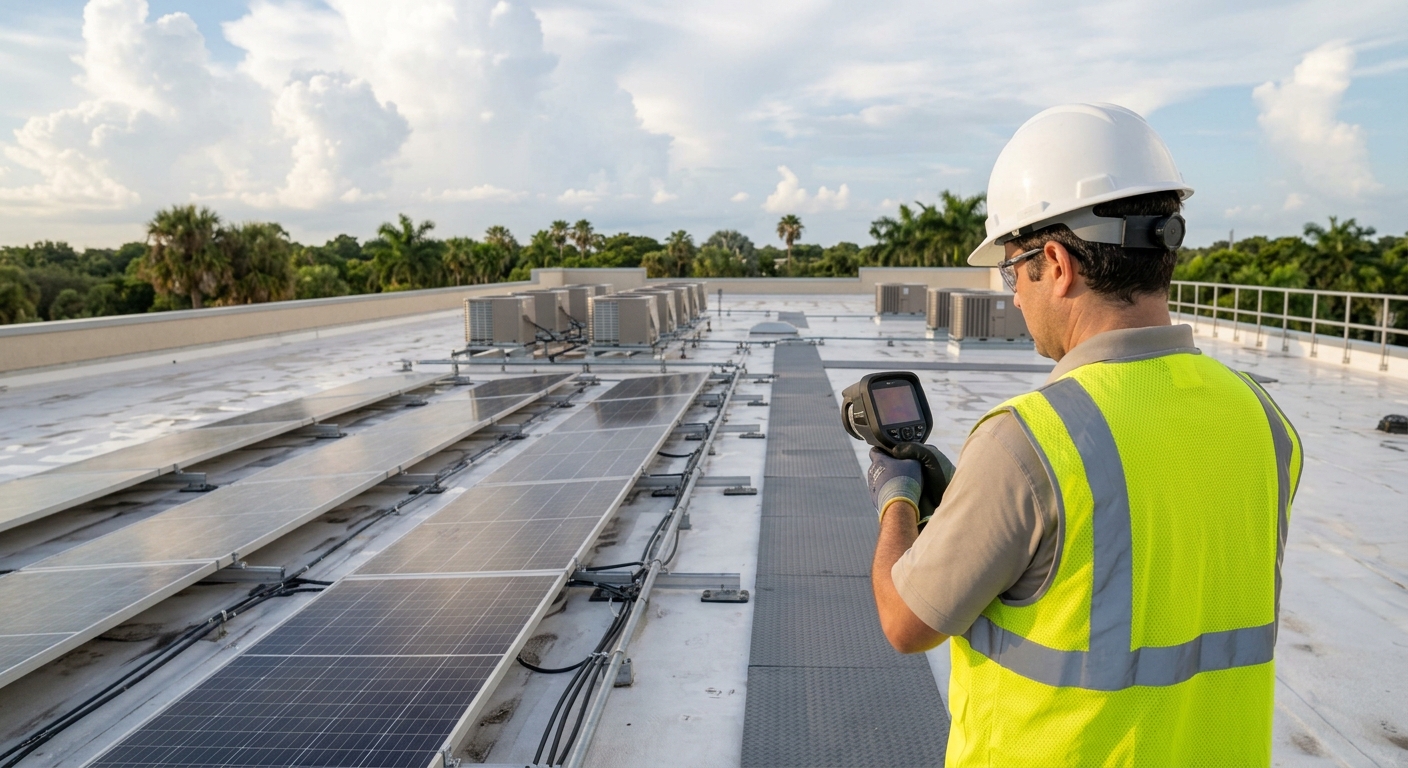
Roof condition is part of the plan. A rooftop array shares the roof’s service life, and a detach-and-reset for a later re-roof interrupts generation and credit. If the membrane has limited life left, an assessment from Advanced Roofing’s commercial re-roofing team before the proposal is final avoids a mid-life removal, and roof and drone solar surveys document conditions before design. Expanding a system later requires a new FPL application at least 30 days before the change.
Is Florida Net Metering Changing? Dates to Re-Check Before You Sign
No statute or PSC rule change scheduled as of October 28, 2026, alters net metering for investor-owned utility customers; re-check that status on the day a contract is signed, since 2027-session bills can be filed before the session convenes. FPL’s Tier 3 agreement states in section 20 that if PSC rules are modified, the agreement will be replaced with one that complies with the amended rules, so a signed agreement does not lock in today’s crediting for the life of the array.
Rates move even when the rule does not. The FPL settlement adds a base-rate increase in 2027, and the COG-1 rate is recalculated annually. Federal incentives run on separate clocks, including Section 48E construction-start and placed-in-service deadlines and the termination of Section 179D for projects beginning construction after June 30, 2026. AGT’s federal commercial funding page summarizes the programs; eligibility is a determination for the owner’s tax advisor.
Decision Checklist for a Commercial Solar Net Metering Proposal
- Facility manager: pull 12 months of bills and interval data, and confirm the utility and rate schedule on each meter.
- Solar designer: compare annual production with each meter’s annual consumption and show the expected December balance.
- Electrical engineer: confirm the service rating, the 90% limit, three-phase service at 50 kW and above, and transformer risk.
- CFO or asset manager: require the pro forma to separate energy and demand savings and value surplus at an avoided-energy rate.
- Property manager: schedule meter exchange, tie-in outage, and inspection windows with tenants.
- Risk manager: confirm liability coverage of $1 million for Tier 2 or $2 million for Tier 3 on FPL service.
- Attorney and tax advisor: review financing terms against the bar on retail electricity sales, and confirm credit eligibility.
- Roof consultant: document remaining membrane life before the layout is fixed.
Frequently Asked Questions
Does net metering reduce demand charges for commercial solar in Florida?
No. Rule 25-6.065(8)(h) and FPL’s tariff require a net metering customer to keep paying the demand charge for the maximum measured demand in each billing period, whether or not the system exported energy. Solar lowers billed demand only when the building’s peak coincides with strong production. Battery storage dispatched to the peak is the usual tool, and its value depends on the rate schedule.
How much does FPL pay for excess solar from a commercial system?
During the year FPL pays no cash; excess kilowatt-hours become a credit against later energy charges for up to 12 months. In the last billing cycle of the year, unused credit is applied at an average annual rate based on FPL’s COG-1 as-available energy tariff, which tracks FPL’s hourly avoided energy cost and changes each year.
What is the largest commercial solar system FPL will net meter?
Rule 25-6.065 covers systems up to 2 MW of AC gross power rating, calculated as DC nameplate times 0.85, and capped at 90% of the customer’s utility distribution service rating. FPL also applies a 115%-of-consumption guideline. Systems above 100 kW AC are Tier 3, with a $1,000 application fee, a possible $2,000 study, and $2 million in liability insurance.
Do Florida municipal utilities and co-ops have to offer full retail net metering?
No. Section 366.91(6), Florida Statutes, requires municipal utilities and rural electric cooperatives to offer a net metering program, and each governing authority sets its own terms. Some credit exports below retail, such as the Orlando Utilities Commission’s TruNet Solar tariff for applications on or after July 1, 2025. Model that utility’s current tariff sheet.
Can a solar lease use net metering in Florida?
Yes, within limits. Rule 25-6.065 allows a third-party purchase, lease, or maintenance contract for an on-site system if the terms do not include the retail purchase of electricity from that party, and FPL’s interconnection agreement repeats the restriction for leases. Compliance of a specific structure is a question for the owner’s attorney, and tax treatment for the tax advisor.
Will commercial net metering terms be grandfathered if Florida changes the rule?
Nothing in the current rule guarantees it. FPL’s interconnection agreement states that if the PSC amends its rules, the agreement will be replaced with one that complies with the amended rules. Protection for existing systems would depend on the text of a future statute or rule. As of October 28, 2026, no change is scheduled.
What Florida Net Metering Is Worth to a Commercial Property
Florida net metering gives commercial solar a dependable value on the energy line of the bill and none on the demand line. Under Rule 25-6.065 and FPL’s 2026 tariff, a kilowatt-hour the building would otherwise buy is worth the energy charge it displaces, and a kilowatt-hour beyond annual consumption is worth an avoided-energy price set in December. Sizing to the meter, reading the rate schedule, and separating energy savings from demand savings decide whether a proposal holds up in year five, while the tiers, the 90% service limit, and the insurance minimums set cost and timing. The rule has held since 2008; the rates behind it change every year.
Written by The Technical Team at Advanced Green Technologies. Founded in 2007, Advanced Green Technologies is 100% employee-owned and was named the #1 Commercial & Industrial EPC contractor in Florida on Solar Power World’s 2026 Top Solar Contractors list (2026 Top Solar Contractors recognition).
To review net metering, sizing, and interconnection for a specific building, request a commercial solar quote or call (888) 735-2641. Related services: rooftop solar installation, solar carports, commercial solar financing, and commercial solar operations and maintenance for existing systems.