

At a glance: Solar farm site selection in Florida turns on four tests: buildable land, grid capacity, water, and wildlife. This guide gives Lawrence Berkeley National Laboratory’s measured land densities (about 3.6 to 5.6 array acres per MW AC), compares common Florida site types, lists the studies that set cost and schedule, explains the stormwater and erosion requirements added to section 163.3205 on July 1, 2026, and closes with dated permit thresholds and a checklist by role.
Solar farm site selection in Florida is decided by four tests that have little to do with the panels: how much buildable land the parcel actually holds, how far it sits from usable grid capacity, how water moves across it in a 100-year storm, and what lives on it. A parcel that fails one of them costs months of redesign, a mitigation bill, or an interconnection upgrade larger than the land price, and since July 1, 2026, Florida law has written part of the water test into the solar statute itself. This article explains how to run those tests before a lease, option, or purchase is signed. It does not value land, predict an interconnection result, or make permit, tax, or legal determinations for any parcel.
What changed for Florida solar farm sites in 2026?
Florida’s solar facility statute changed on July 1, 2026, and the change reaches the site-selection stage. Section 163.3205, Florida Statutes already made a solar facility a permitted use in all agricultural land use categories and agricultural zoning districts in unincorporated areas, subject to the setback and landscaped buffer criteria for similar agricultural uses, and it lets counties adopt buffer and landscaping ordinances no stricter than those for comparable permitted uses. CS/CS/CS/HB 1417, approved by the Governor on March 19, 2026 and filed as Chapter 2026-2, added construction requirements to the same section.
Under the amended statute, an applicant for the state stormwater permit for a solar facility must build an erosion and sediment control plan that includes soil percolation testing on the site, construction-phase stormwater and erosion controls sized for rainfall up to the 100-year, 24-hour design storm, and clearing and stabilization in phases. A certified Florida Stormwater, Erosion, and Sedimentation Control Inspector must inspect the work during construction. Inside the Northwest Florida Water Management District, the permanent stormwater system serving a new solar facility must also be designed to the 100-year, 24-hour storm for applications filed after July 1, 2026.
These rules make soils, drainage, and slope part of the land decision, because a parcel with poor percolation carries a larger erosion-control cost before a pile is driven. Under IRS Notice 2025-42, a solar facility that begins construction after July 4, 2026 must be placed in service by December 31, 2027 to remain eligible for the Section 48E or 45Y credits, and the physical work test is now the main way to show that construction began. Whether any project qualifies is a question for the owner’s tax advisor; our post on the commercial solar tax credit deadline covers the dates in more detail.
How much land does a solar farm need, and what makes land suitable?
A utility-scale solar farm in the United States needs roughly 3.6 to 5.6 acres of array area per megawatt of AC capacity, based on median 2019 densities measured by Lawrence Berkeley National Laboratory. LBNL’s 2022 study of land requirements for utility-scale PV traced satellite images of 736 plants built from 2007 to 2019 and found median power densities of 0.35 MWdc per acre for fixed-tilt plants and 0.24 MWdc per acre for single-axis tracking plants. Those figures cover the array and nearby equipment pads only; the acreage below is inverted from the AC medians and rounded up.
| Mount type | Median power density (DC) | Median power density (AC) | Array acres per MW AC | Source and date |
|---|---|---|---|---|
| Fixed-tilt | 0.35 MWdc per acre | 0.28 MWac per acre | About 3.6 acres | LBNL, IEEE Journal of Photovoltaics, 2022 (2019 medians) |
| Single-axis tracking | 0.24 MWdc per acre | 0.18 MWac per acre | About 5.6 acres | LBNL, IEEE Journal of Photovoltaics, 2022 (2019 medians) |
| Total parcel | Not measured | Not measured | Larger than the array; set by the buildable share | LBNL example: 945-acre array on a 1,375-acre leasehold (69%) |
The parcel always needs more land than the array. In LBNL’s Copper Mountain 3 example, the array covers 69% of the leasehold, and the study recommends derating its densities by each site’s buildable share. On a Florida parcel, wetlands, flood-prone ground, setbacks, buffers, stormwater ponds, access roads, and gopher tortoise habitat all reduce that share. The study also notes that its sample predates wide use of bifacial and larger-format modules, which can change density on newer plants.
Suitable land for a Florida solar farm combines five physical traits: large, contiguous, flat or gently sloped ground; no shading from tree lines or structures across the array area; soils that accept driven or screwed piles and drain well; ground that stays above seasonal high water; and a short, buildable route to a substation or transmission line with capacity to spare. The City of Lake Worth Solar Farm, which Advanced Green Technologies built as EPC contractor and completed in December 2016, put 2 MW on a five-acre former landfill, a constrained site that worked because its limits were designed around from the start.
Which Florida sites make the strongest solar farm candidates?
The strongest Florida candidates are parcels already cleared and drained for another use, close to existing electrical infrastructure, and controlled by an owner who intends to keep them out of other development for the life of the array. Each common site type carries a weakness that site selection has to test.
| Site type | Why it attracts a solar farm | Where it falls short | Who confirms |
|---|---|---|---|
| Improved pasture or row-crop land | Cleared, often flat, and a permitted use in unincorporated agricultural zoning under s. 163.3205 | Drainage ditches, seasonal high water, and wetlands inside the fence line; neighbors and buffer requirements | Civil engineer, environmental consultant, county planning |
| Former citrus grove | Cleared, large contiguous tracts, often on better-drained ground | Old irrigation lines, stumps and debris, and possible agricultural chemical residue to investigate | Environmental consultant (Phase I assessment), civil engineer |
| Closed landfill or brownfield | Few competing uses; often publicly owned | Cap protection can limit pile depth and foundation type; settlement; environmental permit conditions | Geotechnical engineer, FDEP, site owner |
| Land next to the owner’s facility (behind the meter) | Offsets on-site load with a short electrical path | Florida PSC Rule 25-6.065 covers customer-owned systems up to 2 MW; larger arrays need another interconnection path | Electrical engineer, utility |
| Retention or stormwater pond | Uses water surface instead of buildable land | Depth, anchoring, and the pond’s permitted stormwater function must be preserved | Civil engineer, water management district |
Land that is wooded, sloped, or mapped as wetland is not automatically excluded. It moves cost into clearing, grading, mitigation, and permitting. For pond sites, AGT’s floating solar systems page describes the system type. For parcels beside a facility that also needs backup power, battery storage solutions change the electrical layout and belong in the discussion before the layout is fixed. Owners comparing open land with existing parking can use our solar carport site assessment guide for the lot-side tests.
What drives the cost and schedule of a Florida solar farm site?
Site cost and schedule are set by a short list of variables, each answered by a specific study or agency record.
| Driver | How it moves budget and schedule | Where the answer comes from |
|---|---|---|
| Distance to usable grid capacity | Gen-tie length, substation work, and network upgrades assigned in interconnection studies | The interconnecting utility; FERC Order No. 2023 cluster process for FERC-jurisdictional transmission providers |
| Soils and pile embedment | Pile length, refusal, corrosion allowance, and the percolation results the erosion plan needs | Geotechnical borings and pile load tests; USDA Web Soil Survey for screening |
| Karst and subsidence | Foundation redesign or exclusion zones | Geotechnical investigation; Florida Geological Survey records |
| Flood zone and seasonal high water | Equipment elevation, fill, and road and pad design | FEMA Flood Map Service Center; local floodplain administrator |
| Wetlands and surface waters | Avoidance, Environmental Resource Permit conditions, a possible federal Section 404 permit, and mitigation | Environmental consultant; FDEP or water management district; U.S. Army Corps of Engineers |
| Listed and protected species | Survey windows, relocation permits, and the clearing schedule | FWC for gopher tortoises; U.S. Fish and Wildlife Service where federally listed species occur |
| Parcel shape and buildable share | Layout efficiency and fence length | Boundary survey and layout model, derated from LBNL array densities |
| Construction stormwater | Phased clearing, sediment controls sized to the 100-year, 24-hour storm, certified inspections | s. 163.3205(5), Florida Statutes, as amended July 1, 2026 |
Interconnection usually decides the schedule. FERC’s Order No. 2023 interconnection rule requires transmission providers under its jurisdiction to study requests in clusters, with a 150-day cluster study followed by a facilities study before an interconnection agreement, and it adds readiness requirements for projects that enter. Municipal utilities and cooperatives run their own procedures, so the first call on any site goes to the utility that owns the nearest lines.
Three free public records narrow the field before fieldwork starts: the FEMA Flood Map Service Center for effective flood zones, USDA’s Web Soil Survey for mapped soil units, and the Florida Geological Survey’s sinkhole and karst resources, which explain how Florida’s porous limestone dissolves and leaves voids that overlying sediment can collapse into. None replaces borings or a wetland delineation, and each tells the owner which field study to prioritize.
What changes when the land is still in use?
Most Florida solar farm parcels are working land when the option is signed, with cattle or hunting leases, hay cutting, or a municipal operation next door. The site plan has to account for operations that stay on or beside the land. Cattle need fenced separation from laydown yards and trenches, neighbors see months of delivery traffic, and the county’s buffer and landscaping ordinance under s. 163.3205(4) sets what the perimeter must look like when the fence goes up.
Florida’s calendar shapes the sequence. Hurricane season runs from June 1 through November 30 and overlaps the summer rainy season, when low pasture holds water and construction stormwater controls are tested hardest. The statute’s phased-clearing requirement fits that reality. The Florida Fish and Wildlife Conservation Commission’s gopher tortoise permitting guidelines require a relocation permit before land clearing or development within 25 feet of a potentially occupied burrow, and FWC asks for complete applications at least 90 days before the permit is needed. FWC exempts agricultural activities such as mowing and disking under its enforcement policy, so the owner’s environmental consultant should confirm which permit applies before any clearing for construction starts.
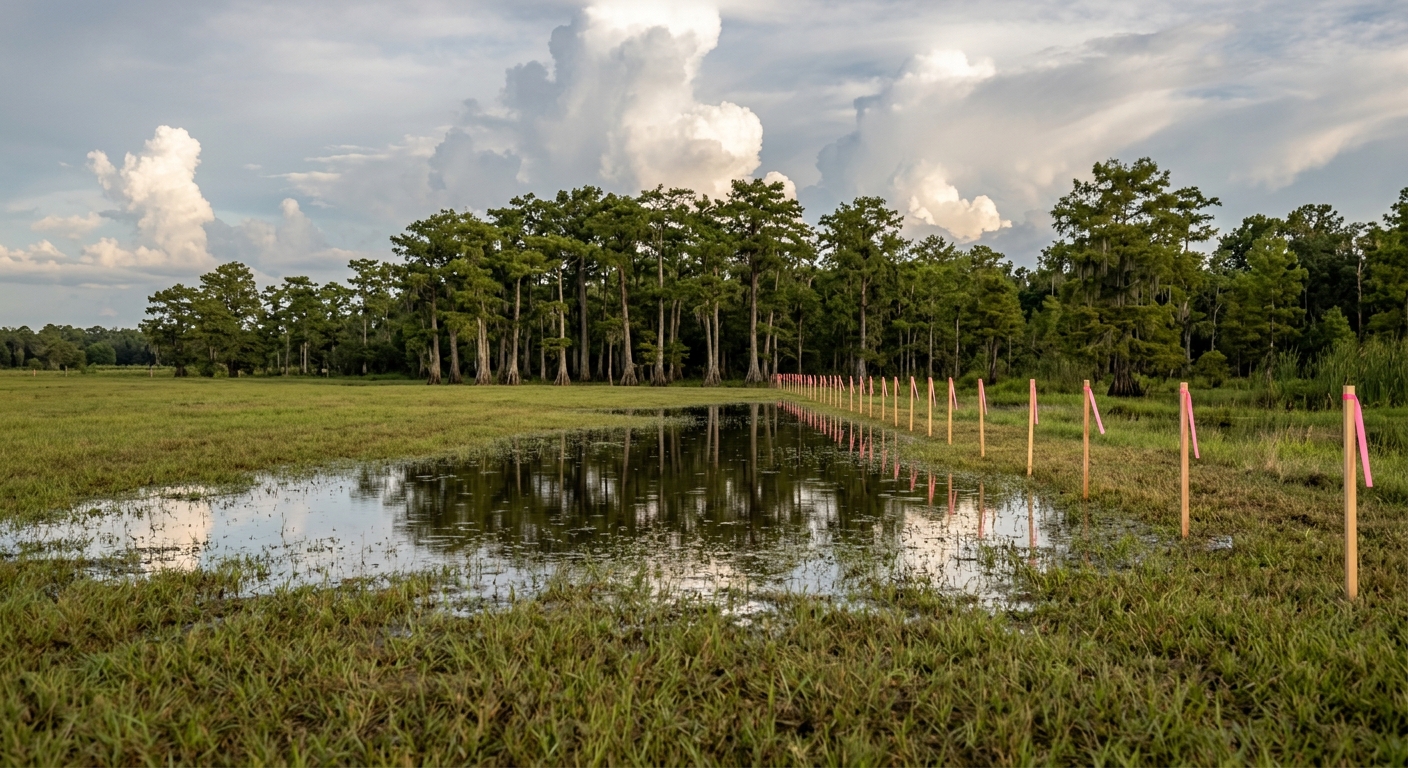
AGT’s solar drone surveys give the design team an accurate surface model of the parcel early, which helps locate low ground, drainage paths, and tree lines before the layout is fixed. Borings, pile load tests, wetland delineation, and burrow surveys still require field crews and have their own seasonal windows.
Which Florida permits and deadlines apply to a solar farm in 2026 and 2027?
As of October 15, 2026, six threshold or dated items belong in every Florida solar farm schedule. Capacity sets the first fork. Under the Power Plant Siting Act definitions in s. 403.503, a solar electrical generating facility of 75 MW or more, measured as AC capacity metered before the point of interconnection, falls under state power plant certification, which electric utilities apply for. Smaller facilities follow local and water management district permitting unless the applicant elects certification.
Inside a city or a non-agricultural district, local codes govern land use. Water permitting runs through the state Environmental Resource Permit program, processed by FDEP or one of the five water management districts. Federal Section 404 permits for filling jurisdictional wetlands are issued by the U.S. Army Corps of Engineers after a federal court vacated Florida’s assumed program in 2024; the D.C. Circuit affirmed that ruling on March 27, 2026, and federal legislation to restore the state program was still pending at last check. The Florida Building Commission has set December 31, 2026 as the effective date of the 9th Edition Florida Building Code, and the permit application date generally determines which edition governs structures and equipment pads. For behind-the-meter arrays, Florida PSC Rule 25-6.065 covers customer-owned renewable systems up to 2 MW. The building official, environmental agencies, utility, attorney, and tax advisor make the determinations for any specific parcel.
Solar farm site selection Florida checklist by role
- Owner or asset manager: State the target capacity in MW AC, the offtake path (on-site use, utility sale, or power purchase agreement), and the in-service date the project needs, then confirm the parcel can be controlled for the full term of the system.
- Real estate counsel: Confirm title, easements, access rights, and zoning, and keep the right under any option to run borings, surveys, and environmental studies before closing.
- Utility: Request available capacity at the nearest substation and lines, the interconnection procedure that applies, and study timelines before the land price is final.
- Civil engineer: Map FEMA flood zones, seasonal high water, drainage paths, and slope, and draft the erosion and sediment control approach that s. 163.3205(5) requires, including percolation testing and phased clearing.
- Geotechnical engineer: Run borings and pile load tests across representative areas, screen for karst, and report the corrosion potential of the soils.
- Environmental consultant: Delineate wetlands, run a Phase I environmental site assessment where prior uses warrant one, and complete listed-species and gopher tortoise surveys within permit windows.
- Solar designer: Build the layout from the buildable area, compare fixed-tilt and tracker density, and model production with actual shading and setbacks.
- Tax advisor: Confirm, for the chosen ownership structure, whether any federal credit remains available given the construction-start and placed-in-service dates.
Frequently Asked Questions
How many acres does a 1 MW solar farm need in Florida?
A 1 MW AC solar farm needs about 3.6 acres of array area with fixed-tilt racking or about 5.6 acres with single-axis trackers, based on Lawrence Berkeley National Laboratory’s 2019 national median densities. The total parcel needs more, because wetlands, setbacks, buffers, stormwater ponds, and access roads are not buildable. A layout drawn on the actual Florida parcel gives the real number.
Is a solar farm allowed on agricultural land in Florida?
Yes, in unincorporated areas. Section 163.3205, Florida Statutes, makes a solar facility a permitted use in all agricultural land use categories and agricultural zoning districts, subject to the setback and buffer criteria for similar agricultural uses. Counties may add buffer and landscaping requirements no stricter than those for comparable uses. Land inside a city follows that city’s code, and the planning department confirms the rules for a parcel.
How close to a substation should a solar farm be?
No fixed distance applies. What matters is whether the nearest substation or line has capacity for the project and what the interconnection study assigns in upgrades. A short line to a constrained substation can cost more than a longer line to one with room. The utility that owns the nearest facilities is the first call, before the land price is settled.
Can a solar farm be built in a flood zone in Florida?
Often, with design changes. A Special Flood Hazard Area on the FEMA map does not by itself rule out a solar farm, but it affects where inverters, transformers, and roads can go and how they are elevated, and it adds permitting review. Seasonal high water outside mapped zones matters as much on Florida pasture. The civil engineer and the local floodplain administrator set the requirements.
Does a Florida solar farm need a state power plant siting permit?
Only at 75 MW or more. Under section 403.503, Florida Statutes, the Power Plant Siting Act covers solar electrical generating facilities of 75 MW or more, measured in AC capacity, and an applicant for a smaller facility may elect certification. Projects below the threshold go through local land use approval, environmental resource permitting, and building permits. Project counsel confirms which path applies.
What does a utility-scale solar site assessment include?
A utility-scale solar site assessment combines a boundary and topographic survey, flood and drainage review, geotechnical borings and pile tests, wetland delineation, listed-species surveys, zoning and title review, and an interconnection screen with the utility. In Florida it now also includes the percolation testing and erosion-control planning required by section 163.3205 as amended in 2026. The result is a buildable-area map and a cost list.
Test the parcel before the price is final
Solar farm site selection in Florida rewards owners who treat the land as an engineering question before it becomes a real estate one. Buildable area, grid capacity, water, and wildlife decide whether a parcel can carry a solar farm on schedule, and the 2026 amendments to s. 163.3205 put soils and stormwater on that list by statute. Each test is cheaper to run before closing, and AGT’s commercial solar engineering process and solar farm installation team can run them alongside the owner’s consultants.
Written by The Technical Team at Advanced Green Technologies. Founded in 2007, Advanced Green Technologies is 100% employee-owned and was ranked the #1 commercial and industrial EPC solar contractor in Florida on Solar Power World’s 2026 Top Solar Contractors list.
Screening land for a solar farm? Request a solar farm quote or call (888) 735-2641 to talk with AGT’s design team.