

At a glance: Florida hotels and resorts can put solar on roofs, over parking, and pair it with battery storage. This article compares the three options for properties that never close: how roof service life limits rooftop arrays, what carports require in structure and parking layout, when storage lowers demand charges, how the work is sequenced around guests, and which dates apply as of November 2026, including the December 31, 2027 federal placed-in-service deadline and the December 31, 2026 Florida Building Code change.
Hotel and resort solar in Florida comes down to three placement decisions made for a property that never closes. The roof decides whether a rooftop array can stay in place for its full production life, the parking field decides whether carports fit the site and the arrival experience, and the utility tariff decides whether battery storage earns its cost. A wrong call on the roof means paying later to remove and reinstall the array, and a wrong call on schedule can leave a project past the December 31, 2027 placed-in-service date that now governs the federal solar credit. This article does not argue that every Florida hotel should install solar, and it makes no tax, tariff, insurance, or code determination for any property.
Why Are Florida Hotel Owners Revisiting Solar in Late 2026?
Florida hotel owners are revisiting solar because energy is a large, round-the-clock operating cost and because two fixed dates now shape any project that starts this winter. The ENERGY STAR program’s guidance for lodging puts energy at about 6 percent of U.S. hotel and motel operating costs and, citing the U.S. Energy Information Administration, identifies lighting and then cooling as the largest electricity uses. The U.S. Department of Energy’s Better Buildings resources on solar PV for hotels document rooftop, carport, and ground-mounted hotel arrays.
In Florida, cooling is the load that tracks the sun. Chillers, rooftop units, and guest-room PTACs work hardest in the midday and afternoon hours when an array produces. Overnight base load does not line up with solar production, which is why sizing starts from 15-minute interval data instead of annual kWh.
The first date is federal. Under the One Big Beautiful Bill Act, as explained in IRS Notice 2025-42, the clean electricity investment credit under Section 48E ends for solar facilities placed in service after December 31, 2027 when construction begins after July 4, 2026, and the notice states that planning and permitting do not count as beginning construction. A project starting now is planning against the placed-in-service date; whether a property qualifies is a question for the owner’s tax advisor.
The second date is the Florida Building Code. The 9th Edition takes effect December 31, 2026, and Miami-Dade County’s 9th Edition permitting notice states that permit applications and plans submitted on or after that date must comply with the new edition. Rooftop attachments and carport structures headed for a 2027 permit should be designed to the 9th Edition, and the engineer of record and building official confirm which edition governs.
How Do Rooftop, Carport, and Battery Systems Fit a Hotel’s Load and Site?
A rooftop array uses existing roof area, a carport creates mounting area over parking, and a battery changes when the property draws from the grid.
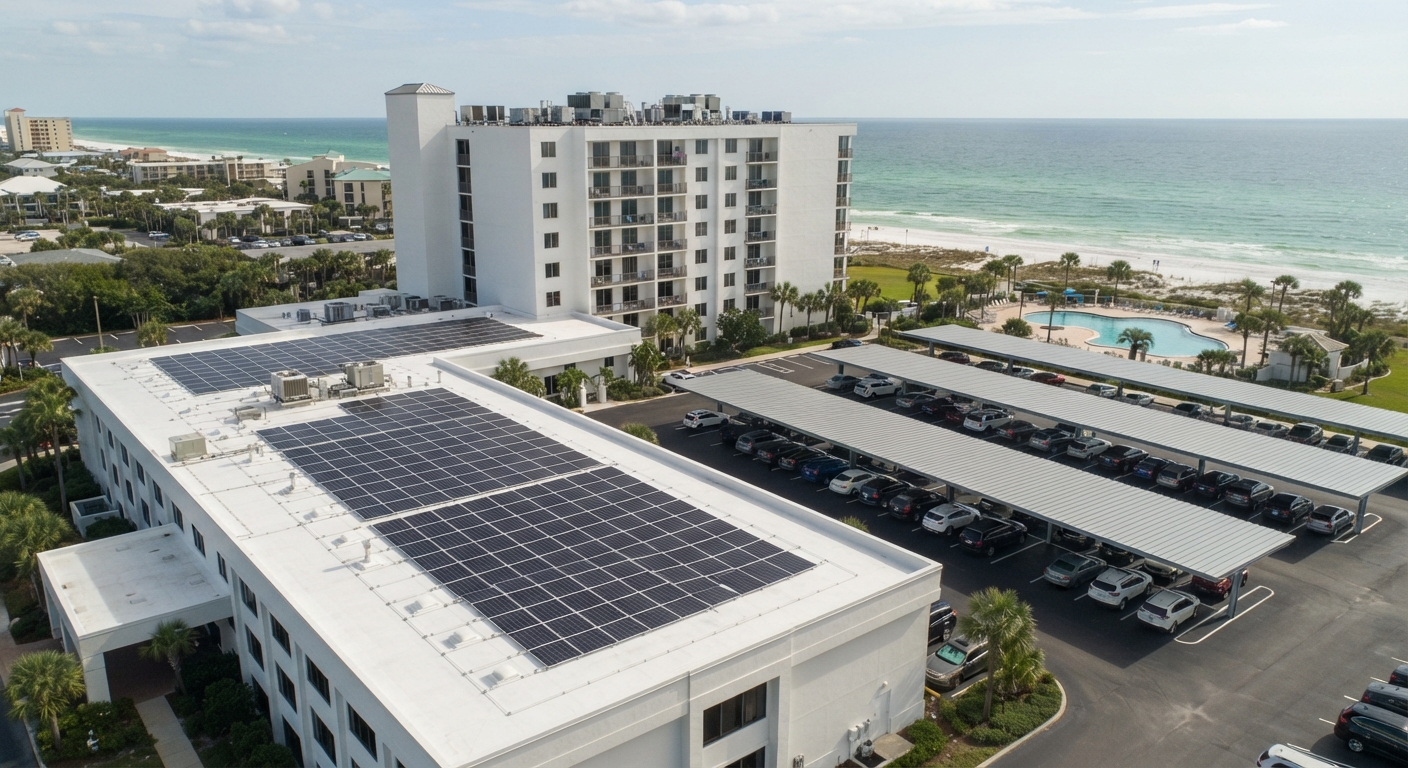
Roof area is the limiting factor on tall guest towers. A twelve-story tower has a roof that is small relative to the floor area it serves, and much of it is taken by cooling towers, rooftop units, elevator overruns, and fire-code access paths. Low-rise resort wings, conference centers, and parking garages usually offer more open low-slope roof. Before any layout, a rooftop solar installation plan needs the roof’s remaining service life, its attachment options, and its drainage pattern, because modules should not sit over drains or block the walkways maintenance crews use.
Carports turn surface parking and the top deck of a parking garage into mounting area. They require structural steel sized for the span, foundations, and column placement that keeps stalls and drive aisles usable. AGT’s solar carport page states that its carport solutions can withstand wind speeds up to 180 mph; that is a company statement, and each site’s wind design is set by the engineer of record.
Storage addresses the demand portion of the bill. As AGT’s guide to Florida net metering commercial rules explains, net metering credits exported energy and leaves the demand charge in place, and FPL bills that charge on the highest measured demand in the cycle. A hotel’s peak often lands on a late summer afternoon, when cooling is near its maximum and solar output is falling. A battery sized and programmed for that window can lower the billed peak. Outage backup for selected loads takes added switching equipment, and life-safety systems stay on their code-required emergency power.
| Placement | Typical hospitality location | What it needs | Main constraint |
|---|---|---|---|
| Rooftop, guest tower | Low-slope roof above guest floors | Roof with remaining service life that matches the array; structural review; attachments accepted for the roof system | Limited open area after mechanical equipment and fire-code access paths |
| Rooftop, low-rise buildings | Conference center, spa, laundry, and maintenance buildings | Same as above, plus an access route away from guest areas | Visibility from guest rooms above; roof age varies building to building |
| Surface-lot carport | Self-park, valet, and employee lots | Foundations, structural steel, and trenching for conduit | Column layout against stall count; underground utilities |
| Garage top-deck canopy | Uppermost level of a parking structure | Structural review of the existing deck, columns, and connection points | Capacity of the existing structure |
| Battery storage | Pad or room near the main electrical service | Fire official review under NFPA 855; UL 9540 listed equipment | Siting clearances; value depends on the tariff |
How Does Hotel and Resort Solar Compare Across Rooftop, Carport, and Storage?
For most Florida hotels and resorts, rooftop solar is the lowest-structure option when the roof has as many years left as the array. Carports add the most mounting area and visible shade over parking at a higher structural cost. Battery storage is justified only when demand charges or backup needs support it on the property’s own tariff.
A rooftop array and the roof under it share a service life. If the membrane on a resort’s conference wing has eight years left and the array is planned to produce for decades, the owner is budgeting for a remove-and-reinstall mid-life, so the roof consultant’s moisture survey belongs in the solar proposal. Advanced Green Technologies was founded in 2007 by Advanced Roofing, and where the survey shows the membrane should be replaced first, Advanced Roofing’s commercial re-roofing team can complete the roof before the array goes on.
Carports carry more steel and concrete per kilowatt than a rooftop array, and that shows up in the price. The owner gets mounting area independent of the roof, shade for guest and employee vehicles, and a direct path to add commercial EV charging stations, which AGT supplies through a ChargePoint partnership. Carports are also the most visible option, which cuts both ways where the arrival drive is part of the brand.
Storage is the option most often oversold. A battery generates no energy, and its savings depend on how the utility bills demand, how often the property sets a new peak, and how the controls are programmed. On a tariff with low demand charges or irregular peaks, the battery may not cover its cost. AGT’s commercial battery storage page and its guide to battery storage permitting in Florida cover fire-code siting.
| Option | Best fit | Guest-facing effect | Where it falls short |
|---|---|---|---|
| Rooftop solar | Roofs whose remaining service life matches the array; low-rise wings, garages, back-of-house | Mostly out of sight; visible from upper floors when it sits on a lower roof | Shares the roof’s service life; little open area on towers; adds penetrations and loads that must be coordinated with the roof warranty |
| Solar carport | Surface lots and garage top decks with room for columns and foundations | Shaded parking and a visible sustainability feature | Higher structural cost per kW; construction takes stalls out of service in phases; underground utilities can move columns |
| Battery storage | Properties with demand charges, repeatable peaks, or defined backup needs | None day to day; felt only during an outage it is designed to cover | Generates no energy; value depends on the tariff; fire-code siting limits where it can go |
| Combination | Resorts with mixed building heights and large parking fields | Depends on the mix | More design and interconnection scope; each element still has to justify itself |
What Drives Cost, Schedule, and Output on a Hotel Solar Project?
Advanced Green Technologies does not publish pricing, and no cost figure in this article is a quote. The variables below move a hospitality project’s budget, schedule, and production, and each one should appear as a stated assumption in any proposal the owner receives. Lawrence Berkeley National Laboratory’s August 2026 Tracking the Sun data update reports installed prices as the up-front price paid before any incentives and describes non-residential prices as essentially flat from 2024 to 2025. National medians do not price a Florida hotel, where wind design, salt-air hardware, foundations, and occupied-site sequencing change the scope.
| Driver | Effect on the project | Source and date |
|---|---|---|
| System size and interconnection tier | Customer-owned renewable systems up to 2 MW qualify for expedited interconnection and net metering; larger tiers carry higher insurance and study requirements | Florida PSC Rule 25-6.065, F.A.C., last amended April 7, 2008, and the utility’s interconnection agreement |
| Roof condition | A roof that needs replacement within the array’s life adds a remove-and-reinstall cost later | Roof consultant report for the specific roof |
| Structure | Carports add foundations and steel; rooftop arrays add attachment and load review | Engineer of record, under the Florida Building Code edition that governs the permit |
| Demand charges | Determine whether storage and peak-hour production reduce the bill | Utility tariff in effect on the proposal date |
| Florida sales tax | Solar energy systems and their components are exempt from sales and use tax | Florida Department of Revenue TIP 19A01-09, issued August 9, 2019 |
| Florida property tax | For nonresidential property, 80 percent of the just value attributable to a renewable energy source device is not considered in assessment | Section 193.624, Florida Statutes (2025) |
| Federal credit timing | Solar placed in service after December 31, 2027 is excluded when construction began after July 4, 2026 | IRS Notice 2025-42; the owner’s tax advisor |
The state tax rows trace to Florida Department of Revenue Tax Information Publication 19A01-09 and Section 193.624, Florida Statutes, which the property appraiser and tax advisor apply; interconnection tiers come from Florida PSC Rule 25-6.065, F.A.C. and the utility’s interconnection agreement. A production estimate should name its weather data and its losses for shading from towers and palms and for soiling near the beach.
What Changes When Solar Is Installed at an Open Hotel or Resort?
A hotel is an occupied building every hour of every day, and the installation plan is built around the guests. Laydown areas and crane picks are placed away from the arrival drive, the pool deck, and guest-room windows, with crane lifts in early-morning windows the general manager approves. Roof access runs through service corridors, away from guest floors.
Carport construction is phased by parking zone. Foundation drilling and steel erection close one block of stalls at a time, valet and self-park routes change before each phase, and the front desk gets the schedule. Loud work is held to agreed daytime hours and moves around weddings, conferences, and peak check-in days.
The electrical tie-in is the one step that touches the whole property. Connecting a new system to the main switchgear can require a planned outage, which the director of engineering schedules for the lowest-occupancy window, with temporary power where the property requires it and written notice to every department. Daily cleanup, photo progress reports, and one point of contact keep the work visible.
Florida’s wind and coastal exposure shape the design. FEMA’s recovery advisory on rooftop solar panel attachment, written after Hurricanes Irma and Maria, recommends attachment, installation, and maintenance practices to improve wind resistance. The DOE Federal Energy Management Program guidance on severe-weather PV design recommends through-bolting modules to racking, locking fasteners on critical joints, and roof attachments that connect to the building structure. In Miami-Dade and Broward, High-Velocity Hurricane Zone product approval applies, and beachfront sites need hardware chosen for salt air. No array is immune to storm damage. Arrays are designed to rated pressures, storms can exceed them, and warranties carry wind-speed limits and exclusions.
Which Code, Credit, and Tariff Dates Apply to Florida Hotel Solar?
As of November 18, 2026, these rules shape a hospitality solar schedule; re-check each when a proposal is signed.
- Federal credit: the December 31, 2027 placed-in-service date above, plus foreign-entity-of-concern restrictions in the same law. The tax advisor decides eligibility.
- Florida Building Code: 9th Edition effective December 31, 2026; the permit application date generally governs.
- Interconnection: Rule 25-6.065 was last amended April 7, 2008; AGT’s overview of commercial solar interconnection in Florida covers common delays.
- Battery storage: NFPA 855 covers the installation of stationary energy storage systems, and the local fire official reviews siting and listing.
Hotel Solar Decision Checklist for Owners and Asset Managers
Each item is assignable to a named role, and the completed list is what an asset manager forwards to ownership, a franchisor, or a lender.
- Director of engineering: pull 12 months of utility bills and 15-minute interval data, and mark the dates and times of the highest demand peaks.
- Roof consultant: core and moisture-survey each candidate roof and state its remaining service life against the planned array life.
- Structural engineer: confirm roof capacity and carport or canopy foundation design under the governing code edition.
- Asset manager: confirm parking counts, brand or franchise approvals, and any lender consent.
- Tax advisor: confirm whether the project can be placed in service by December 31, 2027 and how a paired battery is treated.
- Utility representative: confirm the interconnection tier, service rating, and applicable tariff.
- Insurance broker: ask how the carrier treats an added rooftop array or carport.
- Fire official: review battery siting, clearances, and listing before equipment is ordered.
- General manager: approve work windows, crane days, and guest communication around the event calendar.
A commercial solar feasibility study should produce most of these inputs before a contract price is set.
Frequently Asked Questions
Can a Florida hotel run entirely on solar?
Rarely on its own site. A full-service hotel uses power around the clock, and the roof area on a guest tower is small relative to the load beneath it. Carports and low-rise roofs add area, but most properties offset a share of their consumption, and net metering leaves the demand charge in place. A proposal should state what share of annual use it covers and on what assumptions.
Do solar carports reduce the number of parking spaces at a hotel?
A carport designed for the lot keeps the stall count. Columns are placed along stall lines and islands so that spaces and drive aisles stay usable, and canopy height is set for the vehicles the property serves. During construction, carports do take stalls out of service one zone at a time, so the phasing plan has to work with valet and self-park operations.
Will rooftop solar affect my hotel’s roof warranty?
It can. Attachments add penetrations and loads to the roof system, and roof manufacturers set conditions for work on warranted roofs. The array design should use attachments the roof manufacturer accepts, and the manufacturer or warranty holder should review the plan before installation. If the roof is near the end of its service life, replacing it before the array goes on avoids a remove-and-reinstall later.
Does battery storage make sense for a Florida resort?
It depends on the tariff and the load profile. A battery can lower demand charges when the property sets predictable peaks, and it can carry selected loads in an outage when designed to. Where demand charges are low or peaks are irregular, the savings may not cover the cost. An interval-data analysis shows which case applies before equipment is specified.
What is the federal tax credit deadline for a hotel solar project?
For solar projects that begin construction after July 4, 2026, IRS Notice 2025-42 describes the Section 48E credit as ending for facilities placed in service after December 31, 2027. A hotel project starting now is planning against that date. Eligibility and the foreign-entity-of-concern restrictions are determinations for the owner’s tax advisor, and the guidance should be re-checked at contract signing.
How long does a hotel solar installation take?
Schedules depend on system size, permitting, interconnection, equipment lead times, and the property’s work windows. Engineering, permitting, and interconnection often take longer than field installation, and carports add foundation work. AGT’s commercial solar installation timeline article walks through each phase from contract to power-on. On an occupied hotel, the schedule is built around the event calendar and occupancy.
Choosing the Right Solar Mix for a Florida Hospitality Property
A Florida hotel or resort chooses among rooftop, carport, and storage options by matching each one to a site condition: roof life for rooftop arrays, parking layout and structure for carports, and the demand charge for storage. The 2027 placed-in-service date and the 2026 code change make schedule part of that decision. Owners who settle roof condition, tariff, and guest operations before the layout is drawn can defend the project to ownership. Solar Power World ranked Advanced Green Technologies the #1 commercial and industrial EPC contractor in Florida and #3 overall on its 2026 Top Solar Contractors list, as documented in AGT’s 2026 Top Solar Contractors ranking announcement.
Written by The Technical Team at Advanced Green Technologies. Founded in 2007 by Advanced Roofing, Advanced Green Technologies is 100% employee-owned and has installed more than 380 megawatts of solar for Florida clients.
To evaluate rooftop, carport, or storage options for a Florida hotel or resort, request a free quote or call (888) 735-2641.