

At a glance: Commercial battery storage permitting in Florida is decided mainly by the local fire official applying the Florida Fire Prevention Code, NFPA 1 Chapter 52, and NFPA 855. This guide explains how lithium-ion battery fires develop, how the installation location shapes the permit path, which documents reviewers expect (UL 9540 listing, UL 9540A data, hazard mitigation analysis, emergency response plan), what changes when Florida’s building and fire codes move to new editions on December 31, 2026, and who owns each step.
Commercial battery storage permitting Florida owners face in late 2026 is a fire safety review first and an electrical review second. A lithium-ion battery energy storage system (BESS) is approved when the local fire official accepts how a failure in one cell will be detected, contained, and handed to responders, and that review runs through the Florida Fire Prevention Code, NFPA 855, and the test data behind the equipment. Getting the sequence wrong costs a redesign after plan review, a submittal that lands on the wrong side of the December 31, 2026 code change, or an approved system the property insurer will not accept. This article does not size batteries or evaluate tariffs and tax treatment; it covers what fire and building reviewers ask for and who answers each question.
What governs commercial battery storage permitting Florida projects today?
In Florida, a commercial battery energy storage system is permitted through the local building department and reviewed by the local fire official. The fire review applies the Florida Fire Prevention Code, which adopts NFPA 1, and Chapter 52 of NFPA 1 carries NFPA 855 requirements for listing, spacing, detection, suppression, explosion control, and emergency planning.
Under section 633.202 of the Florida Statutes, the State Fire Marshal adopts a new edition of the Florida Fire Prevention Code every third year, built on the current edition of NFPA 1, and local fire officials enforce it. Local governments may add amendments, and the statute requires that any local amendment strengthen the code’s requirements. Two buildings with identical battery systems can therefore receive different comments in two counties, so the first step is a pre-application meeting with the reviewing fire marshal.
The edition matters because Florida is mid-transition. The State Fire Marshal’s Florida-specific amendments to NFPA 1 (2024 edition) carry an effective date of December 31, 2026, for the 9th Edition of the Florida Fire Prevention Code, and the June 15, 2026 posting of those amendments lists no Florida-specific changes to Chapter 52. NFPA’s ballot record for the 2024 edition of NFPA 1 shows Chapter 52 extracting from the 2023 edition of NFPA 855. NFPA has since published a 2026 edition of NFPA 855, which a summary by fire protection engineers at Telgian Engineering & Consulting describes as a substantial tightening of testing and hazard analysis. Florida’s adopted codes do not reference that edition yet.
| Code or standard | What it governs for a commercial BESS | Florida status as of Oct. 21, 2026 |
|---|---|---|
| Florida Fire Prevention Code (NFPA 1, Chapter 52) | Fire official’s review: location, separation, detection, suppression, emergency planning | 8th Edition in force; 9th Edition (NFPA 1, 2024) effective Dec. 31, 2026 (State Fire Marshal) |
| NFPA 855 | Installation standard extracted into NFPA 1 Chapter 52 | NFPA 1 (2024) extracts the 2023 edition (NFPA); 2026 edition published, not yet referenced |
| Florida Building Code (Building, Existing Building) | Structure, anchorage, wind loads, occupancy separation, HVHZ product approval | 8th Edition in force; 9th Edition effective Dec. 31, 2026 (Florida Building Commission) |
| National Electrical Code (NFPA 70), Article 706 | Electrical design of the energy storage system: disconnects, protection, wiring | 2023 NEC selected as the model for the 9th Edition FBC (Florida Building Commission) |
| UL 9540 | Listing of the complete energy storage system and equipment | Named in NFPA 855 equipment requirements (Sandia codes inventory) |
| UL 9540A | Test method for thermal runaway fire propagation; data behind spacing and protection | Cited in NFPA 855; 2026 NFPA 855 emphasizes large-scale fire testing (UL Solutions) |
How does a lithium-ion battery fire start and spread?
Thermal runaway is a self-heating reaction inside a battery cell that drives temperature and internal pressure up faster than the cell can shed heat. UL Solutions describes the hazards that follow as the release of flammable gas, ignition or deflagration, fire spread between modules and units, and re-ignition. Each hazard has a matching control in the code.
A single failed cell vents gas before it burns. If the module design lets heat reach neighboring cells, the event propagates through the module, then the unit, then potentially to the next enclosure or to the building. Gas that accumulates in a closed room or cabinet can ignite as a deflagration, which is a pressure event as well as a fire. After the flames are out, damaged cells can still hold energy and reignite, so planning extends to monitoring and removal of the damaged equipment.
UL 9540A is the test method that measures this sequence. It forces thermal runaway in a cell and records the results at the module, unit, and installation levels, and that data feeds the spacing, detection, and suppression decisions in the permit set. UL Solutions states that UL 9540A is the only consensus standard NFPA 855 cites explicitly for large-scale fire testing. The listing standard for the complete system is UL 9540, which Sandia National Laboratories’ energy storage safety program lists alongside NFPA 855 and NFPA 70 as core references for energy storage safety.
| Failure stage | What happens physically | Control a reviewer looks for |
|---|---|---|
| Cell thermal runaway | Self-heating reaction; cell vents flammable gas | UL 9540 listing; battery management system; UL 9540A cell and module data |
| Propagation | Heat moves cell to cell, module to module, unit to unit | Unit spacing supported by UL 9540A or large-scale fire test results |
| Gas accumulation | Vent gas collects in an enclosure or room | Explosion control (deflagration venting or prevention) and gas detection |
| Fire spread | Fire reaches adjacent units, combustibles, or the building | Separation, rated construction, detection, automatic fire control |
| After the event | Damaged cells hold energy and can reignite | Emergency response plan covering shutdown, monitoring, and removal |
Rooftop, ground pad, or indoor room: where should the battery go?
The installation location shapes the permit path more than any other single decision, because it determines what separates the battery from people, exits, and the rest of the building. Each option below can be permitted, and each has limits an owner should hear before the design is drawn.
| Location | How the fire review usually treats it | Where it falls short |
|---|---|---|
| Outdoor enclosure on a dedicated pad | Separation by distance; factory-built enclosure with test data for that configuration | Needs site area, vehicle protection, flood-elevation review, and wind anchorage |
| Dedicated indoor room | Rated separation, detection, ventilation or explosion control, firefighter access path | Brings the hazard inside the building envelope; costs usable floor area and construction |
| Rooftop of an occupied building | Case-by-case review; structural, access, and exposure questions to the floors below | Adds load and roof penetrations; hardest firefighting access; roof condition governs |
| Inside an existing electrical or mechanical room | Mixed-use space with other equipment and combustibles | Rarely the right answer for a commercial-scale system; separation is hard to achieve |
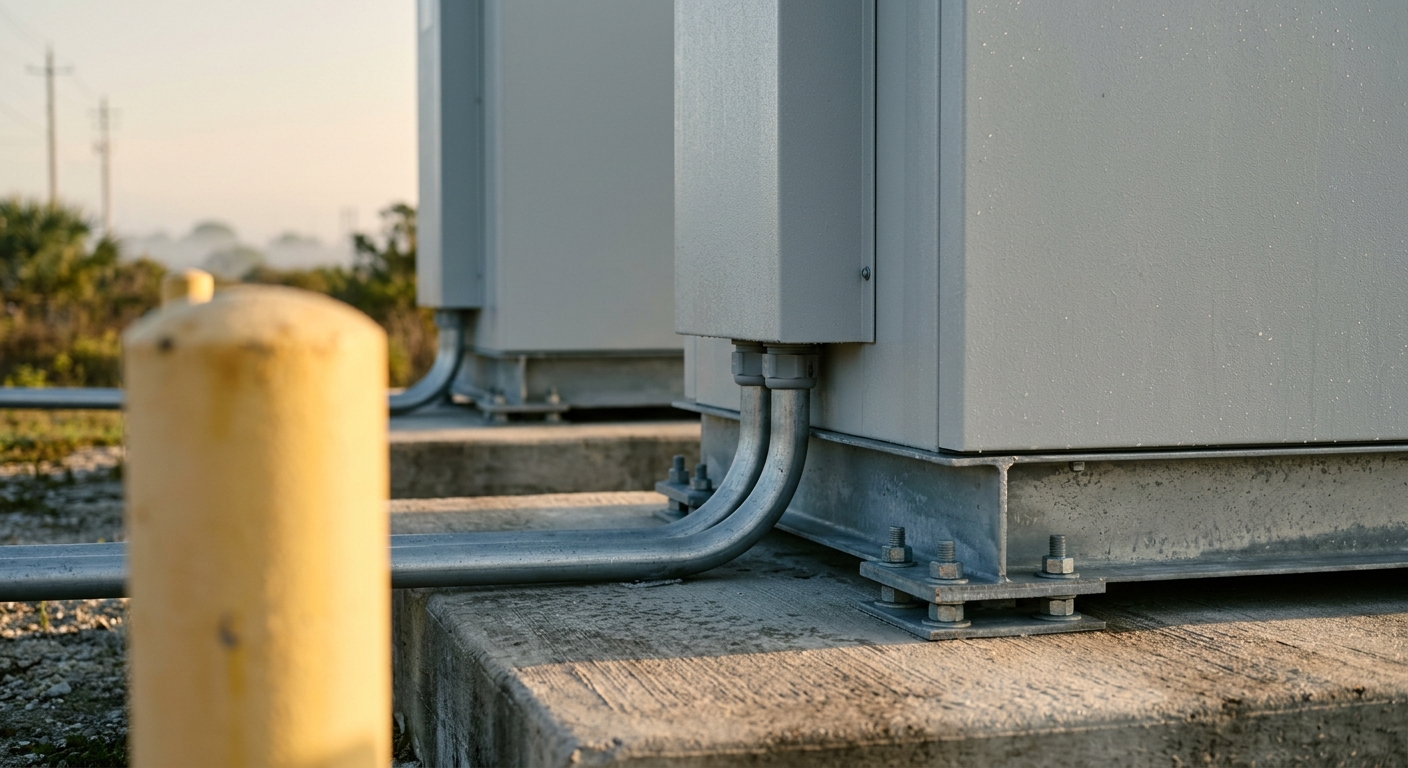
On most Florida commercial sites with open land, an outdoor, factory-built enclosure on a dedicated pad gives the fire official the simplest review, because distance provides the separation instead of rated construction inside an occupied building. The trade-off is site area, vehicle protection, flood elevation, and wind anchorage, each of which the engineer of record must resolve. An indoor room keeps the equipment out of the weather but places the battery inside the building envelope, where the fire official will expect rated separation, detection, ventilation or explosion control, and a clear path for firefighters. A rooftop placement on an occupied building carries the most open questions for a fire reviewer.
None of these locations makes a battery system immune to fire. Listing, testing, spacing, and suppression reduce the probability and the consequence of a failure; they do not remove it, and the emergency response plan exists because the code assumes an event can happen. Storage also does not pay back on every utility tariff, so the location decision should follow a confirmed business case.
What drives the permit timeline and fire protection scope?
The permit schedule for a commercial BESS is driven by how many engineering questions the fire official must see answered before approval. Telgian’s summary reports that the 2026 edition of NFPA 855 makes a hazard mitigation analysis the default for most battery installations, with exceptions for lead-acid and aqueous nickel-based systems, and removes the maximum stored energy table that previously let smaller systems avoid one. The same summary reports that the 2026 edition requires large-scale fire testing alongside UL 9540A and an emergency response plan developed with the fire official, reviewed annually, with annual refresher training.
No Florida-specific source found for this article published permit fees, review durations, or fire protection costs for commercial battery systems on a reliable basis, so the table lists drivers instead of figures. Ask bidders to price each driver as a separate line.
| Driver | Why it moves schedule or scope | Basis |
|---|---|---|
| Hazard mitigation analysis | Engineering study by a registered design professional before approval | NFPA 855 (2026) per Telgian, Oct. 2025 |
| Test data for the exact configuration | Missing installation-level or large-scale data stalls review | UL Solutions UL 9540A page, accessed Oct. 21, 2026 |
| Explosion control design | Venting or prevention design and its evaluation for enclosed spaces | UL Solutions (NFPA 68 and 69 assessments) |
| Detection and fire alarm integration | New devices tied to the building’s existing alarm system | NFPA 855 (2026) per Telgian |
| Emergency response plan | Developed with the fire official; annual review and training | NFPA 855 (2026) per Telgian |
| Code edition at submittal | A design drawn to the 8th Edition may need revision after Dec. 31, 2026 | Miami-Dade County notice; Florida Building Commission |
What changes when the battery serves an occupied Florida building?
On an occupied building, the battery project is scheduled around the people inside it. Tying a battery system into the building’s switchgear usually requires a planned electrical shutdown, and connecting new detection to an existing fire alarm system requires coordination with the alarm contractor of record and may require a fire watch during the cutover, as the fire official directs. Each window is noticed to the property manager in writing before it starts.
Florida adds site conditions that reviewers in many other states see less often. Outdoor enclosures and their anchorage fall under the Florida Building Code’s wind provisions, and in Miami-Dade and Broward counties the High-Velocity Hurricane Zone sections and product approval requirements apply. Flood zones affect where electrical equipment can sit, which is a determination for the engineer of record and the local floodplain administrator. Heat, humidity, and coastal salt air add load on thermal management and exposed hardware.
The emergency response plan is where occupied-building planning meets the fire code. The plan names who shuts the system down, how responders find the battery and its disconnects, and how a damaged system is made safe and removed after an event. After a hurricane, an enclosure that has taken water or impact damage is treated as damaged equipment until a qualified person inspects it; AGT’s commercial solar hurricane preparedness guide covers the related checks for the solar side of a site, and AGT’s safety program governs crew conduct around energized equipment.
Advanced Green Technologies’ published turnkey storage scope includes system engineering, permitting, installation, monitoring, and maintenance, and its battery storage solutions cover commercial, industrial, and community systems; the page on commercial battery storage in Miami covers the South Florida resilience case. Where a rooftop location is considered, roof condition belongs in the decision, and sister company Advanced Roofing performs that roof work in-house.
What should owners do before the December 31, 2026 code change?
As of October 21, 2026, both of Florida’s code families change editions on the same date. The Florida Building Commission’s October 2026 workplan lists December 31, 2026, as the effective date for the 9th Edition Florida Building Code and records the Commission’s selection of the 2024 International Codes and the 2023 National Electrical Code as its model codes, and the 9th Edition Florida Fire Prevention Code takes effect the same day.
Which edition governs a project generally depends on the date the permit application is submitted. Miami-Dade County’s permitting notice states that applications and plans submitted on or after December 31, 2026, must comply with the new edition, and that online submittals after 4 p.m. on December 30, 2026, fall under it. Other jurisdictions set their own cutoffs. An owner with a battery design near completion should ask the building official and the fire marshal which edition will apply, and should plan for revisions if a design drawn to the 8th Edition is submitted after the change.
Utility interconnection and tax treatment fall outside this article. Interconnection questions go to the utility and the project engineer, and AGT’s guide to commercial solar interconnection in Florida covers the common delays. Credit and depreciation questions go to the owner’s tax advisor.
Commercial battery installation code checklist: who owns each step?
Each item is assignable to one role, so the list can serve as the project’s responsibility matrix.
- Owner or facility director: Hold a pre-application meeting with the local fire marshal and building official, and confirm in writing which code editions will govern the review.
- Insurer or risk manager: Confirm whether the property carrier applies its own guidance, such as FM Global Data Sheet 5-33 for lithium-ion systems, before the location is fixed.
- Fire protection engineer (registered design professional): Prepare the hazard mitigation analysis where required and define detection, automatic fire control, and explosion control.
- Battery supplier: Provide the UL 9540 listing and the complete UL 9540A report, including installation-level or large-scale fire test data for the configuration proposed.
- Electrical engineer of record: Design to NFPA 70 Article 706 and place disconnects where the emergency response plan says responders will look for them; AGT’s engineering process shows how design and permitting are sequenced.
- Structural engineer: Confirm pad, roof, or floor capacity and wind anchorage under the Florida Building Code, including HVHZ product approval in Miami-Dade and Broward.
- Fire alarm contractor and property manager: Schedule the alarm tie-in, any fire watch, and written tenant notices for every shutdown window.
- Owner and installer: Draft the emergency response plan with the fire official, schedule responder training, and budget the annual review under an operations and maintenance program.
Owners still deciding whether storage fits the facility can start with a commercial solar feasibility study, which tests the site and tariff questions this checklist assumes are settled.
Frequently Asked Questions
Do I need a fire department permit for a commercial battery system in Florida?
Expect fire plan review in addition to building and electrical permits. Florida’s fire code is enforced by the local fire official in each county, city, or special fire district, so whether a separate fire construction permit is issued, what it costs, and what the submittal checklist contains depend on the jurisdiction. Confirm the permits and the reviewing office with your local fire marshal before design starts.
Which edition of NFPA 855 applies to a Florida project?
The answer follows the Florida Fire Prevention Code edition in force for your submittal. The 9th Edition, effective December 31, 2026, adopts NFPA 1 (2024), whose Chapter 52 extracts from the 2023 edition of NFPA 855. The 2026 edition of NFPA 855 is published but not referenced by Florida’s adopted code. Florida’s amendments let the fire official accept compliance with a later edition, so ask early which edition the review will use.
What is UL 9540A and why does the fire marshal ask for it?
UL 9540A is the national test method for evaluating how thermal runaway propagates in a battery energy storage system, tested at the cell, module, unit, and installation levels. Fire officials use the report to judge whether the proposed spacing, detection, suppression, and explosion control match how the specific product behaves in a failure. Ask the supplier for the complete report for the exact configuration you plan to install.
Can a battery energy storage system go on the roof of an occupied building?
It can be permitted in some cases, and it raises the most questions of any location: structural load, roof penetrations and the roof warranty, wind anchorage, firefighter access at height, and the effect of a fire on the occupied floors below. Fire officials may ask for test data that reflects the rooftop configuration. On sites with available ground area, an outdoor pad usually produces a simpler review.
How long does commercial battery storage permitting take in Florida?
No reliable statewide figure exists, because review time depends on the jurisdiction, the system size and location, and how complete the first submittal is. The schedule is shortest when that submittal already includes the UL 9540 listing, the full UL 9540A report, the hazard mitigation analysis where required, and an emergency response plan drafted with the fire official.
A Florida battery permit is approved on its fire safety case
A commercial battery system in Florida is approved when the fire official accepts the project’s answer to a failure: how it is detected, how it is contained, and how it is handed to responders. The evidence for that answer is the UL 9540 listing, the UL 9540A and large-scale fire test data, the hazard mitigation analysis, and an emergency response plan built with the fire department. With both Florida code families changing editions on December 31, 2026, owners who bring those documents to the first meeting keep the design from being redrawn after review.
Written by The Technical Team at Advanced Green Technologies. Founded in 2007, Advanced Green Technologies is a 100% employee-owned commercial solar and storage contractor, and it ranked #1 among Florida commercial and industrial EPC contractors on Solar Power World’s 2026 Top Solar Contractors list.
To scope a battery storage project and its permit path, request a quote from Advanced Green Technologies or call (888) 735-2641.