
At a glance: Florida demand-rate accounts are billed on a single peak interval each month, 30 minutes on FPL, and the rate schedule decides which interval counts. Rooftop solar mainly lowers kilowatt-hours; Berkeley Lab modeling puts solar-only demand reductions in the single digits under a standard monthly-maximum charge. Battery storage, dispatch controls, and the right rate option do most of the kW work. This article compares FPL, Tampa Electric, and Duke Energy Florida demand billing, FPL’s time-of-use and seasonal options, standby-service exposure, and a checklist to bring to your utility account representative before sizing a system.
The commercial solar demand charges Florida businesses pay are set by a single demand interval each month, 30 minutes long on FPL’s schedules, and the rate schedule decides which interval counts. On a standard FPL, Duke Energy Florida, or Tampa Electric demand rate, a rooftop array lowers kilowatt-hours far more reliably than the kilowatt peak, so the demand line moves mainly when storage, controls, and the rate option are designed together. An owner who buys solar expecting a large demand cut, or a battery sized for the wrong billing window, can carry a capital cost the bill never repays. This article does not estimate savings for any building; it explains how Florida utilities bill peak kW.
Why does the rate schedule decide whether solar or storage cuts the demand charge?
A demand charge bills the highest rate of electricity use in a billing period, and FPL measures it over 30-minute intervals. FPL’s General Service Demand schedule (GSD-1), for measured demand of 25 kW to under 500 kW, bills the 30-minute period of greatest use in the month, adjusted for power factor, at a base demand charge of $12.70 per kW under the sheet effective January 1, 2026, in the FPL electric tariff, Section 8. FPL’s GSLD-1 schedule, for 500 to 1,999 kW, bills the same measure at $15.12 per kW. Per-kW conservation, capacity, and storm protection clauses are added on top and change when the Public Service Commission approves new clause factors.
The timing of the billed interval separates solar from storage. Lawrence Berkeley National Laboratory’s study of commercial solar and demand charges found a median demand-charge reduction of about 7% under a basic monthly-maximum design, with the array sized to half of annual load, against a median near 19% when only noon-to-4 p.m. demand was billed. Hotels and apartment buildings, which peak in the evening, saw near-zero demand savings from solar in almost every modeled case.
The Florida Public Service Commission’s sample bill calculations effective October 1, 2026 show a 450 kW, 162,000 kWh demand account at $19,293 a month on FPL, $21,533 on Duke Energy Florida, and $18,307 on Tampa Electric. Each utility splits costs differently between per-kWh and per-kW charges, so a proposal has to start from the account’s own tariff sheet.
How are commercial solar demand charges Florida utilities bill actually measured?
Each demand-billed account has a meter interval, a billing window, and a price per kW, and those three terms set the target a battery has to hold. The table summarizes published terms as of November 2026; the current tariff governs wherever it differs, as FPL notes in its business rates and clauses effective October 2026.
| Utility and schedule | Who it covers | How billing demand is measured | Demand charge (2026) | Source and date |
|---|---|---|---|---|
| FPL GSD-1 | 25 to 499 kW | Highest 30-minute kW in the month, any hour, power-factor adjusted | $12.70 per kW base, plus per-kW clauses | FPL Tariff Sheet 8.105, effective Jan 1, 2026 |
| FPL GSDT-1 (optional time of use) | 25 to 499 kW | Highest 30-minute kW in on-peak hours (Apr to Oct weekdays noon to 9 p.m.; Nov to Mar weekdays 6 to 10 a.m. and 6 to 10 p.m.), plus the monthly maximum | $11.90 per kW on-peak plus $0.79 per kW maximum | FPL Tariff Sheets 8.107 and 8.108 |
| FPL SDTR rider (optional) | Demand above 25 kW on GSD or GSLD schedules | Seasonal on-peak demand, June to September, weekdays 3 to 6 p.m. | 25 to 499 kW: $13.56 per kW seasonal on-peak plus $0.79 per kW maximum (June to September) | FPL Tariff Sheets 8.830 to 8.832; FPL rate insert effective October 2026 |
| FPL GSLD-1 | 500 to 1,999 kW | Highest 30-minute kW in the month, power-factor adjusted | $15.12 per kW base, plus per-kW clauses | FPL Tariff Sheet 8.310, effective Jan 1, 2026 |
| Tampa Electric GSD | Standard demand-metered general service | Billing demand as defined in the Tampa Electric tariff | $19.06 per kW, plus $2.02 storm protection, $0.72 capacity, $0.79 conservation, and $1.15 clean energy transition per kW | Tampa Electric C&I rate insert, January 2026; consistent with PSC sample bill, Oct 1, 2026 |
| Tampa Electric GSDT (optional time of day) | Demand-metered general service | Billing demand plus peak-period demand | $6.73 per kW billing demand plus $12.34 per kW peak demand | Tampa Electric C&I rate insert, January 2026 |
| Duke Energy Florida GSD-1 | 25 to 499 kW | As defined in the current Duke Energy Florida tariff | Confirm on the current tariff sheet with the account representative | PSC sample bill, Oct 1, 2026 (total bill only) |
Three mechanics follow. A 30-minute interval averages demand, so a five-minute chiller restart weighs less than a 40-minute overlap of cooling and process loads. A monthly-maximum schedule bills one interval at any hour, so an evening or cloudy-afternoon peak sets the charge even when the array performed well all month. FPL’s GSD-1, GSDT-1, and GSLD-1 sheets state no demand ratchet; owners on municipal systems or special contracts should ask whether theirs does. The Tampa Electric figures come from Tampa Electric’s January 2026 commercial rate insert.
Afternoon cumulus can cut array output for minutes at a time. Berkeley Lab’s solar-plus-storage study found strong solar-and-storage synergies in cloudy locations, Miami among them, because the battery covers the passing-cloud dips that would otherwise set the peak.
Solar only, battery only, or solar plus storage: which one moves the kW line?
Under a basic non-coincident demand charge with one-hour averaging, that study’s median reduction in billing demand was about 8% for solar alone, 23% for storage alone, and 42% for the two together, more than the 31% they produced separately, with storage sized at 20% of peak load and three hours of duration. These are national simulation medians rather than Florida forecasts, and the lab treated its one-hour results as conservative for shorter billing intervals, so a 30-minute account has to be modeled on its own data.
| Approach | What it changes on the bill | Where it falls short | Best fit |
|---|---|---|---|
| Solar only | Lowers kWh and fuel charges; trims demand when the billed interval falls in strong sun | Little help with evening, early-morning, or cloudy-afternoon peaks; Berkeley Lab median of about 7% to 8% under monthly-maximum designs | Daytime-peaking buildings, especially on a schedule with a midday window |
| Battery only | Holds grid import below a set kW target while it discharges | Savings stop when stored energy runs out; one missed interval sets the month’s charge; capacity degrades over time | Sharp, short, predictable peaks; sites without usable roof or carport area |
| Solar plus storage | Solar narrows the daytime peak and the battery clips what remains, including cloud dips | Two systems to commission and maintain; controls must coordinate; may raise standby-service questions | Daytime-dominant loads with late-afternoon or cloud-driven peaks |
| Rate option only (FPL GSDT-1 or SDTR, Tampa Electric GSDT) | Moves most of the kW price into a defined window | Higher on-peak price if the building cannot stay low in the window; subject to meter availability | Loads that can shift, pre-cool, or curtail during the window |
| Load management (HVAC staging, pre-cooling, equipment sequencing) | Lowers the peak at the source | Needs operating discipline; comfort and process limits apply | Every building, before battery size is fixed |
The rate option and the battery interact. On GSD-1 a battery must defend every interval of the month, weekends included. On FPL’s SDTR rider, summer on-peak demand is measured only on weekdays from 3 to 6 p.m. in June through September, a window a battery can be sized to cover, and the maximum demand charge in those months drops to $0.79 per kW under the October 2026 insert. Whether that beats GSD-1 depends on the building’s load inside the window, so the comparison belongs in the feasibility study, run on 12 months of interval data. AGT’s peak shaving guide works through an illustrative GSD-1 example.
Storage does not pay back on every tariff. A flat 24-hour load, such as cold storage, has little peak to shave. An FPL account below 25 kW on the non-demand GS-1 schedule has no demand charge, so a battery there rests on backup or other goals. A small account with a modest peak may be better served by load management than by any contractor’s storage bid.
Which variables decide how many kW a Florida battery can hold down?
Five variables set demand savings more than brand or chemistry.
- Peak shape. The height and duration of the top intervals in 12 months of 30-minute data. A peak lasting 30 to 60 minutes is inexpensive to clip; one that holds for four hours needs four hours of stored energy.
- Billing window. Monthly maximum, GSDT-1 on-peak hours, or the SDTR summer window, per FPL tariff sheets effective January 1, 2026.
- Price per kW. $12.70 base on FPL GSD-1, $15.12 on GSLD-1, and $19.06 on Tampa Electric GSD before clauses, as published for 2026 and subject to change each January.
- Dispatch reliability. A battery that holds its target in 11 months of 12 earns 11 months of demand savings, and an interval missed early in a month removes most of that month’s value.
- Storage cost and life. Installed cost per kWh, round-trip losses, degradation, and replacement timing, covered in AGT’s guide to commercial battery storage cost in Florida.
Schedule risk sits mostly outside the building. Interconnection review, a meter change for a time-of-use option, fire-code plan review, and switchgear lead times can each set the critical path. AGT’s solar engineering and design process describes the design sequence, and the commercial battery storage permitting guide covers the fire-code path. Advanced Green Technologies, ranked #1 among Florida commercial and industrial EPC contractors on Solar Power World’s 2026 Top Solar Contractors list, builds these systems for Florida commercial owners.
What changes when demand-charge storage goes into an occupied Florida building?
A behind-the-meter battery ties into the building’s electrical service, so the critical work happens at the switchgear and meter. The tie-in normally needs a planned outage, which on an occupied building is scheduled after hours or on a weekend, with temporary power for loads that cannot drop. Tenants and the property manager receive the shutdown window and restoration sequence in advance.
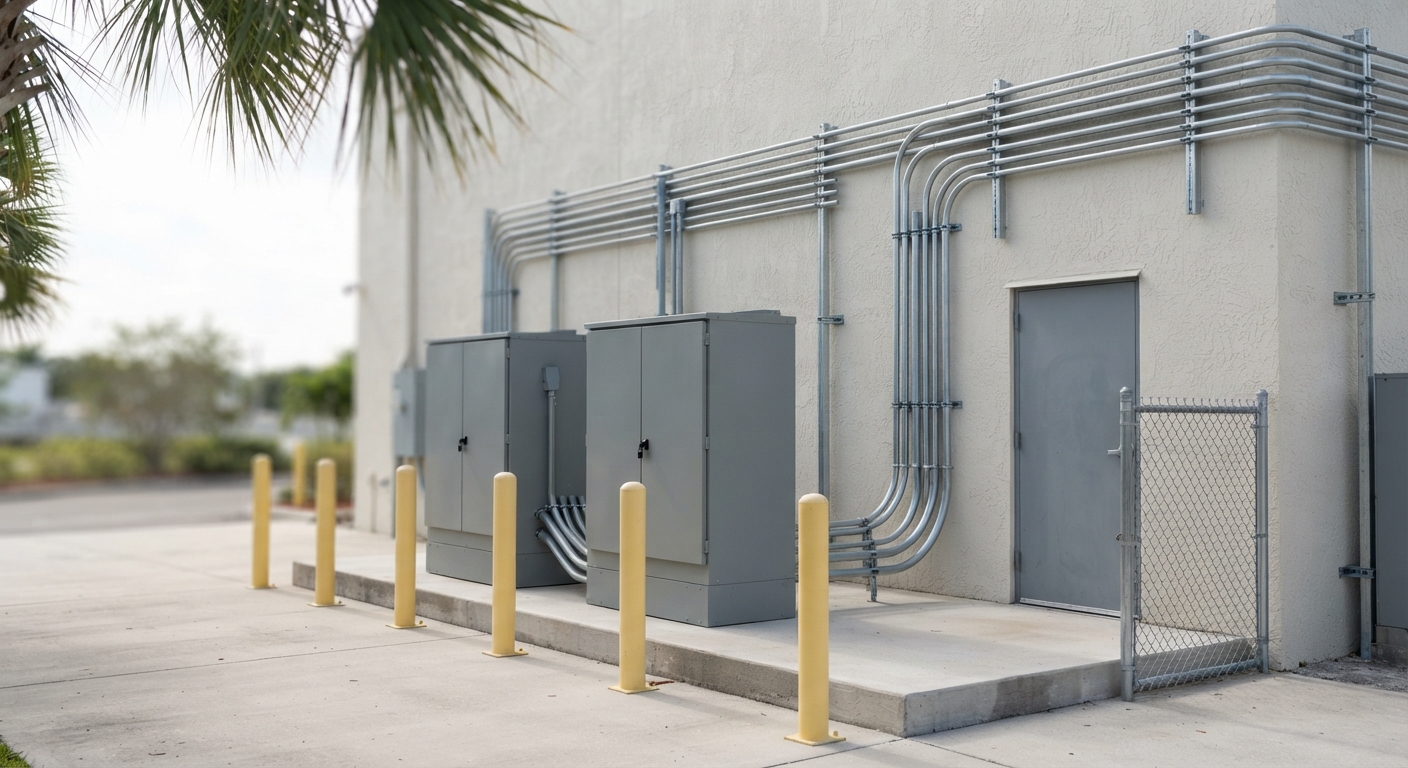
Outdoor enclosures need the clearances and fire department access governed by NFPA 855 and the Florida Fire Prevention Code, with vehicle protection near traffic, and in Miami-Dade and Broward the foundation and anchorage fall under High-Velocity Hurricane Zone review. Trenching across a lot is phased so parking stays open. AGT’s commercial battery storage solutions page outlines the system types it installs.
Controls decide whether the building keeps the month’s savings. The controller needs a live meter reading at the service point and a defined response when communication drops, because an idle controller can let one afternoon set the bill. Staggered chiller starts and pre-cooling ahead of an SDTR window reduce the kW the battery must cover. Advanced Air Systems, part of the Advanced family of businesses, performs commercial HVAC retrofits that can lower the peak at the source.
Energy held in reserve for outage backup cannot be discharged for demand shaving, so a larger reserve means smaller kW savings. AGT’s guide to solar plus battery hurricane resilience covers that trade-off.
Which tariff, tax, and code dates should a 2026 to 2027 demand project track?
Rates are the least stable input in the model. Tampa Electric’s rates page lists a proposed January 2027 decrease for commercial customers pending PSC approval. Every rate here is dated November 2026 and should be re-checked before a proposal is priced.
FPL’s Standby and Supplemental Service schedule (SST-1) applies when a customer’s total generation capacity exceeds 20% of total electrical load and is not for emergency use only; how that applies to a specific solar-plus-storage design is FPL’s determination. Florida’s rule on customer-owned renewable generation, Rule 25-6.065, F.A.C., keeps customers paying the customer charge and demand charge even when they export energy, so export credits do not lower the kW line. AGT’s Florida net metering guide for commercial accounts explains how credits apply.
The IRS describes the Section 48E clean electricity investment credit as covering energy storage technology placed in service after December 31, 2024, and SEIA’s summary of the One Big Beautiful Bill Act states that the new placed-in-service deadline for solar does not apply to storage, while foreign-entity restrictions apply from 2026. Eligibility for a specific project is a question for a tax advisor.
The 9th Edition (2026) Florida Building Code takes effect December 31, 2026, and Miami-Dade County’s permitting center has stated that applications submitted on or after that date must comply with it. The permit application date generally determines the governing edition, and the fire marshal and building official set each site’s requirements.
What should a Florida owner confirm before buying storage for demand charges?
Each item is assignable to a named role before a proposal is signed.
- Facility manager: request 12 months of 30-minute interval data for every demand-billed meter, plus 12 bills showing billed kW.
- Energy manager: mark the interval that set each month’s bill, with its time, duration, and the equipment running.
- Utility account representative: confirm the current schedule, eligibility for GSDT-1, SDTR, or Tampa Electric’s GSDT, meter availability, and in writing whether the system triggers standby service.
- Mechanical engineer or HVAC contractor: identify peak loads that can be staggered, pre-cooled, or retrofitted before battery size is fixed.
- Solar and storage designer: model savings on the actual tariff, state the kW target, and list the months the target would have been missed.
- CFO: require demand savings shown separately from energy savings, with stated rate escalation, degradation, and replacement year.
- Tax advisor: confirm Section 48E eligibility and equipment sourcing for the construction schedule.
- Fire marshal and building official: review enclosure siting and the code edition for the application date.
- Owner: require monthly post-installation reports comparing billed kW with the modeled target.
Frequently Asked Questions
How much do demand charges cost a Florida business on FPL, Duke, or TECO?
Base demand charges published for 2026 are $12.70 per kW on FPL’s GSD-1 schedule, $15.12 per kW on FPL’s GSLD-1, and $19.06 per kW on Tampa Electric’s GSD rate, each before per-kW clause charges. Duke Energy Florida’s terms should be confirmed on its current tariff. The Florida PSC’s October 1, 2026 sample bill for a 450 kW account totals $19,293 on FPL, $21,533 on Duke, and $18,307 on Tampa Electric.
Why does commercial solar cut energy charges more than demand charges?
Solar lowers every kilowatt-hour it produces, but the demand charge bills one interval each month, which often falls in late afternoon, evening, or under a passing cloud. Lawrence Berkeley National Laboratory modeled a median demand reduction of about 7% for commercial solar under a basic monthly-maximum charge, against about 19% when only noon-to-4 p.m. demand was billed.
Can a battery shave the demand on FPL’s SDTR summer window?
FPL’s Seasonal Demand Time of Use Rider measures seasonal on-peak demand on weekdays from 3 p.m. to 6 p.m., June through September, excluding listed holidays. A three-hour window is easier to size a battery for than every interval of the month. Whether the rider lowers a specific bill depends on the building’s load in that window, so compare it with GSD-1 on 12 months of interval data.
What happens to demand savings if the battery misses one interval?
On FPL’s demand schedules, the month’s single highest 30-minute interval sets that month’s demand charge, so one interval above the target sets the bill, and later shaving that month earns nothing below that level. FPL’s GSD-1, GSDT-1, and GSLD-1 sheets state no ratchet, so the next month starts fresh. Proposals should report how many modeled months would miss the target.
Will solar or battery storage move my building onto a standby rate?
It can. FPL’s SST-1 schedule applies when a customer’s total generation capacity exceeds 20% of total electrical load and is not for emergency use only, and Florida’s Rule 25-6.065 lets renewable customers elect a standby rate where one is available. How these provisions apply to a specific design is the utility’s determination, so get the account representative’s answer in writing.
Does the 2027 solar placed-in-service deadline apply to battery storage?
SEIA’s summary of the One Big Beautiful Bill Act states that the placed-in-service deadline for solar projects beginning construction after July 4, 2026 does not apply to energy storage projects, and the IRS lists energy storage technology under the Section 48E credit. Foreign-entity sourcing and construction-start facts still affect eligibility, so a tax advisor should confirm the credit.
Start from the tariff, then size the battery to the interval that bills you
Florida demand charges reward the building that controls one demand interval each month, and the rate schedule decides when that interval can occur. Solar lowers energy costs reliably but trims demand only when the billed peak lands in strong sun. Storage, controls, and the rate option carry most of the kW savings when the battery is sized to the real billing window and verified against billed kW afterward. An owner who brings interval data, the current tariff sheet, and the utility’s written answer on standby service to the first design meeting gets a proposal a board can defend.
Written by The Technical Team at Advanced Green Technologies. Founded in 2007, Advanced Green Technologies is 100% employee-owned and has installed more than 380 megawatts of solar for Florida clients.
To have AGT review 12 months of interval data against your current rate schedule, request a quote for a demand-charge review or call (888) 735-2641.