

At a glance: No agency publishes a Florida price for commercial battery storage. National benchmarks for 2025 and 2026 run from about $219 per kWh for U.S. utility-scale turnkey equipment to about $413 per kWh all-in for utility solar-plus-battery plants, and smaller commercial systems price higher per kWh. This guide breaks a business system into its cost components, compares configurations, shows the FPL demand charges and PSC sample bills that set a battery’s value, covers occupied-building and hurricane-zone scope, lists the 2026 tax and code dates, and ends with a bid checklist.
Commercial battery storage cost in Florida is set by the project’s scope, the utility tariff, and the construction-start date far more than by the price of battery cells. The national surveys quoted as rules of thumb measure everything from bare equipment to utility-scale plants, and none prices a 250 kW system tied into the switchgear of an occupied Florida building. An owner who carries the wrong benchmark into a capital request can underfund the fire protection, interconnection, and site work the building official and utility will require, or buy capacity the tariff does not reward. This article explains what goes into a business system’s price, which published figures apply, and how to test a bid, without quoting Advanced Green Technologies pricing or deciding whether storage pays back for a specific building.
Why is commercial battery storage cost in Florida hard to pin down in 2026?
Commercial battery storage cost in Florida has no single published figure. National benchmarks for 2025 and 2026 run from about $219 per kWh for U.S. utility-scale turnkey equipment to about $413 per kWh all-in for utility solar-plus-battery plants, and commercial behind-the-meter systems generally cost more per kWh than either because fixed project costs are spread over fewer kWh.
BloombergNEF’s Energy Storage Systems Cost Survey 2025, as reported by Energy-Storage.news in December 2025, put the U.S. average turnkey system price at $219 per kWh against a global average of $117. Lawrence Berkeley National Laboratory’s Utility-Scale Solar 2026 Edition found all-in battery capital cost of about $413 per kWh for solar-plus-battery plants completed in 2025, with batteries averaging 3.4 hours. Lazard’s 2026 Levelized Cost of Energy+ report lists $270 to $365 per kWh for a 100 MW, four-hour standalone system and reports that storage costs rose this year, citing tariffs on imported lithium-ion batteries.
The figures disagree because they measure different scopes: equipment under a supply contract, an all-in plant with interconnection and owner’s costs, or capital spread over a system’s life. All three describe utility-scale projects. Pacific Northwest National Laboratory’s June 2026 battery storage report notes that larger systems generally cost less per kWh, and the National Laboratory of the Rockies (formerly NREL) models commercial battery systems from 100 kW to 2,000 kW as a separate class. No Florida agency or national laboratory publishes an installed price for commercial storage in Florida, so a site-specific bid is the only defensible budget number.
What is actually in a commercial battery storage price?
A commercial battery storage price is the sum of energy-related equipment, power-related equipment, and project costs that scale with neither. The 2025 Annual Technology Baseline from the National Laboratory of the Rockies builds system cost from a battery pack cost per kWh, a balance-of-system cost per kW, and a fixed project constant. Battery modules and racks scale with kWh; the inverter, transformer, and switchgear scale with kW; and engineering, permitting, interconnection review, and commissioning stay close to fixed for each project.
Duration is where that structure shows up in a bid. A two-hour and a four-hour system with the same kW rating share the same inverter, transformer, and interconnection, and the four-hour system adds only battery modules and enclosure space, so its price per kWh is lower while its total price is higher. Small systems pay a penalty, because a 100 kWh project carries nearly the engineering and permitting effort of a 1,000 kWh project. Florida heat adds a load the national models do not break out: lithium-ion cells age faster at elevated temperature, so outdoor enclosures carry dedicated cooling that runs all summer on power the system supplies.
Ownership costs belong in the budget from the start. The 2025 baseline assumes fixed operations and maintenance at 4 percent of capital cost per year, an 85 percent round-trip efficiency, and a 15-year service life, with the maintenance allowance covering capacity additions that hold rated output as cells degrade. A bid that leaves out monitoring, maintenance, and augmentation understates the cost of ownership; AGT’s commercial solar operations and maintenance services page describes how those obligations are scoped.
Table 1. Where the money goes in a commercial battery system
| Cost component | What it includes | Scales with | Florida-specific factor |
|---|---|---|---|
| Battery equipment | Cells, modules, racks, battery management system, enclosure | kWh | Enclosure cooling sized for Florida heat and humidity |
| Power conversion | Bidirectional inverter (PCS), energy management system, controls | kW | Controls programmed to the utility’s demand-billing rules |
| Electrical balance of system | Transformer, switchgear, protective relays, metering, conductors | kW and distance to the service | Tie-in at existing switchgear on an occupied building |
| Fire and life safety | Detection, suppression or explosion control, spacing, emergency planning | Siting and stored energy | Local fire official’s review under the adopted fire code |
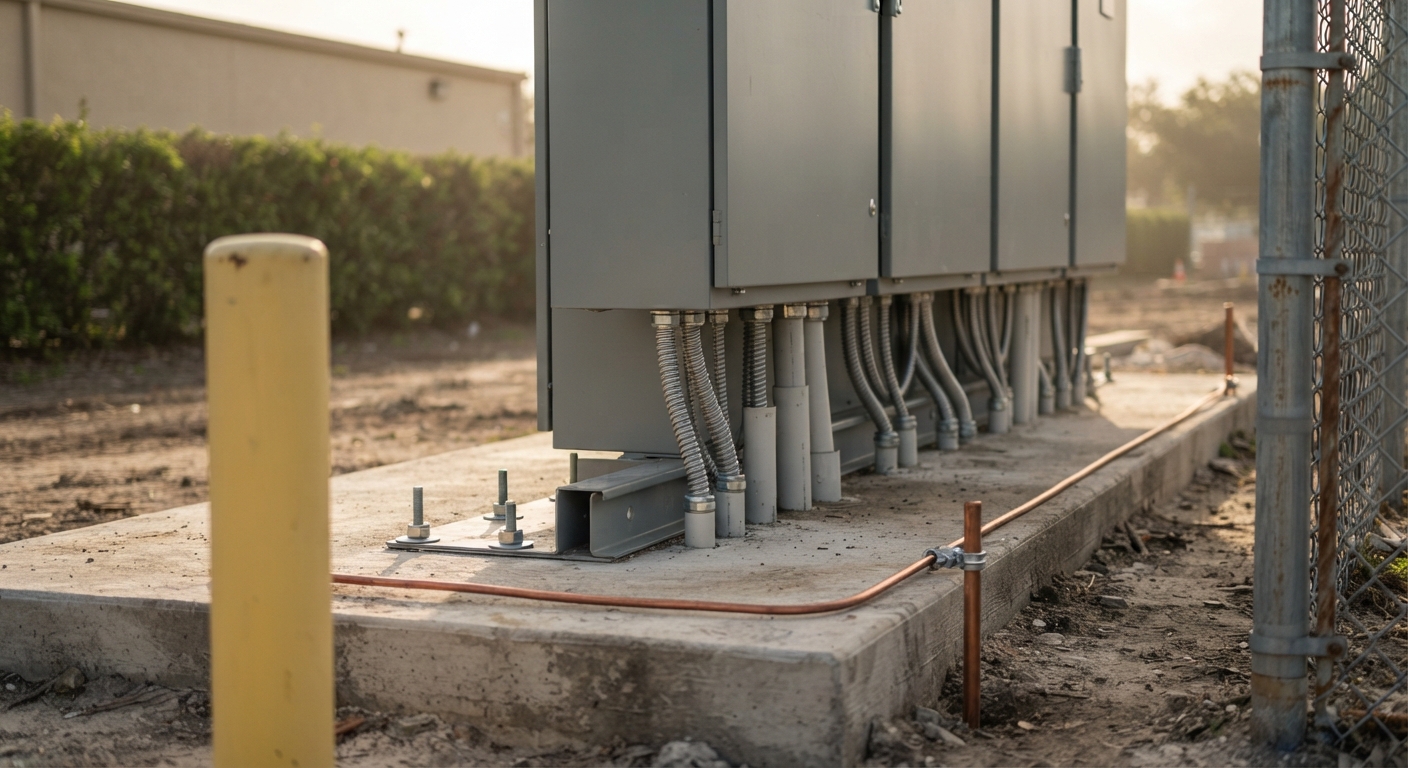
| Site and structure | Concrete pad, anchorage, bollards, trenching, fencing | Site conditions | Wind anchorage in Miami-Dade and Broward; flood elevation on coastal sites |
| Project costs | Engineering, permitting, interconnection review, commissioning | Largely fixed per project | Utility interconnection process and schedule |
| Ownership costs | Monitoring, maintenance, augmentation, warranty administration | Years in service | Corrosion inspection on enclosures exposed to salt air |
Standalone battery, solar plus storage, or backup power: which configuration fits the budget?
The configuration decision sets the scope, and the scope sets the price. A standalone behind-the-meter battery is the narrowest scope: it charges from the grid or on-site solar and discharges to hold down measured peak demand. Pairing with solar can share interconnection and switchgear work, but it adds the array and the roof or canopy that carries it. A battery built to carry critical loads during an outage adds islanding controls, transfer equipment, and a critical-load panel, and it is sized for hours of runtime rather than a demand peak. AGT’s commercial battery storage solutions cover standalone and solar-paired systems at commercial, industrial, and community scale.
No configuration pays back on every tariff. A battery earns demand-charge savings only where the rate bills demand, and because demand is billed on the month’s highest measured interval, a single interval the battery misses can set that month’s charge. A generator provides backup only, with no bill savings and its own fuel, testing, and air permitting obligations. AGT’s guide to peak shaving with solar and battery storage in Florida covers the savings side.
Table 2. Configurations compared, including where each falls short
| Configuration | Built to do | Scope that drives cost | Where it falls short |
|---|---|---|---|
| Standalone behind-the-meter battery | Cut measured peak demand; shift energy on time-of-use rates | Battery, inverter, switchgear tie-in, pad, fire protection | Little value on a rate without demand charges; no generation of its own |
| Solar plus storage | Store on-site solar; reduce demand and energy purchases | Array plus battery, with shared interconnection and switchgear work | Adds roof or canopy scope; solar output varies with weather |
| Backup-focused battery | Carry selected loads through an outage | Islanding controls, transfer equipment, critical-load panel, more kWh | Runtime limited by stored energy; long outages need solar or generator recharge |
| Generator (for comparison) | Carry loads through an outage on fuel | Generator set, fuel storage, transfer switch | No bill savings; fuel logistics after a storm; testing and air permits |
Which numbers move a Florida battery storage budget?
Three groups of numbers move a Florida budget: the equipment price trend, the utility tariff the battery works against, and the tax treatment. The tariff matters as much as the hardware because it sets what a kW of peak reduction is worth. Florida Power & Light’s business rate insert effective October 2026 lists a demand charge of $12.70 per kW on the GSD-1 general service demand schedule and $15.12 per kW on GSLD-1, before the conservation, capacity, and storm protection charges FPL also bills per kW. AGT’s breakdown of how FPL bills demand and credits solar exports walks through those line items.
The utility serving the building changes the math. The Florida Public Service Commission’s sample commercial bill calculation effective October 1, 2026 shows a 450 kW, 162,000 kWh monthly account totaling $19,293 with FPL, $21,533 with Duke Energy Florida, and $18,307 with Tampa Electric; municipal utilities and cooperatives set their own tariffs. In a capital request, treat a utility-scale price as a floor, never a target, and ask bidders which tariff-exposed components are priced at bid and how long the price holds.
Table 3. Published figures that bear on a Florida commercial battery budget
| Figure | Value | Source and date | How to use it |
|---|---|---|---|
| U.S. turnkey BESS price (utility scale) | $219 per kWh | BloombergNEF survey via Energy-Storage.news, Dec 2025 | Equipment floor; commercial projects price above it |
| All-in battery capital cost, utility solar-plus-battery | About $413 per kWh (2025 projects, 3.4-hour average) | Berkeley Lab, Utility-Scale Solar 2026 Edition, Oct 2026 | Includes project costs; still utility scale |
| Total capital cost, 100 MW four-hour standalone | $270 to $365 per kWh | Lazard LCOE+ 2026, Jul 2026 | Shows 2026 direction of utility-scale costs |
| FPL GSD-1 demand charge | $12.70 per kW per month | FPL business rates, effective Oct 2026 | Value of each kW of peak reduction on mid-size FPL demand accounts |
| FPL GSLD-1 demand charge | $15.12 per kW per month | FPL business rates, effective Oct 2026 | Same, for large-demand FPL accounts |
| Sample 450 kW / 162,000 kWh monthly bill | FPL $19,293; Duke $21,533; TECO $18,307 | Florida PSC sample bills, effective Oct 1, 2026 | Shows how the serving utility changes the value |
| Fixed O&M, round-trip efficiency, life | 4% of capital cost per year; 85%; 15 years | NLR Annual Technology Baseline 2025 | Ownership assumptions to test against each bid |
| Federal Section 48E rate for storage | 6% base; 30% under 1 MW or with wage and apprenticeship rules met | 26 U.S.C. 48E(a)(2)(B), current through Oct 2026 | Tax advisor confirms eligibility and bonuses |
What changes when the battery goes in at an occupied Florida building?
On an occupied building, the battery is a construction project sequenced around the tenants. The tie-in to the main switchgear usually requires a planned electrical outage, so the installer and property manager agree on a shutdown window, often overnight or on a weekend, and notify tenants before it starts. Pad construction and trenching through a parking area are phased to keep fire lanes open, and the crane pick that sets a containerized enclosure is scheduled outside business hours where the site allows. Those constraints add labor hours and sometimes premium-time rates, and they belong in the bid as line items rather than change orders.
Florida site conditions add scope a national benchmark does not carry. In Miami-Dade and Broward counties, the High-Velocity Hurricane Zone provisions of the Florida Building Code govern how outdoor equipment is anchored, and the engineer of record designs the pad to the site’s wind loads, as on AGT’s commercial battery storage work in Miami. Coastal sites need equipment set above the local flood elevation, and enclosures in salt air need corrosion-resistant hardware inspected during maintenance. Indoor and rooftop locations change the fire protection scope, as AGT’s guide to commercial battery storage permitting in Florida explains.
Backup-capable systems add a commissioning step occupants feel directly. The grid-to-battery transfer is tested and documented before storm season, with the same notice as any planned outage. AGT’s solar plus battery hurricane resilience article shows what a Florida commercial system can keep running, which helps size the critical loads.
Which tax, code, and tariff dates affect a 2026 or 2027 battery budget?
As of November 18, 2026, energy storage remains eligible for the federal clean electricity investment credit under Section 48E, which the IRS describes as available for storage placed in service after December 31, 2024. Under the text of 26 U.S.C. 48E, the December 31, 2027 placed-in-service cutoff for wind and solar does not apply to energy storage technology, but storage beginning construction after December 31, 2025 is excluded if it includes material assistance from a prohibited foreign entity. IRS Notice 2026-15 sets a 55 percent minimum material assistance cost ratio for storage starting construction in 2026. The base rate is 6 percent, or 30 percent for systems under 1 MW or meeting wage and apprenticeship rules. Eligibility belongs to the owner’s tax advisor; AGT tracks the dates in its commercial solar tax credit deadline guide.
Section 193.624 of the 2026 Florida Statutes lists power conditioning and storage devices that store or use solar energy among renewable energy source devices, and excludes 80 percent of the just value such a device adds to nonresidential property from assessment. How that applies to a battery that also charges from the grid is a question for the property appraiser and tax advisor.
The Florida Building Commission’s October 2026 workplan lists December 31, 2026 as the effective date of the 9th Edition Florida Building Code; the permit application date generally determines the governing edition. UL Solutions reports that NFPA 855 (2026) specifies UL 9540A, whose 6th edition was published March 13, 2026; the local fire official decides which editions apply.
What should a battery storage bid show before the CFO signs?
A battery bid is defensible when every number traces to a scope item, a tariff sheet, or a named assumption. Assign each line below to its owner before the proposal goes to a CFO or board.
- Facility manager: provide 12 months of bills and interval load data for each meter, with the rate schedule, so kW and kWh are sized to measured peaks.
- Energy lead: require kW, usable kWh at beginning of life, duration, round-trip efficiency, and the augmentation plan for the warranty term.
- CFO: require price split into battery, power conversion, electrical, fire protection, site work, engineering, and interconnection, plus annual O&M; compare solar financing options.
- Electrical engineer of record: confirm the switchgear tie-in, any service upgrade, and the outage window, as in AGT’s commercial solar engineering process.
- Fire protection engineer: confirm siting, detection, and suppression or explosion control with the fire official, using the UL 9540 listing and UL 9540A data.
- Tax advisor: confirm Section 48E eligibility, rate, material assistance compliance, depreciation, and Florida property tax position.
- Property manager: approve staging, crane-pick date, shutdown notices, and fire-lane access.
- Procurement officer: confirm the price-hold period and, for public agencies, whether the Equalis Group cooperative contract fits.
Frequently Asked Questions
How much does a commercial battery storage system cost in Florida?
No agency publishes a Florida price for commercial battery storage. National utility-scale benchmarks run from about $219 per kWh for U.S. turnkey equipment (BloombergNEF, 2025) to about $413 per kWh all-in for utility solar-plus-battery plants (Berkeley Lab, 2025 projects). Commercial systems spread fixed project costs over fewer kWh, so they generally price above those figures, and a site-specific bid is the defensible number.
Is commercial battery storage cheaper per kWh than a home battery?
Often, because fixed costs spread across more kWh, but only for similar scopes. A commercial system adds a switchgear tie-in, fire protection review, interconnection, and site work a home battery does not need. Compare proposals on usable kWh at beginning of life, duration, and full installed scope.
Does the federal tax credit still apply to commercial battery storage in 2026?
As of November 2026, energy storage remains eligible for the Section 48E credit, and the 2027 placed-in-service cutoff for wind and solar does not apply to storage. Storage beginning construction after December 31, 2025 must meet the foreign-entity material assistance rules. The base rate is 6 percent, rising to 30 percent under statutory conditions. Your tax advisor determines eligibility.
How long does a commercial lithium-ion battery system last?
The 2025 Annual Technology Baseline models commercial battery systems with a 15-year life, with maintenance spending that covers capacity additions as cells degrade. Actual life depends on cycling, depth of discharge, temperature, and the warranty, so read each warranty’s retained-capacity and throughput limits before comparing bids.
Can a battery replace a generator for a Florida business?
A battery carries critical loads for as many hours as its stored energy allows, and paired solar can recharge it in daylight. A generator runs as long as its fuel lasts. For long post-hurricane outages, some sites pair the two. The building’s electrical engineer should define critical loads and runtime before either is priced.
Does Florida tax a commercial battery system as property?
Section 193.624 of the 2026 Florida Statutes includes power conditioning and storage devices that store or use solar energy among renewable energy source devices and excludes 80 percent of the just value they add to nonresidential property. How it applies to a battery that also charges from the grid is for the property appraiser and your tax advisor.
A Florida battery budget is set by scope, tariff, and timing
The price of a commercial battery system in Florida follows from decisions the owner can see: kW and kWh sized to measured demand, the configuration, the site and fire protection scope, the utility tariff the system works against, and the construction-start date that sets tax treatment. National benchmarks serve as floors and trend lines, and Florida tariffs show what a kW of peak reduction is worth. Owners who start with interval data and a plain statement of what the battery must do give every bidder the same scope to price. A bid that itemizes those decisions can be defended to a board, and a single per-kWh figure cannot.
Written by The Technical Team at Advanced Green Technologies. Founded in 2007, Advanced Green Technologies is 100% employee-owned and ranked first among commercial and industrial EPC contractors in Florida on Solar Power World’s 2026 Top Solar Contractors list.
Price a battery system for your building. Request a free battery storage assessment or call (888) 735-2641, and bring 12 months of utility bills and interval data.