

At a glance: A grid-tied solar array shuts off when utility power fails, so backup comes from the battery, the inverter that can form an island, and the switchgear that separates the building from the grid. Run time depends on the critical-load list, cooling demand, the battery’s charge when the outage starts, and the weather after the storm. This guide covers how islanding works, how solar plus storage compares with generators, what drives run time, what installation looks like in an occupied Florida building, the codes and tax rules to confirm as of October 2026, and a role checklist.
Solar plus battery hurricane resilience comes down to three decisions made long before a storm: whether the system can island from the utility, which loads it is wired to carry, and how much charge the battery holds when the outage begins. A grid-tied solar array without those pieces shuts down when utility power fails, even under clear skies the day after landfall. Owners who install a battery for bill savings and assume it doubles as backup often learn the difference in a dark building, so this article explains how a commercial solar and storage system carries defined critical loads, where it falls short, and when a generator still belongs in the plan, without claiming that storage replaces a generator at every facility.
The question has a recent, documented cost. The U.S. Energy Information Administration reported that major events led by Hurricanes Beryl, Helene, and Milton accounted for 80% of the hours U.S. customers spent without power in 2024, and that Hurricane Milton alone left 3.4 million Florida customers without electricity.
Why are Florida owners asking about solar plus battery hurricane resilience in 2026?
Florida facility teams are asking because outage hours are rising and the outages that matter most are the long ones that follow a direct hit. EIA’s December 2025 analysis found that U.S. customers averaged about 11 hours without power in 2024, nearly twice the annual average of the prior decade. Interruptions from major events alone averaged nearly nine hours, compared with about four hours a year from 2014 to 2023. For a building that must stay open, the relevant number is the length of the longest interruption it can absorb before inventory, tenants, or patients are affected.
Timing also matters. The National Hurricane Center’s Atlantic hurricane climatology places the season from June 1 to November 30, with most activity between mid-August and mid-October. A system approved this fall will not be commissioned before the current season ends, which makes autumn the planning window for next June rather than a deadline for this one.
FEMA’s guidance on emergency power starts in the same place a solar and storage design should. FEMA P-1019, Emergency Power Systems for Critical Facilities, asks owners to identify the critical functions first, then the building systems that support them, then the power those systems need. A battery cannot be sized until that list exists, and most of the disappointment owners report after a storm traces back to skipping it.
Why does a grid-tied solar array shut off in an outage, and what does a battery change?
A grid-tied solar array shuts off in an outage because its inverters are required to stop exporting power when they lose the utility signal. That behavior, called anti-islanding, protects line crews from a building back-feeding a line they believe is dead. IEEE 1547, the interconnection standard for distributed energy resources, sets the islanding requirements, and the Florida Public Service Commission’s interconnection and net metering rule, Rule 25-6.065, requires customer-owned systems up to 2 MW to meet IEEE 1547 and UL 1741.
Adding a battery changes the outcome only when the system is designed to form its own island. A grid-forming inverter creates the voltage and frequency reference that the solar inverters follow once the utility is gone, and an isolation device opens the connection to the grid first, so the building runs as a small microgrid. During daylight the array recharges the battery, and at night the battery carries the load. Every component below has to be specified for that sequence; a battery added later without the islanding hardware stays dark with the array.
| Component | Job during a grid outage | What happens without it |
|---|---|---|
| Solar array and string or central inverters | Produces power in daylight and recharges the battery | No daytime recharge; the battery drains and stays empty |
| Battery energy storage system (UL 9540 listed) | Carries loads at night and through cloud bands | Solar output cannot be stored or delivered after sunset |
| Grid-forming (bidirectional) inverter | Sets voltage and frequency so the solar inverters can keep running | Solar inverters cease output under anti-islanding rules |
| Isolation device or automatic transfer switch | Separates the building from the utility before the island forms | Islanding is not permitted; the system stays off |
| Critical-load panel | Groups the circuits the system is sized to carry | Whole-building demand drains the battery in hours |
| Controller and storm reserve setting | Holds charge in reserve ahead of a forecast storm and sheds loads by priority | The battery may be near empty from daily cycling when the outage starts |
The islanding sequence and protection scheme belong in the engineering phase, before equipment is selected. AGT outlines how it runs that phase in its commercial solar engineering process.
Solar plus battery, generator, or both: which backup approach fits the building?
Solar plus storage fits buildings whose critical loads are moderate and steady, while generators still fit loads that are large, motor-heavy, or needed around the clock regardless of weather. The comparison below states what each approach covers and where each falls short. The most resilient answer for hospitals, emergency shelters, and cold storage is often a hybrid in which the battery and array carry the base load and the generator runs fewer hours.
| Approach | What it covers in an outage | Where it falls short |
|---|---|---|
| Grid-tied solar only | Nothing; savings resume when the grid returns | Shuts down under anti-islanding requirements |
| Battery only, no solar | Critical loads for the hours its stored energy allows | No recharge until the grid or a generator returns |
| Solar plus battery with islanding | Critical loads across multiple days when the array recharges the battery each day | Output drops under post-storm cloud bands; large cooling loads exceed typical sizing; array damage removes recharge |
| Diesel or natural gas generator | Large and motor-driven loads, day or night | Fuel deliveries after a storm; gas supply depends on the pipeline; noise, emissions, and weekly testing; no bill savings |
| Solar, battery, and generator together | Base and daytime loads on storage, peaks and long nights on the generator | Highest first cost and the most complex controls and commissioning |
Berkeley Lab’s national study, Evaluating the Capabilities of Behind-the-Meter Solar-plus-Storage for Providing Backup Power during Long-Duration Power Interruptions (September 2022), found that the array’s ability to recharge the battery each day is what separates solar plus storage from a battery alone over multi-day outages. The same study found performance tends to be lowest where cooling loads are large, which includes parts of the Southeast.
No array or battery enclosure is immune to storm damage. Systems are designed and tested to rated wind speeds, storms can exceed them, and warranties carry exclusions. FEMA’s recovery advisory on rooftop solar panel attachment after Hurricanes Irma and Maria documents how attachment failures removed arrays from service, which is why an array that will recharge a backup battery needs attachment design and maintenance to match. AGT’s commercial solar hurricane preparedness guide covers the before-and-after steps for the array itself.
What determines how long a solar plus battery system runs a Florida building during an outage?
Run time is set by the energy the critical loads consume each day compared with what the battery stores and the array replaces. A system sized for a refrigeration case, network closet, security, and emergency lighting can run for days. The same system asked to carry chillers or rooftop units across a hot week will not.
| Variable | Why it moves run time | Who determines it |
|---|---|---|
| Critical-load list (peak kW and kWh per day) | Sets the daily energy the system must supply | Owner with the electrical engineer |
| Cooling and dehumidification loads | Usually the largest daily energy draw in a Florida building | Mechanical engineer |
| Battery energy (kWh) and power (kW) ratings | Energy sets hours of support; power sets which loads can run at once | Solar and storage designer |
| State of charge when the outage starts | A battery cycled for bill savings may start the outage partly empty | Owner policy in the controller settings |
| Array size and post-storm weather | Sets how much energy is replaced each day | Designer; weather is outside anyone’s control |
| Motor starting loads | Pumps, compressors, and elevators draw high inrush current | Electrical engineer |
| Damage to the array or enclosure | Removes recharge or takes the battery out of service | Inspection after the storm |
Berkeley Lab’s modeling gives a sense of scale for whole-building backup. With a roof-constrained array and a battery sized at 30% of average daily solar output, a typical installed ratio, the study found retail stores and schools had about 75% of building load served on average across its historical outage events, while hospitals had about 43%. Those are whole-building results; separating a smaller critical-load panel is how designers move the served share toward 100% for the loads that matter.
Battery size and backup reserve also interact with savings. A battery that is cycled every afternoon for demand reduction may start a storm with little in reserve, which is why many owners raise the reserve setting during hurricane season. AGT’s article on peak shaving with solar and battery storage in Florida explains that tradeoff from the savings side. Battery storage does not pay back on every tariff; its value depends on demand charges, backup requirements, and the rate structure.
What changes when you add backup storage to an occupied Florida building?
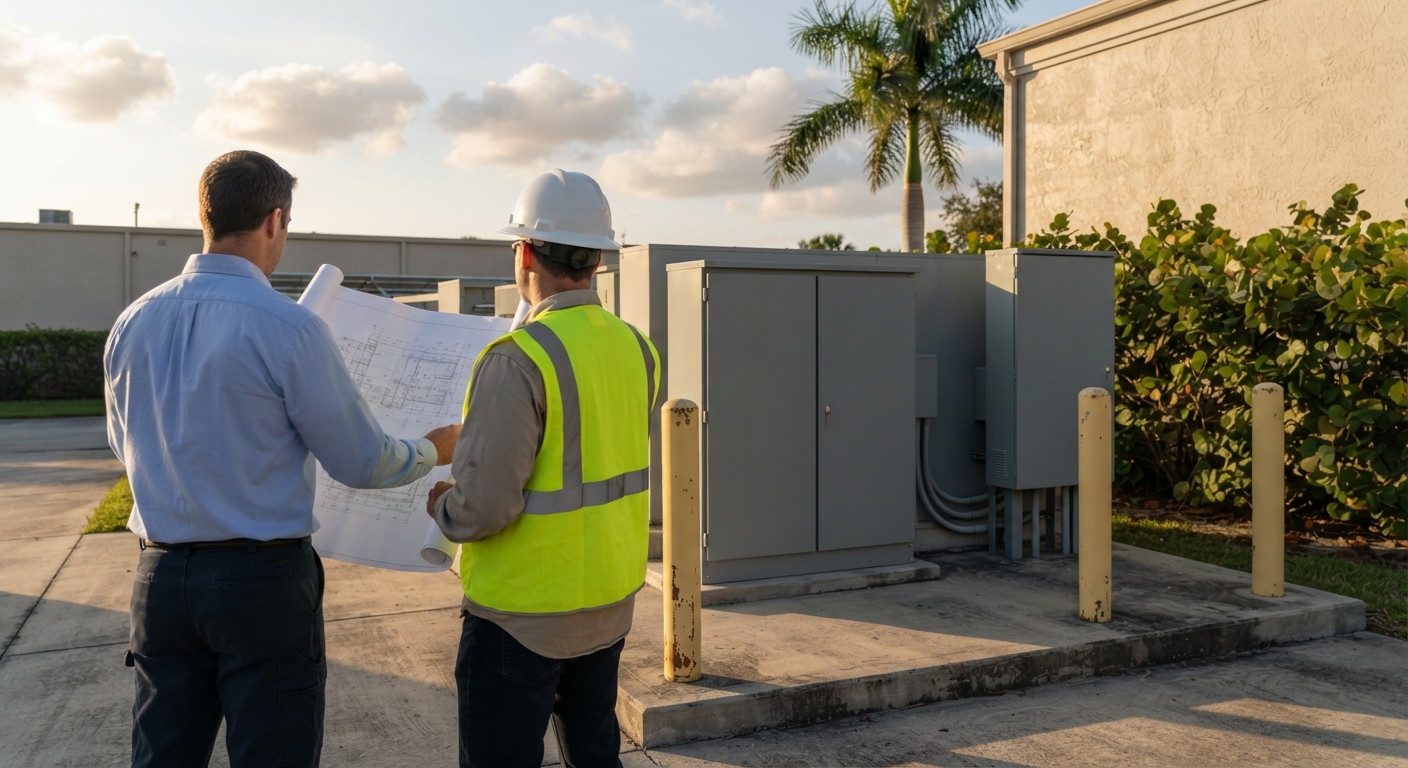
Adding backup storage to an occupied building means rewiring part of the electrical system while tenants keep working. Critical circuits are moved to a new panel, which requires short, scheduled shutdowns of each affected circuit. On an occupied site those shutdowns are planned outside business hours, and the property manager receives the schedule before work starts.
Battery enclosures arrive as heavy, factory-built units set on pads, often with a crane pick. The pick is scheduled when the parking area and walkways can be closed, and the staging area is fenced. NFPA 855, the standard for stationary energy storage systems, governs siting, spacing, and fire protection, and the local fire marshal and building official decide what is acceptable on a given site. FEMA P-1019 recommends that transfer switches and distribution equipment for emergency power sit above the design flood level, a point that matters for ground-mounted enclosures in coastal Florida.
Commissioning should include a planned islanding test: the utility connection is opened on purpose, with tenants notified, and the team confirms that the critical loads transfer, the array follows the battery, and the system reconnects cleanly. Ongoing operations and maintenance for commercial solar should repeat that test before each season. A rooftop array also shares the roof’s service life, so an aging roof under a new array means a remove-and-reinstall later. AGT was founded by Advanced Roofing, and an Advanced Roofing re-roofing assessment can settle roof condition before the array goes on; AGT’s roof and drone solar surveys document the existing roof as part of design.
Which codes, standards, and tax rules apply to solar plus storage as of October 2026?
Several rules govern a backup-capable system in Florida, and several are changing this year. As of October 1, 2026, the items below are current; each should be confirmed on the day a contract is signed.
- Battery safety listing: UL 9540, Energy Storage Systems and Equipment (third edition, 2023) covers the listed system, and UL 9540A test data informs spacing decisions under NFPA 855.
- Fire code: the Florida Fire Prevention Code 8th Edition, based on the 2021 editions of NFPA 1 and NFPA 101, is in effect, and the State Fire Marshal is developing the 9th Edition.
- Building code: the Florida Building Code 8th Edition (2023) is in effect, and the 9th Edition (2026) takes effect December 31, 2026. The permit application date generally determines which edition governs. Miami-Dade and Broward fall in the High-Velocity Hurricane Zone, where Florida Product Approval or Miami-Dade NOAs apply to attachments.
- Federal credit: the IRS lists energy storage technology placed in service after December 31, 2024 as eligible under the Clean Electricity Investment Credit (Section 48E). SEIA’s summary of the One Big Beautiful Bill notes that the placed-in-service deadline applied to solar does not apply to storage, while foreign-entity-of-concern restrictions apply to both. Whether a specific project qualifies is a question for a tax advisor.
- Utility interconnection: PSC Rule 25-6.065 and each utility’s tariff govern how the system connects and how exports are credited; the utility, not the contractor, sets those terms.
Solar plus battery hurricane resilience checklist for facility teams
Each item below has an owner. A facility team that can check every box has a defensible backup plan to put in front of leadership.
- Facility manager: list the critical functions and the circuits that serve them, with the hours each must run during an outage.
- Electrical engineer: convert that list into peak kW and kWh per day, flag motor starting loads, and design the critical-load panel.
- Mechanical engineer: state which cooling and dehumidification loads, if any, must stay on, and at what setpoints.
- Solar and storage designer: confirm grid-forming capability, the isolation device, and the islanding sequence in writing.
- Owner and finance lead: set the hurricane-season reserve policy and accept the savings it gives up.
- Fire marshal and building official: review enclosure siting, separation, and flood elevation before procurement.
- Tax advisor: confirm Section 48E eligibility, construction-start documentation, and sourcing rules.
- Property manager: issue the shutdown schedule and the islanding-test notice to tenants.
AGT’s commercial battery storage solutions pair with its rooftop solar installation work, and South Florida owners can review commercial battery storage in Miami for local considerations. AGT is also part of the ELM MicroGrid dealer network.
Frequently Asked Questions
Will my existing solar panels power my building during a hurricane outage?
Not on their own. A grid-tied array is required to stop exporting power when the utility fails, under IEEE 1547 anti-islanding rules, so it shuts down even in full sun. To run during an outage, the system needs a battery, a grid-forming inverter, and an isolation device that separates the building from the grid. Some existing arrays can be retrofitted; your solar designer can confirm whether yours can.
How long can a commercial battery keep a building running after a hurricane?
It depends on the critical-load list, the battery’s stored energy, its charge when the outage begins, and how much the array recharges it each day. A system carrying lighting, refrigeration, security, and IT can run for days in reasonable sun. Berkeley Lab’s 2022 study found whole-building backup much harder, especially where cooling loads are large.
Can a solar plus battery system replace a diesel generator?
For moderate, steady critical loads, it can. For large motor loads, round-the-clock cooling, or code-required emergency systems in hospitals and similar occupancies, a generator usually remains part of the design. Many owners pair the two so the battery and array carry daytime and base loads while the generator runs fewer hours and burns less fuel.
Can the same battery handle peak shaving and hurricane backup?
Yes, when the system includes islanding equipment and the controller holds a reserve for outages. The reserve reduces the energy available for demand reduction, so owners often raise it from June through November. Your designer should show the savings with and without the seasonal reserve before you approve the settings.
Should a battery be fully charged before a hurricane makes landfall?
Most backup plans raise the reserve to full charge when a storm enters the forecast cone, so the system starts the outage with its maximum stored energy. The controller can be set to do this automatically. Follow the manufacturer’s storm instructions and confirm the change with your O&M provider well ahead of landfall.
Does a commercial battery system need fire marshal approval in Florida?
Yes. Battery energy storage systems are reviewed under the Florida Fire Prevention Code and NFPA 855, and the local fire marshal and building official decide siting, separation, and fire protection for each site. Plan that review before equipment is ordered, because it can change where enclosures go and how many fit.
Hurricane backup from solar and storage is set at design, months before landfall
Solar plus storage can carry a Florida building’s critical loads through a multi-day outage when the system can island, the load list is defined, and the battery starts the outage with charge in reserve. Without those three, a building with solar and a battery can still go dark. The evidence from EIA, FEMA, and Berkeley Lab points the same way: identify the critical functions, size to them, and decide where a generator still belongs. The review this fall sets the plan for next June.
Written by The Technical Team at Advanced Green Technologies. Founded in 2007 and 100% employee-owned, Advanced Green Technologies has installed more than 380 megawatts of solar for Florida clients and placed third among Florida solar contractors on Solar Power World’s 2026 Top Solar Contractors list (2026 ranking).
Planning solar plus battery backup for a Florida building? Request a free quote or call (888) 735-2641 to schedule a critical-load review with AGT’s engineering team.