
At a glance: On a leased Florida office building, solar savings go to whoever pays the account the array is wired to. This guide explains how PSC metering rules, net metering, and lease type (gross, modified gross, or triple net) decide who captures those savings, why Florida landlords generally cannot sell solar power to tenants, which ownership structures fit, what the roof, electrical service, and occupied-building logistics change, and which tax, code, and credit dates to recheck as of November 2026. It ends with a role-by-role decision checklist.
Commercial landlord solar Florida projects on leased office buildings are decided by two documents, the building’s electric service configuration and its tenant leases, before any module is priced. An array that feeds the landlord’s house account, which in many office buildings carries the central plant, common-area lighting, and elevators, returns its savings to the landlord, while an array whose output reaches tenant bills under a triple net lease returns them to tenants unless the lease lets the landlord recover the capital cost. Getting the structure wrong means paying for an array whose savings go to someone else, or putting it on a membrane that will not outlast it. This article does not argue that every Florida office building should add solar, and it makes no legal, tax, or utility determination for any specific building.
Why is office building solar in Florida a different decision in late 2026?
Office building solar in Florida is being evaluated against three dated changes: a federal credit deadline, a building code edition change, and the state’s commercial electricity rates. Under Public Law 119-21, a solar facility that begins construction after July 4, 2026 must be placed in service by December 31, 2027 to claim the section 48E clean electricity investment credit. IRS Notice 2025-42 sets out how beginning of construction is established, and that guidance has been litigated since it was issued. The IRS clean electricity investment credit page lists a 6% base credit that can rise to 30% for facilities meeting prevailing wage and registered apprenticeship requirements. Whether a project qualifies is a determination for the owner’s tax advisor.
The 9th Edition (2026) Florida Building Code takes effect on December 31, 2026, and the Miami-Dade permitting notice on the 9th Edition code change states that permit applications submitted on or after that date must comply with the new edition. Rooftop attachments and carport structures are permitted under the code, and projects in Miami-Dade and Broward also fall under High-Velocity Hurricane Zone provisions, so a design prepared under the 8th Edition and filed after December 30 can need revisions.
Rates set the stakes. The U.S. Energy Information Administration’s Electric Power Annual, released October 21, 2026, reports that Florida commercial customers paid an average of 11.53 cents per kWh in 2025, against a U.S. commercial average of 13.37 cents per kWh. A below-average rate lengthens the payback on any array, which raises the cost of building one whose savings land on the wrong account.
Commercial landlord solar Florida rules: how do the meter and the lease decide who keeps the savings?
Net metering in Florida credits the account the array is wired to and no other account. PSC Rule 25-6.065 covers customer-owned renewable systems up to 2 MW, caps a system’s gross power rating at 90% of the customer’s utility distribution service rating, and carries excess energy forward as a kilowatt-hour credit on the next bill while the customer still pays customer and demand charges. The first engineering question is which service the array can feed and what load sits behind that meter.
PSC Rule 25-6.049 requires individual utility metering for each separate occupancy unit of new commercial establishments, with listed exceptions that include electricity used in central heating, ventilating, and air conditioning systems. In many multi-tenant office buildings, tenant suites carry their own meters for lighting and plug load, while the chiller plant, air handlers, elevators, garage lighting, and lobbies sit on a house account in the landlord’s name. A landlord-owned array tied to that service offsets the landlord’s bill directly. The same rule caps what a master-metered customer may recover when it reallocates electricity costs at its actual cost of electricity.
Selling solar kilowatt-hours to tenants is a separate question. In PW Ventures v. Nichols (1988), the Florida Supreme Court upheld the Public Service Commission’s conclusion that a company selling on-site electricity to a single customer would be a public utility under section 366.02, Florida Statutes. Landlords should treat per-kWh billing of solar output to tenants as unavailable unless their attorney concludes otherwise for a specific structure.
Can a commercial landlord in Florida benefit from solar? Yes, where the array offsets a house account the landlord pays, such as the central plant and common areas, or where the lease lets the landlord recover capital costs that lower operating expenses. Florida landlords generally cannot sell solar electricity to tenants by the kilowatt-hour.
Table 1. Who captures savings from a landlord-owned array, by lease and meter setup (Florida office buildings)
| Building and lease setup | Where the array connects | Who sees the bill reduction | What the landlord needs |
|---|---|---|---|
| Full-service gross lease; central plant on the house meter | House account | Landlord, directly | Confirm no expense-stop or base-year language reallocates the savings |
| Modified gross lease with an expense stop | House account | Landlord until expenses pass the stop; tenants above it | Attorney review of base-year treatment after a capital project |
| Triple net or full utility pass-through | House account billed back as an operating expense | Tenants, through CAM reconciliation | A cost-recovery clause that allows amortized capital costs |
| Suites metered individually for their own HVAC (packaged units per suite) | Small house account | Little for either party unless house load is large | Size to the house load, or consider a carport or tenant-funded array |
| Single-tenant office; tenant is the utility customer | Tenant’s account | Tenant | Roof license or tenant-installed array with landlord consent |
Sources: PSC Rules 25-6.049 and 25-6.065. Lease outcomes depend on each lease’s text.
Which ownership structure fits solar for leased commercial buildings?
Solar for leased commercial buildings in Florida reduces to five workable structures, each with a different owner of the equipment and a different path for the savings. Florida’s limits on third-party electricity sales narrow the field; AGT’s guide to commercial solar PPA, lease, and cash structures in Florida covers financing.
The energy-aligned lease closes the gap on pass-through leases. The Green Lease Leaders program, developed by the U.S. Department of Energy with the Institute for Market Transformation in 2014, recognizes landlords and tenants whose leases realign the financial incentives of energy measures; DOE’s 2021 Green Lease Leaders announcement reported 43 organizations representing more than 2 billion square feet of leased space. A cost-recovery clause lets a landlord amortize a capital improvement that lowers operating costs and recover it through operating expenses. Whether existing leases already permit that recovery is a question for the landlord’s real estate attorney.
A single-tenant office user that pays its own utility bill can fund an array on its leased roof with landlord consent, and the lease or license then has to address roof warranty, insurance, removal at lease end, and access for roof repairs. Where a third party proposes to lease the roof and sell power to tenants, the public-utility question from PW Ventures applies, and the landlord’s attorney should confirm who buys the power before the roof is committed.
Table 2. Office building solar structures compared
| Structure | Who owns the array | Where savings land | Best fit | Where it falls short |
|---|---|---|---|---|
| Landlord-owned array on the house service | Landlord | Landlord’s house account (central plant, common areas) | Gross-lease buildings or buildings with a large house load | Capped by house load and service rating; pass-through leases send savings to tenants without a recovery clause |
| Landlord-owned array with a cost-recovery clause | Landlord | Tenants first; landlord recovers amortized cost through operating expenses | Triple net and modified gross buildings at renewal | Needs lease amendments or renewals; tenants can dispute savings estimates |
| Solar carport over surface lot or garage | Landlord | House account, garage loads, or EV charging | Suburban office parks; roofs crowded with equipment | Steel, foundations, and wind design add permitting and schedule; parking is disrupted during construction |
| Tenant-installed array with landlord consent | Tenant | Tenant’s own account | Single-tenant office with a long remaining term | Removal and restoration obligations at lease end; term can be shorter than array life |
| Equipment lease or third-party roof arrangement | Lessor or third party | Account the array is wired to | Owners without tax appetite | Commercial lease status and any sale of power need attorney review in Florida; long roof commitment |
As of November 2026; not a legal or tax determination.
What drives cost, schedule, and output on an office building array?
Office building arrays are limited by the roof area left after setbacks and equipment, by the electrical service, and by the shape of the house load. Rooftop units, cooling towers, and fire-code access paths often leave usable module area well below gross roof area. AGT’s commercial rooftop solar cost guide for Florida covers price-per-watt ranges and their assumptions.
Table 3. What moves cost, schedule, and production on a leased Florida office building
| Driver | What it changes | Who confirms | Source and date |
|---|---|---|---|
| Usable roof area after setbacks and rooftop equipment | System size and layout | Solar designer; local fire official | Site survey; fire code in force at permit application |
| Electrical service rating | Maximum system size (gross power rating no more than 90% of service rating) | Electrical engineer; utility | PSC Rule 25-6.065 (amended Apr. 7, 2008) |
| Daytime house load | Share of output used on site versus carried as a kWh credit | Energy analyst using 12 months of interval data | Utility interval data for the house account |
| Demand charges | Bill savings; net metering credits energy, and demand charges still apply | Utility tariff review | PSC Rule 25-6.065; utility tariff |
| Remaining roof life | Whether a remove-and-reinstall falls inside the array’s life | Roof consultant (cores and moisture scan) | Roof condition survey |
| HVHZ location (Miami-Dade, Broward) | Attachment design, product approvals, permit review time | Engineer of record; building official | Florida Building Code HVHZ provisions; 9th Edition effective Dec. 31, 2026 |
| Placed-in-service date | Federal credit eligibility for projects starting after July 4, 2026 | Tax advisor | IRS Notice 2025-42; Public Law 119-21 |
Utility review sits on the critical path. AGT’s commercial solar installation timeline sequences design, permitting, and power-on, and the guide to Florida net metering rules for commercial accounts explains how a net-metered account is billed for energy and demand.
What changes when solar goes on an occupied Florida office building?
An occupied office building keeps its tenants and rooftop equipment running through the installation, so the schedule is built around them. Crane picks are scheduled outside business hours where the site allows, roof access routes avoid tenant suites, and the property manager issues notice before work that affects parking, loading docks, or the roof hatch. The interconnection tie-in requires a planned shutdown, scheduled overnight or on a weekend around tenants that run server rooms or medical equipment.
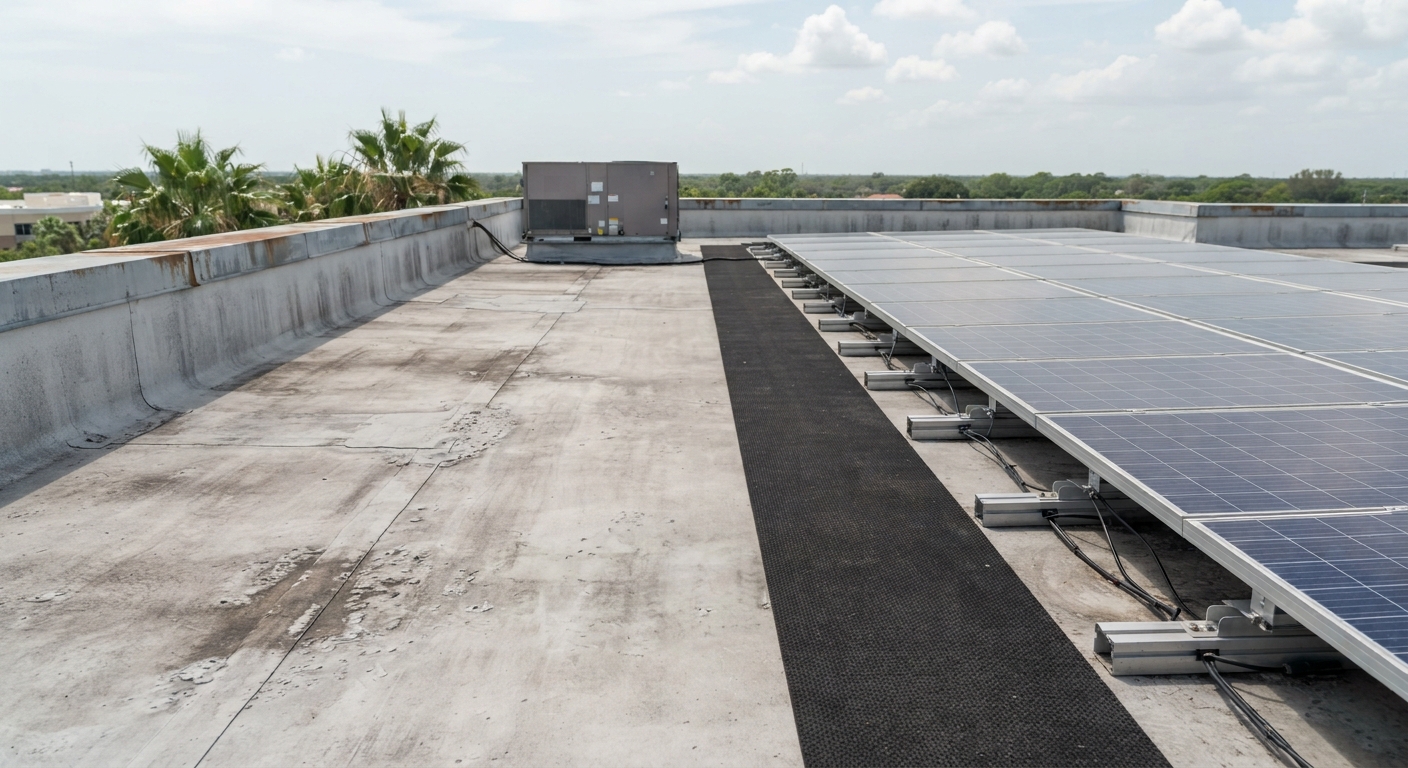
A rooftop array and the membrane under it share a service life, and an array placed on a roof with a few years left commits the owner to a mid-life remove-and-reinstall. Have a roof consultant core and moisture-scan the roof before the proposal is final; AGT’s guide to keeping commercial roof warranty coverage when solar goes on lists the manufacturer steps. Advanced Green Technologies was founded in 2007 by Advanced Roofing, and where a membrane is near the end of its life, Advanced Roofing’s re-roofing division can replace it first. AGT’s roof and drone solar surveys document the existing condition before design starts.
Parking structures are often the better host on an office campus. AGT’s project portfolio includes the Raymond James Solar Parking Garages in St. Petersburg, a 1.7 MW system built on two existing parking garages at an operating corporate headquarters (AGT solar project portfolio). Building over parking moves the work away from the occupied roof, at the cost of garage traffic management during construction; see AGT’s solar carports and rooftop solar installation pages. No array is hurricane-proof: racking is designed to the site’s rated wind pressures, storms can exceed them, and warranties carry wind-speed limits and exclusions.
Which tax, code, and utility rules should a Florida office landlord check as of November 2026?
Each item below is dated and should be rechecked on the day a proposal or lease amendment is signed.
- Federal credit. Projects that begin construction after July 4, 2026 must be placed in service by December 31, 2027 for the section 48E credit; the tax advisor confirms eligibility, rate, and foreign-entity-of-concern restrictions.
- Property tax. Section 193.624, Florida Statutes, excludes 80% of the just value a renewable energy source device adds to nonresidential property, for devices installed on or after January 1, 2018. The lease’s tax pass-through decides who sees the benefit; AGT’s guide to Florida solar property and sales tax exemptions for businesses covers reporting.
- Financing. Section 163.082, Florida Statutes, allows commercial property improvements to be financed through non-ad valorem assessments collected with property taxes, and requires written consent from current mortgage holders or servicers.
- Metering. PSC Rule 25-6.049 was amended effective November 8, 2026; confirm the current text before relying on the central HVAC exception or the cost-allocation limit.
- Code. The 9th Edition Florida Building Code governs permit applications submitted on or after December 31, 2026.
Decision checklist: who confirms each item before a landlord approves office building solar?
Each item belongs to a named role and should be closed before the solar contract or lease amendment is signed.
- Asset manager: map every lease by type and remaining term, and flag which leases allow recovery of capital improvements that reduce operating costs.
- Property manager: pull 12 months of interval data for the house account and list every load it serves.
- Electrical engineer: confirm the service rating, the point of interconnection, and the tie-in shutdown length.
- Roof consultant: core and moisture-scan the roof and state remaining service life in years.
- Real estate attorney: confirm no electricity is sold to tenants, and draft any cost-recovery or roof-license language.
- Tax advisor: confirm construction-start and placed-in-service dates, credit rate, and depreciation.
- Lender: confirm consent for the improvement and any PACE assessment or equipment lease.
- Utility: confirm the net metering tier, interconnection requirements, and house-account demand billing.
- Solar designer: hold fire-code setbacks and equipment clearances, and model production against the house load.
Frequently Asked Questions
Can a landlord sell solar power to office tenants in Florida?
Generally no. In PW Ventures v. Nichols (1988), the Florida Supreme Court upheld a finding that selling on-site electricity to even one customer can make the seller a public utility under section 366.02. PSC Rule 25-6.049 also caps a master-metered customer’s reallocation of electricity costs at actual cost. Landlords capture solar value through their house account or lease cost-recovery terms.
Who gets the savings from solar on a triple net leased building?
Under a triple net lease, utility costs pass through to tenants, so a landlord-owned array lowers what tenants reimburse and the savings flow to them. The landlord recovers its investment only if the lease allows capital improvements that reduce operating costs to be amortized into operating expenses. Review each lease before sizing the array.
Can a commercial tenant install solar on a leased building in Florida?
Yes, with the landlord’s written consent and usually the lender’s. The array offsets the tenant’s own utility account. The lease or a roof license should cover roof warranty, insurance, access for roof repairs, and removal at lease end. Tenants should compare their remaining term with the expected payback before committing.
Does solar on an office building raise its property tax in Florida?
Partly. Section 193.624, Florida Statutes, excludes 80% of the just value a renewable energy source device adds to nonresidential property installed on or after January 1, 2018, and the 2026 text sets that subsection to expire December 31, 2037. The county property appraiser assesses the rest, and the lease decides whether tenants bear it.
What happens to a rooftop array when the office roof needs replacing?
The array is removed, staged, and reinstalled after the new roof goes on, which adds labor and lost production during the outage. That cost is why roof condition belongs in the solar decision. Replacing a short-lived roof first, or building over parking instead, avoids a mid-life remove-and-reinstall.
Is the federal solar tax credit still available for office building solar in 2026?
For projects that begin construction after July 4, 2026, the section 48E credit requires the system to be placed in service by December 31, 2027. Earlier starts follow separate continuity rules. Beginning-of-construction guidance in IRS Notice 2025-42 has been litigated, so have a tax advisor confirm the timeline before signing a construction contract.
Where office building solar pays a Florida landlord
On a leased Florida office building, solar pays the landlord where the array offsets an account the landlord pays or where the lease lets the landlord recover the capital cost. Florida’s metering rule keeps central HVAC and common loads on the house service in many multi-tenant buildings, and Florida law generally rules out selling solar output to tenants. The roof, the service rating, the December 31, 2027 placed-in-service date, and the December 31, 2026 code change set the limits. A building whose leases send every dollar of savings to tenants, or whose roof will not outlast the array, is a weak candidate. A statewide EPC contractor built for occupied commercial buildings may also not be the lowest bid for a small, simple array.
Written by The Technical Team at Advanced Green Technologies. Founded in 2007, Advanced Green Technologies is 100% employee-owned and ranked #1 among Florida commercial and industrial EPC contractors on Solar Power World’s 2026 Top Solar Contractors list (2026 Solar Power World ranking announcement).
Planning solar on a leased office building? Request a quote or call (888) 735-2641 to schedule a roof, meter, and lease-structure review with the Advanced Green Technologies team.