
At a glance: Advanced Green Technologies built a 352 kW DC solar array on two curved court canopies at The Fort, the 43-court pickleball complex in Fort Lauderdale’s Snyder Park. This case study explains how canopy-mounted solar works, how it compares with rooftop, carport, and ground-mount options, what delayed commissioning, and which Florida code, interconnection, and federal tax dates apply in 2026 and 2027. It closes with a role-by-role checklist for owners, engineers, contractors, utilities, and advisors.
A sports facility solar installation is decided in the structure, the electrical room, and the utility queue long before modules arrive on site. Advanced Green Technologies (AGT) built a 352 kW DC array on two court canopy structures at The Fort, the 43-court pickleball complex in Fort Lauderdale’s Snyder Park, and its project record for The Fort shows where the schedule risk sat. AGT reports finishing its contract scope on time and within budget, yet final commissioning slipped about three months on a transformer outside its scope, and utility approval for interconnection was listed as pending. For an owner, that gap means an array that is built, paid for, and idle while a budget year or a federal tax-credit deadline runs.
This article uses The Fort as a working example for the developer, owner’s representative, or facility director planning covered courts, grandstand shade, or field canopies in Florida, and for the general contractor coordinating the trades around them. It does not argue that every sports facility should add solar, and it makes no estimate of The Fort’s financial return.
Why are Florida sports facilities putting solar on court canopies?
Florida sports facilities are adding solar to court canopies because the structure that shades players is often the largest open, unshaded surface on the site. The City of Fort Lauderdale’s solar power guidance for property owners cites close to 3,000 hours of annual sunshine and notes the city’s SolSmart Gold designation for streamlining solar permits. The same guidance tells owners to check the condition of the surface before installing, because removing a system later to repair what sits under it is expensive.
The Fort follows that pattern. Miller Construction, the general contractor, describes the complex on its project page for The Fort Pickleball Complex as a 10-acre site with 43 courts, 14 of them weatherproof, and reports that 20,000 square feet of solar panels were installed to support energy efficiency. AGT’s project record lists Miller Construction as its customer and describes AGT’s scope as the full design, procurement, and installation of the photovoltaic system on the newly built court canopies.
Timing pressure comes from federal and state rules. The IRS page on the clean electricity investment credit describes a base credit of 6% of qualified investment, rising to as much as 30% for facilities that meet prevailing wage and apprenticeship requirements. IRS Notice 2025-42 explains that, as of October 21, 2026, solar facilities beginning construction after July 4, 2026 must be placed in service by December 31, 2027 to remain eligible. On the state side, the 9th Edition of the Florida Building Code takes effect December 31, 2026, according to the Florida Building Commission. Whether a project qualifies for a credit, and which code edition governs it, are questions for the owner’s tax advisor and building official.
How does a solar array on a court canopy work?
A canopy-mounted array is a structural system first and an electrical system second. Modules clamp to aluminum rails, the rails fasten to the canopy framing, and every pound of dead load and every gust of wind uplift travels through those connections into the columns and foundations. Broward County sits in the High-Velocity Hurricane Zone, so the engineer of record has to carry those loads in the canopy design. Adding an array to a structure that was never designed for one becomes a re-engineering exercise instead of an installation task.
Curved canopies add an electrical consideration. Modules that follow an arc sit at different tilts, so rows on the crown and rows near the eave receive different amounts of sunlight through the day. Designers group modules of similar orientation onto the same inverter input so that one weaker section does not pull down its neighbors. From the inverters, alternating current runs to the facility’s switchgear and transformer and then to the utility meter, and a monitoring gateway reports production so the owner and the operations provider can find a failed string or inverter quickly.
AGT’s project record for The Fort lists the components in the table below and describes the two canopies as architecturally curved steel structures built to shade the courts while carrying the solar equipment.
| Component | Specification | Why it matters on a sports facility |
|---|---|---|
| System size | 352 kW DC | Above 100 kW AC, the array falls in the largest interconnection tier under Florida PSC Rule 25-6.065 |
| Modules | 880 Canadian Solar 400 W | Module count and weight set the canopy’s design dead load |
| Inverters | Six Chint 50 kW units (300 kW AC combined) | Ground-level cabinets need protected, serviceable space inside the fencing plan |
| Racking | IronRidge | Rails carry wind uplift into the canopy framing |
| Structure | Two curved steel canopy structures | Curvature changes module tilt from crown to eave, which shapes string design |
| Monitoring | Chint Flex Gateway | Lets the owner and O&M provider see string and inverter faults |
| Design offset | About 77.7% of estimated facility energy use | AGT design estimate, not a metered result |
The 77.7% offset in the record is AGT’s design estimate. Actual offset depends on how the facility uses power, including court lighting and events after sunset, when the array produces nothing.
Court canopy, rooftop, carport, or ground mount: which surface fits a sports facility?
The right surface for a sports facility array is the one whose structure, service life, and location already suit the job, and each option gives something up. Clubhouses and pro shops usually have roofs, which makes commercial rooftop solar in Fort Lauderdale the first comparison most owners run. Roof area on a sports complex is often small relative to the courts, and a rooftop array inherits the remaining life of the membrane under it. Parking lots and spare land are the other candidates.
| Option | Best fit | What it adds | Where it falls short |
|---|---|---|---|
| Court canopy or covered-court structure | New covered courts or grandstand shade | Shade for players and spectators plus generation from one structure | Must be engineered for module dead load and uplift from day one; finishes may bar foot traffic, as at The Fort; more steel than a roof-mounted rack |
| Existing building roof (clubhouse, pro shop) | A roof with many years of life left and clear area | No new structure; short electrical runs | Limited area; the array comes off when the roof is replaced; roof warranty coordination required |
| Parking lot solar carport | Large surface lots | Shaded parking and an EV charging option | Lot foundations, vehicle clearance, buried utilities, and stormwater add cost; lot closures during work |
| Ground mount | Unused land outside the playing footprint | Simplest racking and maintenance access | Uses land the facility may want for courts or parking; fencing and setbacks |
A canopy is the strongest fit when the facility is building covered courts anyway, because the shade structure and the array share one set of columns and one foundation design. AGT builds solar carports and canopies through in-house design, metal fabrication, and construction divisions, and its earlier sports-venue work includes solar canopies at Daytona International Speedway, completed in February 2016 according to AGT’s project page. A statewide EPC contractor is not always the lowest-cost option for a small, single-roof system, and owners should weigh that against the coordination load of a multi-structure project.
What drives cost and schedule on a sports facility solar installation?
Budget, schedule, and production on a sports facility array move with a short list of variables, and most of them are settled before construction starts. AGT does not publish pricing, and no figure in this article should be read as a price.
| Driver | Effect on budget, schedule, or output | Source |
|---|---|---|
| Structure designed for solar loads | Canopy steel, connections, and foundations sized for module weight and wind uplift; a retrofit costs more than designing it in | Florida Building Code; engineer of record decides |
| Interconnection tier | Systems above 100 kW AC and up to 2 MW fall in Tier 3, where the utility may require an interconnection study and added equipment | Fla. Admin. Code R. 25-6.065(4) |
| Transformer and switchgear delivery | At The Fort, a transformer managed by the electrical contractor postponed final commissioning by about three months | AGT project record |
| Federal credit timing | Solar beginning construction after July 4, 2026 must be placed in service by December 31, 2027 to stay eligible | IRS Notice 2025-42 |
| Equipment space on site | Limited ground area and perimeter fencing constrained inverter placement at The Fort | AGT project record |
| Load profile | Court lighting and evening events use power after sunset; daytime surplus offsets later use through net metering credits for up to 12 months | Fla. Admin. Code R. 25-6.065(8) |
The interconnection rule converts DC nameplate capacity to AC at a factor of 0.85, so arrays above about 118 kW DC reach Tier 3. Owners should ask the utility early whether a study will be required and how long it is expected to take, because that answer sets the commissioning date as much as the construction schedule does.
What changes when solar is installed on an active Florida sports site?
Solar on a sports facility is built among other trades, and on an open facility it is built around players and spectators. At The Fort, AGT’s record describes structural steel installers, fencing crews, and electricians working the site at the same time. AGT responded with joint field walks, progress meetings, and a resequenced installation order so each trade could keep working.
Access was the second constraint. The canopy surfaces carried a green finish that crews were not permitted to walk on, so installers worked from aerial lifts and moved across the racking once it was installed. Work at height falls under OSHA’s duty to have fall protection in 29 CFR 1926.501, and AGT’s record describes a site-specific safety plan with training in fall protection and restraint, aerial lift operation, and access methods for curved canopies, with no safety incidents reported.
Ground space was the third. Limited area and perimeter fencing restricted where the inverters could go, and AGT worked with the general contractor to find locations that stayed secure and serviceable. Miller Construction reports raising low-lying parts of The Fort’s site by up to 3 feet with reused fill to reduce flooding, and equipment pads should sit where the civil design keeps them dry.
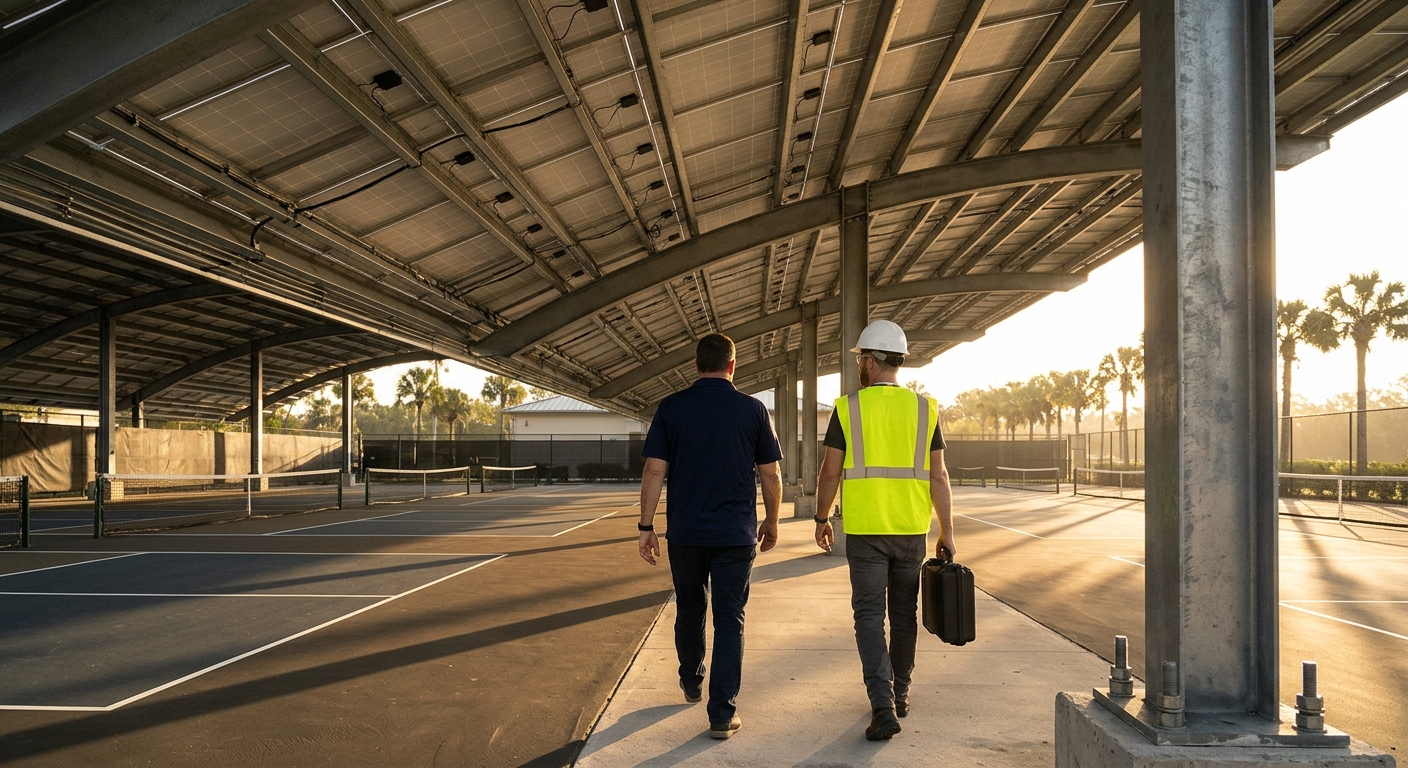
Adding solar to a facility that is already open changes the sequence. Court closures are phased so play continues on the rest of the complex, lift work and deliveries are scheduled outside league and tournament hours where the site allows, and the facility manager receives notice of every closure and electrical shutdown before it starts. In Broward and Miami-Dade counties, products and attachments also have to meet the High-Velocity Hurricane Zone approval requirements that the building official enforces.
Which code, interconnection, and tax dates apply in 2026 and 2027?
Three sets of dates govern a Florida sports facility solar project starting now, and each belongs to a different professional. The Florida Building Code’s 9th Edition takes effect December 31, 2026, and Miami-Dade County’s permitting notice on the 9th Edition states that applications submitted on or after that date must comply with it. The structural engineer of record and the building official decide which edition governs a given permit.
Interconnection follows Florida Public Service Commission Rule 25-6.065 on customer-owned renewable generation, which applies to investor-owned utilities, including Florida Power & Light. The rule requires local code officials to inspect and approve customer-owned generation before it operates in parallel with the grid, sets the Tier 3 study path for larger systems, and lets excess generation credits carry forward for up to 12 months before the utility pays for unused credits at its as-available energy rate. Demand charges still apply. AGT’s guide to commercial solar interconnection delays in Florida covers the utility process in more detail.
Federal credit timing follows IRS Notice 2025-42 as described above, and AGT’s article on the commercial solar tax credit deadline tracks the current rules. All three items should be re-checked on the day a contract is signed, and eligibility questions go to the owner’s tax advisor.
What should a sports facility owner settle before signing a solar contract?
A solar contract for a sports facility is ready to sign when each item below has a named owner and a written answer.
- Owner or developer: decide early whether covered courts or shade structures will carry solar, so the structure is designed for it instead of modified later.
- Structural engineer of record: confirm the canopy design loads include modules, rails, and wind uplift for the site’s risk category. AGT’s commercial solar engineering process starts with this load check.
- Architect: specify whether canopy finishes can take foot traffic; if they cannot, put lift access and fall protection into the schedule.
- General contractor: build a trade sequence that gives the solar crew clear access windows between steel, fencing, and electrical work.
- Electrical contractor: confirm transformer and switchgear lead times and who carries the schedule risk if they slip.
- Solar EPC contractor: reserve ground space for inverters inside the fencing plan, with service clearance, and confirm the owner’s monitoring access.
- Utility: confirm the interconnection tier, whether a study is required, and the expected approval timeline.
- Tax advisor: confirm beginning-of-construction and placed-in-service dates against current IRS guidance.
- Insurer: confirm coverage for the array and the structure under it, including wind exclusions.
- Operations and maintenance provider: set inspection intervals, including post-storm checks, through a plan such as AGT’s commercial solar operations and maintenance service.
Frequently Asked Questions
How big is the solar installation at The Fort in Fort Lauderdale?
AGT’s project record lists a 352 kW DC system of 880 Canadian Solar 400-watt modules on two curved steel canopy structures, with IronRidge racking and six Chint 50 kW inverters. AGT handled design, procurement, and installation for Miller Construction, the general contractor. The listed offset of about 77.7% of facility energy use is a design estimate, not a metered result.
Can solar panels be installed on pickleball court canopies?
Yes, when the canopy is engineered for the array’s dead load and wind uplift. The simplest path is to design covered courts for solar from the start, as The Fort’s canopies were. A canopy built without solar loads needs a structural review, and possibly reinforcement, before modules go on, and the engineer of record makes that determination.
How long does it take to commission a commercial solar canopy?
Installation follows the construction schedule, while commissioning waits on transformers, switchgear, local inspections, and utility approval. At The Fort, AGT reports finishing its scope on time, but a transformer delay outside that scope pushed final commissioning back about three months, and utility approval was listed as pending. Owners should track utility and equipment milestones separately.
Is a court canopy better than commercial rooftop solar in Fort Lauderdale?
The answer depends on what the site already has. A canopy suits a facility that is building covered courts, because one structure delivers shade and generation. A rooftop array suits a clubhouse roof with years of service life left and clear area. Rooftop systems avoid new steel, and canopies avoid tying the array to an aging membrane.
Will a sports facility still have an electric bill after installing solar?
Almost always. Under Florida PSC Rule 25-6.065, excess daytime generation becomes a credit against later usage for up to 12 months, but the facility still pays the customer charge and any demand charge. Courts lit after sunset draw power when the array produces nothing, so savings depend on the tariff, the load profile, and the system design.
Do solar canopies hold up to hurricanes in Broward County?
Solar canopies are engineered to rated wind pressures under the Florida Building Code, and Broward County projects follow High-Velocity Hurricane Zone requirements. Storms can exceed design conditions, and warranties carry wind limits and exclusions. FEMA’s recovery advisories on rooftop solar panel attachment recommend regular inspection of attachments, and AGT’s guide to hurricane-rated solar carports covers wind ratings and coastal corrosion.
What The Fort shows about planning solar for sports facilities
The Fort’s array shows that a sports facility solar installation is won in preconstruction. AGT’s record describes a scope delivered on time and within budget on structures designed to carry it, with the remaining delay sitting in transformer delivery and utility approval, items that belonged to other parties. Owners who design the structure for solar, reserve equipment space inside the fencing plan, and track the utility and tax dates as separate milestones give their array the best chance of producing on the day construction ends. The engineer, the utility, and the tax advisor each own part of that answer, and the contract should name them.
Written by The Technical Team at Advanced Green Technologies. Founded in 2007, Advanced Green Technologies is 100% employee-owned and was ranked #1 among Florida commercial and industrial EPC contractors on Solar Power World’s 2026 Top Solar Contractors list, as noted in AGT’s 2026 Top Solar Contractors announcement.
To plan covered courts, grandstand shade, or a canopy array for a Florida sports facility, request a solar quote or call (888) 735-2641 to reach AGT’s Fort Lauderdale commercial solar team.