

At a glance: A hurricane rating on a solar carport is a design wind speed, and in South Florida the right number depends on the county, the risk category, and the exposure of the lot. This guide shows the Florida Building Code’s HVHZ values for Miami-Dade and Broward, explains where carports fail in storms and how salt air affects their steel, breaks down what drives savings on FPL commercial rates, and lists the code, tax, and utility dates that matter through 2027, ending with a checklist by role.
Hurricane-rated solar carports in South Florida are only as strong as the site-specific engineering behind the rating. The design wind speed a canopy must resist depends on the county, the risk category the engineer of record assigns, and the exposure of the lot, and the structure resists that load only through its connections, foundations, and coatings. A canopy bought on a headline wind speed can be designed to the wrong number, or detailed with hardware that loosens and corrodes, over a lot full of cars and people. This article covers wind ratings in Miami-Dade, Broward, and Palm Beach counties, salt air, FPL savings, and the dates that matter through 2027. It makes no structural, tax, or code determination for any site.
Why do hurricane-rated solar carports in South Florida need a site-specific wind design?
A solar carport is a freestanding structure over occupied parking, so the Florida Building Code sets its wind design by location and by risk category, as it does for any other structure. The code defines the High-Velocity Hurricane Zone as Miami-Dade and Broward counties, and Section 1620.2 of the Florida Building Code, 8th Edition (2023), Building, Chapter 16 sets a single 3-second-gust design wind velocity for each risk category in each county. Palm Beach County sits outside the HVHZ, and its design speeds come from the code’s wind speed maps for the specific site.
| County | Risk Category I | Risk Category II | Risk Category III | Risk Category IV |
|---|---|---|---|---|
| Miami-Dade | 165 | 175 | 186 | 195 |
| Broward | 156 | 170 | 180 | 185 |
Those numbers are a different measurement from a storm’s category. The National Hurricane Center’s Saffir-Simpson Hurricane Wind Scale rates hurricanes by maximum sustained wind, and Category 5 begins at 157 mph sustained. Code design speeds are 3-second gusts, as Section 1620.2 states, and the engineer of record converts the design speed, the exposure category of the open lot, and the canopy geometry into the pressures every member and connection must carry.
The calendar adds pressure. The Florida Building Code, 9th Edition takes effect December 31, 2026, and Miami-Dade’s permitting center has notified applicants that portal submissions after 4 p.m. on December 30, 2026 must comply with the new edition. As of October 6, 2026, the building official confirms which edition governs each permit.
What actually fails on a solar carport in a hurricane?
A carport fails along its load path, and the weakest link is rarely the steel column itself. Wind flowing under an open canopy pushes it upward while wind passing over the top pulls it upward, so uplift arrives at the module frames, passes through clamps and purlins into the beams, and ends in a small number of columns and foundations that must also resist the overturning moment of the whole canopy. Every connection along that path sees repeated load reversals during a long storm, and a fastener that has loosened or corroded carries less load than it did the day it was installed.
Caribbean field investigations show the same pattern. RMI’s Solar Under Storm III report, which examined ground-mounted arrays hit by Hurricane Beryl in 2024, names inadequate load design, low-cycle fatigue of module frames, top-down clamps, and self-tapping screws among the common failure points, and emphasizes dual-post piers, through-bolting, lateral racking support, and vibration-resistant connections. FEMA’s Recovery Advisory 5 on rooftop solar panel attachment, written after Hurricanes Irma and Maria, sets out attachment design, installation, and maintenance practices for arrays in hurricane regions. Carport canopies use much of the same module hardware.
| Load path element | What it carries | How it fails | What to ask the bidder |
|---|---|---|---|
| Module-to-purlin attachment | Uplift on each module | Clamps slip or loosen; module frames fatigue under cycling | Attachment method, fastener specification, torque values |
| Purlin-to-beam connection | Uplift from each row of modules | Self-tapping screws pull out; bolts lose preload | Bolt type, size, and locking method |
| Beam-to-column connection | Canopy uplift and overturning | Bolt group or weld overstressed if the design speed was too low | Design wind speed, risk category, and exposure on the drawings |
| Column base and anchor bolts | Overturning moment and shear | Anchor bolts corrode or were never tensioned | Anchor bolt specification, coating, and inspection plan |
| Foundation (pier or auger-cast pile) | Uplift and overturning into the soil | An undersized pier rotates or pulls out | Geotechnical report reference and basis for pier depth |
How do solar carport designs compare when the wind rating is the same?
Two canopies can carry the same rated wind speed and age very differently. Structural form, module attachment, and corrosion protection set how much margin the structure keeps and how easily it can be inspected. AGT’s overview of commercial solar carports in Florida compares canopies with rooftop arrays; the table below compares choices within a carport.
| Option | What it does well | Where it falls short |
|---|---|---|
| Single-column cantilever canopy | Fewest columns in drive aisles; open parking geometry | Highest overturning moment per foundation; less redundancy if one connection fails |
| Two-column (dual-post) canopy | Shares uplift and overturning between two foundations; RMI emphasizes dual-post supports | More columns in the parking field; can cost stalls or require restriping |
| Long-span multi-column canopy | Covers several rows with fewer separate structures | Longer beams and more connections to inspect; larger cranes for erection |
| Through-bolted module attachment | Fixed connection that RMI emphasizes for hurricane exposure | Slower to install; the module manufacturer must permit the bolt pattern |
| Top-down clamp attachment | Fast installation and module replacement | Named by RMI among common failure points; relies on torque staying in place |
| Hot-dip galvanized steel (ASTM A123) | Zinc protects cut and scratched steel sacrificially | Coating wears faster in tropical marine air; field cuts and welds need repair |
| Duplex system (paint or powder over galvanizing) | Adds a barrier layer over the zinc in salt air | Higher cost; the topcoat needs its own inspection and touch-up |
Advanced Green Technologies states that its solar carports are designed to withstand wind speeds up to 180 mph, a company rating for its engineered designs that does not describe carports in general. Each project is still designed to the speed its engineer of record assigns, and in Miami-Dade the code values above run from 165 mph to 195 mph by risk category. A canopy serving a hospital or emergency facility can be assigned a higher risk category than one serving a retail center, so the design wind speed, risk category, and exposure belong on the drawings of every bid. No carport is immune to hurricanes: a storm can exceed design loads, and module and structure warranties carry wind limits and exclusions.
What drives the energy savings of a South Florida solar carport?
A solar carport reduces the kilowatt-hours a building buys, which is only part of a commercial bill. Under Florida Power & Light’s GSD-1 rate schedule, effective January 1, 2026, a customer with 25 kW to 499 kW of demand pays a base demand charge of $12.70 per kW, set by its highest 30-minute interval in the month, plus a base energy charge of 2.825 cents per kWh before fuel and other clause charges; larger GSLD-1 accounts pay $15.12 per kW of demand. A canopy reliably cuts the energy portion, but it cuts the demand charge only when the peak falls in strong sun. Pairing the canopy with battery storage for peak shaving is the usual way to address demand.
Florida’s net metering rule, 25-6.065, F.A.C., requires investor-owned utilities to offer net metering for customer-owned renewable systems up to 2 MW. Excess energy carries forward as a kilowatt-hour credit, and credits left at the end of the calendar year are paid at a rate based on the utility’s as-available energy cost. A kilowatt-hour used on site offsets the full retail energy rate, so the structure favors a carport sized to the building’s own daytime use. FPL’s Tier 3 interconnection agreement covers systems above 100 kW and up to 2 MW and carries a $1,000 application fee.
| Driver | Why it moves savings | Source and date |
|---|---|---|
| Rate schedule (GSD-1, GSLD-1) | Sets the split between demand ($/kW) and energy (cents/kWh) charges | FPL Tariff Section 8, effective Jan. 1, 2026 |
| Load timing | Daytime use is offset at the retail energy rate; exports earn kWh credits | Rule 25-6.065, F.A.C. (accessed Oct. 6, 2026) |
| System size vs. annual use | Credits left at year end are paid at an as-available energy rate | Rule 25-6.065, F.A.C. |
| Shading, tilt, and soiling | Light poles, trees, and nearby buildings cut production on parts of the lot | Site production model by the solar designer |
| Property tax treatment | 80% of the just value attributable to the device on nonresidential property is not assessed | Section 193.624, F.S. (2026) |
| Federal credit timing | The placed-in-service deadline can change the after-tax cost | IRS Notice 2025-42 |
Section 193.624, Florida Statutes, excludes 80 percent of the just value attributable to a renewable energy source device from the assessed value of nonresidential property, and its definition includes structural supports used as integral parts of the system. It also excludes any structure that would be required without the device, so how much carport steel qualifies is a question for the county property appraiser and the owner’s tax advisor.
What changes when a solar carport goes up over an occupied South Florida parking lot?
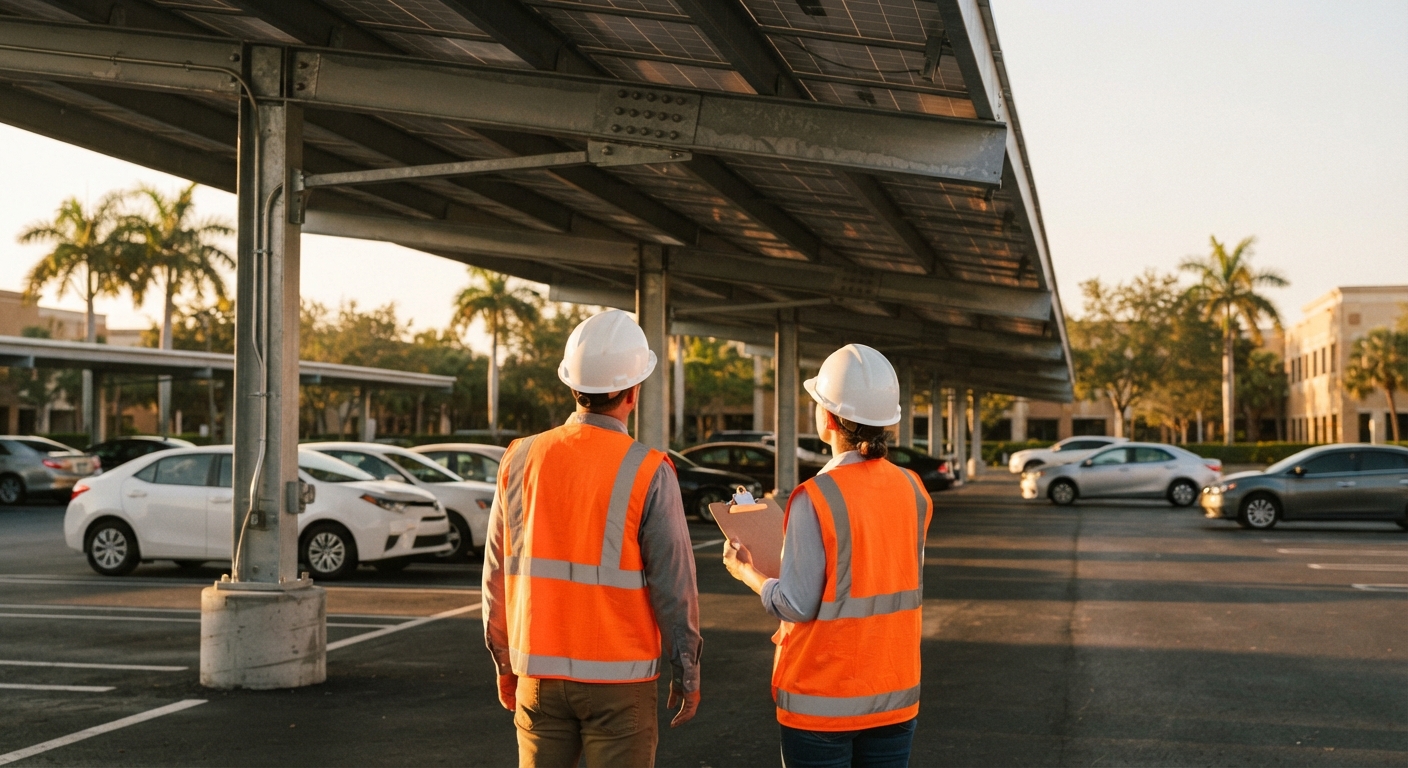
On an occupied site the lot keeps working while the canopy is built. Construction is phased so one section of stalls closes at a time, accessible routes and stall counts stay compliant in each phase, and tenants receive notice before each closure. Crane picks for steel and modules are scheduled outside business hours where the site allows. Underground utilities are located before excavation; on its 1.4 MW carport for United Therapeutics in Jacksonville, AGT performed ground-penetrating radar locates at every excavation location and installed auger-cast pile foundations. In South Florida, AGT’s documented work includes the 1.4 MW solar carport at Florida International University in Miami, completed in April 2016 with more than 4,400 modules on a custom canopy that shades 400 vehicles.
Hurricane season changes the construction plan itself. A partly erected canopy or staged modules are more exposed than the finished structure, and the season runs June 1 through November 30. A bid for work in those months should include a written plan for securing incomplete steel, purlins, and stored modules when a watch is issued, as AGT’s commercial solar hurricane preparedness guide describes for finished systems.
Salt air is the slower threat. The American Galvanizers Association’s guide to estimating the life of hot-dip galvanized coatings plots time to first maintenance against coating thickness for five climate types, including tropical marine, and notes that ASTM A123 requires a minimum average of 4.0 mils of zinc on structural steel 1/4 inch or thicker. On a lot within sight of the bay or the Intracoastal, the coating specification, the repair of field cuts and welds, and the isolation of aluminum rails from steel framing deserve the same attention as the wind design.
Which code, tax, and utility dates apply to South Florida solar carports through 2027?
The building code calendar belongs to the local building official, with the 9th Edition effective December 31, 2026. In the HVHZ, Miami-Dade’s solar systems permit document guideline asks for signed and sealed drawings and calculations showing that exposed solar equipment meets wind load, that support framing meets uplift and lateral forces, and that connections are designed for wind loads. Which carport components also need a Miami-Dade Notice of Acceptance or Florida Product Approval is a determination for the engineer of record and the building official.
The federal calendar is tighter. Under IRS Notice 2025-42, solar facilities that begin construction after July 4, 2026 lose the Section 48E clean electricity investment credit unless they are placed in service by December 31, 2027. The notice treats planning, design, permitting, and soil test drilling as preliminary activities that do not begin construction, and lists the installation of racks or other structures that affix PV panels as on-site physical work that can. As of October 6, 2026, only the owner’s tax advisor can confirm eligibility, foreign-entity rules, and bonus amounts. AGT’s commercial solar tax credit deadline guide covers the timeline in more detail.
On the utility side, Miami-Dade’s guideline tells Tier 2 and Tier 3 designers to contact FPL before final design to confirm the disconnect switch, and municipal utility customers follow that utility’s own terms.
Decision checklist for hurricane-rated solar carports in South Florida
- Owner or asset manager: require every bid to state the design wind speed, risk category, exposure category, and code edition on its drawings.
- Structural engineer of record: assign the risk category, base the foundation design on a site geotechnical report, and specify module attachment and fastener locking.
- Facility manager: pull 12 months of 30-minute interval data and mark when the building’s demand peaks occur.
- Property manager: map stall counts, accessible routes, and tenant parking needs for each construction phase.
- Contractor: provide the coating specification, field touch-up procedure, and a storm-securing plan for incomplete work, consistent with AGT’s commercial solar engineering process.
- Electrical engineer: confirm the FPL interconnection tier early.
- Tax advisor: set the construction-start and placed-in-service schedule against the December 31, 2027 date.
- Operations and maintenance provider: schedule annual torque and corrosion checks of clamps, bolts, and base plates, plus post-storm inspections, through a commercial solar operations and maintenance program.
Frequently Asked Questions
How much wind can a solar carport withstand in South Florida?
A solar carport withstands the design wind speed its engineer of record assigns, and that speed depends on location and risk category. Under Section 1620.2 of the Florida Building Code, 8th Edition, Miami-Dade values range from 165 to 195 mph and Broward values from 156 to 185 mph, stated as 3-second gusts. Palm Beach County designs use the code’s site wind maps. Storms can exceed design loads, so connections, foundations, and maintenance matter as much as the rating.
Is a solar carport wind rating the same as a hurricane category?
No. The National Hurricane Center’s Saffir-Simpson scale rates hurricanes by maximum sustained wind, with Category 5 starting at 157 mph. Building code design speeds are 3-second gusts used to calculate pressures on the structure, so a carport’s rated speed and a storm’s category measure different things. Ask the engineer of record which risk category and exposure category the design assumes.
Do solar carports in Miami-Dade and Broward need product approval?
Both counties are in the High-Velocity Hurricane Zone. Miami-Dade’s solar permit guideline asks for signed and sealed drawings and calculations showing that the solar equipment, support framing, and connections meet wind loads. Whether specific components also need a Miami-Dade Notice of Acceptance or Florida Product Approval is decided by the engineer of record and the building official for that permit.
How much can a solar carport save on an FPL commercial bill?
Savings depend on the rate schedule, when the building uses power, and how the system is sized. On FPL’s GSD-1 and GSLD-1 schedules, a carport reliably offsets energy charges, while demand charges set by the highest 30-minute interval fall only when that peak coincides with strong sun. Exported energy earns kilowatt-hour credits, with a year-end payout at a lower rate. A solar designer should model savings from 12 months of interval data.
Can a solar carport still qualify for the federal tax credit if construction starts now?
Under IRS Notice 2025-42, solar facilities that begin construction after July 4, 2026 must be placed in service by December 31, 2027 to claim the Section 48E credit. Planning, permitting, and soil test drilling do not count as beginning construction. Whether a specific project qualifies, including foreign-entity rules and bonus amounts, is a determination for the owner’s tax advisor.
How is a solar carport protected from salt-air corrosion near the coast?
Coastal carports rely on hot-dip galvanized steel to ASTM A123, sometimes with a paint or powder topcoat in a duplex system, plus repair of field cuts and welds and isolation of dissimilar metals. The American Galvanizers Association estimates time to first maintenance by coating thickness and climate type, including tropical marine. Annual inspections of base plates, anchor bolts, and fasteners catch corrosion before it reduces capacity.
The rating, the details, and the calendar decide how a South Florida carport performs
A hurricane rating on a South Florida solar carport starts a design set by county, risk category, and exposure, and it holds only if the clamps, bolts, foundations, and coatings keep carrying the load in salt air. The savings follow FPL’s rate structure and Florida’s net metering rule, which favor a canopy sized to the building’s own use, and the federal credit now turns on a December 31, 2027 placed-in-service date. Owners who put design criteria on the drawings and coating and storm plans in the bid can compare proposals on the terms that decide performance.
Written by The Technical Team at Advanced Green Technologies. Founded in 2007, Advanced Green Technologies is 100% employee-owned and was named the #1 commercial and industrial EPC contractor in Florida, and #3 overall in Florida, on Solar Power World’s 2026 Top Solar Contractors list (read AGT’s 2026 ranking announcement).
To plan a hurricane-rated solar carport for a property in Miami, Fort Lauderdale, or Palm Beach, request a free quote from Advanced Green Technologies or call (888) 735-2641.