
At a glance: Inverters are usually the first major component to fail on a commercial solar array, and DOE puts their typical lifetime near ten years against 20 to 30 for modules. This article compares three paths after a solar inverter failure: component repair, like-for-like replacement, and an inverter upgrade. It explains what each costs in time and risk, what changes on an occupied Florida building, which FPL, building code, and tax rules to check, and which professional confirms each item before a contract is signed.
Commercial solar inverter replacement is a decision about the remaining life of the whole array, and the fault code that triggered it is only the starting point. The inverter is the component most likely to fail first on a commercial PV system, so most owners of a ten-year-old Florida rooftop or carport array will face this choice well before the modules wear out. A component repair, a like-for-like swap, and an upgrade that changes the inverter architecture can each be the right answer. Choosing badly costs a second outage, a second lift or crane mobilization, and a utility or permit review nobody budgeted for. This article explains how each path works, where each one falls short, and who should verify what before a contract is signed. It does not recommend an inverter brand, and it does not make tax, interconnection, or code determinations for any specific building.
Why is solar inverter failure the first major repair on an aging commercial array?
Inverters wear out sooner than modules because they are power electronics running hot for thousands of hours a year. The DOE Solar Energy Technologies Office put the typical lifetime of PV power electronics at about ten years in a May 2018 article, against 20 to 30 years for modules on the market, and it names the parts that wear: passive filters, active switches, thermal management, and packaging, stressed by everyday operation, faults, and electromagnetic disturbances. An array commissioned in 2014 has passed that mark even if its modules still produce close to plan.
Field records point the same way. A Sandia National Laboratories-led analysis published in IEEE Access in 2020 used machine learning to sort 55,000 maintenance records from more than 800 PV sites and isolate the inverter-related entries. Failure frequency varied over time and by inverter type, with communication failures more common in early years. A monitoring alarm in year two and a hard failure in year eleven call for different responses.
Architecture shapes the consequence of a failure. As the Department of Energy explains, a central inverter serves a large block of modules, a string inverter serves one set of modules, and microinverters sit on each module. When a central inverter stops, every module behind it stops. Two dated items also bear on timing this year: the 9th Edition of the Florida Building Code takes effect December 31, 2026, and federal solar credit rules changed in 2025.
What actually fails inside a commercial PV inverter?
Most inverter failures begin with heat. Capacitors and semiconductor switches age faster at high temperature, and every cloud edge adds a thermal cycle. Cooling fans and intake filters keep that heat in range, so a failed fan or a filter packed with pollen and dust produces derating on hot afternoons long before the inverter stops outright. Florida adds humidity and, near the coast, salt air that corrodes terminals, heat sinks, and enclosure seals.
Many alarms reported by the inverter originate elsewhere. A ground-fault or isolation alarm after a rainstorm often traces to a wet connector or damaged conductor insulation on the DC side, and replacing the inverter leaves that fault in place. A unit that appears offline in the portal may still be exporting energy through the meter while its communication card or the site gateway has failed. Grid events form a third category: inverters ride through small disturbances and disconnect on large or long ones, so a trip that matches a utility event is protection working as designed. Table 1 sets out the first check for each pattern. The root cause should be confirmed before any replacement is priced.
| Symptom in monitoring or on site | What it often points to | First check | Who checks |
|---|---|---|---|
| Inverter shows offline, no fault code | Lost communication or a failed monitoring gateway; the inverter may still be exporting | Compare the utility or revenue meter against the monitoring portal | O&M technician |
| Ground-fault or isolation alarms after rain | Moisture in DC connectors, wiring, or module insulation upstream of the inverter | Insulation resistance test on each string | Licensed electrician or O&M technician |
| Derating or shutdown on hot afternoons | Failed fan, clogged filter, blocked airflow, or enclosure overheating | Thermal scan of the enclosure; fan and filter inspection | O&M technician |
| Trips logged with grid voltage or frequency alarms | A utility-side event or a protection settings mismatch | Event log review against utility outage records; settings check | O&M technician with the utility |
| No power-up after a reset | Internal power stage, capacitor, or control board failure | Manufacturer diagnostic and warranty status | Manufacturer-authorized service |
| Corrosion on terminals, heat sink, or enclosure | Salt-air exposure or a failed enclosure seal | Visual inspection and terminal torque check | O&M technician |
Repair, like-for-like replacement, or upgrade: how do the three paths compare?
A component repair is the lowest-disruption path when the model is still supported and the failure is a first occurrence. It replaces the failed fan, fuse, board, or power module and returns the unit to service. Its limit is parts availability: once a manufacturer stops supporting a model, every repair depends on salvaged or third-party parts, and the outage lasts as long as the search for them.
A like-for-like replacement keeps the existing electrical design and swaps the unit for the same model or the manufacturer’s designated successor. It works when the original design was sound and the successor accepts the same string voltages, currents, and grounding. It usually still needs a permit and carries forward the original design’s limits.
An inverter upgrade, often called repowering, changes the architecture. The common commercial case replaces one central inverter with several string inverters, which limits the production lost when a single unit fails and usually improves string-level monitoring. The trade is more units to maintain and a larger design scope: new conductors or combiner changes, a revised single-line diagram, possibly transformer work, and a fresh look at code requirements for equipment on buildings. An upgrade is also the moment to decide whether the site will add battery storage later, because some inverter choices make that easier. An upgrade is not automatically the better answer; on a supported model with one failure, it can spend capital the array does not need.
| Path | What it involves | When it fits | Where it falls short |
|---|---|---|---|
| Component repair | Replace a fan, fuse, board, or power module under manufacturer service procedures | First failure on a supported model with parts in stock, often within warranty | Parts for discontinued models may not exist; repeat failures stack outages and service calls |
| Like-for-like replacement | Install the same model or the manufacturer’s designated successor in the same footprint and electrical design | The installed model is still supported and the original design is sound | Carries forward the old design’s limits; still needs a permit and may need utility notice |
| Inverter upgrade (repowering) | Change the inverter architecture, for example one central unit replaced by several string inverters, with a new single-line diagram | The model is unsupported, failures repeat, monitoring is weak, or roof or storage work is coming | Needs engineering, permitting, and possibly utility review; may require conductor, combiner, or transformer rework; more individual units to maintain |
What drives the cost and timeline of a commercial solar inverter replacement?
Equipment price is only one line of a commercial solar inverter replacement. No general cost range is offered here, because a real budget depends on the installed model, the scope of electrical change, and the site. Table 3 lists the drivers and who confirms each one.
Two drivers deserve emphasis. The first is warranty status: a manufacturer warranty may cover the replacement unit while excluding labor, lifts, and lost production, and the exact terms are in the warranty document for the installed model. The second is whether the work changes the system’s rating, because that is the point at which the utility’s own process and fees can enter the schedule. Lost production is site-specific; monitoring history and the rate schedule are the honest basis for estimating it.
| Driver | Effect on budget or schedule | Source or who confirms |
|---|---|---|
| Equipment availability | A discontinued model forces a redesign; long-lead units extend the outage | Manufacturer or distributor quote at time of bid |
| Warranty status | Equipment may be covered while labor, lifts, and lost production are not | Manufacturer warranty document for the installed model |
| Scope of electrical change | New single-line diagram, conductors, combiners, or transformer work add design and field time | Engineer of record |
| Increase in system rating | FPL requires a new application at least 30 calendar days before the change; the Tier 3 application fee is $1,000 and the study fee, if fast-track screens fail, is $2,000 | FPL Tier 3 agreement, Sheets 9.065 to 9.069 |
| Permit and inspection | Local code official inspection; the code edition depends on the permit application date | Building official |
| Access and logistics | Roof access, lifts, cranes, parking closures, and after-hours work | Contractor site plan |
| Lost production during the outage | Depends on array size, season, and the customer’s rate schedule | Monitoring data and utility bills |
What changes when the building stays open during the work?
On an occupied building, the tenants set the schedule for an inverter replacement. De-energizing the array requires opening the AC and DC disconnects and applying lockout and tagout at points that may sit in a tenant’s electrical room or a shared switchgear space, so access is arranged with the property manager before the shutdown window starts.
Rooftop work adds roof traffic. Walkway pads and protected staging protect the membrane, and the roof manufacturer’s requirements govern keeping the roof warranty in force. If the roof under a rooftop array is close to the end of its service life, the inverter decision and the roof decision belong in the same plan, and Advanced Roofing’s re-roofing team can scope the roof alongside the electrical work so the array is not disturbed twice. Carport arrays move the logistics to the parking lot: stall closures, lift placement, and pedestrian routing.
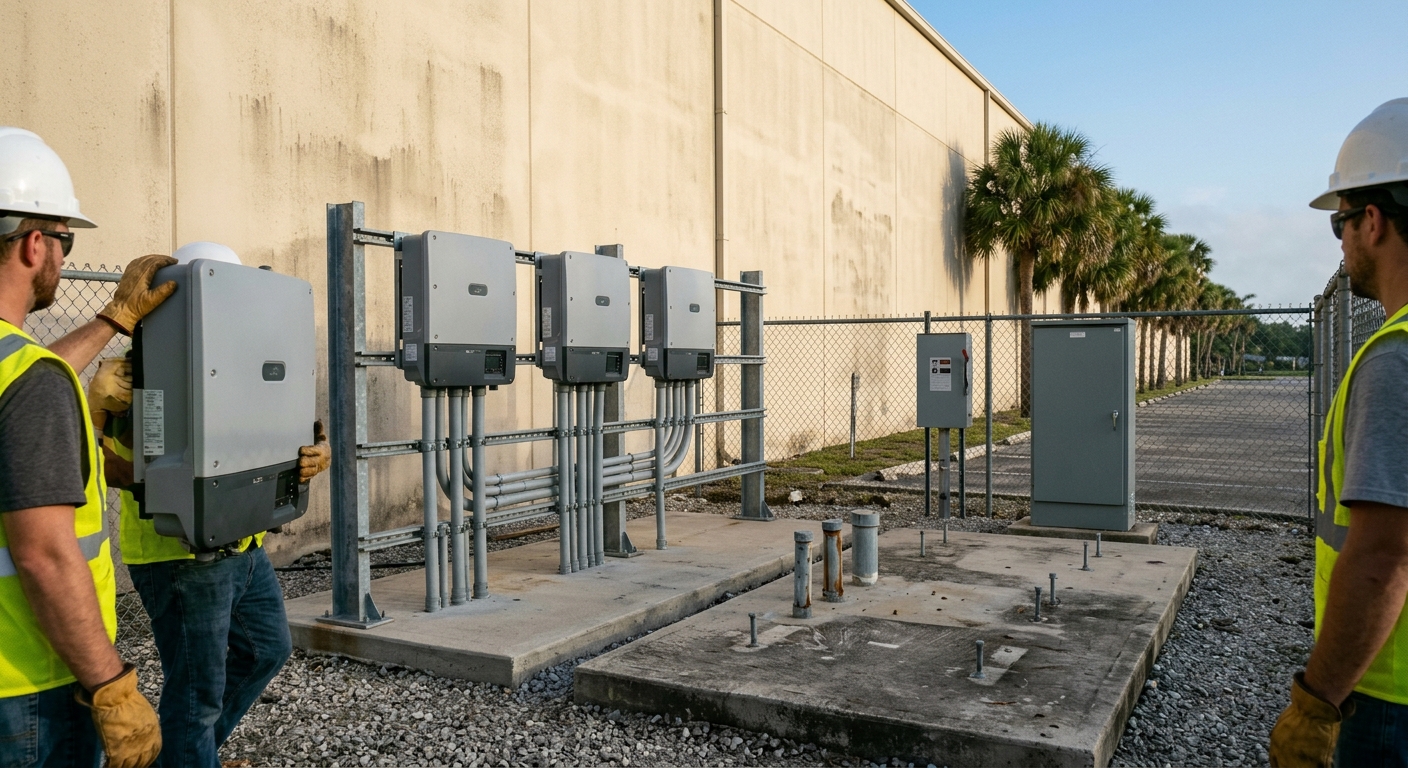
Weather sets the field schedule in Florida. Summer afternoon thunderstorms favor morning electrical work, and the June through November hurricane season argues for not leaving a system partially disconnected when a storm is forecast; the steps in commercial solar hurricane preparedness apply to a site mid-replacement. The job closes with commissioning, a check that monitoring reports every new unit, and a close-out package with as-built drawings, warranty registrations, and inspection records. Advanced Green Technologies’ commercial solar operations and maintenance program includes real-time monitoring, inverter verification during scheduled maintenance, and 24/7 emergency support in Florida, according to its service page.
Which Florida utility, code, and tax rules apply to an inverter replacement?
As of October 21, 2026, three sets of rules apply, each owned by a different authority. For interconnection, Florida Public Service Commission Rule 25-6.065 requires a certified utility-interactive inverter and makes the customer responsible for maintaining and testing it under the manufacturer’s instructions. A modification that increases gross power rating requires a new application at least 30 days in advance. Because the rule calculates that rating from DC nameplate multiplied by 0.85, ask the utility in writing how it treats an inverter-only change. FPL’s Tier 3 interconnection agreement carries the same 30-calendar-day requirement and calls for a new agreement. See commercial solar interconnection in Florida for the full process.
For building and electrical code, the Florida Building Commission lists December 31, 2026 as the effective date of the 9th Edition, and Miami-Dade County’s permitting notice states that permit applications submitted on or after that date must comply with it. Rooftop systems also fall under the National Electrical Code’s rapid shutdown requirements in Section 690.12, which the International Association of Electrical Inspectors summary of the 2023 NEC describes. Whether a replacement brings rapid shutdown or other upgrades into scope is a determination for the engineer of record and the building official.
For federal tax, IRS Notice 2025-42 implements the 2025 law that ends the Section 48E credit for solar facilities placed in service after December 31, 2027 unless construction began by July 4, 2026. Whether replacement equipment on an existing array supports any credit or depreciation treatment is a question for a tax advisor, who will read the notice alongside the final Section 45Y and 48E regulations published January 15, 2025. Our post on the commercial solar tax credit deadline covers the timing.
Decision checklist: who confirms what before you approve the work?
Each item has an owner, and the list is written to be forwarded to whoever signs the purchase order.
- Facility manager: export at least 12 months of monitoring data and meter reads, with every fault dated.
- O&M provider: confirm the root cause with insulation resistance tests and a thermal scan; a solar drone survey can screen the module field on the same visit.
- Asset manager or owner: obtain written confirmation of warranty status and whether the manufacturer still supports the installed model.
- Engineer of record: confirm string compatibility, grounding, conductors, rapid shutdown, and the single-line diagram through a defined commercial solar engineering process.
- Utility: get a written answer on whether the change requires a new interconnection application or agreement.
- Building official: confirm the permit path and which code edition applies to the application date.
- Roof consultant: state the remaining service life of the roof under any rooftop array.
- Tax advisor: confirm credit and depreciation treatment before the scope is finalized.
- Procurement: compare bids on one defined scope, with each path priced separately.
Frequently Asked Questions
How long does a commercial solar inverter last?
The Department of Energy’s Solar Energy Technologies Office cites a typical lifetime of about ten years for PV power electronics, against 20 to 30 years for modules. Actual life depends on the model, operating temperature, cooling maintenance, and salt-air exposure. Use the ten-year figure for planning, and let fault history and manufacturer support status set the replacement year.
Can a failed commercial inverter be repaired instead of replaced?
Often, yes, when the model is still supported and the failure is a first occurrence. Fans, fuses, communication cards, and some boards and power modules are field-replaceable under manufacturer procedures. Repair is the weaker choice when parts are discontinued, failures repeat, or the root cause sits on the DC side. Confirm the cause with testing first.
Do I need to notify FPL before replacing a solar inverter?
Florida PSC Rule 25-6.065 and FPL’s interconnection agreements require a new application at least 30 days before a modification that increases a system’s gross power rating. How FPL treats an inverter-only change on a specific system is FPL’s determination. Ask in writing before work starts, and keep the response with the project records.
Should I switch from a central inverter to string inverters?
It depends on support status, failure history, and site layout. String inverters limit the production lost when one unit fails and usually improve monitoring detail, but they add units to maintain and can require conductor, combiner, or transformer changes. Your engineer of record should compare the conversion against a supported like-for-like replacement for that site.
Does replacing an inverter qualify for the federal solar tax credit?
No general answer applies. IRS Notice 2025-42 implements the 2025 law that ends the Section 48E credit for solar facilities placed in service after December 31, 2027 unless construction began by July 4, 2026. Whether replacement equipment on an existing array supports any credit or depreciation treatment is a question for your tax advisor.
How long does a commercial solar inverter replacement take?
Schedule depends more on lead times and approvals than on field labor. A supported like-for-like unit in stock moves quickly once permitted, while an upgrade adds engineering, plan review, and possibly utility review. Ask the contractor for a schedule that lists lead time, permit, inspection, access, and weather separately so the outage window is visible.
Why should the decision follow the array’s remaining life?
An inverter decision made on the fault code alone tends to be made twice. Inverters wear out on a shorter clock than modules, many alarms originate outside the inverter, and much of the cost sits in permits, utility process, access, and lost production. A repair fits a supported model with a confirmed internal fault. A like-for-like replacement fits a sound design with an available successor. An upgrade fits a site whose model is unsupported, whose failures repeat, or whose roof or storage plans make a new architecture worth the larger scope. Owners who confirm root cause, warranty, utility treatment, code path, and tax position before choosing are the ones who replace an inverter once.
Written by The Technical Team at Advanced Green Technologies. Founded in 2007 by Advanced Roofing and 100% employee-owned, Advanced Green Technologies was named the #1 commercial and industrial EPC contractor in Florida on Solar Power World’s 2026 Top Solar Contractors list.
To have the Technical Team confirm the cause of an inverter fault and price repair, replacement, and upgrade options on the same scope, request a quote or call (888) 735-2641.