

At a glance: Caribbean businesses are pairing commercial solar with battery backup because island grids are expensive and fragile, and a grid-tied array without storage shuts off during every outage. This article explains how a battery keeps selected circuits running, compares solar plus storage with generators and hybrid systems, lists what drives size and cost, covers occupied-building and hurricane design issues, and summarizes the interconnection rules in Puerto Rico and The Bahamas as of October 28, 2026, with a checklist of who decides each step.
Commercial solar battery backup in the Caribbean has become the reason many island businesses buy solar at all. Where one transmission fault or one hurricane can take down the whole grid, a rooftop array without storage shuts off at the moment the building needs it, so the battery decides whether the investment keeps a hotel, cold-storage warehouse, or clinic running. Getting the pairing wrong costs a system that sits dark through the next outage, a battery sized to the whole building that the budget cannot carry, or an array that does not survive the storm it was bought for. This article covers why owners in Puerto Rico and The Bahamas are making the decision now, how a battery behaves when the grid fails, and who answers each sizing, safety, and regulatory question; it does not set a price or promise a payback, because both depend on the site, the tariff, and the loads chosen.
Why are Caribbean businesses adding battery backup to commercial solar now?
Caribbean businesses are adding batteries because the grids they buy from are both expensive and fragile, and the installation data now shows owners acting on it. The U.S. Energy Information Administration reported in April 2026 that rooftop solar in Puerto Rico reached 1,456 MW at the end of 2025, 20% of the island’s generating capacity, and that 171,372 homes and businesses had a distributed battery system with a combined 2,864 MWh of storage, according to EIA’s analysis of Puerto Rico Energy Bureau data.
Two island-wide blackouts in less than four months made the risk concrete. The Associated Press reported that the April 16, 2025 blackout left all 1.4 million LUMA Energy customers without power, following a New Year’s Eve outage. Price adds to the pressure. EIA’s Puerto Rico territory profile notes that the island’s average electricity price would have ranked fourth-highest among U.S. states in 2023, and the Associated Press reported in early October 2026 that a record rate of 33.86 cents per kWh took effect after the Puerto Rico Energy Bureau approved an increase.
The Bahamas faces the same storms on a different grid structure. The National Hurricane Center’s September 1, 2019 advisory placed Category 5 Hurricane Dorian over Great Abaco and Grand Bahama with maximum sustained winds near 185 mph, and on October 28, 2025, NHC kept hurricane warnings in effect for the southeastern and central Bahamas as Category 5 Hurricane Melissa crossed western Jamaica. The Utilities Regulation and Competition Authority (URCA) regulates the sector under the Electricity Act, 2024, which took effect June 1, 2024, according to URCA’s electricity sector page. For island businesses, the question has shifted to how much of the building should keep running when the utility cannot.
What does a battery do for a commercial solar array when the island grid fails?
Commercial solar battery backup is a battery energy storage system wired to a business’s solar array so that selected circuits keep running when the utility fails. The array recharges the battery each day, and the battery carries the backed-up loads through the night and the rest of the outage. Without storage, a grid-tied array turns off whenever the grid goes down.
That shutdown is deliberate. Interconnection rules built on the IEEE 1547 standard require a grid-tied inverter to detect a utility outage and stop energizing the line, which protects line crews working on a circuit they expect to be dead. A battery changes the picture by giving the inverter a stable voltage and frequency reference, so the system can open an automatic transfer point, separate from the utility, and operate as a small island grid for the circuits wired behind it.
Two ratings define what that island grid can do. Power, in kilowatts (kW), sets how much load the inverter and battery can carry at once, including the inrush when a compressor, pump, or elevator motor starts. Energy, in kilowatt-hours (kWh), sets how long the battery can carry that load before the sun returns. Hours of backup follow from the energy available divided across the backed-up load, less inverter losses and the reserve the battery management system holds back, which is why the load list matters more than the battery brochure.
| Operating mode | Solar array | Battery | What the building gets |
|---|---|---|---|
| Grid up, daytime | Serves building load; exports surplus under the net metering or net billing terms that apply | Charges from surplus solar or holds charge in reserve | Lower grid purchases |
| Grid up, evening peak | Production falling toward zero | Discharges where a tariff or utility program rewards it | Program or bill value, only where the rules pay for it |
| Grid down, daytime | Keeps producing because the battery forms the island grid | Absorbs surplus and covers motor starts | Backed-up circuits stay on |
| Grid down, night | No production | Carries backed-up circuits until morning or until reserve is reached | Runtime set by kWh and the size of the load |
| Grid down, several cloudy days | Reduced production | Recharges only partly each day | Shrinking runtime unless a generator joins |
Solar battery backup, generator, or both: how do Caribbean owners compare the options?
Each configuration below fits some buildings, and each has a failure mode. Diesel and propane generators remain common on island commercial sites because they run for as long as fuel arrives. A battery runs for as long as its stored energy and the next day’s sun allow.
| Option | What it does well | Where it falls short |
|---|---|---|
| Grid-tied solar only | Lowers daytime grid purchases with the least equipment | Shuts off in every utility outage; no backup value |
| Solar plus battery, critical loads | Keeps selected circuits running and recharges daily from the array with no fuel deliveries | Finite runtime; a run of overcast days after a storm shortens it; adds fire code review |
| Solar plus battery, whole building | Backs up every load, including all air conditioning | Battery size, cost, and footprint rise steeply; rarely justified for long outages |
| Generator only | Runs as long as fuel is available; familiar to facility staff | Fuel logistics after a storm, noise, emissions, and maintenance; no savings on normal days |
| Solar, battery, and generator | Battery covers short outages and nights; a smaller generator covers long cloudy stretches | Most equipment to maintain and the most complex controls to commission |
Many occupied commercial buildings land on the hybrid row after a load study, because it lets the battery absorb the frequent short interruptions while a smaller generator carries the rare extended event. A battery is also no substitute for fixing waste. Cutting lighting and cooling losses before sizing storage shrinks the battery the owner has to buy.
What drives the size and cost of commercial solar battery backup in the Caribbean?
No reliable published source gives a single installed price for commercial solar plus storage in Puerto Rico or The Bahamas, and ocean freight, crane access, and wind design move every bid, so the table lists drivers instead of figures. Ask each bidder to price these drivers as separate lines so proposals can be compared on the same basis.
| Driver | Why it moves the budget or the result | Who confirms it |
|---|---|---|
| Critical load list (kW) | Sets the inverter and battery power rating, including motor starts | Owner and electrical engineer of record |
| Backup duration target (hours) | Sets battery energy (kWh), usually the largest storage cost line | Owner, operations, and insurer |
| Array size and roof or carport area | Sets how much the battery can recharge each day of a long outage | Solar designer |
| Export compensation rules | Puerto Rico net metering under Act 114-2007 as amended; URCA SSRG and RESG programs in The Bahamas | Utility, regulator, and project engineer |
| Utility program value | LUMA’s Customer Battery Energy Sharing program compensates participating battery owners for energy shared during shortfalls | LUMA program rules and the enrolling aggregator |
| Wind design and anchorage | Enclosures, racking, and attachments engineered to local wind loads | Structural engineer of record |
| Fire code path | Listing, spacing, detection, and test data required by the local fire official | Fire protection engineer and fire official |
| Tax position | Any federal credit depends on location, ownership, and timing | Owner’s tax advisor |
Payback is the line most often oversold. Backup value is the downtime a battery prevents; everyday value exists only where a tariff or program pays for shifting or exporting energy, and those terms can change. URCA’s March 2022 final decision on renewable self-generation tariffs found that battery storage was not cost-effective for Bahamian participants under net billing at fuel-based rates, even after counting avoided generator use during outages, and noted that the economics of solar with storage are highly site-specific. Prices have moved since; model each site with current prices and rules.
What changes when the building is an occupied hotel, warehouse, or clinic on an island?
On an occupied island property, the work is sequenced around guests, inventory, and patients. Tying a battery into the main switchgear and moving critical circuits onto a dedicated backed-up panel requires planned shutdowns, which are scheduled for the lowest-occupancy window and noticed to the property manager in writing before each one starts. Enclosures, inverters, and racking usually arrive by ocean freight, so long-lead equipment is ordered against a confirmed design, staged securely, and set by crane outside guest and delivery hours.
The site sets hard design limits. Battery enclosures and outdoor electrical equipment must be anchored for local wind loads and placed above the flood elevation the engineer of record and the local authority set, and salt air attacks exposed fasteners, enclosure seams, and the cooling equipment that keeps battery temperatures in range. Advanced Green Technologies keeps design, metal fabrication, and construction under one roof through its in-house solar design, fabrication, and construction divisions.
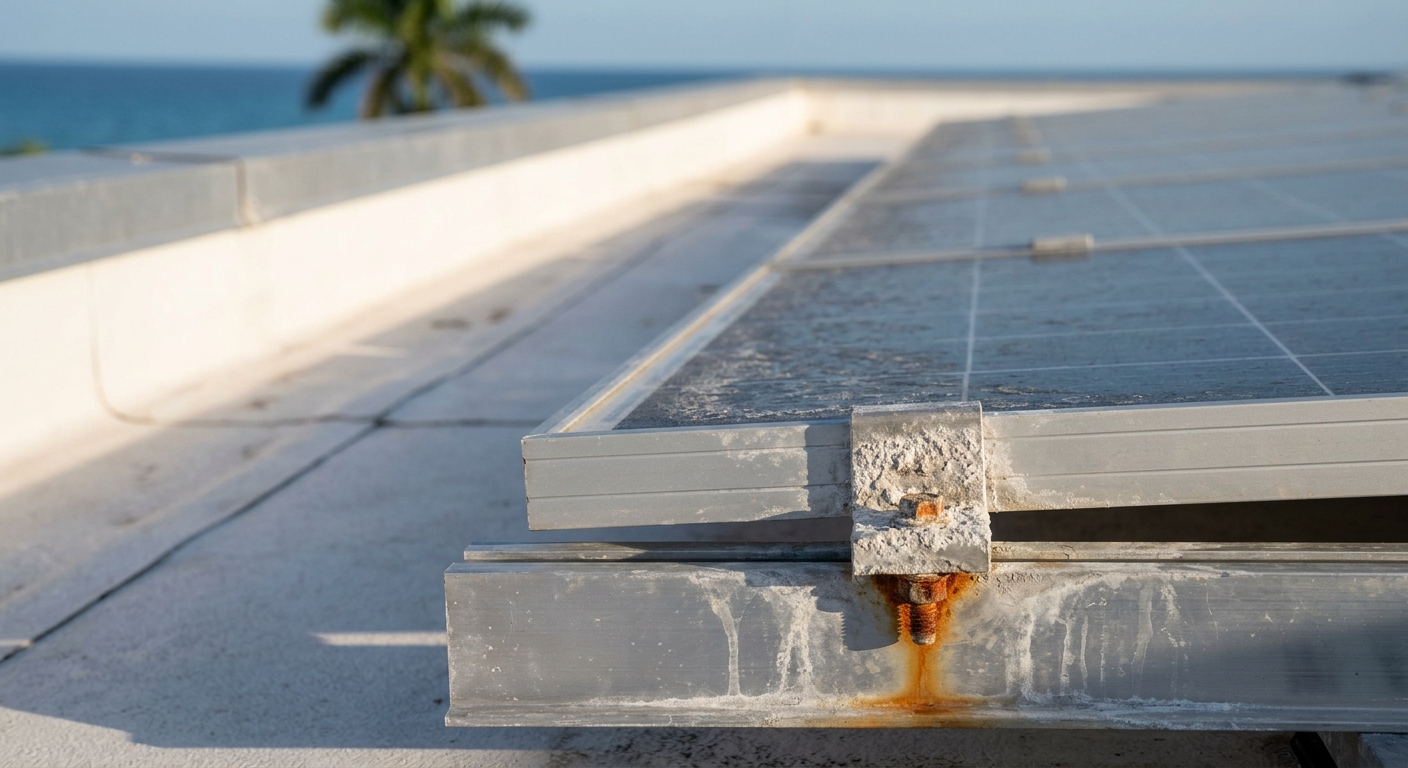
The battery only helps if the array and its attachments survive the storm. RMI’s Solar Under Storm reports, based on post-hurricane field inspections of Caribbean systems after storms including Maria, Dorian, and Beryl, trace many failures to top-down module clamps, self-tapping screws, undersized racking, and bolts without locking hardware, and recommend through-bolted modules, locking fasteners, high-load-rated modules, and structural engineering review. The same series reports that rooftop systems can be made resilient at little additional cost. AGT’s guide to what underwriters check on high-wind and coastal arrays covers the documentation insurers ask for on those same details, and a disciplined operations and maintenance program catches corroded hardware before the next storm finds it.
Which rules govern solar and battery interconnection in Puerto Rico and The Bahamas?
As of October 28, 2026, customer-sited solar exports in Puerto Rico are compensated under the net metering program created by Act 114-2007. Act 10-2024 amended that law to keep the Puerto Rico Energy Bureau from changing the program until at least 2031, and the Financial Oversight and Management Board’s Act 10 FAQ explains its legal challenge while stating that invalidating Act 10 would not change the current program. On storage, EIA reports that LUMA expanded its Customer Battery Energy Sharing program in summer 2025 so distributed batteries can supply the grid when the operator forecasts shortages, with participants compensated, and the Energy Bureau’s April 10, 2026 order authorized additional auto-enrollment of batteries for the summer 2026 season. Confirm commercial eligibility and payment terms with LUMA and the enrolling aggregator before counting the revenue.
In The Bahamas, URCA approves customer generation in writing. Its Small Scale Renewable Generation commercial application covers grid-tied solar and wind from 0 to 100 kW, and its Renewable Energy Self Generation application covers grid-tied systems between 100 kW and 1 MW and off-grid systems under 1 MW. URCA’s 2022 final decision set RESG compensation through net billing at a rate tied to the utility’s non-hedged avoided fuel cost, under 15-year contracts; confirm the current terms with URCA and the serving utility before design.
In both places the local fire and building authorities review the battery itself, looking for a UL 9540 listing, UL 9540A test data, and spacing consistent with NFPA 855 or the fire code they enforce. AGT’s battery storage permitting guide walks through those documents for Florida. Federal tax treatment is covered in the FAQ below.
Commercial solar battery backup checklist: who decides each step?
Advanced Green Technologies serves clients throughout Florida and the Caribbean. Owners weighing Puerto Rico commercial solar or solar and battery storage in The Bahamas can use this list as a responsibility matrix; AGT’s commercial battery storage solutions and commercial solar engineering process follow the same sequence, and a commercial solar feasibility study tests the site and tariff questions first.
- Owner or CFO: Put a figure on one day of downtime, because it sets how much backup is worth buying.
- Facility director: List critical circuits one by one, such as refrigeration, IT, life safety, and selected cooling zones.
- Electrical engineer of record: Move critical circuits to a backed-up panel, design transfer and islanding to the utility’s rules, and size inverter power for motor starts.
- Structural engineer: Confirm roof or pad capacity and wind anchorage, and specify through-bolted modules and locking fasteners.
- Fire protection engineer and fire official: Confirm the UL 9540 listing, the UL 9540A report, and required spacing and detection.
- Utility and regulator: In Puerto Rico, confirm net metering and Customer Battery Energy Sharing eligibility; in The Bahamas, file the SSRG or RESG application with URCA before installation.
- Insurer and tax advisor: Confirm coverage conditions and any credit before either enters the budget.
- Installer and operations staff: Witness an islanding test at commissioning, test the transfer yearly, and keep storm-damaged equipment de-energized until a qualified person clears it.
Frequently Asked Questions
How long will a commercial solar battery run a business during a Caribbean outage?
Runtime depends on the battery’s usable kWh, the backed-up load in kW, inverter losses, and the reserve the battery management system protects. In daylight the array recharges the battery, so a well-matched system can cycle through a multi-day outage, while a run of cloudy days shortens it. Size it to a written critical-load list, not the whole building.
Is commercial solar battery backup worth it in Puerto Rico?
It depends on what an outage costs the business, the current rate, and the export and program terms for the site. EIA counted more than 171,000 Puerto Rico homes and businesses with distributed batteries at the end of 2025. Whether a specific building pays back is a site model built on current rates and reviewed by the owner’s tax advisor.
Can a business in The Bahamas connect solar and batteries to the grid?
Yes, with written approval from URCA. Small Scale Renewable Generation covers grid-tied commercial systems up to 100 kW, and Renewable Energy Self Generation covers grid-tied systems from 100 kW to 1 MW and off-grid systems under 1 MW. Exports have been paid at the utility’s avoided fuel cost, so storage value comes mainly from self-consumption and backup.
Should a Caribbean business keep its diesel generator after adding solar and storage?
Often, yes. A battery covers short outages and nights without fuel, and the array recharges it daily, but a week of heavy cloud after a storm can outlast the stored energy. A generator, often a smaller one, gives the hybrid system a backstop, provided the controls let the generator, battery, and array share the island grid safely.
Does adding a battery protect a solar array from hurricane damage?
No. The battery decides whether power is available after the storm; the array’s survival depends on racking, fasteners, module ratings, and attachments. RMI’s Caribbean field studies link many failures to top-down clamps, self-tapping screws, and undersized racking. Battery enclosures need their own wind anchorage and flood elevation.
Do U.S. federal tax credits apply to solar and battery projects in Puerto Rico or The Bahamas?
The IRS describes the Section 48E clean electricity investment credit as covering energy storage placed in service after December 31, 2024, and the 2025 One Big Beautiful Bill Act left storage outside the accelerated wind and solar termination. Whether a credit applies to a particular project depends on location, ownership, and timing, which is a determination for the owner’s tax advisor.
Battery backup turns a Caribbean solar array into an outage plan
Commercial solar battery backup in the Caribbean earns its place on the day the grid fails, and Puerto Rico’s battery counts, its island-wide blackouts, and the storms that have crossed The Bahamas all point to that day arriving again. A battery will not save an array that was not engineered for the wind, will not pay back on every tariff, and will not run a whole building through a week of cloud. Sized to a critical-load list, fire-reviewed, and paired with an array built to stay on the roof, it keeps the circuits that matter running. Owners who settle the load list, backup hours, and regulatory path before the first bid get proposals they can compare.
Written by The Technical Team at Advanced Green Technologies. Founded in 2007, Advanced Green Technologies is 100% employee-owned and ranked #1 among Florida commercial and industrial EPC contractors on Solar Power World’s 2026 Top Solar Contractors list.
To scope commercial solar battery backup for a Caribbean facility, request a quote from Advanced Green Technologies or call (888) 735-2641.