
At a glance: Whether a Florida commercial solar array is insured on workable terms is settled mostly at design, by the wind engineering, the attachment method, the roof under the array, and the records that prove each one. This guide maps the questions property underwriters ask to the documents that answer them, compares rooftop, ballasted, metal-roof, carport, and ground-mount configurations, covers FM Global’s October 2025 data sheet revisions, the Florida Building Code change on December 31, 2026, and utility liability insurance limits, and ends with a role-by-role checklist.
The commercial solar insurance Florida carriers will write on workable terms is largely decided before the array is built, by the wind design, the attachment method, the roof underneath, and the records that prove all three. An owner who leaves coverage to the renewal meeting risks an array that is sublimited, excluded, or carried under a named-storm deductible large enough to change the project’s economics, along with a roof failure that costs more than the modules. This article explains what property underwriters and FM Global loss prevention guidance look for on a Florida commercial array and how to document it; it does not interpret any policy, which is work for the owner’s broker and insurer.
FM Global, the commercial property insurer formally named Factory Mutual Insurance Company, issued interim revisions in October 2025 to Data Sheet 1-15 on roof-mounted solar and Data Sheet 1-28 on wind design, according to a March 2026 summary in NRCA’s Professional Roofing coverage of the October 2025 FM data sheet updates. The 9th Edition of the Florida Building Code takes effect December 31, 2026, so an array permitted this fall and an array permitted next spring may be designed under different code editions.
Why Do Insurers Treat a Florida Solar Array as a Roof Risk?
Property insurers evaluate a rooftop array as a change to the building, because the costliest solar losses rarely stop at the modules. FM Approvals, the certification arm of FM Global, explains that the largest risk in a rooftop system is its effect on the roof and the contents below, and that a solar-related roof failure leading to business interruption or reroofing will cost more than the array itself. That framing is why an underwriter asks about the membrane, the deck, drainage, and fire classification before asking about module wattage.
Wind is the exposure that dominates a Florida submission. FEMA’s Recovery Advisory 5 on rooftop solar panel attachment, written after Hurricanes Irma and Maria damaged rooftop arrays in the U.S. Virgin Islands in 2017, recommends engineered attachment design, competent installation, and periodic re-inspection, and notes that ASCE 7 added wind load criteria written specifically for rooftop solar panels.
Insurer loss data points the same direction. kWh Analytics’ 2026 Solar Risk Assessment, released in May 2026 and summarized by Renewable Energy Magazine, still ranks hail as the most expensive type of insured solar loss, and one contributed study in the report found that IEC test standards underrepresent the cyclical loading of a real hurricane by a factor of eight. A certification test is a laboratory minimum, not proof of survival through hours of gusting load.
Storm categories and equipment wind ratings measure different things. The National Hurricane Center’s Saffir-Simpson Hurricane Wind Scale rates storms by maximum sustained wind, from 74 to 95 mph for Category 1 to 157 mph or higher for Category 5, while the Florida Building Code assigns design wind speeds by risk category and site. A rack rated to a stated mph was designed to a specific pressure under specific assumptions, and storms can exceed them.
What Do Commercial Solar Insurance Florida Underwriters Ask About an Array?
FM Approvals lists the risk factors a loss prevention engineer weighs on a rooftop array: wind uplift and securement, compatibility with the roof cover, combustibility, roof loading, drainage, and hail resistance. An underwriter’s questions map to those six factors, and each one is answered by a document the owner can assemble before the broker submits the building.
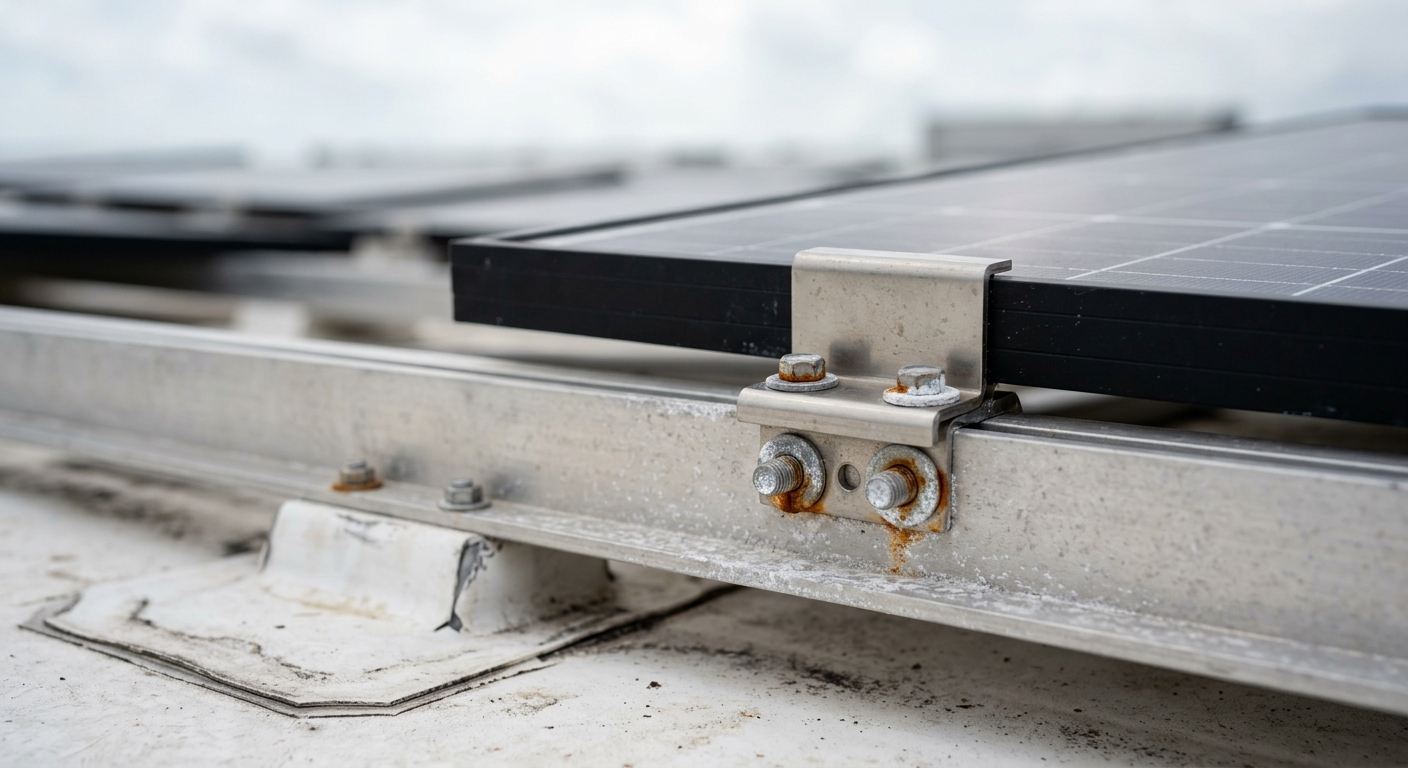
Wind failure on a low-slope roof array follows a predictable path. Uplift pressure concentrates at roof corners, along edges, and on the leading rows of an array, so the modules and clamps in those zones carry the highest loads. When a clamp loosens under repeated gusts or a fastener pulls out of a deteriorated deck, a single module can release and strike the modules, equipment, and membrane downwind. A punctured membrane admits water into the insulation and building, and the claim becomes a roof and interior loss.
Fire is the second line of questioning. Per Professional Roofing’s March 2026 summary, FM’s interim revision to Data Sheet 1-15 now calls for noncombustible mounting systems and racking, and it adds an FM Approved roof PV coating as a way for an existing roof to meet FM’s fire criteria without replacement. The data sheets are published free of charge by FM, and the owner’s engineer should work from the current edition rather than a summary.
| Underwriter question | What it tests | Document that answers it |
|---|---|---|
| How is the array attached, and to what wind pressure was it designed? | Wind uplift and securement | Signed and sealed structural calculations and attachment details from the engineer of record |
| Are the modules and racking approved products? | Tested performance under wind, fire, and hail | Florida Product Approval or Miami-Dade NOA in the HVHZ; FM Approvals listing where the insurer requires it; manufacturer installation manual |
| How old is the roof, and is its warranty intact? | Roof condition and compatibility | Roof survey or core report; roof manufacturer’s written acceptance of the solar attachments |
| What is the fire classification of the roof and PV assembly? | Combustibility and fire spread | Roof assembly listing; racking material specification |
| Does the array block drainage or overload the structure? | Roof loading and drainage | Structural load review; layout showing drains and scuppers clear |
| Who inspects it, how often, and what was found? | Maintenance and post-storm condition | Dated inspection logs, fastener torque checks, photo and thermal reports |
Which Array Types Are Easier to Insure, and Where Does Each Fall Short?
Every mounting approach trades one insurance strength for a weakness an underwriter will find. The comparison below judges common Florida configurations by what the insurer sees in the submission.
| Configuration | What helps the submission | Where it falls short |
|---|---|---|
| Mechanically attached rails on a single-ply or modified bitumen roof | Engineered load path into the structure; attachment details can be inspected and documented | Each attachment is a roof penetration that must be flashed and accepted by the roof manufacturer; deck condition governs pull-out capacity |
| Ballasted rooftop array | Few or no roof penetrations | Holds by weight and friction, so the structure must carry the added dead load; in high-wind zones the engineer must show the array will not shift or become debris |
| Seam-clamped array on a standing-seam metal roof | No membrane penetrations; clamps attach to the seams | Capacity is limited by how well the metal roof itself is attached; an aging metal roof can fail with the array on it |
| Solar carport canopy | Off the building roof, so no roof-cover exposure; designed as its own structure | A structure over parked vehicles and people; foundations, steel, and coatings must suit coastal corrosion |
| Ground-mounted array | Separated from the occupied building | Flood and surge exposure on low sites; FM addresses ground-mounted systems in a separate data sheet, 7-106 |
No array is immune to hurricane damage; each is designed to rated pressures a storm can exceed. Advanced Green Technologies is also not the right contractor for every array: a small single-building system on a simple roof, for an owner whose insurer imposes no FM-style requirements, may be served at lower cost by a smaller installer. The configuration choice belongs to the owner’s structural engineer and roof consultant.
What Moves the Premium, Deductible, and Coverage Terms on a Solar Array?
None of the Advanced family of businesses is an insurer; the carrier sets premiums, deductibles, and exclusions. The drivers below are ones loss prevention guidance and insurer data tie to solar risk, and the owner can influence or document each.
| Driver | Why it matters to the insurer | Source and date |
|---|---|---|
| Location and wind exposure | Sets the design wind speed and whether High-Velocity Hurricane Zone rules apply (Miami-Dade and Broward) | Florida Building Code; Miami-Dade County notice, 2026 |
| Roof condition under the array | A roof failure caused or worsened by the array costs more than the array | FM Approvals PV module guidance, accessed Oct. 2026 |
| Product approvals and fire classification | FM Approvals Standards 4476 and 4478 test combustibility, wind uplift, hail, and electrical safety | FM Approvals, accessed Oct. 2026 |
| Inspection frequency | FM Data Sheet 1-15 calls for checking roof-mounted PV equipment every six months and after severe weather | Professional Roofing, April 2024 |
| Hail exposure and module selection | Severe hail is the largest contributor to insured PV losses worldwide | U.S. DOE Federal Energy Management Program, updated Dec. 2025 |
| Deductible structure | Higher deductibles expected in hail- and wind-prone regions | kWh Analytics 2026 forecast, reported Jan. 2026 |
The deductible line deserves the most attention in a Florida budget. In predictions reported by Solar Builder in January 2026, kWh Analytics expected higher deductibles in hail- and wind-prone regions to push owners toward supplemental risk transfer, and expected insurance pricing for resilience investments to stay fragmented across markets, so two carriers may value the same records differently.
After hail, the Department of Energy’s Federal Energy Management Program notes that cells can crack without breaking the glass and recommends an infrared, ultraviolet, or electroluminescence scan within a month of a hail event. That scan gives the claim file evidence of damage a visual check would miss.
What Changes When the Building Stays Open During Installation?
Installation adds a temporary exposure the finished array does not have. Modules, rails, and ballast staged on a roof before attachment are loose objects in a storm, so hurricane-season work should never leave material unsecured overnight, and the owner should ask the broker whether the property policy, a builder’s risk policy, or the contractor’s coverage responds to a loss during construction.
Tenant operations shape the schedule: crane picks outside business hours where the site allows, clear fire code setbacks, walkway pads on traffic routes, and notice to the property manager before each roof access window. Daily photographs of attachments, flashing, and torque checks become the as-built record an underwriter asks for at the next renewal, and an aerial roof and solar drone survey gives the owner a dated baseline of roof and array condition.
Roof condition and roof warranty come first. AGT’s guide to keeping a commercial roof warranty when solar goes on covers manufacturer acceptance, and where the membrane is near the end of its service life, its sister company’s commercial re-roofing service at Advanced Roofing can replace the roof before the array is installed, avoiding a remove-and-reinstall midway through the array’s life.
AGT’s JM Family Enterprises rooftop project in Deerfield Beach, a 150 kW array completed in 2013 and 2014, shows how an insured building shapes design. AGT’s case study states the system was designed in coordination with FM Global, GAF, and the Deerfield Beach Building Department, and that pre-design work found a post-tension concrete slab, which required revised attachment details and embeds made for post-tension use. Advanced Roofing’s write-up of the same installation states that it satisfied FM Global’s 170 mph hurricane wind requirement for that site while the GAF 20-year NDL warranted roof stayed in force, and Solar Builder named the project an honorable mention in its 2014 Roof-Mount Project of the Year awards.
Coastal sites add corrosion to the wind question. AGT’s case study of its 2.25 MW Lockheed Martin carport in Oldsmar states that because Factory Mutual insured the facility, the structure had to meet strict high-wind guidelines, with components specified for salt spray corrosion. Salt air attacks fasteners, clamps, and steel coatings over years, so corrosion findings belong in the inspection record.
Which Florida Code and Utility Rules Touch Solar Coverage as of October 2026?
Miami-Dade County’s notice on the 9th Edition code change states that the 9th Edition of the Florida Building Code becomes effective December 31, 2026, and that permit applications submitted on or after that date must comply with it. In Miami-Dade and Broward, the code’s High-Velocity Hurricane Zone provisions also apply. The building official and the engineer of record determine which provisions govern a project.
Utility interconnection carries its own insurance requirement, separate from property coverage on the array. Under Florida Administrative Code Rule 25-6.065, an investor-owned utility’s standard interconnection agreement may require general liability insurance, or proof of self-insurance, of no more than $1 million for Tier 2 systems (greater than 10 kW up to 100 kW) and no more than $2 million for Tier 3 systems (greater than 100 kW up to 2 MW), and none for Tier 1. Failure to maintain required insurance is grounds for disconnection. As of October 2026 the rule text shows its last amendment in April 2008; each utility’s tariff sets the exact amount, and AGT’s overview of commercial solar interconnection in Florida covers the application sequence.
Decision Checklist: What to Assemble Before the Array Goes to the Broker
- Risk manager: Before design is frozen, get the broker’s written answer on which loss prevention standard the carrier applies.
- Engineer of record: Provide signed and sealed wind calculations, attachment details, and the code edition and risk category used.
- Roof consultant: Core and moisture-survey the roof, state its remaining service life, and document the roof manufacturer’s acceptance of the attachments.
- Solar contractor: Submit product approvals for modules and racking (Florida Product Approval or Miami-Dade NOA in the HVHZ, and FM Approvals listings where required) with the installation manuals.
- Facility manager: Schedule inspections at the interval the carrier’s standard calls for, plus after every named storm, and keep dated reports with the policy file.
- CFO: Set declared values that include removal, crane, engineering, permitting, and roof repair, and model the named-storm deductible against the project’s savings.
- Facility manager: Confirm the utility interconnection agreement’s liability insurance amount and keep the certificate current.
AGT’s commercial solar engineering process produces the design record, and its solar operations and maintenance program in Florida produces the inspection record.
Frequently Asked Questions
Does commercial property insurance cover rooftop solar panels in Florida?
It depends on the policy. Some commercial property policies treat a rooftop array as part of the building, some schedule it separately, and some apply sublimits, wind exclusions, or a separate named-storm deductible. Only the insurer and broker can say how a specific policy responds. The owner should declare the array, its value, and its design and inspection records.
What are FM Global solar installation requirements for a rooftop array?
FM Global addresses rooftop solar in Property Loss Prevention Data Sheet 1-15 and roof-mounted equipment wind design in Data Sheet 1-28. According to NRCA’s Professional Roofing, the October 2025 revisions call for noncombustible racking and allow an FM Approved PV coating on certain existing roofs. FM publishes the data sheets free, and the engineer of record should design to the current edition.
Does solar array wind damage insurance require a separate policy?
Not necessarily. Wind damage to a commercial array may fall under the building’s property policy, a scheduled equipment endorsement, or a dedicated renewable energy policy, depending on the carrier and the building. The broker should confirm how wind losses to the array, the roof, and interior contents are each handled.
Can adding rooftop solar affect a building’s insurance or roof warranty?
It can. FM Approvals notes that the largest risk in a rooftop array is its effect on the roof and contents below, so insurers review roof condition, attachment, and fire classification. Roof manufacturers often require written acceptance of solar attachments to keep a warranty in force. Notify the broker before installation and get the roof manufacturer’s approval in writing.
How much liability insurance does a Florida utility require for a commercial solar interconnection?
Florida Administrative Code Rule 25-6.065 caps what an investor-owned utility may require in its standard interconnection agreement: no more than $1 million in general liability coverage for Tier 2 systems (over 10 kW to 100 kW) and no more than $2 million for Tier 3 systems (over 100 kW to 2 MW). The utility’s tariff sets the exact amount, so check it on the application date.
Are solar carports easier to insure than rooftop arrays?
Sometimes. A carport keeps the array off the building roof, which removes roof-cover and interior water exposure from the risk. It adds exposure of its own: a structure over vehicles and people, foundations, and coastal corrosion on steel. Underwriters review its structural design and wind rating much as they review rooftop attachments.
Insurability Is Built Into the Design, Not Negotiated at Renewal
The terms a Florida commercial array is insured on follow from decisions made before installation: how it is attached, what roof it sits on, which products carry approvals, and what records prove each one. The revised FM data sheets and the December 31, 2026 code change reward owners who bring the broker into design. None of that removes storm risk or guarantees a coverage outcome, which remains the insurer’s decision. It gives the underwriter facts to evaluate instead of assumptions.
Written by The Technical Team at Advanced Green Technologies. Advanced Green Technologies is a 100% employee-owned commercial solar contractor founded in 2007 that describes itself on its About page as having extensive FM Global insurance experience, and it was ranked #1 among Florida commercial and industrial EPC contractors on Solar Power World’s 2026 Top Solar Contractors list.
To plan a new array with insurability in the design, or to document an existing one before renewal, request a quote from Advanced Green Technologies or call (888) 735-2641. Owners comparing attachment options can also review AGT’s commercial rooftop solar installation approach.