
At a glance: A solar O&M contract decides how a commercial array is monitored, maintained, cleaned, repaired, and documented. This guide lists what the contract should cover, maps Florida loss mechanisms such as soiling, heat, and salt air to the clauses that address them, compares monitoring-only, preventive, comprehensive, and guaranteed structures, explains what drives cost, and covers occupied-building logistics, Florida rules as of October 2026, and a sign-off checklist by role.
A solar O&M contract is the document that decides whether a commercial array on a Florida building keeps producing at the level it was financed on, or slowly drifts below it between visits nobody scheduled. The contract should name every task, interval, response time, report, and exclusion before the first fault, because an owner who negotiates scope during an outage negotiates from the weakest position. Getting it wrong shows up as lost production, an inverter fault that sits for weeks, an unmet warranty requirement, or a utility disconnection. This article sets out what the plan should cover, how contract structures compare, and which determinations belong to the owner’s engineer, roof consultant, insurer, and attorney. It does not quote prices or promise a production outcome.
Why does a commercial solar array need a written O&M plan?
A commercial solar array needs a written O&M plan because its output, its warranties, and its interconnection all depend on maintenance that someone has to own. The 3rd edition of Best Practices for Operation and Maintenance of Photovoltaic and Energy Storage Systems (NREL/TP-7A40-73822), prepared by the National Renewable Energy Laboratory with Sandia and the SunSpec Alliance, states that reported O&M costs vary widely with system requirements and the nature of the contract, and that standardized planning can make them lower and more predictable. The SunSpec Alliance summary of the same guide cites actuarial data suggesting comprehensive O&M could raise the average age- and temperature-adjusted performance ratio of PV-only systems from 91.7 percent to at least 95 percent.
In Florida, the owner’s obligation is also written into utility regulation. Florida Administrative Code Rule 25-6.065, the Public Service Commission rule on interconnection and metering of customer-owned renewable generation, requires the customer to inspect, maintain, and test the equipment according to the manufacturer’s instructions. The same rule lets the utility open the disconnect switch when the customer’s equipment creates a hazardous condition, and it allows utilities to require general liability insurance of up to $1 million for Tier 2 systems (over 10 kW to 100 kW AC) and up to $2 million for Tier 3 systems (over 100 kW to 2 MW AC). A maintenance lapse is a compliance exposure as well as a production loss.
The electrical side carries its own standard. NFPA 70B, Standard for Electrical Equipment Maintenance, became a standard rather than a recommended practice with its 2023 edition, according to the Electrical Safety Foundation’s summary of NFPA 70B, and it calls for a documented maintenance program with a named coordinator, qualified personnel, written procedures, and retained records. Whether an insurer or the authority having jurisdiction enforces it on a given building is their determination. Sandia National Laboratories’ 2014 report on solar PV O&M standards and best practices (SAND2014-19432) makes the same case for standardized procedures.
How does a Florida commercial array lose output between maintenance visits?
A Florida commercial array loses output through slow mechanisms that monitoring detects before anyone on the roof sees them. Pollen, bird droppings, construction dust, and a fine salt film near the coast block light at the glass. Low-tilt rooftop arrays shed less of that material in rain than steeper ground mounts, and droppings concentrated on a few cells can force a bypass diode to switch out part of the module, which lowers the output of the string it sits in. Commercial solar panel cleaning restores the recoverable part of that loss and does nothing for cells that are cracked or degraded.
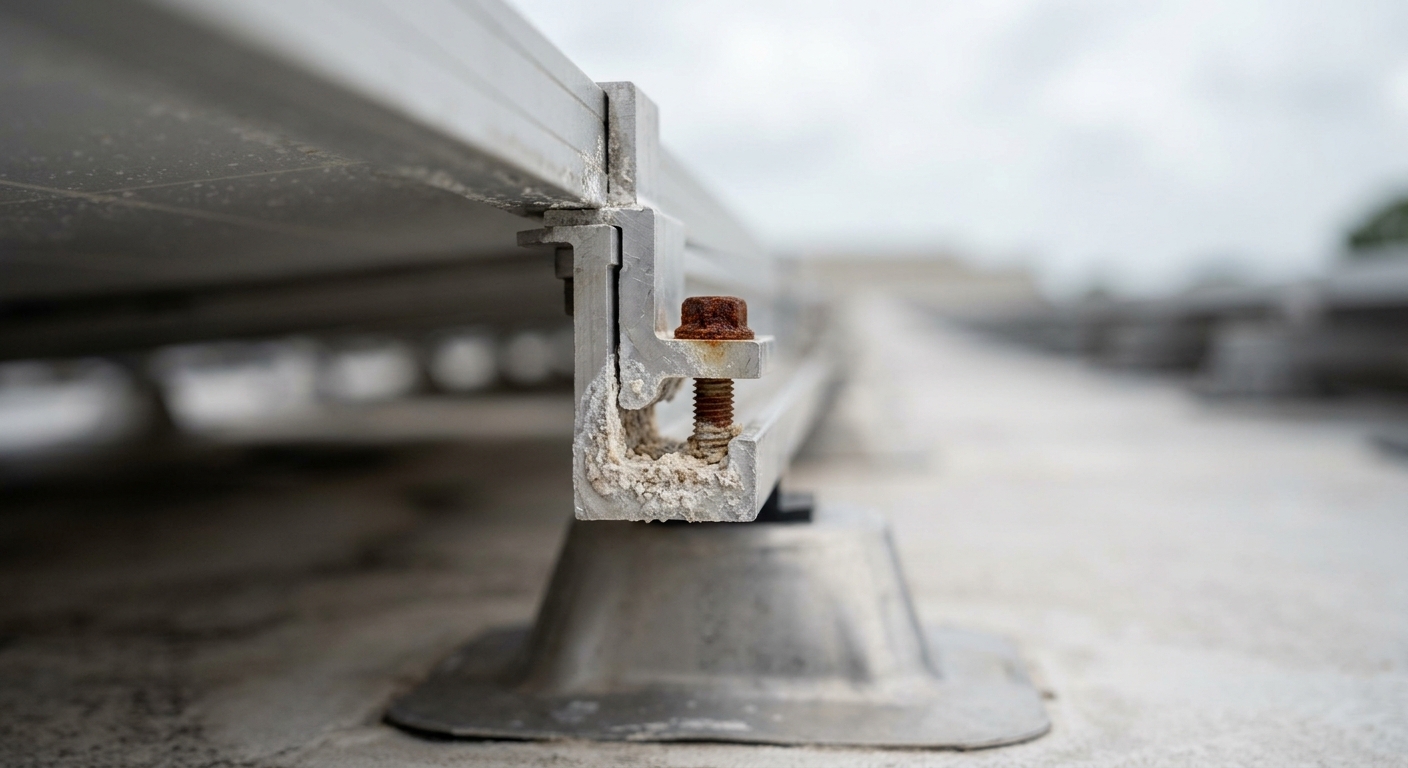
Daily thermal cycling loosens terminations and ages connectors, and a high-resistance connection becomes a hot spot that a thermal camera or drone solar survey can find well before it fails. Inverters contain fans, filters, and power electronics that need service on their own schedule, and when one does fail, AGT’s guide to commercial solar inverter replacement covers the repair, replace, or upgrade decision. Coastal air corrodes racking clamps, fasteners, and conduit fittings. When a monitoring gateway loses its network connection, the array keeps producing while nobody can see it, and a string fault that starts during the outage waits for the next site visit. The table maps each mechanism to the clause that should cover it.
| Loss mechanism | What happens physically | How it is caught | Clause that should cover it |
|---|---|---|---|
| Soiling (pollen, droppings, salt film) | Light blocked at the glass; partial shading of cells | Production trend against irradiance; visual inspection | Cleaning method, trigger, water source, and access |
| Loose or aging connections | Resistance rises, heat builds, a hot spot forms | Thermal imaging; IV curve tracing | Preventive electrical inspection and torque checks |
| Inverter faults and derating | Fans, filters, or power electronics fail or overheat | Monitoring alarms; inverter event logs | Corrective response time; spares; warranty claim handling |
| Corrosion on coastal hardware | Salt air attacks clamps, fasteners, and fittings | Visual and mechanical inspection | Racking inspection interval; replacement part specification |
| Storm damage | Wind and debris shift modules, crack glass, strain attachments | Post-storm inspection; drone survey | Post-storm inspection trigger, timing, and photo record |
| Monitoring outage | Data stops while the array keeps running | Communication-loss alarm | Monitoring uptime and data-loss reporting |
What should a solar O&M contract cover on a Florida commercial array?
A solar O&M contract for a Florida commercial array should cover continuous performance monitoring, scheduled preventive maintenance, corrective repair with stated response times, module cleaning on a defined trigger, post-storm inspection, spare parts, roof and warranty coordination, and dated reporting. Each item needs an interval, an owner, and a record, or it cannot be enforced.
- Monitoring. Production compared against measured irradiance, with alarm thresholds, named recipients, and a time to dispatch.
- Preventive maintenance. IEC 62446-2:2020 sets preventive, corrective, and performance-related maintenance requirements for grid-connected PV, including cleaning and vegetation upkeep. The contract should list each task and interval.
- Corrective maintenance. Response times by fault severity, parts sourcing, and who manages warranty claims.
- Cleaning. The method the module manufacturer permits, water source, runoff handling, and the production loss that triggers a visit.
- Post-storm inspection. How soon after a named storm, what is checked, and the photo record.
- Spare parts. What is stocked and who pays for parts outside warranty.
- Reporting. Monthly performance reports, an annual condition report, and records that support warranties, the insurer, and an NFPA 70B program.
- Roof coordination. Walkway paths, attachment inspection, and roof warranty rules.
- Exclusions and term. What the fee excludes, escalation, and termination rights.
Advanced Green Technologies’ commercial solar operations and maintenance program in Florida lists real-time monitoring, routine maintenance with cleaning, connection checks, wiring inspections, and inverter and battery verification, around-the-clock emergency support in Florida, and reporting and analytics; the same scope appears on AGT’s page for commercial solar maintenance in Miami. Sites with commercial battery storage should add the battery manufacturer’s inspection tasks to the same contract.
Which solar O&M contract structure fits the building?
Commercial solar O&M contracts fall into five common structures, and each one moves risk between the owner and the provider differently. The structure decides who must respond to a failure, how fast, and who pays for parts and labor.
| Structure | What it includes | Typical fit | Where it falls short |
|---|---|---|---|
| Monitoring only | Remote data review and alarm notification | Owners with qualified in-house electrical staff | No one is contracted to fix what monitoring finds |
| Scheduled preventive (fixed scope) | Set visits for inspection, cleaning, torque and thermal checks | Smaller rooftop or carport arrays on stable sites | Corrective work billed separately; response times often undefined |
| Comprehensive (full wrap) | Monitoring, preventive, and corrective labor, often parts, with response times | Larger arrays, financed systems, multi-site portfolios | Highest fixed fee; exclusions and parts caps decide its real value |
| Comprehensive with availability or performance guarantee | Full wrap plus a guaranteed level with a remedy if missed | Owners whose lender or investor requires a guarantee | Worth only as much as its definitions and exclusions |
| Time and materials (on call) | Service when the owner calls | Owners willing to carry the risk directly | Slowest path to diagnosis; no preventive record |
Availability guarantees need the most care. Sandia National Laboratories’ 2015 report A Best Practice for Developing Availability Guarantee Language in PV O&M Agreements (SAND2015-10223) found that many PV guarantees were adapted from conventional power plant contracts, which fit poorly on a system whose output varies with the weather. An availability percentage means little until the contract defines which hours count, which outages are excluded, and how the figure is calculated.
No contract structure prevents storm damage or equipment failure. Arrays are designed to rated wind speeds, storms can exceed them, and warranties carry exclusions. A large statewide provider is also not the right fit for every site; a single solar carport with an engaged facilities team may need only a scheduled preventive contract, while a portfolio of rooftop solar installations on occupied buildings usually justifies comprehensive coverage.
What drives the cost of commercial solar maintenance in Florida?
The cost of commercial solar maintenance in Florida is set by the system and the contract terms, which is why the national best practices guide reports such wide variation. AGT does not publish O&M pricing; a quote is built from the variables below, and bids are only comparable when those variables are held constant.
| Cost driver | Why it moves the price | Who confirms it |
|---|---|---|
| System size and type (rooftop, carport, ground mount) | Access, travel, and labor hours per visit | Owner and provider, on a site walk |
| Inverter architecture (string or central; device count) | Number of devices to inspect; spare parts strategy | Original design and as-built documents |
| Access and roof conditions | Lifts, fall protection, walkways, escort requirements | Facility manager; roof consultant |
| Cleaning frequency and water source | Labor per cleaning; water handling; scheduling around occupants | Monitoring data; facility manager |
| Response time commitment | Staffing needed to meet the stated window | Contract terms |
| Parts coverage and caps | Who pays for components outside warranty | Contract terms; attorney |
| Availability or performance guarantee | Provider prices the risk of paying the remedy | Contract terms; lender or investor |
| Coastal exposure | More frequent hardware inspection and replacement | Site assessment |
AGT’s O&M service page recommends maintenance, cleaning, and connection adjustments at least twice a year. The right cleaning interval for a given array is the one at which the production recovered by commercial solar panel cleaning exceeds the cost of the visit, which monitoring data shows once a clean baseline exists.
What changes when solar maintenance happens on an occupied Florida building?
Maintenance on an occupied building is planned around the tenants, the roof, and the electrical shutdowns. Most preventive work proceeds without interrupting the building, but inverter replacement, AC disconnect work, and some testing require the array to be de-energized and locked out, and the contract should state who gives notice of each shutdown window and how far ahead. OSHA’s solar energy hazard guidance lists arc flash, electric shock, falls, and thermal burns as the hazards of this work, so the contract should require written lockout/tagout and fall protection procedures; AGT describes its own program on its safety page.
The roof under the array has its own warranty. Technicians should stay on walkway paths and pads, keep equipment off unprotected membrane, and report damage near attachments. Because the array and the roof share a service life, a roof that needs replacement before the array retires means a remove-and-reinstall later; AGT’s sister company, Advanced Roofing, can re-roof under an existing array, and roof condition belongs in the O&M records.
Carport arrays move the work over parked cars and pedestrians, so bays are closed and coned off and cleaning water is kept off vehicles and walkways. In Miami-Dade and Broward, which follow the High-Velocity Hurricane Zone provisions of the Florida Building Code, replacing parts of an approved attachment or structure is a product approval question for the engineer of record.
Which Florida code, utility, and safety rules apply to solar O&M as of October 2026?
As of October 2026, four sets of rules touch a commercial solar O&M plan in Florida. Rule 25-6.065 assigns inspection, maintenance, and testing to the customer and lets the utility disconnect hazardous equipment. The Florida Building Code 8th Edition (2023) is in effect, and the Florida Building Commission’s October 2026 code development workplan lists December 31, 2026 as the effective date of the 9th Edition (2026). Permitted repairs generally follow the edition in force when the permit application is submitted, which the building official confirms.
On the electrical side, Article 690 of NFPA 70, the National Electrical Code, governs PV systems, and NFPA 70B sets the structure of a maintenance program; which editions apply is the authority having jurisdiction’s determination. Insurers may set their own inspection intervals, covered in AGT’s article on commercial solar insurance in Florida. Re-check each item on the day the contract is signed.
Solar O&M contract checklist: who confirms what before signing?
- Facility manager: confirm roof access rules, shutdown notice periods, and carport parking closures.
- Energy or sustainability lead: confirm monitoring access, alarm recipients, and the reporting baseline.
- Electrical engineer: confirm the preventive task list, test methods (thermal, IV curve, insulation resistance), and the NFPA 70B program structure.
- Roof consultant or roofing contractor: confirm walkway layout, attachment and penetration inspection, and roof warranty conditions for rooftop work.
- Insurer or broker: confirm required inspection intervals and post-storm documentation.
- Attorney: review guarantee definitions, exclusions, liability caps, and termination terms.
- CFO or asset manager: compare bids on identical scope, response times, parts coverage, and term, and confirm any lender or investor O&M requirement.
- O&M provider: deliver a written scope with intervals, a sample monthly report, and a post-storm procedure.
Frequently Asked Questions
What should a solar O&M contract include?
A solar O&M contract should include performance monitoring with alarm thresholds, a preventive task list with intervals, corrective response times by severity, a cleaning method and trigger, post-storm inspection, spare parts terms, roof coordination rules, reporting, and exclusions. IEC 62446-2:2020 is a useful reference for the tasks a grid-connected PV system needs.
How often should commercial solar panels be cleaned in Florida?
There is no single interval. AGT’s O&M service page recommends maintenance and cleaning at least twice a year, and the right frequency for a specific array depends on tilt, nearby trees and birds, construction dust, and coastal salt. Production data compared against irradiance shows when soiling justifies a visit, which is the trigger the contract should use.
What is an availability guarantee in a solar O&M contract?
An availability guarantee is a commitment that the system’s equipment will be available to produce for a stated share of eligible time, with a remedy if it falls short. Sandia National Laboratories’ 2015 report notes that many PV guarantees were adapted from conventional power plant contracts, so the definitions of eligible hours, exclusions, and measurement decide what the guarantee is worth.
Who is responsible for maintaining a net-metered commercial solar system in Florida?
The customer is. Florida Administrative Code Rule 25-6.065 requires the owner of an interconnected renewable system to inspect, maintain, and test it according to the manufacturer’s instructions, and it lets the utility disconnect hazardous equipment. An O&M contract delegates the work; the owner keeps the records.
Should a solar O&M contract cover the roof under the array?
It should cover how technicians protect the roof and report what they see, while the roof itself stays under the roofing contractor’s warranty and maintenance plan. The contract should name walkway paths, require reporting of membrane damage near attachments, and coordinate repairs with the roof consultant.
What should happen to the O&M plan after a named storm?
The contract should require a post-storm inspection within a stated number of days after a named storm affects the site, covering modules, racking and attachments, wiring, and inverters, with dated photos. A drone survey can document a large roof quickly. The report goes to the owner and, where coverage is involved, to the insurer or broker; the O&M provider does not adjust claims.
Why should the solar O&M contract be settled before the first fault?
A commercial array produces for decades, and the O&M contract keeps that output close to the level the project was financed on. The national best practices guide ties O&M cost to contract terms, Florida’s interconnection rule puts maintenance on the owner, NFPA 70B expects a documented program, and Sandia’s work shows that guarantees are only as clear as their definitions. A contract written before the first fault sets response times, the cleaning trigger, the storm procedure, and the records while the owner still has leverage, and it gives the engineer, roof consultant, building official, insurer, and attorney the documentation their own determinations require.
Written by The Technical Team at Advanced Green Technologies. Founded in 2007, Advanced Green Technologies is 100% employee-owned, has installed more than 380 MW of solar for Florida clients, and ranked first among Florida commercial and industrial EPC contractors on Solar Power World’s 2026 Top Solar Contractors list.
Request an O&M assessment. To review an existing O&M contract or set one up for a rooftop, carport, or ground-mount array, request a free quote from Advanced Green Technologies or call (888) 735-2641.