

At a glance: Dry warehouses and cold storage buildings use power on opposite schedules, so the same roof calls for different solar designs. This article compares their load profiles with EIA data, explains why rooftop solar alone rarely lowers a cold storage demand charge on FPL’s large-demand tariff, compares five configurations and where each falls short, lists cost drivers with sources, covers vapor-critical freezer roofs and occupied cold chain operations, and closes with the 2027 federal credit deadline and a role-by-role decision checklist.
A dry warehouse and a cold storage facility can share a roof profile and a utility tariff and still need opposite solar designs, because one uses most of its power during daylight shifts at low intensity while the other runs refrigeration around the clock at roughly five times the electricity per square foot. For warehouse solar, Florida owners get a defensible project by sizing the array to the building’s interval load data, its demand charges, and the remaining life of the roof under it. Sizing it wrong has two familiar costs, a roof-filling array on a dry warehouse that exports energy for less than it displaces, or a freezer-roof array that misses the demand peak it was budgeted to cut after penetrating a vapor-critical roof; projects not yet under construction must also be placed in service by December 31, 2027 to keep the federal clean electricity credit. This article covers warehouses, distribution centers, and refrigerated buildings in Florida, and it does not address ground-mounted solar farms, off-site power purchase agreements, or pricing for a specific building.
Why is warehouse solar Florida’s most mis-sized rooftop project in 2026?
Warehouses and cold storage buildings sit at opposite ends of the commercial energy-use range, and that gap drives every sizing decision. The U.S. Energy Information Administration’s 2018 Commercial Buildings Energy Consumption Survey, Table C22, reports mean electricity intensity of 5.3 kWh per square foot per year for nonrefrigerated warehouses and 29.6 kWh per square foot per year for refrigerated warehouses. The refrigerated sample is small, and EIA publishes a relative standard error of about 19% on that intensity, so the figure works as a national order of magnitude; a specific Florida building needs its own meter data.
Roof area does not scale with load. A large dry warehouse can host an array that produces far more energy than the building uses, while a freezer of the same footprint can use several times what its roof can produce. Berkeley Lab’s August 2026 U.S. Distributed Solar and Storage Data update found that warehouses were one of the most common commercial host types for solar installed in 2025, with a median warehouse system size of 85 kW, which is small against the roofs involved.
The calendar adds pressure. Under the One Big Beautiful Bill Act, as described in IRS Notice 2025-42 on beginning of construction, a solar facility that begins construction after July 4, 2026 must be placed in service by December 31, 2027 to claim the Section 48E clean electricity investment credit. As of October 28, 2026, that leaves roughly 14 months for design, permitting, utility interconnection, and construction on a project starting now. Parts of the notice’s beginning-of-construction guidance have been litigated, and foreign-entity-of-concern sourcing rules also apply, so eligibility is a question for the owner’s tax advisor.
How do a dry warehouse and a cold storage building use solar power differently?
A rooftop array produces power from mid-morning to late afternoon and nothing at night, so the value of each kilowatt-hour depends on whether the building is using power when the array makes it. A dry warehouse draws most of its load during operating shifts for lighting, dock doors and levelers, conveyors, office cooling, forklift battery charging, and any workplace or fleet EV charging. On a single-shift operation, much of a roof-filling array’s output arrives when the building cannot use it, and that energy goes back to the grid under the utility’s net metering terms.
A cold storage building runs compressors, condenser fans, evaporator fans, and defrost cycles around the clock. Refrigeration work rises in the afternoon, because higher outdoor temperatures raise condensing pressure and the compressors work harder to reject heat, and that timing lines up with solar production. Nearly every kilowatt-hour from a properly sized array is used on site. The weak point is the monthly demand charge. Florida Power & Light’s October 2026 business rate sheet lists a base maximum-demand charge of $15.12 per kW for General Service Large Demand (GSLD-1) accounts, with conservation, capacity, and storm protection charges also billed per kW. Billed demand is set by the highest interval of the month, and a cloudy afternoon, a defrost overlap, or a hot evening with the array at zero can set that peak with no solar contribution at all.
| Factor | Dry warehouse | Cold storage |
|---|---|---|
| Mean electricity intensity | 5.3 kWh per sq ft per year | 29.6 kWh per sq ft per year (small sample) |
| When load occurs | Operating shifts, mostly daytime | 24 hours, highest on hot afternoons |
| Share of solar output used on site | Low to moderate on a roof-filling array | High for an array sized below daytime load |
| Effect on monthly demand charge | Small; peak often set by dock and charging equipment | Unreliable without storage or refrigeration controls |
| Main roof concern | Membrane condition and remaining life | Continuous vapor retarder and insulation over cold space |
| What usually sets array size | Daytime load and net metering limits | Roof area, structure, and interconnection limits |
Source: Intensity figures: U.S. EIA, 2018 CBECS Table C22 (released December 2022), accessed October 28, 2026. Other rows: The Technical Team at Advanced Green Technologies.
Warehouse solar in short: Size a dry warehouse array to the building’s daytime use, because exported energy earns less than energy used on site. Size a cold storage array to the roof and structure, then add storage or refrigeration controls if the goal is a lower demand charge, because solar alone does not reliably cut the monthly peak.
Which solar configuration fits a Florida warehouse or cold storage facility?
Five configurations cover most Florida projects, and each one has a predictable limit.
| Option | Best fit | Strength | Where it falls short |
|---|---|---|---|
| Roof-sized array, net metered | Owner wants maximum production on a large dry warehouse | Lowest installed price per watt through scale | Florida’s net metering rule covers systems up to 2 MW; exports are credited on the utility’s terms |
| Load-sized rooftop array | Known daytime load; cold storage seeking energy savings | Highest share of output used on site | Leaves roof unused; does not reliably lower demand charges |
| Rooftop solar plus battery storage | Cold storage with high demand charges or critical loads | Battery covers the peak interval and can carry selected loads if designed to island | About $1.3 per W more than stand-alone PV for large systems (Berkeley Lab, 2025 installs); NFPA 855 siting review |
| Solar plus refrigeration controls | Freezers with central controls and product temperature margin | Uses stored product as thermal mass to move compressor load out of the peak | Needs controls work and a refrigeration engineer; coolers with tight limits have less room |
| Solar carport over parking | Sites whose roof cannot carry added load | Keeps penetrations off a vapor-critical roof | Structural steel and foundations cost more per watt than rooftop racking |
Source: Battery price differential: Berkeley Lab, U.S. Distributed Solar and Storage 2026 Data Update (August 2026). Net metering limit: Florida PSC Rule 25-6.065, F.A.C.
The controls option is the least familiar. Lawrence Berkeley National Laboratory’s Refrigerated Warehouse Demand Response Strategy Guide describes pre-cooling product before a peak period and limiting compressor capacity during it, using the stored product’s thermal mass. The guide was written around California demand response programs, so its payback estimates do not transfer to a Florida tariff without new analysis.
No configuration keeps a freezer running in a grid outage by default. A standard grid-tied inverter shuts down when the utility feed drops, by design, to protect line workers. Outage ride-through requires commercial battery storage, an inverter system able to island from the grid, and a defined critical load panel. Where the roof cannot take added weight or penetrations, solar carports over employee or trailer parking move the array off the building.
Roof scale is rarely the constraint. Advanced Green Technologies’ distribution center project for Toys “R” Us in Flanders, New Jersey, covered more than 70% of a one-million-square-foot standing-seam roof, with the racking clamped to the seams.
What drives the cost and payback of industrial rooftop solar in Florida?
No contractor can price a warehouse array before the roof, structure, and interconnection are known, and Advanced Green Technologies does not publish pricing. National data gives a starting range. Berkeley Lab’s Tracking the Sun 2024 executive summary reported state-level median prices for large non-residential systems, over 100 kW, installed in 2023 of $1.8 to $2.6 per watt DC before incentives, and the same lab’s August 2026 data update found non-residential prices essentially flat from 2024 to 2025. Those prices can include roofing or electrical work.
| Driver | Figure | Source and date |
|---|---|---|
| Installed price, large non-residential PV | $1.8 to $2.6 per W DC, state-level medians, 2023 installs | Berkeley Lab, Tracking the Sun, August 2024 |
| Added price for paired battery storage | About $1.3 per W of PV, large non-residential median, 2025 installs | Berkeley Lab data update, August 2026 |
| FPL GSLD-1 base demand charge | $15.12 per kW per month, plus per-kW clause charges | FPL business rates, effective October 2026 |
| FPL GSLD-1 base energy and fuel charges | 2.179 cents per kWh energy; 3.198 cents per kWh fuel | FPL business rates, effective October 2026 |
| Florida property tax treatment | 80% of just value attributable to the system excluded, nonresidential | F.S. 193.624, devices installed on or after January 1, 2018 |
| Federal credit timing | In service by December 31, 2027 if construction begins after July 4, 2026 | IRS Notice 2025-42 |
| Roof work | Re-roof or repairs before installation, priced separately | Roof consultant’s report |
Source: All figures accessed October 28, 2026. Rounded figures are as published by each source.
Two variables move the result more than equipment price. The first is the share of output used on site, which the facility’s interval data answers. The second is roof work: a membrane with eight years left under an array expected to produce for decades means a remove-and-reinstall later, and that cost belongs in the comparison, and the tax advisor confirms which credits and depreciation apply. AGT’s federal commercial funding resources and solar financing options describe the structures owners commonly use.
What changes when solar goes onto an occupied cold storage or distribution building?
A cold chain cannot pause for a contractor. The electrical tie-in is the one step that may require de-energizing switchgear, so it is scheduled at the facility’s lowest load, after product has been pre-cooled, with a generator staged and the refrigeration contractor on site. The operations manager receives the shutdown window in writing before work starts. Crane picks for modules and racking are set outside receiving windows, and material staging stays clear of truck courts, dock aprons, and forklift routes.
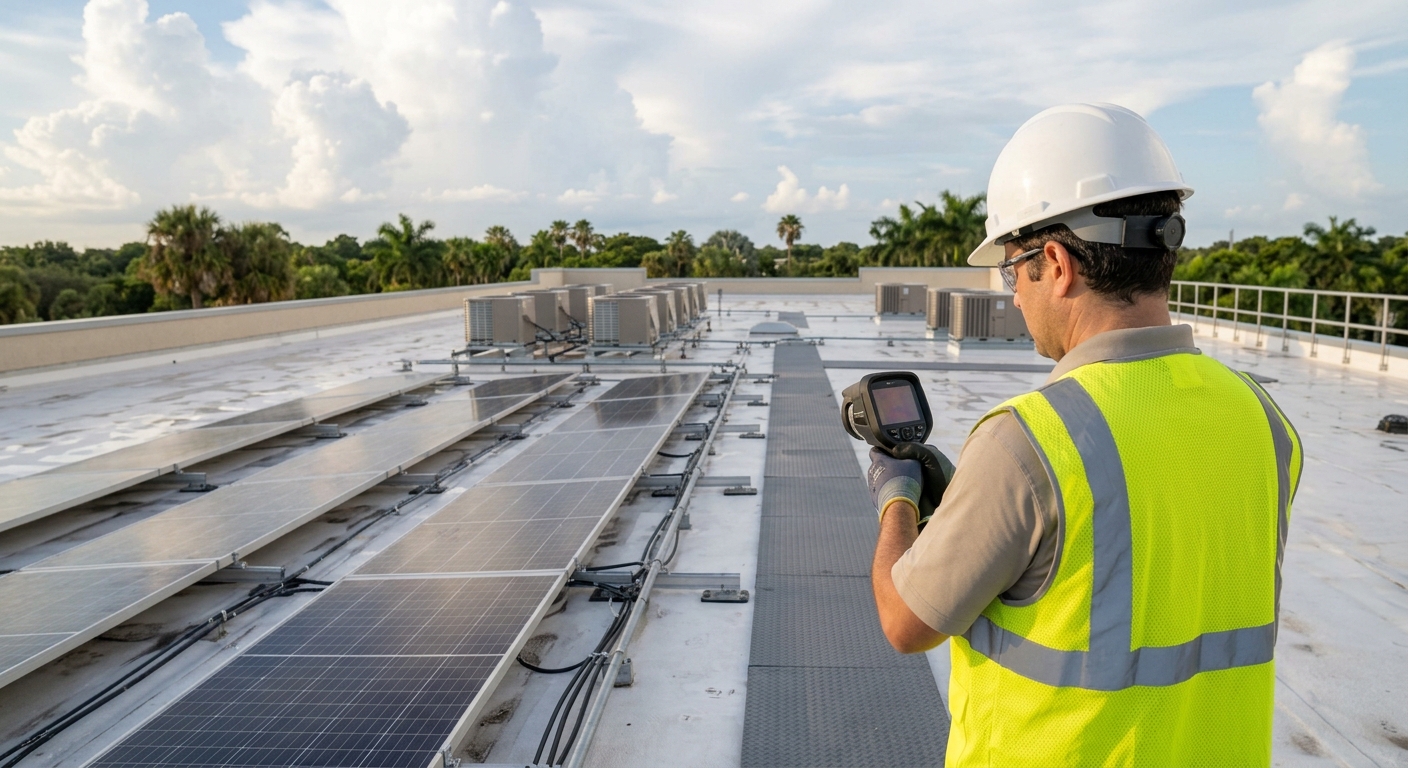
The roof over a freezer is part of the refrigeration system. Its vapor retarder sits on the warm side of the insulation, and every penetration through it gives humid Florida air a path to cold insulation, where moisture condenses and can freeze. Ballasted racking or attachments that leave the vapor retarder intact are preferred where the structure can carry the load, which makes a structural engineer’s dead-load review the first design step. AGT’s commercial solar engineering process and roof and drone solar surveys establish roof condition and layout before racking is chosen.
Florida adds its own conditions. Buildings in Miami-Dade and Broward fall in the High-Velocity Hurricane Zone, where racking and attachments need product approval and engineered wind design, the basis of AGT’s commercial rooftop solar installations. No array is immune to a hurricane: systems are designed to rated pressures, storms can exceed them, and module and racking warranties carry wind-speed limits and exclusions. Coastal sites need corrosion-resistant hardware against salt air. Crews work under OSHA’s 29 CFR 1926.501 fall protection requirements, with guardrails or warning lines kept at the required setback from roof edges. Where the roof has little life left, AGT’s sister company can re-roof the building through Advanced Roofing before the array goes on, which avoids a remove-and-reinstall later.
Which Florida rules and federal deadlines apply to warehouse solar projects in late 2026?
As of October 28, 2026, five rules shape most projects. The Florida Public Service Commission’s interconnection and net metering rule, Rule 25-6.065, F.A.C., covers customer-owned renewable generation up to 2 MW, as the PSC’s rule workshop materials describe, and each utility’s tariff sets how exported energy is credited.
The Florida Building Commission’s 2026 code workplan lists December 31, 2026 as the effective date of the Florida Building Code 9th Edition, and the permit application date generally determines which edition governs a project. Section 193.624, Florida Statutes, excludes 80% of the just value attributable to a renewable energy source device from the assessed value of nonresidential property for devices installed on or after January 1, 2018. Battery systems fall under NFPA 855 and UL 9540, with siting decided by the fire marshal and building official.
These rules do not decide whether a specific warehouse qualifies; the utility, the building official, and the owner’s tax advisor make those calls.
Warehouse and cold storage solar decision checklist
A warehouse solar decision holds up in front of an owner or board when each item below has a named owner.
- Facility manager: pull 12 months of interval load data from the utility and mark refrigeration, charging, and dock loads.
- Refrigeration engineer: state which loads can shift, the product temperature limits, and how long freezers can coast through a peak.
- Roof consultant: core and moisture-scan the roof, confirm the vapor retarder’s condition, and state remaining service life against the array’s expected life.
- Structural engineer: confirm dead-load capacity for ballasted racking or the attachment method.
- Serving utility: confirm the rate schedule, interconnection requirements, and the 2 MW net metering limit in writing.
- Tax advisor: confirm credit timing against the December 31, 2027 placed-in-service date, sourcing rules, and depreciation.
- Insurer: review the array, attachment method, and any battery before contract.
- CFO: compare load-sized, roof-sized, and solar-plus-storage options built on the same assumptions.
- Solar contractor: deliver an hourly production model laid over the interval data, an attachment detail accepted by the roof manufacturer, and an operations and maintenance plan covering monitoring and storm-season inspections.
Frequently Asked Questions
Does solar make sense for a cold storage facility in Florida?
Solar fits cold storage well on energy, because refrigeration runs through every daylight hour, so nearly all output is used on site. It fits less well on demand charges, which one cloudy afternoon can set. The case depends on the tariff, roof condition, and whether storage or controls are added.
How big should a warehouse solar system be?
Size it from 12 months of interval load data; roof area only sets the ceiling. A dry warehouse usually gets the best return from an array its daytime operations can absorb. A cold storage building can often use a roof-filling array, subject to structure, roof condition, and the 2 MW limit in Florida’s net metering rule.
Can rooftop solar reduce demand charges at a cold storage warehouse?
Solar alone does not reliably lower demand charges, because the billed peak is the month’s highest interval, which can fall during clouds, at night, or during a defrost overlap. Battery storage or refrigeration controls that shift compressor load can lower that peak.
Will a solar array keep a freezer running during a power outage?
A standard grid-tied array shuts down during an outage, by design, so it will not run a freezer on its own. Outage operation requires battery storage, an inverter system able to island from the grid, and a defined critical load panel. Most operators still keep a generator for long outages.
Can solar panels be installed on an insulated cold storage roof?
Yes, with attention to the roof assembly. Penetrations through the vapor retarder let humid air reach cold insulation, where moisture condenses or freezes. Ballasted racking or manufacturer-accepted attachments are common choices once a structural engineer confirms the roof can carry the added dead load.
What is the federal solar tax credit deadline for warehouse projects?
For solar projects that begin construction after July 4, 2026, the Section 48E credit requires the system to be placed in service by December 31, 2027, as described in IRS Notice 2025-42. Projects that began construction earlier follow other timing rules, and the owner’s tax advisor confirms eligibility.
Size warehouse solar to the load, the roof, and the calendar
A dry warehouse and a cold storage building ask different things of the same rooftop array. The dry warehouse needs an array its daytime operations can absorb. The cold storage building can use more of its roof, but it needs storage or refrigeration controls if the owner expects a lower demand charge, and its roof assembly has to stay intact. Both depend on a roof with enough life left to carry the array, and both now run against a December 31, 2027 placed-in-service date for projects that start construction today. Interval data, a roof report, a structural review, and a tax advisor’s opinion turn those conditions into a defensible proposal.
Written by The Technical Team at Advanced Green Technologies. Founded in 2007, Advanced Green Technologies is 100% employee-owned and ranked #1 among Florida commercial and industrial EPC contractors on Solar Power World’s 2026 Top Solar Contractors list (2026 ranking announcement).
To compare load-sized, roof-sized, and solar-plus-storage options for your warehouse or cold storage building, request a free quote from Advanced Green Technologies or call (888) 735-2641.