

At a glance: For most Florida workplaces, multifamily properties, and retail centers, networked Level 2 charging matched to parking time is the right first investment. DC fast charging fits fleets and quick-stop sites where vehicles must turn around in under an hour, and it carries far higher installation costs and demand-charge exposure. This article compares the two, explains what drives cost and the monthly bill, covers Florida’s 2026 registration and incentive status, and ends with a checklist for the people who must sign off.
For most Florida offices, multifamily properties, and retail centers, the Level 2 vs DC fast charging choice should be settled in favor of networked Level 2 charging sized to how long cars actually stay parked. DC fast charging earns its cost only where vehicles must turn around in under an hour. Getting this wrong turns a modest operating line into a monthly demand charge that can exceed what the chargers bring in, on equipment that costs roughly ten to twenty-five times as much per connector to buy and install, using the U.S. Department of Energy’s national cost ranges. This article covers light-duty cars and vans at commercial properties; it does not address heavy-duty truck depots or highway corridor stations, where the economics differ.
Why does the Level 2 vs DC fast charging decision look different in Florida in 2026?
Several rule changes since 2024 have moved the economics of commercial charging in Florida. The federal Section 30C credit for EV charging property, which many 2024 and 2025 proposals used to offset up to 30% of project cost, is gone for new projects: the IRS instructions for Form 8911 state that it cannot be claimed for property placed in service after June 30, 2026. Any proposal still carrying that credit in its payback line needs to be repriced.
At the state level, section 366.94, Florida Statutes, preempts the regulation of EV charging stations to the state and directs the Florida Department of Agriculture and Consumer Services (FDACS) to set standards for their placement, design, installation, and operation. Local governments must issue permits based on those standards, so an owner with properties in several counties works from one rulebook. Chargers open to the public must be registered through the FDACS EV charging station registration portal before they go into service.
Florida Power & Light’s current tariff sheets, effective January 1, 2026, include EV charging riders for commercial accounts that change how demand charges apply to public charging. The U.S. Department of Energy’s Vehicle Technologies Office, summarizing a national laboratory study, projects that Level 1 and Level 2 charging will meet 80% of U.S. EV charging needs in 2030, with DC fast charging covering the other 20%.
How do Level 2 and DC fast chargers deliver power to a vehicle?
A Level 2 charger supplies alternating current, and the vehicle’s onboard charger converts it to direct current for the battery. That onboard charger usually sets the ceiling on speed, so a 19.2 kW station feeding a car with an 11 kW onboard charger delivers about 11 kW. On commercial buildings, Level 2 equipment typically runs on 208-volt service from existing distribution, which is why a bank of Level 2 ports can often be added with new panels and branch circuits instead of a new utility service.
A DC fast charger moves the conversion out of the car and into a cabinet on the site. The cabinet takes three-phase AC power, rectifies it, and delivers direct current straight to the battery at up to hundreds of kilowatts. The vehicle’s battery management system decides how much of that power it accepts and tapers the rate as the battery fills, which is why fast-charging times are quoted to about 80%. A charger’s rating is the most it can deliver; the car decides what it actually draws.
| Characteristic | Level 2 (AC) | DC fast |
|---|---|---|
| Site power | 208 V on commercial sites (240 V residential) | Three-phase AC service feeding a rectifier cabinet |
| Output power | 2.9 to 19.2 kW | Up to 500 kW |
| Range added | About 25 miles per hour of charging | About 100 to 200+ miles per 30 minutes |
| Connectors | J1772; J3400 (NACS) | CCS; J3400 (NACS); CHAdeMO |
| Typical sites | Workplaces, multifamily, destination retail | Corridors, fleet, transit, and rideshare hubs |
Source: U.S. Department of Energy, Alternative Fuels Data Center, Electric Vehicle Charging Stations, accessed October 28, 2026.
The Alternative Fuels Data Center’s charging station guide notes that the SAE J3400 connector, based on Tesla’s NACS design, works at every charging level. Hardware that accepts both J1772 and J3400, or allows a cable change, avoids stranding a charger.
Level 2 vs DC fast charging compared: where does each fall short?
The right charger is the one whose charging time fits the time a vehicle is already parked. An employee on an eight-hour shift only needs to replace a day’s commute, which a Level 2 port adding about 25 miles per hour covers in a few hours, leaving the port free for a second car. A delivery van with a 40-minute window between routes needs DC fast charging, because no Level 2 port replaces meaningful range in that time.
Level 2 vs DC fast charging in short: Level 2 chargers add about 25 miles of range per hour on 208-volt service and suit workplaces, multifamily, and retail sites where cars park two hours or more. DC fast chargers add about 100 to 200 miles in 30 minutes, cost far more to install, and suit fleets and quick-stop sites.
| Option | Best fit | Strength | Where it falls short |
|---|---|---|---|
| Level 2, networked | Workplaces, office parks, multifamily, hotels | Low cost per port; fits existing 208 V distribution; supports access control, fees, and usage data | Too slow for vehicles that stay under an hour; needs a sharing policy once drivers outnumber ports |
| Level 2, non-networked | Small employee-only lots; private fleets parked overnight | Lowest equipment cost; no network fees | No usage data, payment, or remote fault alerts; sharing is hard to manage |
| DC fast | Fleet yards with short turnarounds; quick-stop retail; sites near highways | Adds 100 or more miles of range in about 30 minutes | Highest hardware and installation cost; can set a high monthly demand charge; often needs a service or transformer upgrade |
| Mostly Level 2 plus one or two DC fast | Retail centers and campuses with long-stay and short-stay visitors | Serves both groups; the DC fast unit covers urgent needs | Two equipment platforms to maintain; DC fast use must be watched against demand charges |
Comparison prepared by The Technical Team at Advanced Green Technologies from the DOE Alternative Fuels Data Center specifications above.
No charger type guarantees use. A DC fast charger at an office park where employees park all day sits idle most of the month while still adding to the account’s peak demand, and Level 2 ports at a quick-service restaurant turn over too slowly for customers who stay twenty minutes. Utilization drives every financial outcome here, so dwell-time data from the lot should be gathered before equipment is chosen.
What drives the cost of a commercial EV charger installation in Florida?
Equipment is usually the smaller share of a commercial EV charger installation in Florida; trenching, conduit, panels, and utility work are the larger one. The U.S. Department of Energy’s guide to procuring and installing charging infrastructure reports, citing national laboratory data, that public Level 2 hardware runs about $3,500 per connector with installation around $2,500, while DC fast hardware runs $38,000 to $90,000 per connector with installation of $20,000 to $60,000. These national figures carry no Florida adjustment, and a site far from its electrical room can land well above them.
| Cost driver | What moves it | Who confirms it |
|---|---|---|
| Distance from service to parking | Trenching or boring length, conduit, asphalt and curb restoration | Electrical engineer; site civil engineer |
| Available electrical capacity | Whether existing switchgear can carry the new load or a service upgrade is needed | Electrical engineer; serving utility |
| Utility service and transformer work | Cost and lead time of a new or upsized service, set by the utility | Serving utility |
| Charger count and power level | Number of ports, kW per port, and load management settings | Owner; charging designer |
| Networking and software | Annual network fees, payment hardware, OCPP compatibility | Owner; network provider |
| Accessibility and signage | Accessible spaces, access aisles, and state-required signs | Designer; building official |
Drivers drawn from DOE Alternative Fuels Data Center installation guidance, accessed October 28, 2026.
Demand charges are the operating cost most often missed in early budgets. Commercial rates generally bill both energy used, in kWh, and the highest rate of use in the billing period, in kW. Two 150 kW DC fast chargers running together can set a 300 kW peak for the month even if they deliver little energy otherwise. Florida Power & Light’s rate schedules (tariff Section 8) address this for eligible public charging with the GSD-1EV and GSLD-1EV riders, which cap billed demand at the month’s kWh sales divided by 75 hours for installations with measured demand from 25 kW up to 2,000 kW. The riders require public access, so an employee-only installation may not qualify. The serving utility confirms the rate for each account.
Load management and storage change this math. Networked equipment can share a fixed power allocation across ports so the site stays under a set kW limit, and commercial battery storage can supply the peak while the grid draw stays steady. AGT’s guide to commercial solar carports in Florida explains how a battery under a canopy smooths charging peaks. Solar output alone does not reliably cut DC fast peaks, because a passing cloud can drop generation just as a fast charger draws full power.
What changes when chargers go into an occupied Florida parking lot?
Most commercial charger projects happen in lots that stay open. Trenching across drive aisles and pouring equipment pads take stalls out of service, so the work is phased by parking section, and the property manager receives each closure schedule in advance. Directional boring can keep a drive aisle open where trenching would close it. AGT’s commercial EV charging service in Miami covers ChargePoint installations at occupied South Florida sites.
Accessibility belongs in the first site layout, because retrofitting an access aisle can cost a charging stall. The U.S. Access Board’s design recommendations for EV charging, which are technical assistance rather than binding rules, recommend at least two charging spaces with accessible mobility features, a vehicle space at least 11 feet wide and 20 feet long, a 60-inch access aisle, and operable parts no higher than 48 inches. Chapter 5J-28 of the Florida Administrative Code also addresses EV equipment installation and design, so the designer checks both.
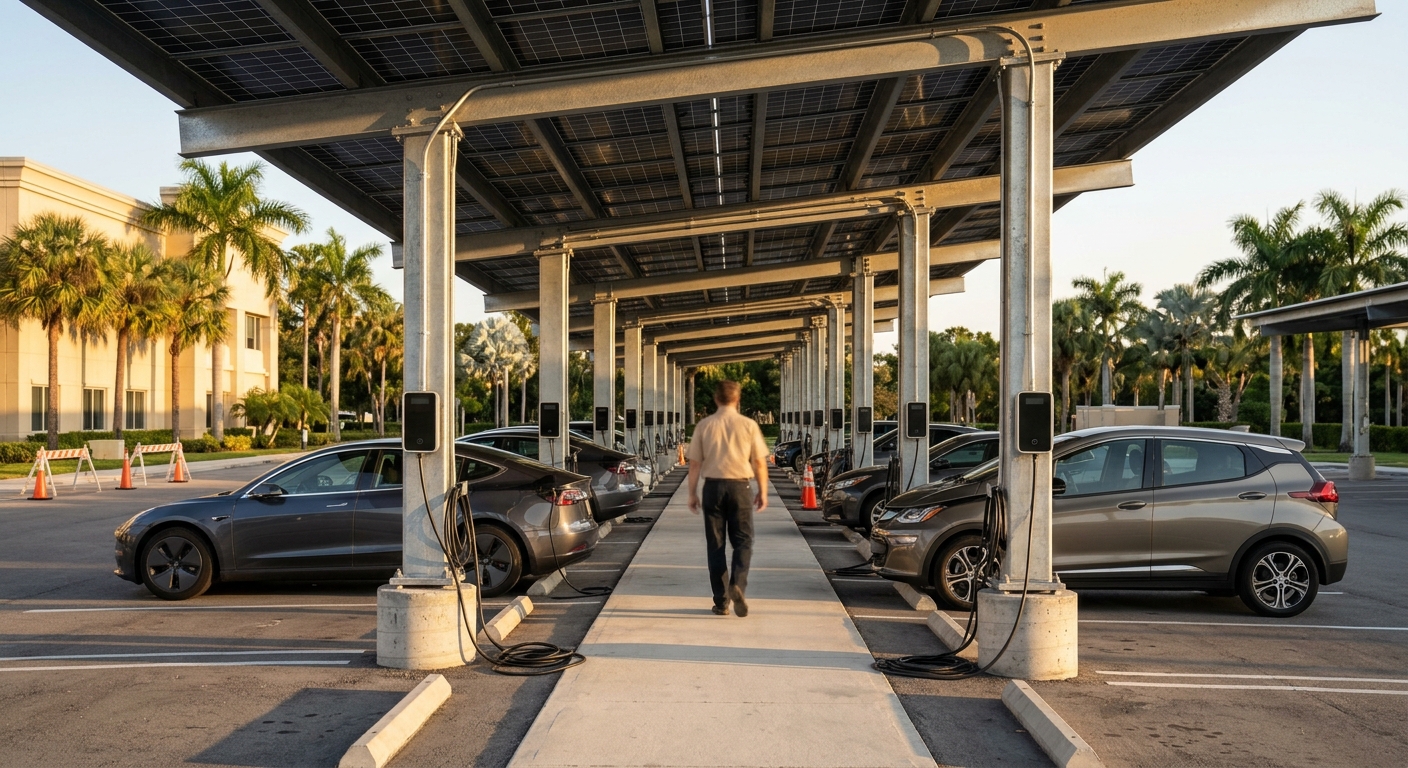
Coastal equipment needs enclosures and finishes suited to salt air, and pads in low areas should sit above known ponding levels. Where chargers mount under solar carports, the canopy is a structure governed by the Florida Building Code, whose 9th Edition takes effect December 31, 2026, with High-Velocity Hurricane Zone provisions in Miami-Dade and Broward. Rule 5J-28.005 requires an “Electric Vehicle Charging Only” sign on reserved spaces, a unique identifier on each charger, and the FDACS complaint hotline posted where drivers can see it.
Which Florida rules and incentives apply to commercial EV chargers in 2026?
As of October 28, 2026, a few items govern most Florida commercial charging projects. Section 366.94 preempts local EV charging regulation, provides that a business selling charging to the public is not making a utility retail sale of electricity under Chapter 366, and makes parking a non-charging vehicle in a designated charging space a noncriminal traffic infraction. FDACS Rule 5J-28.006 requires registration before a charger is placed into service for public use, with exemptions for chargers used only by a private fleet, employees, a government, or multifamily residents.
Electrical work follows NFPA 70, the National Electrical Code, whose Article 625 covers EV power transfer equipment, along with the equipment’s listing and the permit review. Federal support has narrowed with the end of Section 30C, and CS/SB 680, a 2026 bill that would have exempted separately metered charging electricity from Florida sales tax, died in committee in March 2026. None of this determines whether a specific site qualifies for a rate, an exemption, or a permit path; those calls belong to the utility, a tax advisor, and the building official.
Workplace EV charging decision checklist for Florida properties
A charging decision holds up before an owner or board when each item below has a named owner.
- Property manager: log how long cars stay parked in each lot section for two typical weeks, split by employees, visitors, and fleet.
- Owner or asset manager: decide whether chargers serve employees, tenants, or the public, because public access triggers FDACS registration and affects FPL rider eligibility.
- Electrical engineer: confirm spare switchgear capacity and the distance to each charger bank before hardware is priced; AGT’s engineering process starts with this survey.
- Serving utility: provide the rate schedule, any service upgrade requirement, and the lead time in writing.
- Owner and HR: set an employee charging policy from the DOE workplace charging guidance, including time limits, a sharing method, and whether to charge a fee slightly above residential electricity rates.
- Designer: place accessible charging spaces and access aisles in the first site plan.
- Tax advisor: confirm which incentives, if any, apply to the placed-in-service date.
- Contractor: price conduit for future ports in the same trench and specify OCPP-capable networked hardware so the site can change network providers later.
Frequently Asked Questions
Is Level 2 or DC fast charging better for workplace EV charging?
Level 2 is the better fit for most workplace EV charging. Employees park for hours, and a Level 2 port adding about 25 miles of range per hour covers a typical commute in part of a shift, so one port can serve two drivers a day. DC fast charging makes sense at a workplace only when company vehicles must recharge between short shifts or routes.
How much does a commercial EV charger installation cost in Florida?
Cost depends mostly on site work and electrical capacity. The DOE Alternative Fuels Data Center reports national figures of about $3,500 per connector for public Level 2 hardware plus about $2,500 to install, and $38,000 to $90,000 per connector for DC fast hardware plus $20,000 to $60,000 to install. Trenching distance and utility upgrades can push a Florida site above those ranges.
Do commercial EV chargers in Florida need to be registered with the state?
Chargers available to the public must be registered with the Florida Department of Agriculture and Consumer Services before they are placed into service, under Rule 5J-28.006. The rule exempts chargers used only by a private fleet, by employees, by a government, or as a multifamily resident amenity. Changes to registered information must be reported to the department within 30 days.
Is there still a federal tax credit for commercial EV chargers?
The Section 30C Alternative Fuel Vehicle Refueling Property Credit cannot be claimed for property placed in service after June 30, 2026, according to the IRS instructions for Form 8911. Earlier projects also had to sit in an eligible census tract. A tax advisor should confirm the treatment of any specific project.
Can a solar carport power DC fast chargers?
A solar carport can supply energy to DC fast chargers, but solar output alone does not reliably cover their peak draw, because output falls when clouds pass. Battery storage or load management handles those peaks. Solar is a closer match for Level 2 workplace charging, which draws steadier power through the daylight hours when employees are parked.
How many EV chargers should a Florida business install?
The count should come from parking data: how many drivers use EVs now, how long they stay, and how fast that number is expected to grow. Many properties install a first phase of Level 2 ports sized to current demand and run conduit for more ports in the same trench, so the lot is not opened twice.
Matching charger speed to parking time protects the budget
The Level 2 vs DC fast charging decision is a dwell-time decision first and an equipment decision second. Level 2 charging fits the workplaces, multifamily properties, and retail centers where Florida drivers park for hours, at a fraction of the installed cost per port, while DC fast charging belongs where vehicles must turn around quickly and the owner has accounted for demand charges. With Section 30C gone, a proposal now has to stand on site data and the utility’s rate. AGT’s commercial EV charging station installation and earlier article on combining parking with solar energy production cover the next steps for owners pairing charging with a carport.
Written by The Technical Team at Advanced Green Technologies. Founded in 2007, Advanced Green Technologies is 100% employee-owned and ranked #1 among Florida commercial and industrial EPC contractors on Solar Power World’s 2026 Top Solar Contractors list (2026 ranking announcement).
To compare Level 2 and DC fast charging options for your property, request a free quote from Advanced Green Technologies or call (888) 735-2641.