

At a glance: A solar carport offsets EV charging energy over the year, but it cannot power chargers in real time, so the charger mix, the electrical service, load management, and the demand charge decide the result. This guide shows how much charging one covered space can offset, compares make-ready, Level 2, and DC fast charging plans, lists the cost drivers to price separately, covers Florida’s 2026 rules (the end of Section 30C, FDACS registration, and FPL’s EV rider), and closes with a checklist assigned by role.
Solar carport EV charging works when the canopy, the conduit, and the electrical service are designed as one project, and it disappoints when owners expect the modules overhead to run the chargers below. A canopy over a parking space produces a small fraction of what a busy charger can draw, so the result is decided by the charger mix, the size of the electrical service, load management, and the demand charge on the meter. Getting those wrong means saw-cutting a finished lot a second time or watching a new demand peak absorb the solar savings. This guide is for Florida property and facility teams planning chargers under a new or planned canopy. It does not argue that every lot needs chargers, and it makes no tax, tariff, code, or accessibility determination for any site.
Why does solar carport EV charging need a fresh plan in Florida this year?
Three rule changes reshaped commercial EV charging in Florida, and all three land on projects designed in late 2026. The first is federal. The IRS page for the alternative fuel vehicle refueling property credit states that the business credit covers qualified charging property placed in service from January 1, 2023, through June 30, 2026, at 6% of cost, or 30% where prevailing wage and apprenticeship requirements are met, capped at $100,000 per charging port and limited to eligible census tracts. Chargers placed in service after June 30, 2026 fall outside that window, so a 2027 charger budget carries no Section 30C offset.
The second is state law. Under section 366.94, Florida Statutes, public EV charging by a non-utility is not a retail sale of electricity, regulation of charging stations is preempted to the state, and local governments may not enact or enforce their own charging-station ordinances. The Florida Department of Agriculture and Consumer Services (FDACS) carries out the statute through Rule Chapter 5J-28, Florida Administrative Code, effective May 1, 2025, which covers installation and design, signage, and registration before a public charger goes into service.
The third is the utility bill. Florida Power & Light’s electric tariff, effective January 1, 2026, bills General Service Demand accounts (25 kW to under 500 kW) a base demand charge of $12.70 per kW on the month’s highest 30-minute interval. The same tariff offers an optional GSD-1EV rider for public charging on a dedicated meter that caps billed demand at the month’s kWh divided by 75 hours. Charging creates tall, brief peaks, and those peaks land on the building meter when chargers are added without a plan.
How much EV charging can a solar carport actually cover?
A solar carport with EV charging offsets charging energy over the year, but it does not power the chargers in real time. The canopy produces at the pace of the sun, and the chargers draw at the pace of the drivers plugged in. Most hours, those two curves do not match, and the utility supplies the difference.
The charger side is larger than most owners expect. The U.S. Department of Energy’s Alternative Fuels Data Center rates commercial Level 2 equipment, typically on 208-volt service, at 2.9 to 19.2 kW per port, and DC fast chargers at outputs up to 500 kW. A common 7.2 kW Level 2 unit adds about 25 miles of range per hour of charging, and the AFDC notes that it needs a dedicated 40-amp circuit under Article 625 of the National Electrical Code.
The canopy side is smaller than most owners assume. Advanced Roofing reports that its 16-space, 84 kW headquarters solar carport in Fort Lauderdale produces more than 124,000 kWh a year. Spread across the spaces it covers, that is about 5 kW of solar capacity and roughly 7,750 kWh a year per parking space, or about 21 kWh on an average day. One 7.2 kW Level 2 charger delivers that much energy in about three hours of use.
| Charging level | Power per port (DOE AFDC) | Range added (DOE AFDC) | Fits sites where vehicles stay | One covered space’s average solar day (about 21 kWh) equals |
|---|---|---|---|---|
| Level 2, 7.2 kW | 7.2 kW | About 25 miles per hour | Several hours: workplace, multifamily, hotel | About 3 hours of charging |
| Level 2, maximum rating | Up to 19.2 kW | Limited by the vehicle’s onboard charger | An hour or two: retail, medical office | About 1 hour at full rating |
| DC fast charging | Up to 500 kW; many vehicles accept less | About 100 to 200+ miles per 30 minutes | Minutes: fleet turnaround, corridor, high-traffic retail | About 3 minutes at 500 kW |
The canopy lowers the account’s kWh purchases across the year, while the charging plan has to keep the kW peak from growing faster than the solar offset. At 7 p.m., nearly every charging kilowatt comes from the utility. A commercial battery storage system can carry some daytime solar into evening charging, and AGT’s guide to peak shaving with solar and battery storage explains how a battery defends a monthly demand target.
Level 2, DC fast charging, or make-ready conduit: which plan fits a solar carport?
The right charging plan follows how long vehicles stay parked under the canopy, because dwell time sets the power each port needs. Employees and residents park for hours, so moderate-power Level 2 ports can deliver a full day’s driving at a low cost per port. Retail and medical visitors stay an hour or two, which favors higher-power Level 2. DC fast charging fits sites where drivers expect to leave within minutes, and it is the option most likely to require a new utility transformer and a service upgrade.
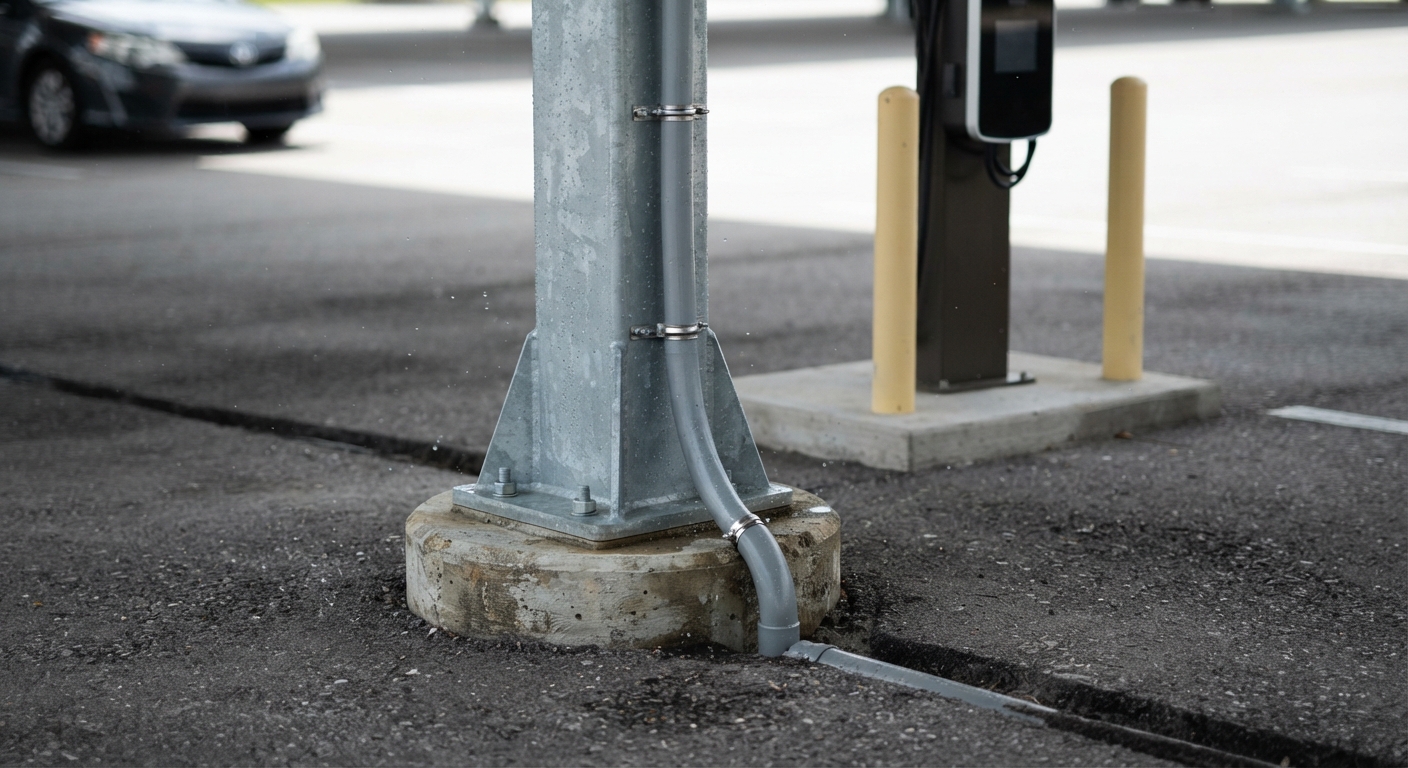
Make-ready is the fourth option and often the one with the best return on a new canopy. Make-ready means installing the conduit, pull boxes, pads, and panel capacity for future chargers while the lot is open for carport construction, then setting chargers later as demand appears. The lot is already trenched for the canopy’s electrical runs, so adding charger conduit there avoids cutting a finished lot later. AGT’s commercial EV charging station services and its solar carport design and construction teams scope both so the conduit is in the ground before paving closes it.
| Option | Best fit | What it requires | Where it falls short |
|---|---|---|---|
| Make-ready only | Sites unsure of demand; long ownership horizon | Conduit sized for future conductors, panel or switchboard space, pads at future charger locations | No amenity or charging revenue until chargers are added; capacity assumptions can age |
| Networked Level 2 | Workplace, multifamily, hotel, campus | 208-volt branch circuits, network software, FDACS registration if public | Slow for short visits; utilization varies widely by site |
| Higher-power Level 2 (up to 19.2 kW) | Retail, medical office, mixed use | Larger branch circuits and load management to cap simultaneous draw | Many vehicles accept less power than the port can deliver |
| DC fast charging | Fleet turnaround, corridor, high-traffic retail | Three-phase service, often a new transformer; dedicated meter to use GSD-1EV | Highest cost and demand exposure; heavy, short cables complicate accessible design |
Load management changes the math for every option except make-ready. Article 625 of the National Electrical Code, published by the National Fire Protection Association as NFPA 70, allows EV supply equipment to be governed by an energy management system that limits the total power a group of chargers can draw, so an engineer can size the service for the managed load instead of every port running at full rating at once. The trade-off is slower charging when many vehicles plug in at once.
What drives the cost and performance of a solar carport with EV charging?
On a combined canopy and charging project, service capacity, trenching, and the demand charge surprise owners more often than the modules do, and each can be priced before award. Require the drivers below as separate lines in every proposal so bids compare on the same scope.
| Driver | Why it moves cost or results | Source and date | How to pin it down |
|---|---|---|---|
| Electrical service capacity | Chargers can exceed existing switchboard or transformer capacity | Utility service planning; site load calculation | Load calculation and utility service request before design freeze |
| Trenching and paving | Conduit added after paving means saw-cutting and patching a finished lot | Project-specific | Charger conduit included in the carport’s electrical trench scope |
| Demand charge | GSD-1 base demand charge of $12.70 per kW on the highest 30-minute interval | FPL Sheet 8.105, effective Jan. 1, 2026 | Model charging peaks against 12 months of interval data |
| Dedicated EV meter | GSD-1EV caps billed demand at monthly kWh divided by 75 hours for public charging | FPL Sheet 8.106, effective Jan. 1, 2026 | Ask the utility which meter the array ties to |
| Load management | Caps simultaneous draw and can reduce service size | NFPA 70, Article 625 | Specify the managed kW limit in the design |
| Battery storage | Shifts solar into evening; limits charging peaks | Site-specific | Size from 12 months of interval data |
| Federal credits | Section 30C closed to chargers placed in service after June 30, 2026; Section 48E timing applies to solar | IRS, as of October 2026 | Tax advisor confirms before budget approval |
The dedicated-meter rider deserves a careful read. GSD-1EV applies only to charging open to the public on its own meter, and it ties billed demand to energy sold: a station that delivers 7,500 kWh in a month is billed for no more than 100 kW of demand, regardless of its actual peak. Moving chargers to a separate meter also changes where the carport’s solar lands. If the array stays on the building service, it offsets building load and none of the charging load. The utility and the project engineer decide which arrangement is permitted on a given site, and AGT’s commercial solar engineering process models both before a design is frozen.
What changes when solar carport EV charging goes in on an occupied Florida lot?
A parking lot under construction is a parking lot with fewer spaces, so the build is phased around the people who still need to park. Rows close in sections, foundations and conduit go in first, and steel erection and module setting follow inside the closed zone while the rest of the lot stays open. The property manager receives notice of each closure before it starts.
Column placement is decided before steel is ordered, and EV accessibility belongs in that decision. The U.S. Access Board’s design recommendations for accessible EV charging stations (last updated July 17, 2023) recommend that charging spaces with accessible mobility features be at least 11 feet wide and 20 feet long with an adjacent 5-foot access aisle, that chargers sit at the level of the charging space with operable parts no higher than 48 inches, and that shelter columns stay out of charging spaces, access aisles, and clear floor space. The Board recommends at least two such spaces. The owner’s architect or accessibility consultant decides how they apply to a given lot.
Florida adds wind, water, and salt. The canopy is engineered for the site’s design wind loads, with High-Velocity Hurricane Zone requirements in Miami-Dade and Broward, and AGT states that its carports are designed for wind speeds up to 180 mph, a company rating for its engineered designs that does not describe carports in general. Charger pedestals sit on pads above drainage paths, conduit entries are sealed against standing water, and coastal sites call for hardware suited to salt exposure.
Which Florida rules, tariffs, and tax items apply as of October 2026?
These items change on a calendar and belong to named professionals. Each should be rechecked on the contract signing date, and none is decided here.
| Item | Status as of October 2026 | Who confirms |
|---|---|---|
| Charger tax credit (Section 30C) | Business credit applies to property placed in service Jan. 1, 2023 through June 30, 2026, in eligible census tracts | Owner’s tax advisor |
| Solar credit (Section 48E) | Solar beginning construction after July 4, 2026 must be placed in service by Dec. 31, 2027; foreign-entity rules apply | Owner’s tax advisor |
| Charging station regulation | Preempted to the state under F.S. 366.94; FDACS Rule Chapter 5J-28 governs design, signage, and registration | FDACS; local permit office applies state standards |
| Public charger registration | Required before public use under Rule 5J-28.006 | Charging station operator |
| Utility rates | FPL GSD-1 and GSD-1EV sheets effective Jan. 1, 2026; FPL’s tariff index also lists an MRC-1 make-ready credit | Utility account manager and energy analyst |
| Building and electrical code | 9th Edition Florida Building Code takes effect Dec. 31, 2026; permit application date generally decides the edition | Building official and engineer of record |
| Accessibility | Access Board technical assistance (2023) and the ADA standards it references | Architect or accessibility consultant |
For the solar side of the budget, the IRS page for the clean electricity investment credit describes a base credit of 6% that rises to 30% for projects meeting prevailing wage and apprenticeship requirements, and AGT’s commercial solar tax credit deadline guide walks through the construction-start and placed-in-service dates in detail. The Florida Building Commission’s 2026 code development page posts the 9th Edition’s adoption record.
Solar carport EV charging checklist, by role
- Owner or asset manager: Decide whether chargers serve employees, residents, a fleet, or the public; that choice sets charging level, metering, registration, and accessibility scope.
- Facility manager: Pull 12 months of interval data and note when peaks occur relative to expected charging hours.
- Electrical engineer: Run the load calculation with and without load management, and confirm switchboard and transformer capacity with the utility before the canopy design is frozen.
- Utility account manager: Confirm rate eligibility, meter arrangement, which service the array interconnects to, and any current make-ready program terms.
- Architect or accessibility consultant: Lay out accessible charging spaces and access aisles against the carport column grid.
- Tax advisor: Confirm credit eligibility for the solar and storage scope, and confirm that charger costs are budgeted with no Section 30C credit.
- Contractor: Price canopy, foundations, trenching, make-ready conduit, chargers, and network software as separate lines; AGT’s guide on how to select a solar contractor lists questions for comparing bids.
- O&M provider: Confirm who monitors the array and chargers; AGT’s solar operations and maintenance program covers the solar side.
Frequently Asked Questions
Can a solar carport power EV chargers directly?
Not in a way that keeps chargers running on solar alone. The carport’s output and the chargers’ draw both pass through the site’s electrical service, so the canopy offsets charging energy across the year while the utility supplies whatever the modules are not producing at that moment. Cloudy afternoons and evening charging fall almost entirely on the grid. A battery can shift some daytime solar into later hours.
How many EV chargers can a solar carport support?
The limit is the electrical service and the load management design, and the canopy does not set it. Advanced Roofing’s published figures for its 16-space carport work out to roughly 21 kWh of solar per covered space on an average day, about three hours of one 7.2 kW Level 2 charger. An electrical engineer sizes the charger count from service capacity, the managed load limit, and expected use.
Is there still a federal tax credit for commercial EV chargers in 2026?
Not for chargers placed in service after June 30, 2026. The IRS states that the Section 30C business credit applies to qualified charging property placed in service from January 1, 2023, through June 30, 2026, and only in eligible census tracts. The solar canopy may still qualify under Section 48E, subject to its own timing rules. Your tax advisor confirms eligibility.
Do public EV chargers in Florida need to be registered?
Yes. Section 366.94, Florida Statutes, requires a charger at a station offered to the public to be registered with the Florida Department of Agriculture and Consumer Services before it goes into service, and Rule 5J-28.006 sets the form and its contents. Registration applies whether or not drivers pay. Chargers that are not available for public use fall outside the registration rule.
Will adding EV chargers raise my demand charge?
It can. Demand-rate accounts such as FPL’s GSD-1 are billed on the highest 30-minute interval of the month, so several chargers starting together can set a new peak. Load management, a battery, or FPL’s GSD-1EV rider for public charging on a dedicated meter can limit the effect. Twelve months of interval data shows how much headroom the account has.
Should we install chargers now or only make-ready conduit?
Make-ready conduit, panel space, and pads are easier and less disruptive to install while the lot is already open for carport construction than after it is repaved. Chargers can follow once demand is clear. Sites with confirmed employee, fleet, or resident demand often install a first set of Level 2 ports during construction and leave capacity for the rest.
Build the conduit once, then size chargers to how long cars stay
Solar carport EV charging is a parking-lot infrastructure decision first and an energy decision second. The canopy offsets a meaningful share of charging energy over a year, and it does not run chargers on its own; the electrical service, load management, and demand charge decide what the chargers cost to operate. With Section 30C closed to chargers placed in service after June 30, 2026, and FDACS registration and state preemption now governing public stations, the owners who come out ahead install make-ready conduit while the lot is open, match the charger level to how long vehicles stay, and model the peak before they sign. Advanced Green Technologies was ranked #1 among Florida commercial and industrial EPC contractors on Solar Power World’s 2026 Top Solar Contractors list, as documented in AGT’s 2026 Top Solar Contractors ranking announcement, and plans the canopy and the charging scope as one project.
Written by The Technical Team at Advanced Green Technologies. Founded in 2007 by Advanced Roofing, Advanced Green Technologies is 100% employee-owned and states that it has installed more than 380 megawatts of solar for Florida clients.
To plan a solar carport with EV charging or make-ready conduit, request a free quote from Advanced Green Technologies or call (888) 735-2641.