

At a glance: Florida law has made floating solar a permitted use on stormwater, wastewater, reclaimed water, and mine ponds since 2022, and the Florida Department of Transportation began leasing its stormwater ponds for floating arrays in 2026. This article explains how a floating photovoltaic system is moored against Florida wind loads and changing water levels, how it compares with ground-mount and rooftop arrays, what drives installation cost, how the work proceeds on a pond that stays in service, and which permits, code editions, and tax dates apply, with a pre-bid checklist assigned by role.
The deciding variable in floating solar Florida projects is the water body. A floating photovoltaic system on a stormwater, wastewater, or cooling pond is a moored structure that must hold position through hurricane winds, follow a moving waterline, and leave the pond able to do its permitted job. Owners who scope it as a ground-mount array on floats meet the anchoring and permitting questions after the bid, when answers cost the most.
This article covers the engineering and installation decisions specific to Florida sites. It does not argue that every pond should carry an array, and it does not replace the engineer of record, the water management district, the utility, or a tax advisor.
Why is floating solar getting serious attention in Florida now?
Florida made room for commercial floating solar in two steps. In 2022 the Legislature enacted section 163.32051, Florida Statutes, which makes a floating solar facility a permitted use in the appropriate land use categories of every local comprehensive plan and directs local governments to amend their land development regulations to promote it. The statute defines eligible sites as wastewater treatment ponds, abandoned limerock mine areas, stormwater treatment ponds, reclaimed water ponds, and other water storage reservoirs. Local buffer rules cannot exceed those for comparable solar facilities in agricultural zones.
The second signal came in 2026. Solar Power World reported on May 19, 2026 that the Florida Department of Transportation signed a master lease naming D3Energy its exclusive floating solar developer on FDOT stormwater ponds, with a first array on an Orlando pond commissioned earlier that year. The developer’s estimate of more than 1 GW statewide is a projection, not an engineering assessment of any pond.
Florida utilities have already put arrays on water. Florida Power & Light commissioned a 402-panel floating array beside Miami International Airport in February 2020 as a test bed. Tampa Electric announced a 1 MW, 3,200-panel array on about 3 acres of a 14-acre pond at Big Bend Power Station in 2022, anchored to pilings around the shoreline. Duke Energy Florida completed a nearly 1 MW pilot on about 2 acres of a cooling pond in Bartow in December 2023. All three are utility pilots on industrial water, useful context and never a performance guarantee.
How do floating photovoltaic systems stay in place on a Florida pond?
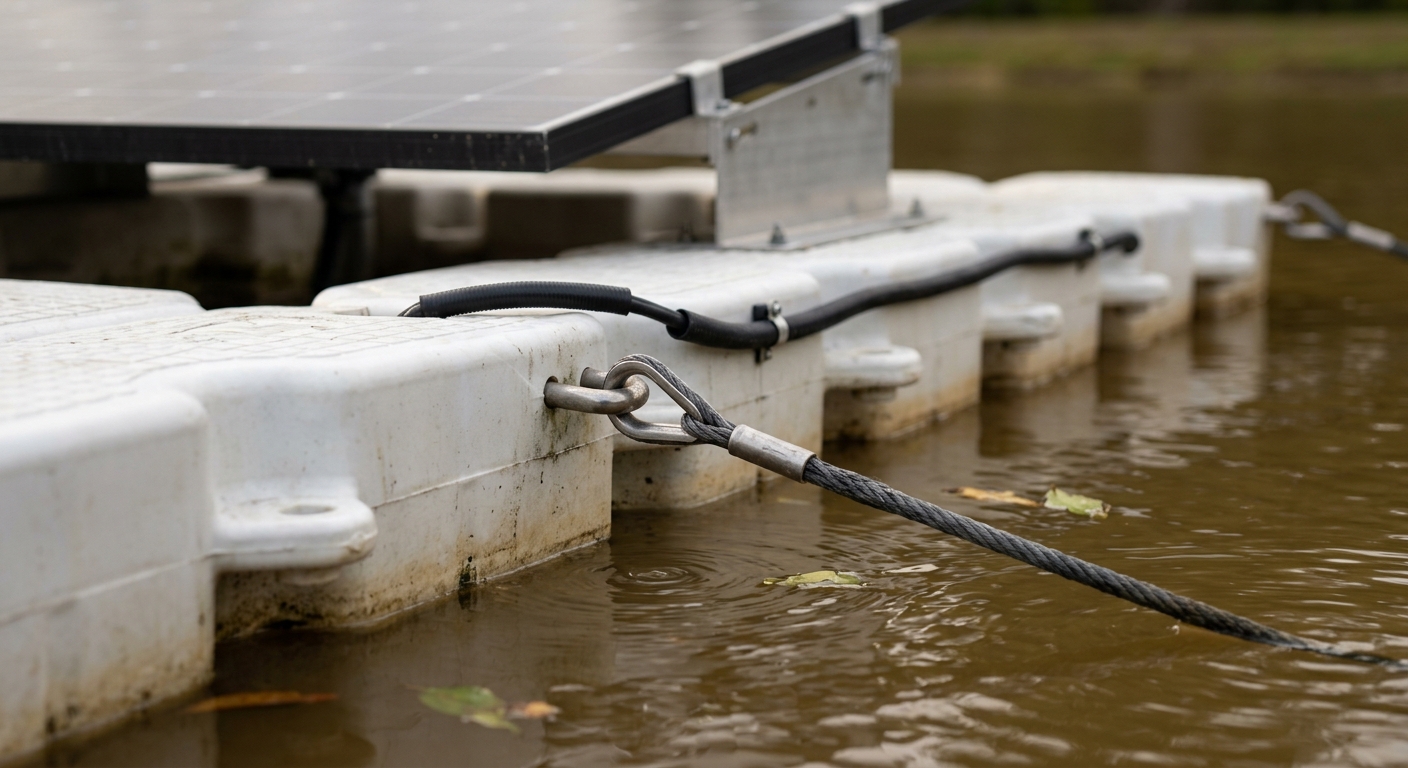
A floating photovoltaic system is a field of solar modules mounted on buoyant floats, joined into one or more islands, and held in position by mooring lines tied to anchors on the bank, on the pond bottom, or on driven piles. Flexible cable carries power from the island to fixed equipment on shore.
The mooring system carries most of the engineering burden. Wind pushes on modules and floats, and the island transfers that load through its mooring lines into the anchors. In Florida, the design wind speed for the site under the Florida Building Code governs that load, and Miami-Dade and Broward sites fall in the High-Velocity Hurricane Zone, where product approval adds a layer of review. The waterline also moves. A wet detention pond is built to rise during a storm and draw back down afterward, so mooring lines need enough slack or elasticity to follow the island up and enough restraint to keep it off the banks and outfalls when the water drops.
The pond bottom decides the anchor. Soft muck can make bottom anchors unreliable, a clay seal or liner may be off-limits to penetration, and a narrow pond may favor bank or pile anchoring. The World Bank, ESMAP, and the Solar Energy Research Institute of Singapore list anchoring, mooring, and electrical safety among the main challenges in their 2019 floating solar handbook for practitioners, and DNV’s recommended practice DNV-RP-0584 covers floating systems on sheltered inland water. AGT’s commercial solar engineering process draws on frameworks like these, with the engineer of record signing the final design.
| Component | What it does | Florida design question | Who decides |
|---|---|---|---|
| Floats and island frame | Buoyancy, module support, maintenance walkways | Material data for UV, heat, and fire exposure over the planned service life | Structural engineer, using the float manufacturer’s data sheet |
| Mooring lines | Transfer wind and wave load to anchors | Slack and elasticity across the pond’s full design water-level range | Engineer of record |
| Anchors (bank, bottom, or pile) | Hold the island in position | Muck depth, soil strength, and any liner or clay seal that cannot be penetrated | Geotechnical engineer |
| Cabling and connectors | Carry power from the island to shore | Wiring methods that allow movement; connections kept clear of the water | Electrical engineer and authority having jurisdiction |
| Shore equipment and interconnection | Inverters, disconnects, metering, utility tie | Location above design flood elevation; truck access for service | Electrical engineer and utility |
Floating solar vs ground mount solar and rooftop arrays: where does each fall short?
Floating solar is one of several surfaces a Florida owner with land, roofs, parking, and permitted ponds can compare, and each has a weakness. Floating systems use water with no other building value. A 2019 national assessment by National Renewable Energy Laboratory researchers, published in Environmental Science & Technology, identified 24,419 man-made water bodies in the contiguous United States as suitable for floating arrays. Ground-mount remains the lower-cost benchmark.
The cooling claim needs care. A 2021 study in the journal Solar Energy by researchers at TNO and the Solar Energy Research Institute of Singapore measured floating arrays in the Netherlands and Singapore and found that the best-performing open-frame system in Singapore ran 14.5 °C cooler, on an irradiance-weighted basis, than its land reference, while closed float designs gained less. The researchers attributed most of the cooling to higher wind speeds over water, so float design and row spacing decide how much benefit a Florida pond delivers.
| Option | Where it fits | Where it falls short |
|---|---|---|
| Floating PV on a permitted pond | Land-constrained sites; water utilities, treatment plants, and industrial sites with ponds that have no other building use | Higher installed cost than ground-mount; site-specific anchoring and permitting work; the pond’s permitted function limits coverage; few Florida reference projects |
| Ground-mount on dry land | Open parcels with workable soils and room for setbacks | Consumes buildable land; clearing, grading, and new stormwater design bring their own permits |
| Rooftop | Buildings with sound roofs and large unobstructed areas | Shares the roof’s service life; structural capacity and fire-code setbacks limit array size |
| Solar carport | Parking lots that can host canopies | Steel and foundation cost; construction disrupts parking during the build |
No surface wins on every site. AGT evaluates floating solar and ground-mount solar farm installation against the owner’s roofs and parking on the same parcel before a design is set, because the cheapest watt on paper can carry the largest permitting or schedule risk.
What drives floating solar installation cost and schedule?
The most cited public cost reference for floating solar installation is a 2021 benchmark by Vignesh Ramasamy and Robert Margolis, now hosted by the National Laboratory of the Rockies. It estimated a premium of $0.26 per watt DC, about 25 percent, for a 10 MWdc fixed-tilt floating system over a fixed-tilt ground-mount system on bare ground, in Q1 2021 dollars, with floats and anchoring the largest contributors. Its base case assumed 50 m of water depth and 10 m of water-level variation, unlike most Florida stormwater ponds, so the figure is a reference point and never a quote. AGT does not publish pricing; a site estimate follows the design.
These variables move a Florida budget and schedule most:
- Bathymetry and pond bottom: depth, muck, and any liner decide the anchor type.
- Design wind speed: coastal and HVHZ sites raise mooring and float loads.
- Water-level range: a wide storm-stage range needs longer, more elastic mooring.
- Launch area: a flat bank beside the water shortens assembly; a tight site adds crane or boat work.
- Interconnection: cable distance to shore equipment and the utility study queue set the back half of the schedule.
- Float supply: the benchmark found cost most sensitive to float price, wind loading, and module efficiency.
Duke Energy reported its Bartow pilot took about six months to build and connect. On commercial projects, permitting and interconnection often set the critical path before any float reaches the water.
What changes on a floating solar Florida site that stays in service?
The pond under a floating array keeps working during construction and for the life of the system, and the installation plan is built around that. A stormwater treatment pond still has to receive and treat runoff, a cooling pond still serves the plant. The owner’s engineer confirms how much surface the array can cover without degrading treatment and keeps outfalls, skimmers, and control structures clear and reachable.
Installation usually follows the sequence Duke Energy described for Bartow: crews assemble float sections on land at a launch area, push them onto the water, connect them into an island, and winch or tow the island into its moored position. That launch area needs a stable bank, a laydown yard for pallets, and a delivery plan that keeps trucks clear of the facility’s own operations. AGT’s commercial solar installation crews set that plan with the facility before mobilization.
Work over water adds risks land crews do not face. OSHA’s standard for working over or near water requires Coast Guard-approved life jackets or work vests, ring buoys, and a lifesaving skiff on hand. Afternoon thunderstorms stop work on an open pond, so wet-season schedules put water work in the morning, and island electrical work follows lockout procedures because the array is energized whenever the sun is up. Maintenance access belongs in the design and the operations and maintenance plan, and periodic solar drone surveys let the owner inspect moorings without putting a crew on the water.
Which floating solar permits, code editions, and tax deadlines apply in Florida?
A floating array on a permitted stormwater system can require Environmental Resource Permit review, because the ERP program regulates activities that alter surface water flows. The five water management districts review most applications; DEP handles listed categories such as power infrastructure. If the project sits on navigable fresh water below the ordinary high water line, or on tidal water, it is on sovereign submerged lands and also needs proprietary authorization, processed on the same application. The engineer and the reviewing agency decide which pathway applies.
On the electrical side, the 2023 edition of the National Electrical Code, NFPA 70, added section 690.4(G) for PV equipment floating on bodies of water, requiring equipment identified as suitable for the purpose and wiring methods that allow for expected movement. As of October 2026, the 9th Edition (2026) Florida Building Code, adopted alongside the 2023 NEC, takes effect December 31, 2026, and the permit application date generally determines which edition governs.
For federal credits, IRS Notice 2025-42 sets beginning-of-construction rules for the 2025 law that ends the Section 48E credit for solar facilities placed in service after December 31, 2027; projects that began construction on or before July 4, 2026 fall outside that termination. A floating project starting now faces that date, so survey and permit time matter. Eligibility belongs to the owner’s tax advisor; AGT’s article on the commercial solar tax credit deadline covers the timeline in more detail.
What belongs on a floating solar feasibility checklist before you bid?
Each pre-bid question below is assigned to the person who owns the answer, so the list can be forwarded as the scope for a feasibility phase.
- Facility or utility director: confirm the pond’s permitted function, its permit number, and any limit on surface coverage.
- Owner’s civil engineer: provide the design water-level range and outfall and control structure locations.
- Geotechnical engineer: survey bathymetry and pond-bottom conditions, including muck depth and any liner or clay seal.
- Structural engineer of record: set the design wind speed and confirm whether HVHZ product approval applies to floats and moorings.
- Electrical engineer: place shore equipment above the design flood elevation and confirm which NEC edition governs the permit.
- Interconnection manager: file the utility interconnection request early and confirm metering under the utility’s tariff.
- Tax advisor: confirm beginning-of-construction status and placed-in-service timing under current IRS guidance.
- Procurement officer (public owners): check whether a cooperative vehicle such as the Equalis Group contract fits the project.
- Board or leadership: require floating, ground-mount, and rooftop options compared on the same site.
Frequently Asked Questions
Is floating solar allowed on stormwater ponds in Florida?
Yes, as a land use matter. Section 163.32051, Florida Statutes, makes a floating solar facility a permitted use on stormwater treatment ponds, wastewater and reclaimed water ponds, abandoned limerock mine areas, and other water storage reservoirs. Local buffer rules apply, and the project still needs environmental, building, and electrical permits, including district review of any change to a permitted stormwater system.
How are floating solar panels anchored in a hurricane zone?
Floating islands are held by mooring lines tied to bank anchors, bottom anchors, or driven piles. The engineer of record sizes them for the site’s design wind speed and the pond’s full water-level range. No array is hurricane-proof; it is designed to a rated wind speed that a storm can exceed, so post-storm inspection belongs in the O&M plan, and AGT’s commercial solar hurricane preparedness guide covers it.
Does floating solar produce more energy than ground-mount solar?
It can, depending on design. A 2021 Solar Energy study by TNO and the Solar Energy Research Institute of Singapore found open-frame floating arrays ran markedly cooler than land references while closed float designs gained less, mostly because of higher wind speeds over water. A Florida estimate should come from a site energy model of the selected float system.
How much more does floating solar installation cost than ground-mount?
A 2021 benchmark by Ramasamy and Margolis estimated a premium of $0.26 per watt DC, about 25 percent, for a 10 MWdc fixed-tilt floating system over ground-mount, in Q1 2021 dollars, driven mostly by floats and anchoring. A Florida pond’s bathymetry, wind exposure, and interconnection distance set the real number, and the estimate follows the design.
Will a floating array affect the pond’s water quality?
The evidence is still developing. Florida’s statute lists reduced evaporation and fewer algal blooms as legislative findings, while the World Bank handbook calls environmental effects uncertain. A Department of Energy-funded University of Central Florida study is collecting water quality data at floating and land sites. The owner’s engineer sets coverage limits and any monitoring the permit requires.
How long does a floating photovoltaic system take to install?
On-water assembly is often the shorter part. Duke Energy reported that its nearly 1 MW Bartow pilot took about six months to build and connect. For commercial owners, site investigation, Environmental Resource Permit review, and the utility interconnection study can take longer than construction, so those requests should start when a pond is shortlisted.
Floating solar in Florida works when the pond is engineered first
Floating solar has clear legal footing in Florida, three utility reference projects, and a state agency leasing its stormwater ponds for development. The engineering and cost records agree that floats, mooring, and anchors carry most of the premium and the risk, and the pond’s permitted function limits coverage. An owner who brings bathymetry, water-level data, the ERP file, and an interconnection request to the first design meeting can compare floating fairly against ground-mount and rooftop options. Savings still depend on the tariff, the site, and the installation.
Written by The Technical Team at Advanced Green Technologies. Founded in 2007, Advanced Green Technologies is a 100% employee-owned commercial solar contractor that has installed more than 380 megawatts of solar for Florida clients, and Solar Power World ranked it the #1 commercial and industrial EPC contractor in Florida on its 2026 Top Solar Contractors list.
To evaluate a pond, reservoir, or mine pit for a floating array, request a free quote from Advanced Green Technologies or call (888) 735-2641.