

At a glance: Florida law lets a condominium board install solar on the common elements without a unit owner vote under Section 718.113(7), and it protects an individual owner’s solar rights only within that owner’s unit. The harder limits sit elsewhere. Net metering credits only the account the array is wired to, third-party sales of power remain unavailable, and the roof under the array has to outlast it. This guide covers the statutes, the meter question, roof and reserve-study timing, work on an occupied building, the 2026 and 2027 deadlines, and a role-by-role checklist.
The legal side of condo solar Florida associations face is settled faster than the engineering side. Section 718.113(7) of the Florida Statutes lets a condominium board install solar collectors on the common elements without a unit owner vote, and Section 163.04 protects an individual owner’s solar rights only within that owner’s unit, so the roof decision almost always belongs to the board. Getting the rest wrong is expensive, because an array on a roof with eight years left becomes a funded remove-and-reinstall in the structural integrity reserve study, and an array sized for unit loads it cannot serve will miss the savings promised to owners. This article does not argue that every condominium, HOA, or apartment building should install solar, and it offers no legal opinion on any building; it sets out what the rules allow and who confirms each point.
Condo Solar Florida Law: What Can a Board Approve Without an Owner Vote?
A Florida condominium board can install a solar array on the common elements without a unit owner vote. Section 718.113, Florida Statutes, generally requires 75 percent of the voting interests for a material alteration when the declaration is silent, and subsection (7) sets that rule aside for solar collectors installed for the unit owners’ benefit.
Individual owners hold a narrower right. Section 163.04, Florida Statutes, bars a declaration or covenant from prohibiting solar collectors, and it bars an approving entity from denying permission on residential dwellings and within the boundaries of a condominium unit. In most Florida condominiums the roof is a common element outside every unit’s boundaries, so an owner cannot rely on the statute to mount panels there. In an HOA of single-family homes or townhomes, the owner usually owns the roof, and the association may only choose a location facing south or within 45 degrees east or west of due south that does not impair the system’s operation.
Three dates make late 2026 a working deadline for boards. Miami-Dade County’s notice on the 9th Edition Florida Building Code states that permit applications submitted on or after December 31, 2026 must comply with the new edition. Under IRS Notice 2025-42 and the 2025 tax law it implements, a solar facility that began construction after July 4, 2026 must be placed in service by December 31, 2027 to qualify for the Section 48E credit. And associations that used the milestone-coordination path must finish their initial structural integrity reserve study by December 31, 2026, a study in which the Florida Department of Business and Professional Regulation lists the roof as a required component.
How Does Net Metering Decide What a Condo or Apartment Array Can Offset?
Net metering in Florida credits the customer account the system is connected to and nothing else. Florida Public Service Commission Rule 25-6.065 requires investor-owned utilities to offer interconnection and net metering for customer-owned renewable generation up to 2 MW, and the Commission’s rule summary sorts systems into three tiers: 10 kW or less, above 10 kW through 100 kW, and above 100 kW through 2 MW. Section 366.91 defines net metering as generation allowed to offset the customer’s electricity consumption on site, and in a 2020 order the Commission described the purpose of net metering as offsetting usage rather than building a system to export.
That definition shapes every multifamily design. A condominium tower or apartment community usually has one or more house accounts for common areas, including corridor lighting, elevators, pumps, pool equipment, garage ventilation, and amenity rooms, plus a separate utility account for each unit. An association-owned array wired to the house service offsets the house account. It does not lower the bill on a unit account, because the electricity behind that meter belongs to a different customer.
Third-party sales close the obvious workaround. In PW Ventures v. Nichols (1988), the Florida Supreme Court upheld the Commission’s finding that a company selling on-site power to a single customer would be a public utility, and a solar company or an apartment owner still cannot sell rooftop kilowatt-hours to unit owners or tenants. The Commission has accepted equipment leases that are not sales of electricity, beginning with a 2018 declaratory statement on a residential solar lease. Hardware that divides one array among several unit meters has been tried; pv magazine reported in 2023 that the Orlando Utilities Commission reviewed one such system, and each utility decides whether to accept it.
| Configuration | Account it offsets | Who decides | Florida constraint |
|---|---|---|---|
| Association-owned array on a common-element roof | House (common-area) account | Condo board, Section 718.113(7) | Offset limited to house load; the roof is a SIRS component |
| Unit owner array on a common-element roof | Not available as of right | Board, under the declaration | Section 163.04 protection stops at the unit boundary |
| HOA homeowner array on the owner’s own roof | That owner’s account | Owner; HOA may set a south-facing location | Location rule cannot impair operation |
| Apartment owner array on the house service | Owner’s house account | Owner | No kilowatt-hour sales to tenants |
| Behind-the-meter sharing to unit meters | Participating unit accounts | Owner and utility | Requires utility review; no standard tariff |
Rooftop Array, Carport, Battery, or Wait: Which Option Fits a Florida Multifamily Building?
Florida multifamily solar projects reduce to five choices, each with a condition that rules it out. A commercial rooftop solar installation on the house service suits low-rise and garden-style buildings, where roof area is large relative to common-area load. On a high-rise, elevator machine rooms, cooling towers, rooftop units, fire-code pathways, and wind setbacks at the roof edge leave a small usable area, and the share of building load the array can carry falls with every added floor. Solar carports over resident parking move generation off the roof but add foundations and lot closures.
| Option | Where it works | Where it falls short | Confirm with |
|---|---|---|---|
| Rooftop array on the house service | Low-rise and garden-style buildings with most of the roof’s service life left | Small usable area on towers; tied to roof life; offsets house load only | Engineer of record, roof consultant |
| Solar carport over resident parking | Surface lots with sound soils and open sky | Higher structural scope; parking disruption during build | Structural and geotechnical engineers |
| Solar plus battery for selected common loads | Buildings that want limited backup for amenity or lighting circuits | Storage does not pay back on every tariff; fire and siting review | Electrical engineer, fire marshal |
| Defer to the roof replacement | Roofs inside the last third of their service life | Postpones savings; needs the roof on the SIRS schedule | Reserve study professional |
| Decline solar for now | Buildings with small house load or heavy roof equipment | Leaves common-area energy cost unchanged | Board and CAM |
Storage deserves a separate test. A commercial battery storage system can carry selected common-area circuits through an outage, but its value depends on the rate structure, and the fire marshal and building official decide siting. A large statewide contractor built for occupied commercial buildings may not be the lowest bid on a 15 kW common-area system on a three-story building, and the board should bid that job with a checklist such as how to select a solar contractor.
What Drives the Budget, Schedule, and Output of a Condo Solar Project?
No public dataset publishes Florida condominium solar prices as of November 2026, so a defensible budget comes from an engineered site estimate built on the variables below. The commercial solar engineering process starts with twelve months of house-account bills, the roof survey, and the structural drawings, and a roof and drone solar survey documents usable area and roof condition before layout.
| Driver | How it moves the project | Who confirms |
|---|---|---|
| Remaining roof service life | Short life adds a re-roof first or a future remove-and-reinstall | Roof consultant; reserve study professional |
| House-account load profile | Sets the useful system size; excess export earns less at annual true-up | Utility bills; solar designer |
| Usable roof area after setbacks | Equipment, pathways, and edge zones cap module count | Solar designer; fire marshal |
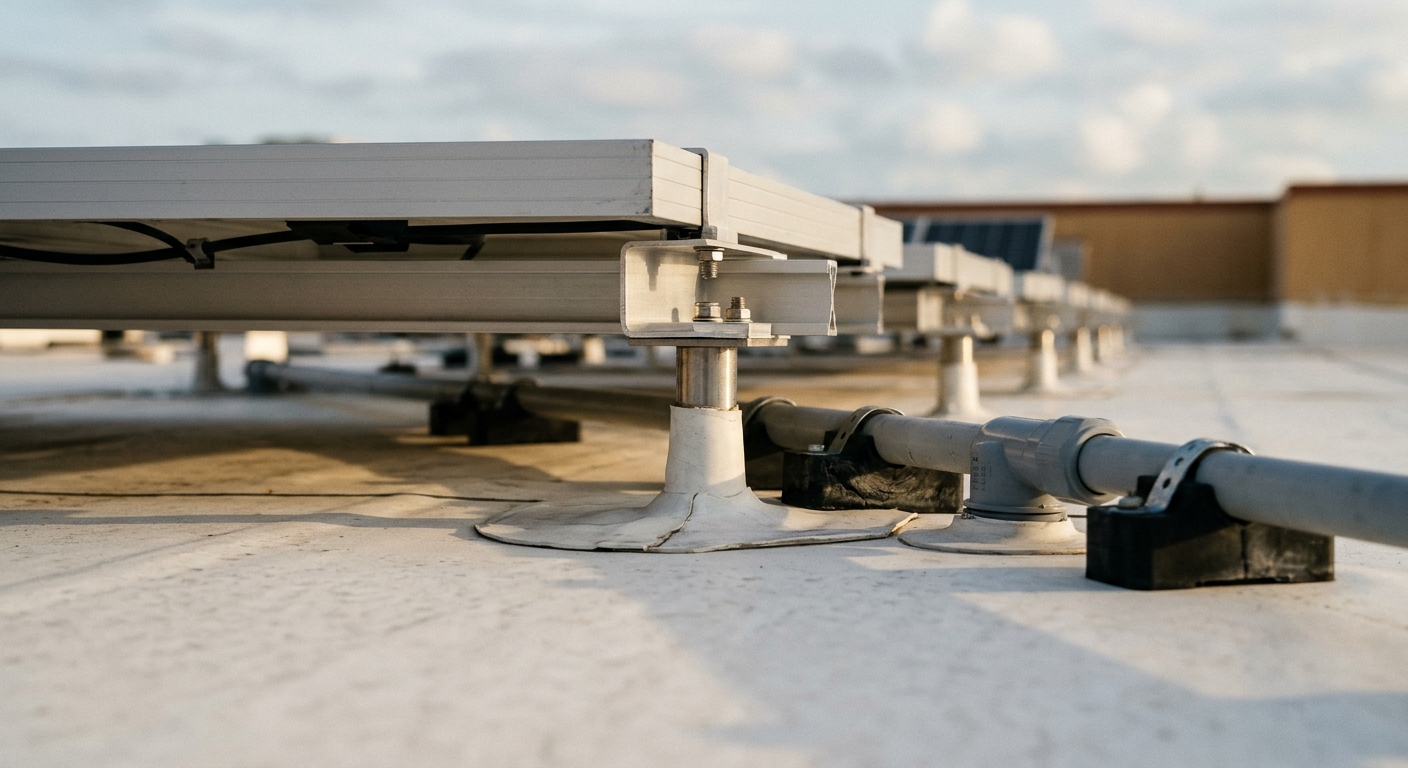
| Structure and wind design | Ballast or attachment scheme, HVHZ product approval, uplift | Structural engineer of record |
| Electrical service and tie-in | Switchgear capacity and the shutdown window for the house panel | Electrical engineer; utility |
| Utility tier | Tier 2 and Tier 3 systems carry tariff fees and insurance terms | Utility interconnection tariff |
| Tax position and funding path | Credit eligibility; reserves, special assessment, or financing | Tax advisor; association attorney |
Funding follows governance. Operating funds, a special assessment, and financing each carry notice and approval rules set by the declaration and Chapter 718. Solar financing options differ for an association and for an apartment owner, and the association attorney confirms the path before the contract.
What Changes When the Array Goes on an Occupied Florida Condo Building?
Residents stay in place for the whole project, so the schedule is built around them. Work hours follow the association’s contractor rules, and the community association manager sends owners notice of roof work, crane days, and any power interruption before each one starts. Material goes up by crane or hoist with the pick zone closed, crews use a designated route with elevator cabs protected, and staging stays clear of entrances and fire lanes.
The electrical tie-in is the step owners notice. Connecting to the house service usually means a planned shutdown of common-area power, and fire alarm panels, emergency lighting, fire pumps, and elevators sit on that service. The electrical engineer sequences the outage, the building’s life-safety vendors are on call, and the window is set with the manager in writing. Every new roof penetration is flashed and watertight the same day.
Florida conditions add three checks. In Miami-Dade and Broward, the High-Velocity Hurricane Zone requires product approval for solar attachments, and the engineer of record sets the wind design. Hardware is specified for coastal salt exposure. Every penetration is coordinated with the roof manufacturer so the roof warranty stays in force, and AGT’s sister company Advanced Roofing can assess or replace the roof before the array goes on. FEMA’s rooftop solar attachment advisory, written after Hurricanes Irma and Maria, recommends inspecting rooftop solar assemblies at least annually, a task that belongs in the solar operations and maintenance plan.
Which Florida and Federal Deadlines Apply to Condo and Apartment Solar as of November 2026?
The IRS FAQ on the 2025 tax law states that the Section 25D residential clean energy credit is not allowed for expenditures made after December 31, 2025, so unit owners and HOA homeowners installing now have no residential credit. A commercial-type solar facility that began construction after July 4, 2026 must be placed in service by December 31, 2027 to remain eligible for Section 48E, and foreign-entity restrictions apply. Whether an association or an apartment owner can use that credit is a tax advisor’s call; AGT’s commercial solar tax credit deadline guide explains the timing.
Section 193.624, Florida Statutes, excludes the just value of a renewable energy source device when assessing property used for residential purposes and excludes 80 percent for nonresidential property, and the property appraiser’s classification of the parcel decides which applies. Section 212.08(7)(hh) exempts solar energy systems and their components from sales and use tax, and the Department of Revenue’s Tax Information Publication 19A01-09 lists qualifying equipment. Rule 25-6.065 shows no amendment since 2008 as of this writing, and municipal utilities and cooperatives run their own programs. Milestone inspections under Section 553.899 apply to condominium and cooperative buildings of three or more habitable stories, by December 31 of the year the building turns 30 and every 10 years after.
Condo Solar Board Checklist: Who Confirms Each Item Before the Board Acts?
- Association attorney: Confirm the project fits Section 718.113(7) and approve the funding path and owner notices.
- Community association manager: Assemble twelve months of house-account bills, the roof warranty, the milestone report, and the SIRS.
- Roof consultant: Core and moisture-scan the roof and state its remaining service life in writing before any layout.
- Reserve study professional: Show how the array changes the roof’s SIRS line, including a future remove-and-reinstall.
- Structural engineer of record: Set wind design, attachment scheme, and HVHZ approval needs.
- Electrical engineer: Confirm switchgear capacity, the tie-in point, and a sequenced shutdown plan for life-safety loads.
- Utility: Confirm the interconnection tier, fees, insurance terms, and the account to be offset.
- Tax advisor: Determine any federal credit eligibility and the required placed-in-service date.
- Insurance agent: Confirm master-policy coverage for the array.
- Board: Adopt the decision at a noticed meeting with these documents in the record.
Frequently Asked Questions
Can a Florida condo board install solar panels without a unit owner vote?
Yes, under Section 718.113(7), Florida Statutes. The board may install solar collectors and other renewable energy devices on the common elements or association property for the benefit of unit owners without owner approval, notwithstanding the declaration’s material alteration procedure. The board still acts at a noticed meeting, and the association attorney should confirm the project fits the subsection before signing.
Can a condo owner put solar panels on the building roof in Florida?
Not as a matter of right in most buildings. Section 163.04 protects an owner’s ability to install solar within the boundaries of a condominium unit, and the roof is usually a common element outside them. An owner needs board approval under the declaration, or can ask the board to pursue an association-owned system.
Can an HOA deny solar panels in Florida?
No. Section 163.04 bars HOA covenants and approving bodies from prohibiting solar collectors on residential dwellings. The association may decide where roof-mounted collectors go, but only on a roof facing south or within 45 degrees east or west of due south, and only if that location does not impair the system’s operation. The prevailing party in litigation under the section is entitled to reasonable attorney’s fees.
Can solar on a condo building lower individual unit electric bills?
Usually not directly. Net metering under PSC Rule 25-6.065 offsets the account the array is connected to, which for an association system is the house account for common areas. Unit accounts belong to separate customers, and Florida law does not allow the association or a solar company to sell rooftop power to them. Lower common-area bills reduce association operating costs, which is the owner benefit to model.
Is there still a federal tax credit for condo or apartment solar in 2026?
The residential Section 25D credit ended for expenditures after December 31, 2025, according to the IRS. Commercial-type solar may still qualify for Section 48E if it is placed in service by December 31, 2027 when construction began after July 4, 2026, subject to foreign-entity rules. Whether an association or apartment owner qualifies depends on its tax status and project facts, so a tax advisor makes that call.
Should a condo replace its roof before installing solar?
When the roof has less than the array’s expected production life remaining, the replacement usually belongs first. A rooftop array shares the roof’s service life, so an aging membrane under new modules means paying later to remove and reinstall the array. The roof consultant’s report and the SIRS roof line should be in the solar proposal before bids are compared.
What a Defensible Condo Solar Decision Looks Like in Florida
The statute is rarely the obstacle. Condo boards have clear authority over common-element solar, HOA homeowners have a protected right on their own roofs, and apartment owners can build on their house service. The project is decided by three limits instead. The array offsets only the account it is wired to, nobody can sell its output to residents, and it shares the life of the roof under it. A board that sizes to the house load, schedules the roof first when the SIRS says so, and has each professional sign off on its own item will have a decision it can defend to owners. Advanced Green Technologies runs engineering, procurement, and construction in-house and was ranked the #1 commercial and industrial EPC contractor in Florida on Solar Power World’s 2026 Top Solar Contractors list, as documented in AGT’s 2026 ranking announcement.
Written by The Technical Team at Advanced Green Technologies. Founded in 2007, Advanced Green Technologies is 100% employee-owned and designs and builds rooftop, carport, and storage systems for Florida buildings that stay occupied during the work.
Evaluate your building’s options. Send the house-account bills and roof report to the AGT team and request a solar assessment, or call (888) 735-2641.