
At a glance: Agricultural solar in Florida fits best on packing-house and cold-storage roofs and on land already out of production, sized to daytime refrigeration and processing loads. This guide covers the 2026 changes that reshape farm solar: the December 31, 2027 placed-in-service deadline for new federal-credit projects, USDA’s REAP final rule, and Florida’s Chapter 2026-2 solar construction requirements. It compares rooftop, ground-mount, grazing, crop, floating, and canopy options, sets out the net metering, tax, and greenbelt questions, and ends with a role-by-role checklist.
Agricultural solar in Florida earns its place first on the loads a farm already carries in daylight: packing-house refrigeration, pre-cooling, wash and grading lines, and daytime irrigation, sited on roofs, field edges, and land that no longer produces a crop. The federal and USDA rules that changed in 2026 push in the same direction, and an owner who puts an array on productive cropland, or who starts too late to finish before the end of 2027, can lose the credit and the grant eligibility that made the numbers work. This article does not argue that every farm should install solar or that crop agrivoltaics is proven in Florida; it explains where each option fits, what each cannot do, and which professional confirms each assumption.
Why Did Agricultural Solar in Florida Change in 2026?
Three rule changes landed in 2026, and each rewards a different siting decision than many growers planned a year ago. Under the One Big Beautiful Bill Act (Public Law 119-21), solar facilities that begin construction after July 4, 2026 must be placed in service by December 31, 2027 to claim the §48E clean electricity investment credit or the §45Y production credit. The IRS Clean Electricity Investment Credit page describes the §48E base credit as 6 percent of the qualified investment, increased up to 30 percent for facilities that meet prevailing wage and registered apprenticeship requirements. Beginning-of-construction guidance was litigated during 2026, so start date and eligibility are questions for the owner’s tax advisor to settle before a contract is signed.
The second change is USDA’s Rural Energy for America Program (REAP). USDA stopped making REAP grant awards in March 2026 pending new regulations, and its March 31, 2026 REAP FAQ confirms guaranteed loan applications continued. On October 2, 2026, USDA announced a REAP final rule that disincentivizes solar and wind systems on cropland, makes multilocation projects ineligible, and requires projects to be fully built, operational, and demonstrating performance before applying, with application windows set in later annual notices.
The third change is Florida’s. Chapter 2026-2, Laws of Florida (HB 1417), effective July 1, 2026, requires site-specific additional protections in erosion and sediment control plans for solar facility construction and, in the Northwest Florida Water Management District, sizes operational stormwater systems serving solar facilities to the 100-year, 24-hour design storm. Read together, the 2026 rules favor roofs and non-crop ground over prime cropland, and a schedule that is already moving.
Which Farm Loads Can Solar Actually Serve?
On-farm solar offsets electricity at the meter it is connected to, so the first engineering question is which meter carries daytime load and how that load moves through the year. A packing house with forced-air pre-cooling and cold rooms draws power through the middle of the day as product arrives from the field, which is when modules produce. Remote well and livestock watering pumps are often better served by a small off-grid system.
Where a packing house runs hardest from late fall through spring, as winter-crop operations do, a fixed array’s output still follows the sun angle and the summer cloud pattern. A solar designer models monthly production against twelve months of interval data from each candidate meter, and that model shows whether summer generation is used on site, carried forward as credit, or exported at a lower value. A compressor bank that starts at 2 p.m. under a passing cloud sets the month’s demand peak whether or not the array produced at noon, which is why solar alone rarely moves a demand charge.
| Farm load | Typical operating window | Fit with solar | What decides it |
|---|---|---|---|
| Forced-air pre-cooling and cold rooms | Daytime during harvest; holding load overnight | Strong when the packing season overlaps high-production months | Twelve months of interval data; refrigeration contractor’s load profile |
| Wash, grading, and packing lines | Daytime shifts in season | Strong in season; idle off-season | Season length; whether credits carry forward under the tariff |
| Grid-tied irrigation pumps | Day or night by crop and permit | Good for daytime schedules; weak at night without storage | Pumping schedule; whether each pump station has its own meter |
| Remote wells and livestock watering | Intermittent daylight | Often best as a small off-grid system | Distance to utility service; storage tank size |
| Shop, office, and equipment charging | Business hours | Moderate; small share of total load | Whether it shares a meter with a larger load |
Meter structure matters as much as load. Farms often have a separate service for every pump station, barn, and residence, and net metering credits apply to the account where the system is connected. An array sized for the packing house cannot offset a distant pump on a different account unless the utility’s tariff provides for it, which the utility should confirm in writing.
Rooftop, Ground-Mount, or Agrivoltaics: Which Fits a Florida Farm?
Agricultural solar in Florida works best as a rooftop array on a packing house or cold-storage building, or as a ground mount on land already out of production, sized to the daytime refrigeration and processing load on one meter. Grazing under a standard ground mount is a workable vegetation strategy. Crops grown under panels remain at the pilot stage in Florida.
| Siting option | Best fit | Where it falls short |
|---|---|---|
| Packing-house or cold-storage roof | Large daytime refrigeration and line loads on the same meter | Older metal roofs and light purlins may need structural upgrades or re-roofing first; roof area caps system size |
| Ground mount on non-crop land | Loads larger than the roof can serve; field corners, retired groves, low-value pasture, former landfill | Needs fencing, vegetation management, and Chapter 2026-2 erosion and stormwater controls; occupies the land for the system’s life |
| Ground mount with sheep grazing | Sites where mowing is a major operations cost | Requires a grazier, water, predator fencing, and module clearance for animals; cattle generally need taller, costlier racking |
| Elevated agrivoltaics over crops | Research plots and high-value, shade-tolerant crops | Florida yield data are early and crop-specific; added height raises structural and wind design demands |
| Floating solar on an irrigation or retention pond | Farms with reservoirs and little spare land | Water level swings, anchoring, pond depth, and water management district review decide feasibility |
| Canopy over an equipment yard or loading area | Shade for staging, trucks, and equipment | Higher structural cost per kW than a ground mount; must clear truck and forklift paths |
A rooftop array and the roof under it share a service life, so a roof with eight years left under modules expected to produce for decades means a remove-and-reinstall mid-life. Our sister company’s commercial re-roofing team at Advanced Roofing can replace the roof before the array goes on, and a roof and drone solar survey documents condition before AGT scopes rooftop solar installation or ground-mount solar farm installation.
Ground mounts belong on land already out of production. AGT’s 2 MW City of Lake Worth solar farm, documented in the AGT solar project portfolio, sits on a five-acre former landfill. Reservoirs can host floating solar, and equipment yards can carry solar carports and canopies. Before any ground-mount layout, read our guide to solar farm site selection for the flood, wetland, soil, and interconnection checks that eliminate sites late.
The U.S. Department of Energy defines agrivoltaics as agricultural production, such as crops, livestock, or pollinator habitat, underneath or between rows of solar panels, and reports that as of March 2023 most of the 314 U.S. agrivoltaic projects then identified focused on grazing and pollinator habitat. In Florida, FPL’s pilot program places honeybees at 40 solar sites and is testing cattle grazing in DeSoto County and sheep in Northwest Florida, and the UF/IFAS Tropical Research and Education Center is studying crop production with FPL at the Miami-Dade Solar Energy Center. Those are pilots, and crop yields under panels in Florida should be treated as unproven until that research publishes results for the specific crop.
What Drives Cost, Schedule, and Return on Farm Solar?
None of the figures below is a price, and AGT prices each project from a design. They are the published rules and conditions that move a farm solar budget, each with its source, stated as of November 4, 2026.
| Driver | Current rule or condition (as of Nov 4, 2026) | Source |
|---|---|---|
| Federal investment credit | §48E base 6%, up to 30% with prevailing wage and apprenticeship; solar beginning construction after July 4, 2026 must be placed in service by Dec 31, 2027 | IRS; Public Law 119-21 |
| USDA REAP | Grant awards stopped March 2026; final rule announced Oct 2, 2026 disincentivizes cropland solar and requires an operating project before application; guaranteed loans accepted | USDA press release; USDA REAP FAQ |
| Net metering, investor-owned utilities | Expedited interconnection and net metering to 2 MW; Tier 3 covers over 100 kW to 2 MW; gross rating no more than 90% of the service rating | Florida PSC, Rule 25-6.065, F.A.C. |
| Net metering, cooperatives and municipal utilities | Each utility runs its own program, required by a 2008 amendment to s. 366.91, F.S. | Florida PSC |
| Property tax | 80% of the assessed value of a renewable energy source device exempt as tangible personal property | s. 196.182, F.S. |
| Sales tax | Solar energy systems and components exempt; the Florida Solar Energy Center certifies the equipment list | s. 212.08(7)(hh), F.S. |
| Erosion and stormwater, ground mounts | Site-specific protections in erosion and sediment control plans; 100-year, 24-hour storm in the NWFWMD | Ch. 2026-2, Laws of Fla. |
Three variables decide whether those rules turn into a return. The tariff and utility type set the value of every kilowatt-hour, and farms outside investor-owned utility territory are served by cooperatives or municipal utilities whose net metering terms differ from the rule described by the Florida Public Service Commission. The overlap between the packing season and the array’s strongest months sets how much generation is used on site. The schedule sets the credit, because a project that cannot be placed in service before December 31, 2027 should be underwritten without it, and the solar financing options AGT reviews with owners change with that answer. Property tax treatment under section 196.182, F.S. and the sales tax exemption apply in either case, subject to the owner’s tax advisor.
What Changes When Solar Goes In on a Working Farm or Packing House?
A packing house during harvest is an occupied building with a perishable schedule, and construction is planned around it. Roof work is sequenced for the off-season where the schedule allows, crane picks of module pallets are set outside packing shifts, and staging stays clear of receiving docks, forklift routes, and areas the food safety plan designates as controlled. The electrical tie-in requires a planned outage at the service, agreed in writing with the operations manager and the utility, and timed for when cold rooms can hold temperature or carried on a temporary source.
Ground mounts in production areas bring different exposures. Tillage dust and spray drift soil modules faster than an urban array, so cleaning frequency belongs in the solar operations and maintenance plan, and wash water must not carry residue into a field or pond. Open trenches and stockpiles are stabilized under the Chapter 2026-2 erosion requirements ahead of afternoon storms.
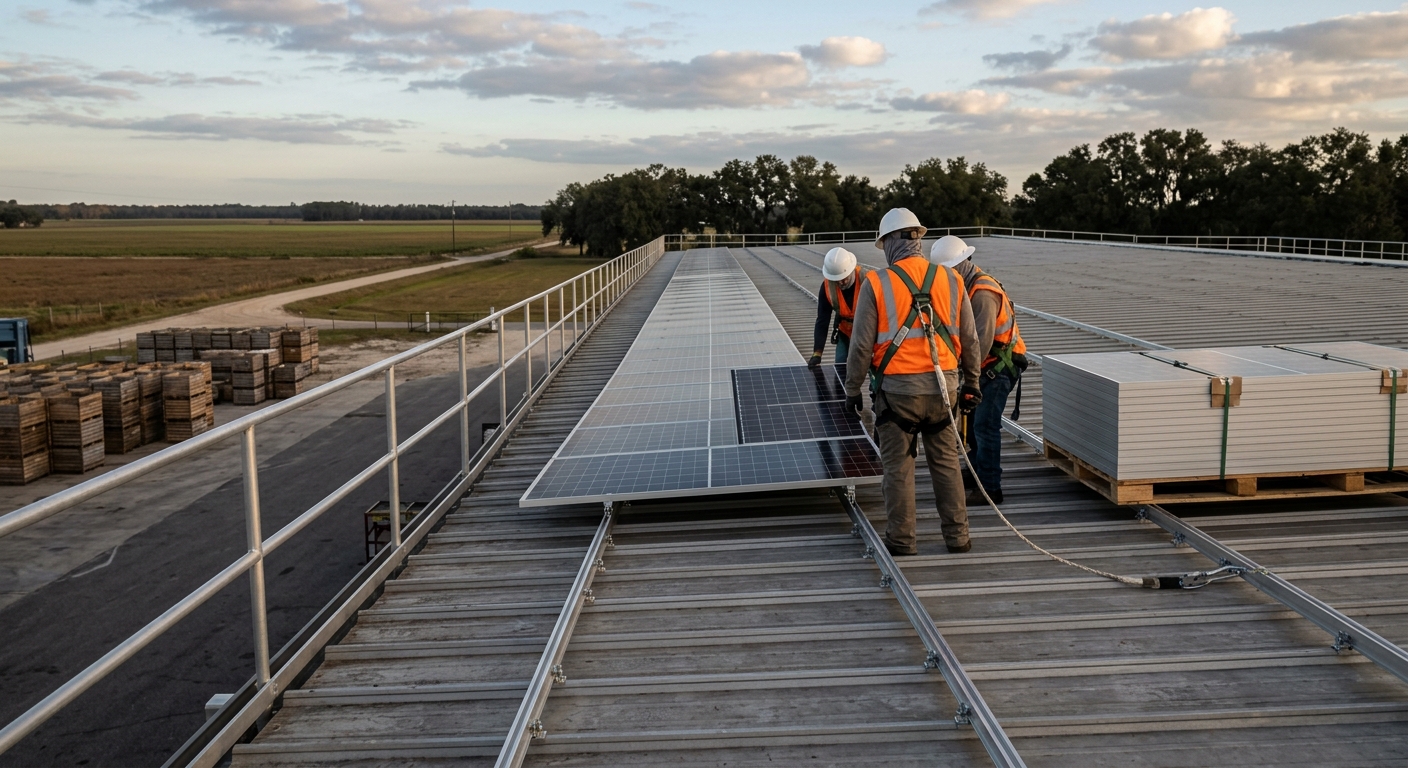
Every array, whether rooftop, ground-mount, or canopy, is designed to the wind loads the engineer of record calculates for its site. Storms can exceed those design loads, and module and racking warranties carry storm exclusions. Where cold storage holds a week of harvest, battery storage with a defined backup load can carry critical refrigeration through a grid outage, but storage does not pay back on every tariff; its value depends on demand charges, backup requirements, and the rate structure.
Which Florida Codes, Statutes, and Tariffs Apply to Farm Solar?
Each rule set has an owner who makes the determination. Land use starts with section 163.3205, Florida Statutes, which makes a solar facility a permitted use in agricultural land use categories and agricultural zoning districts in unincorporated areas, subject to setback and buffer requirements; the county planning department confirms whether a behind-the-meter farm array falls under it. Bills to repeal that section or add decommissioning requirements were filed in the 2025 and 2026 sessions. Structural and electrical permits follow the Florida Building Code, whose 9th Edition takes effect December 31, 2026, with the permit application date generally determining the edition and High-Velocity Hurricane Zone product approval applying in Miami-Dade and Broward.
Property classification is the question growers ask most and the one least settled. Florida’s greenbelt statute, section 193.461, F.S., classifies land used primarily for bona fide agricultural purposes, and a Fall 2025 article in the Florida State University Journal of Land Use and Environmental Law argues the statute should be amended to state that solar serving the farm will not by itself preclude agricultural classification. The county property appraiser makes the call, and the owner’s attorney should raise it before the layout is fixed. Every rule in this section is stated as of November 4, 2026.
What Should a Grower Confirm Before Signing a Farm Solar Contract?
Each item is assigned to the person who owns the answer. Bring the completed list to the partners or lender before signing.
- Operations manager: pull twelve months of interval data for every candidate meter and mark the packing season on it.
- Utility representative: confirm the utility type, net metering tier, and whether credits can be shared across accounts.
- Tax advisor: confirm credit eligibility, the beginning-of-construction position, and whether the project can be placed in service by December 31, 2027.
- Property appraiser and attorney: confirm how a ground mount affects the parcel’s agricultural classification.
- Roof consultant: document remaining roof life and structural capacity before a packing-house array is designed.
- Engineer of record: confirm wind, attachment or foundation, and stormwater design under the governing code edition.
- Food safety lead: mark controlled areas, staging limits, and cleaning-water rules for the contractor.
- Lender or USDA Rural Development energy coordinator: confirm whether a REAP guaranteed loan or a later grant window fits the timeline.
- Solar contractor: deliver a monthly production model against the load data, an interconnection timeline, and a maintenance scope. Advanced Green Technologies ranked #1 among Florida commercial and industrial EPC contractors on Solar Power World’s 2026 Top Solar Contractors list; ask every bidder for comparable references.
Frequently Asked Questions
Does solar on farmland affect greenbelt classification in Florida?
It can, and the county property appraiser decides. Section 193.461, Florida Statutes, classifies land used primarily for bona fide agricultural purposes and does not expressly address solar that serves the farm; a 2025 Florida State University law review article proposes an amendment to say it would not by itself preclude classification. Have your attorney raise the question with the appraiser before construction.
Can a Florida farm net meter a solar system?
Yes, under rules that depend on the utility. Investor-owned utilities follow Florida PSC Rule 25-6.065, which provides expedited interconnection and net metering for customer-owned renewable systems up to 2 MW. Electric cooperatives and municipal utilities run their own programs. Confirm the tier, credit treatment, and any account limits with your utility in writing.
Is USDA REAP still funding farm solar in 2026?
Not with grants on the old terms. USDA stopped making REAP grant awards in March 2026 while guaranteed loan applications continued. The final rule announced October 2, 2026 disincentivizes solar on cropland and requires projects to be operating before applying. Check the next annual notice with your USDA Rural Development state energy coordinator.
What is agrivoltaics, and does it work in Florida?
Agrivoltaics is agricultural production, such as grazing, pollinator habitat, or crops, under or between rows of solar panels, as the U.S. Department of Energy defines it. In Florida, beekeeping and grazing on solar sites are in utility pilots, and UF/IFAS crop trials are under way. Grazing fits standard racking more easily than crops, which generally need elevated or widely spaced arrays.
Is a packing house roof or a field better for farm solar installation?
A packing house roof is usually the first choice when the building carries daytime refrigeration and line load, because it keeps acreage in production and sits next to the meter. A field ground mount fits when the load exceeds roof capacity. Confirm roof life and structure first, and put any ground mount on land already out of crop production.
What is the federal solar tax credit deadline for a farm project?
Under the One Big Beautiful Bill Act, a solar facility that begins construction after July 4, 2026 must be placed in service by December 31, 2027 to claim the §48E or §45Y credit. Projects that began construction earlier follow continuity rules. Your tax advisor determines eligibility, so plan permitting and interconnection with margin before that date.
Where Agricultural Solar Earns Its Place on a Florida Farm
Packing-house refrigeration and processing loads run when modules produce, roofs and retired land keep acreage in crops, and the 2026 rules from Congress, USDA, and the Florida Legislature reward those choices while closing the federal credit window for new projects on December 31, 2027. A grower who brings meter data, roof condition, the utility’s tariff, and a tax advisor’s answer to the first design meeting will learn quickly whether solar fits the operation, which option fits, and whether the schedule can still meet the deadline.
Written by The Technical Team at Advanced Green Technologies. Founded in 2007 by Advanced Roofing, Advanced Green Technologies is 100% employee-owned and has installed more than 380 megawatts of solar for Florida clients.
To scope solar for a packing house, cold-storage building, or farm parcel, request a quote from Advanced Green Technologies or call (888) 735-2641.