
Serving St. Thomas · St. Croix · St. John
Commercial Solar and Battery Storage for the U.S. Virgin Islands
WAPA rates are among the highest in the United States and the grid still drops. AGT builds hurricane-rated solar and battery systems that let resorts, manufacturers and large properties generate and store most of their own power, designed and shipped from Florida by a U.S. licensed EPC.
- Self-consumption solar + battery designs built for WAPA's Net Energy Billing rules
- Engineered to Florida's High-Velocity Hurricane Zone standards, built for Irma- and Maria-class storms
- Batteries that carry critical loads through WAPA outages without a generator start
- One contractor for solar, storage, electrical and the roof underneath
 Ranked #1 commercial solar EPC in Florida by Solar Power World. 100% employee-owned.

Get a Free USVI Project Estimate
A solar and storage engineer replies within one business day. No obligation.
Why USVI operators are moving now
Three problems, one system
Operating on St. Thomas, St. Croix or St. John means paying some of the highest electricity rates in the country for power that isn’t always there. These are the three problems every operator raises.
The most expensive power in the U.S.
At 40¢+ per kWh, a resort or plant's electricity line item is two to three times what a mainland competitor pays. Solar produces power on your own roof for a fraction of that, fixed for 25 years.
Outages are routine, not exceptional
WAPA load shedding, feeder faults and generation shortfalls happen in normal weather. Batteries pick up critical loads instantly, and your generator becomes the backup to the backup.
Irma and Maria set the design standard
Two Category 5 storms in two weeks in 2017. Any system installed here has to be engineered for that, and it has to come with a shutdown, inspection and restart plan your team can run.
What you’re paying today. WAPA’s commercial tariff has run in the 40–47¢ per kWh range in recent years, including the LEAC fuel surcharge. That is roughly three times the U.S. mainland commercial average. Figures are from public utility and regulator sources; we verify your actual tariff from your bills.
Interactive estimator
Size a solar + battery system for your facility
A first-pass estimate from your monthly WAPA bill. It tells you roughly how much solar fits, how large a battery you need to carry critical loads through an outage, and what that offsets. Our engineers refine it with your interval data.
Your facility
All fields are editable, including the rate.
First-pass system
Estimates only. Assumes about 1,500 kWh per kW per year of production, 95 sq ft per kW of roof area, 90% usable battery capacity and a 30% peak factor. Final sizing depends on your interval data, roof structure, utility tariff and interconnection limits.
Who we build for in the U.S. Virgin Islands
Built for facilities where downtime has a price
Commercial and industrial properties with a meaningful energy bill and loads that can’t wait for the grid to come back.
Resorts & hotels
St. Thomas, St. John and St. Croix properties with large daytime cooling, laundry and pool loads that match solar production.
Manufacturing & industrial
St. Croix distilleries, bottling, light industrial and port-adjacent operations where downtime stops the line.
Marinas, yacht services & large estates
Properties already running on generators that want to cut fuel deliveries by 60–80%.
Grocery, cold storage & distribution
Where every outage becomes written-off inventory.
Hospitals, clinics & government facilities
Critical loads beyond the life-safety generator, with documented battery runtime.
Shopping centers & cruise-port retail
Carport and rooftop solar with batteries for anchor tenants' critical circuits.
Scope of work
One contractor from engineering to energization
AGT is a turnkey EPC with in-house engineering, electrical, roofing, crane and logistics divisions. There is no hand-off between a designer, an installer and an electrician — and no one to point fingers at when the storm comes.
Rooftop, carport and ground-mount solar
Designed to the wind loads your island actually sees, with attachment and ballast engineering, not catalog assumptions.
Battery energy storage (BESS)
Sized for your critical loads: from hours of outage ride-through to full microgrid operation for days at a time.
Microgrid controls & generator integration
Solar and batteries carry the base load; your existing generators become the backup to the backup and burn far less fuel.
Virgin Islands logistics
Equipment ships from Florida to Charlotte Amalie and Christiansted with the schedule built around vessel sailings. Our crews work alongside licensed Virgin Islands electrical partners.
Roof condition & re-roof coordination
Our sister company Advanced Roofing can assess, repair or replace the roof before the array goes on, so you never pull panels off early.
Interconnection, permitting & utility paperwork
We manage the application, studies and inspections with the utility and local authorities from start to energization.
Operations & maintenance
Monitoring, preventive maintenance and storm-response service plans with a 24/7 remote team.
How the work runs
From your utility bill to a commissioned system
Projects in the U.S. Virgin Islands are managed from AGT’s Fort Lauderdale headquarters, a three-hour flight from St. Thomas.
Remote assessment
Send us 12 months of utility bills, roof or site plans and your outage history. We model loads, backup needs and a first-pass system size from Fort Lauderdale before anyone gets on a plane.
Site visit & engineering
Our engineers and drone survey team visit the property, verify the roof structure, electrical service and interconnection point, and return a stamped design with a fixed scope and price.
Procurement & logistics
Hurricane-rated modules, racking, inverters and batteries are staged and containerized in South Florida, then shipped with the customs and import paperwork handled.
Install, commission, monitor
AGT crews lead the installation with vetted local trade partners, commission the system with the utility, and monitor performance and battery health from our Florida operations center.
Proof from hurricane country
Built in Florida’s High-Velocity Hurricane Zone. Ready for the U.S. Virgin Islands.
Every system AGT builds in South Florida is engineered and permitted to the same wind standards your property needs. These are a few of the 450+ MW we’ve delivered.

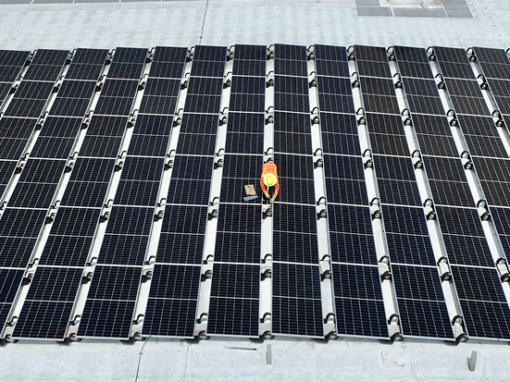
COSTEX Tractor Parts
Doral (Miami), FL · 1.6 MW rooftopHeavy-equipment parts distributor. One of the largest private rooftop arrays in South Florida, built on an occupied distribution center.
Orange County Convention Center
Orlando, FL · 2.3 MW rooftopRe-roof and solar upgrade delivered together with Advanced Roofing on a live, high-traffic public facility.

North Dade Regional Library
Miami-Dade, FL · 475 kW rooftopPublic building in Miami-Dade's High-Velocity Hurricane Zone, engineered and permitted to the strictest wind code in the U.S.

Frontline Insurance
Lake Mary, FL · solar carport, net-zero35,775 sq ft carport producing roughly 986 MWh a year and taking the headquarters to net-zero.
An honest, reliable, problem-solving solar EPC. Delivered 4.7 MW across eight commercial rooftop projects for us.
James M. Rice, CEO, Nautilus Solar EnergyFull re-roof and a 90 kW solar system on our 20,000 sq ft facility — on time and on budget, working through every obstacle.
Benjamin Koppenhoefer, President, Elite Marine A/CQuestions from USVI operators
Frequently asked questions
Can we still net meter with WAPA?
The original Net Energy Metering program closed to new applicants in 2017 and has been replaced by the Net Energy Billing (NEB) program, which credits exports below the retail rate. That is why we design USVI systems around self-consumption: solar covers daytime load, batteries shift the rest into the evening, and very little is exported. We handle the WAPA interconnection application and review.
How much of our bill can solar and storage offset?
For a facility with good roof or carport area, 50–80% of annual consumption is common, and higher with batteries shifting production into the evening. The estimator on this page gives a first pass; we refine it with 12 months of WAPA bills and interval data.
Is the equipment built for Category 5 storms?
AGT designs to the wind speeds required in Miami-Dade’s High-Velocity Hurricane Zone, the strictest wind code in the U.S., with engineered attachments and ballast verified for your roof. Battery and inverter enclosures are rated for salt air and installed above flood elevation, and we hand over a pre-storm shutdown and restart procedure.
Which incentives apply in the Virgin Islands?
The Virgin Islands Energy Office and federal programs change frequently, and the right answer depends on your entity’s tax position. We review the current incentives, accelerated depreciation and financing structures (cash, loan, lease or PPA) with your finance team and show the project both ways.
How long does a project take?
A remote assessment and budget takes about two weeks. From signed contract to energization, a commercial solar and battery project typically runs five to nine months depending on equipment lead times, shipping and WAPA’s interconnection process.
Who maintains the system?
AGT monitors every system we build from our Florida operations center. Scheduled maintenance and storm response are delivered by our crews and vetted Virgin Islands partners under a service agreement.
Get started
Get a free USVI solar and storage estimate
- Call
- (888) 735-2641
- Hours
- Monday–Friday, 8:00 am–5:00 pm Eastern
- HQ
- Advanced Green Technologies
1950 NW 22nd St., Suite A
Fort Lauderdale, FL 33311 - Region
- Projects in the U.S. Virgin Islands are managed from AGT's Fort Lauderdale headquarters, a three-hour flight from St. Thomas.
Founded 2007 as the solar division of Advanced Roofing, Inc. 100% employee-owned.
What happens after you submit
- A solar and storage engineer calls or emails within one business day.
- We ask for 12 months of utility bills and any roof or site plans you have.
- You get a remote assessment with a first-pass system size and budget range in about two weeks.
Get a Free USVI Project Estimate
A solar and storage engineer replies within one business day. No obligation.