

At a glance: Bifacial modules add output only when light reaches the back of the module. This article explains the physical conditions that control that gain, compares rooftop, carport, and ground-mount configurations using published field data, and lists what moves cost and return, including glass durability and modeling uncertainty. It also covers Florida wind and occupied-building constraints, the 2026 code change, federal credit and module-sourcing dates, and a checklist for reviewing a bifacial proposal before it goes to a CFO or board.
Bifacial solar panels for commercial projects are worth specifying when the site can put light on the back of the module, which in practice means an elevated carport over light pavement, a ground-mount over reflective ground cover, or a tilted array raised above a clean white roof membrane. On a flush or low-tilt array over a dark or aged roof, the measured gain is small enough that module price, weight, and glass durability decide the comparison, and a monofacial module can be the better purchase. Getting this wrong means a production model that overstates rear-side output, so the owner pays for kilowatt-hours that never arrive and the payback shown to the CFO slips. This article sets aside which module is better in general and covers the site conditions that move the number, how to test a proposal, and the Florida dates that apply.
Why Are Bifacial Modules Showing Up in Every Commercial Solar Bid?
Bifacial modules now make up a large share of global module supply. The IEA PVPS Task 13 report on bifacial tracking systems (August 2024), citing industry roadmap data, reports that about 95% of modules used bifacial cells and 62% were built as bifacial modules. For an owner comparing high-efficiency commercial solar modules, the choice is often the same cell technology packaged two ways: glass on both faces so the rear collects light, or a backsheet on the rear.
IEC TS 60904-1-2:2024, amended in 2026, sets the procedure for measuring bifacial modules, including bifaciality, the ratio of rear-side to front-side performance. A datasheet lists the front-side nameplate rating, the bifaciality factor, and often higher power classes at an assumed rear irradiance. Those classes describe laboratory conditions, not site output.
The Sandia National Laboratories bifacial PV project, run with the National Renewable Energy Laboratory and the University of Iowa from 2016 to 2018, measured bifacial and monofacial modules side by side and found that gain depends on module characteristics, sun position, tilt and azimuth, ground reflectance, height, system size, and rear obstructions. The IEA PVPS report also describes a blind modeling comparison in which rear-side irradiance predictions differed by up to about 100% between participants. The bifacial line in a production estimate carries the widest uncertainty, and the commercial solar engineering process should show how it was produced.
How Does a Bifacial Module Turn Reflected Light Into Extra Kilowatt-Hours?
A bifacial module produces extra energy from light that reaches its rear face after reflecting off the surface below or scattering from the sky, converted at the module’s bifaciality factor. Three physical conditions set how much rear light there is: the reflectance of the surface under the array, the gap between module and surface, and the hardware behind the module that shades the rear glass.
Surface reflectance, called albedo, is the largest single variable. A new white single-ply membrane reflects far more light than a granulated cap sheet, gravel, or asphalt, and every roof loses reflectance as it weathers and soils. A module set close to the surface sees mostly the shadow of its own row, while a module raised higher sees a wider patch of lit surface.
Uneven rear light costs more than its average suggests, because cells wired in series are limited by the dimmest cells behind a rail, purlin, or torque tube. A 2024 outdoor study on industrial-style rooftops by Politecnico di Milano researchers found that small misalignment between modules and the beams behind them could virtually eliminate the bifacial contribution, an estimated 3.43% of potential gain. Racking is part of the module decision, which is why a commercial rooftop solar installation designed for bifacial modules differs from one designed for monofacial modules.
Table 1. What controls bifacial gain on a commercial site
| Variable | What it changes | Florida commercial condition to check | Source |
|---|---|---|---|
| Surface reflectance (albedo) | Light available to the rear face | White TPO or PVC vs. aged modified bitumen, gravel, or asphalt; reflectance after three years of weathering | Cool Roof Rating Council (2025); Vasilakopoulou et al. (2023) |
| Module height above surface | How much lit surface the rear face sees | Ballasted rooftop racks sit close to the membrane; carports and ground-mounts sit higher | Sandia bifacial PV project (2016-2018) |
| Row spacing and tilt | Rear view of the surface; inter-row shading | Low-tilt layouts packed for maximum kW on a fixed roof area | Sandia bifacial PV project (2016-2018) |
| Rear-side obstructions | Uniformity of rear light across cells | Rails, purlins, beams, torque tubes, under-canopy decks | Gonzalez-Moreno et al. (2024) |
| Bifaciality factor | Conversion of rear light to power | Datasheet value measured under IEC TS 60904-1-2 | IEC TS 60904-1-2:2024 |
| Modeling method | Predicted gain in the proposal | Measured vs. assumed albedo; view-factor vs. ray-tracing model | IEA PVPS Task 13 (2024) |
Where Do Bifacial Solar Panels for Commercial Projects Earn Their Gain?
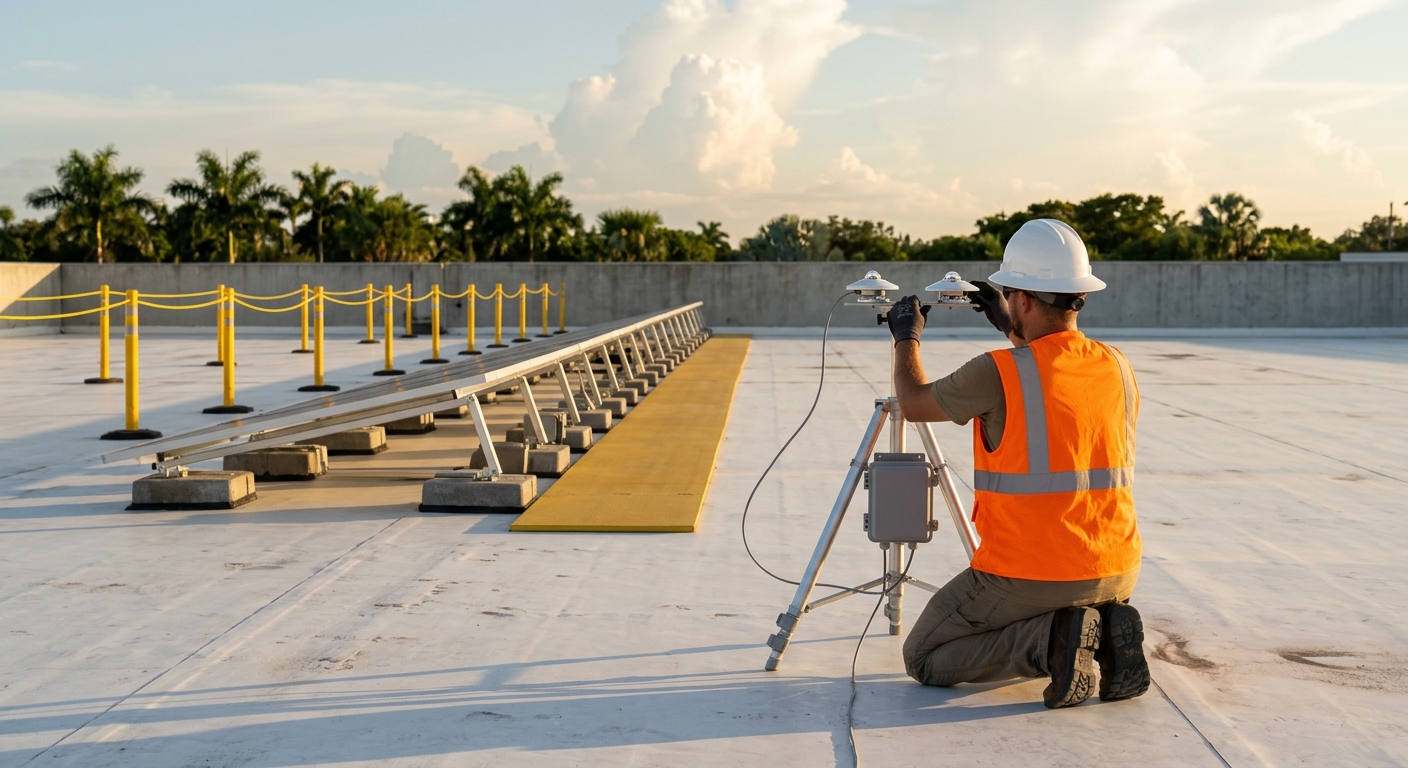
Bifacial solar panels are worth it for commercial projects where the rear face sees reflected light, such as elevated carports, ground-mounts, and tilted arrays raised over a clean white roof. Peer-reviewed rooftop field tests report about 4% more energy than monofacial modules over an ordinary roof surface and about 9% over a reflective cool-roof coating, while flush arrays over dark roofs gain little.
Those rooftop figures come from a 2023 Journal of Building Engineering field study of four prototypes of about 1 kWp each near Barcelona: bifacial modules over an ordinary roof floor produced 4% to 4.5% more than monofacial modules, and 8.6% more over a cool-roof coating. A 2023 Solar Energy review of 57 bifacial case studies found that each 0.1 increase in roof albedo raised bifacial energy by an average of 4.55%, against 0.7% for monofacial modules. The Cool Roof Rating Council’s 2025 guide to cool roofs and rooftop PV applies that relationship to rated roofing products and notes that the effect depends heavily on tilt, elevation, and latitude.
Ground-mounts give bifacial modules the most room, and the IEA PVPS report gives typical bifacial gains of 2% to 10% on single-axis trackers, additive to the tracker’s own gain. A commercial solar farm installation can also control ground cover. Carports have the least published data. They offer height and an open rear, while pavement is often dark asphalt, and any under-canopy deck, gutter, or rain-control layer sits in the rear light path. No Florida carport bifacial dataset was found at the time of writing, so model carport gain from measured pavement reflectance.
Table 2. Bifacial vs monofacial by mounting configuration
| Configuration | Rear-side conditions | Published result (source) | Where it falls short |
|---|---|---|---|
| Flush or low-tilt array on a dark or aged roof | Little reflected light; small gap to the roof | Gain scales with albedo, so low-albedo roofs sit at the bottom of the published range (Vasilakopoulou et al., 2023) | Extra module cost and glass weight may not be repaid; a monofacial module is often competitive |
| Low-tilt array on white single-ply or coated roof | Higher albedo; small gap | 4%-4.5% over ordinary roof floor; 8.6% over cool-roof coating (Valencia-Caballero et al., 2023) | Gain falls as the membrane soils; roof must outlast the array; rail shadows reduce uniformity |
| Tilted racks raised higher on a white roof | More rear view of lit membrane | 2%-15% bifacial power gain under identical conditions on industrial-style rooftops (Gonzalez-Moreno et al., 2024) | Higher racks raise wind loads, ballast, and attachment demands; structural and HVHZ review required |
| Solar carport | Height and open rear; pavement reflectance varies | No Florida carport dataset located at build; model from measured pavement albedo | Purlins, beams, and rain-control layers shade the rear; canopy design decides the result |
| Ground-mount on single-axis trackers | High clearance; open rear; controllable ground cover | 2%-10% typical bifacial gain (IEA PVPS Task 13, 2024) | Torque-tube shading; vegetation management; requires land |
What Moves the Budget and the Return on a Bifacial Array?
The return on a bifacial array turns on six variables, each of which belongs in the proposal as a stated assumption.
- Module price difference. Pricing changes by supplier and contract date, so compare the same cell technology and wattage class priced both ways as separate line items.
- Structure and weight. Glass-glass construction changes module weight and framing, so the structural engineer checks dead load, ballast, and attachments against the datasheet.
- Glass durability. The IEA PVPS Task 13 report on degradation and failure modes in new module technologies (February 2025) found that thin glass of 2 mm or less in glass-glass modules has sometimes broken at high rates, with 5% to 10% of rear glasses broken within two years in documented cases.
- Reflectance over time. At the 2023 review’s average of 4.55% per 0.1 of albedo, a membrane that soils or ages gives back part of the gain, so cleaning and coating schedules affect production.
- Model uncertainty. With rear-irradiance predictions differing by up to about 100% in the IEA PVPS 2024 comparison, a single gain figure without a sensitivity range is a weak basis for a capital decision.
- Value per kilowatt-hour. Extra production is worth what the utility rate, demand charges, and on-site use make it worth, and the tariff sets that value.
What Changes When a Bifacial Array Goes on an Occupied Florida Building?
Raising modules to give the rear face more light also raises them into higher wind exposure, which changes uplift and drag; in Miami-Dade and Broward the High-Velocity Hurricane Zone provisions and product approval apply. Advanced Green Technologies states that its commercial solar carports are designed for wind speeds up to 180 mph; that is a company design statement for its carports, and site design wind speed and pressures are confirmed by the project engineer. No array is immune to a storm that exceeds its design pressures.
A rooftop bifacial array needs a roof that outlasts the array and a surface that stays reflective; a roof with eight years left means a remove-and-reinstall in the array’s mid-life. A roof and drone solar survey records condition and surface type before design, and AGT’s sister company, Advanced Roofing, can replace or restore the roof first so roof and array start their service lives together.
On an occupied building, the work is sequenced around the tenants. Crane picks are scheduled outside business hours where the site allows, glass-glass module pallets are staged away from walkways and drains, and the property manager receives notice of each lift and electrical shutdown. Carports over an active lot are built in phased rows.
Broken rear glass on a carport is visible only from below, and a roof membrane under the array becomes part of the generating system, so a commercial solar operations and maintenance program for a bifacial site should include rear-side inspection and surface cleaning.
Which Code, Tax, and Utility Dates Apply to a Bifacial Project in 2026 and 2027?
As of November 4, 2026, the Florida Building Code 9th Edition (2026) takes effect on December 31, 2026. A Miami-Dade County permitting notice states that permit applications submitted on or after that date must comply, and that online submissions after 4 p.m. on December 30, 2026 fall under it as well. Current code text is posted by the Florida Building Commission.
Under the One Big Beautiful Bill Act, as described in IRS Notice 2025-42, the Section 48E investment credit ends for solar facilities placed in service after December 31, 2027 unless construction began by July 4, 2026. A federal district court vacated Notice 2025-42 on June 6, 2026 in Oregon Environmental Council v. IRS, and further proceedings are possible. Prohibited foreign entity material assistance rules apply to facilities beginning construction after December 31, 2025, with cost-ratio guidance in IRS Notice 2026-15, so module and cell origin is a tax question as well as a price question. Eligibility is a determination for the owner’s tax advisor.
Interconnection and net metering for customer-owned generation on Florida’s investor-owned utilities fall under Florida Public Service Commission Rule 25-6.065, last effective April 7, 2008, and each utility’s tariff; the utility confirms how added production is credited.
What Should a Bifacial Proposal Show Before the CFO or Board Signs?
A bifacial proposal is ready for approval when every assumption behind the rear-side gain is written down, sourced, and assigned to the professional who owns it.
- Solar designer: bifacial and monofacial production models on the same layout, stating the albedo used, whether it was measured or assumed, and the model method.
- Solar designer: a sensitivity case at the membrane’s aged reflectance or the measured pavement reflectance under a carport.
- Roof consultant: remaining roof service life, core and moisture results, and whether the roof is replaced or restored first.
- Structural engineer of record: module dead load, rack height, wind design under the code edition in force on the permit date, and HVHZ approval where applicable.
- Procurement lead: bifaciality factor measured under IEC TS 60904-1-2, front and rear glass thickness, independent reliability test results, and warranty terms for glass breakage.
- Tax advisor: beginning-of-construction date, placed-in-service schedule against December 31, 2027, and material assistance cost ratio.
- Energy lead and utility: tariff, export share, and interconnection timing.
- Facility manager: crane windows, parking phasing, and shutdown notices.
- O&M provider: rear-side inspection and surface cleaning in scope.
Frequently Asked Questions
Are bifacial solar panels worth it for commercial rooftops?
Bifacial solar panels are worth it on commercial rooftops when the roof is white, clean, and expected to outlast the array, and the racking leaves an open gap behind the modules. A 2023 field study measured about 4% more energy than monofacial modules over an ordinary roof surface and 8.6% over a cool-roof coating. On a dark or aging roof with flush racking, a monofacial module can deliver the better return.
How much more energy do bifacial solar panels produce than monofacial panels?
Published results range from a few percent to the low teens. The IEA PVPS Task 13 report gives typical gains of 2% to 10% on single-axis trackers, and a 2024 study of industrial-style rooftops measured 2% to 15% bifacial power gain under identical conditions. A specific building needs its own model built on measured surface reflectance and the actual racking.
Do bifacial solar panels work on solar carports?
Bifacial modules can work on solar carports because the canopy holds them high above the pavement with an open rear face. Results depend on pavement reflectance, since dark asphalt reflects less than concrete, and on whether purlins, beams, or gutters sit behind the modules. Model carport gain for the specific canopy.
Does a white roof increase bifacial solar panel output?
A white roof increases bifacial output because it reflects more light onto the rear face. A 2023 review of 57 bifacial case studies found an average 4.55% gain in bifacial energy for each 0.1 increase in roof albedo, against 0.7% for monofacial modules. Reflectance falls as membranes weather, so models should use an aged value.
Are glass-glass bifacial modules strong enough for Florida hurricanes?
Wind performance depends on the structural design, the attachments, and the module’s tested mechanical load rating, which the engineer of record confirms for each site. Glass thickness also matters, and an IEA PVPS report from February 2025 documented cases where 5% to 10% of thin rear glasses broke within two years, so ask for glass thickness and test results.
Do bifacial panels change federal solar tax credit eligibility?
Module type does not change the Section 48E timing rule, which requires solar facilities that began construction after July 4, 2026 to be placed in service by December 31, 2027. Module and cell origin does matter, because material assistance rules apply to facilities beginning construction after December 31, 2025. Eligibility for a project is a determination for the owner’s tax advisor.
Bifacial Modules Pay Where the Site Lights the Rear Side
Bifacial modules earn their place on a commercial project when the rear face sees reflected light and the design keeps that light even across the cells. Carports over light pavement, ground-mounts with controlled ground cover, and raised arrays over a clean white roof meet that test, and flush arrays over dark or aging roofs usually do not. Published field data supports a site-by-site decision, and wide disagreement among rear-side models means the proposal has to show its assumptions. In Florida, wind design, roof life, glass durability, and the 2026 and 2027 code and tax dates complete the decision.
Written by The Technical Team at Advanced Green Technologies. Founded in 2007, Advanced Green Technologies is 100% employee-owned and was ranked #1 among Florida commercial and industrial EPC contractors on Solar Power World’s 2026 Top Solar Contractors list, as described in AGT’s 2026 Top Solar Contractors announcement.
Comparing bifacial and monofacial designs for a roof, carport, or site? Request a commercial solar quote or call (888) 735-2641.