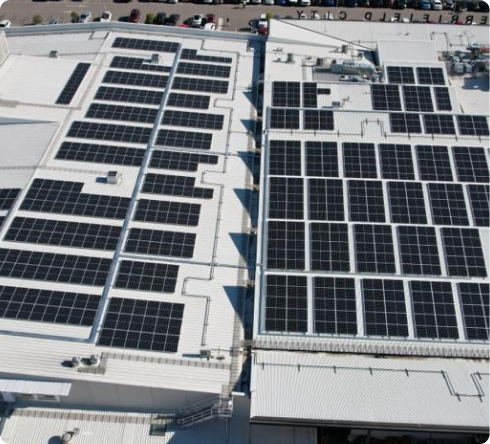

Welcome to Advanced Green Technologies

Commercial Rooftop Solar in Miami

Introduction:

Commercial rooftop solar in Miami turns unused roof space on offices, warehouses, and retail centers into on-site power, cutting grid dependence and utility spend. Because Miami-Dade sits in Florida’s High-Velocity Hurricane Zone (HVHZ), every system must be engineered to design wind speeds of roughly 170–180 mph and built with product-approved racking and attachments. Compliant projects also need site-specific wind-load calculations, a Florida professional engineer’s stamp, and permits cleared through the local building department. Advanced Green Technologies (AGT) designs, permits, and installs code-compliant commercial systems across Miami as a single-source, in-house EPC contractor with more than 380 megawatts installed since 2007.

A rooftop built for the Sunshine State — and its storms

Miami gives commercial buildings two things in abundance: intense sunlight and severe weather. Commercial rooftop solar in Miami has to capture the first while surviving the second, so the engineering behind the panels matters as much as the panels themselves. For property owners, facility managers, and developers, a system that isn’t designed for hurricane wind loads is a liability rather than an asset. This page explains what a compliant Miami system actually requires, how the permitting and incentive landscape works in Miami-Dade, and why AGT’s hurricane-zone engineering approach — refined across Florida since 2007 — fits commercial rooftops in this demanding coastal market.

What is commercial rooftop solar in Miami?

Commercial rooftop solar in Miami is a photovoltaic (PV) system mounted on the roof of a business, industrial, or multi-tenant property to generate electricity on-site. Panels convert sunlight into direct current, an inverter converts it to the alternating current your building uses, and any surplus can flow back to the grid under net metering. For Miami facilities, these systems reduce reliance on utility power and hedge against volatile energy costs. The difference from a standard rooftop array is engineering: Miami-Dade’s building code treats wind loading, roof attachment, and product approval far more strictly than most of the country, so design decisions are driven by hurricane resilience from the first drawing.

Why does commercial rooftop solar installation in Miami need HVHZ engineering?

Commercial rooftop solar installation in Miami requires HVHZ engineering because Miami-Dade County lies inside Florida’s High-Velocity Hurricane Zone, the strictest wind-resistant building standard in the United States. The Florida Building Code defines the HVHZ as Miami-Dade and Broward counties, a framework created after Hurricane Andrew in 1992. Under ASCE 7 design maps, ultimate design wind speeds here typically run around 170–180 mph for standard-risk buildings, though the exact figure varies by site, roof height, and exposure. That drives some of the highest roof-uplift pressures in the country. A compliant system uses wind-load calculations, a licensed engineer’s stamp, and racking rated to hold panels down under those pressures — not a generic mounting kit.

How are commercial solar panels in Miami mounted to survive hurricanes?

Commercial solar panels in Miami are secured with product-approved racking and attachments engineered to resist hurricane wind uplift, then verified by a professional engineer for the specific roof. Every mounting component — rails, clamps, flashing, and fasteners — should carry a Miami-Dade Notice of Acceptance (NOA) or a statewide Florida Product Approval with HVHZ certification, tested to Miami-Dade’s stringent TAS protocols. The mounting method also depends on roof type: ballasted or mechanically attached systems on flat commercial roofs, with attachment points chosen to protect the roof membrane and warranty. AGT integrates panels with flat-roof systems by engineering for load distribution, waterproofing, and structural integrity, so the array performs without compromising the roof beneath it.

HVHZ requirements at a glance

Requirement

$

Design wind speed

$

Product approval

$

Testing standard

$

Engineering

$

Inspection

$

Roof integrity

Choose re-roofing when

$

Systems engineered for ~170–180 mph ultimate wind speed (ASCE 7, varies by site)

$

Racking and attachments need a Miami-Dade NOA or Florida Product Approval with HVHZ certification

$

Components tested to Miami-Dade TAS protocols (cyclic pressure + impact)

$

Site-specific wind-load calculations with a Florida professional engineer (PE) stamp

$

Third-party and municipal inspections through the local building department

$

Attachment designed to preserve roof membrane, drainage, and manufacturer warranty

If you’re unsure which side of the line you’re on, a professional inspection with infrared moisture scanning is the most reliable way to assess how much of your roof is compromised. At Advanced Roofing, our inspectors give you a clear, honest recommendation — repair only what needs it, replace only when it makes financial sense — and document every finding in our Advanced Access portal so you have a full record for insurance, warranty, and capital planning purposes.

What incentives make commercial rooftop solar in Miami worth it?

Commercial rooftop solar in Miami is supported by federal and state incentives that improve return on investment. The federal Investment Tax Credit under Section 48E offers eligible commercial projects a 30% credit when prevailing-wage and apprenticeship requirements are met, and the IRS allows depreciation of solar equipment through MACRS. Note that the commercial credit now carries begin-construction and placed-in-service deadlines, so timing matters — confirm current eligibility with your tax advisor. At the state level, Florida applies no state income tax, offers a property-tax exclusion for the added value of solar equipment, and supports net metering so surplus generation earns bill credits. Together, these mechanisms shorten payback and strengthen the financial case for Miami businesses.

How does commercial solar permitting work in Miami?
Commercial rooftop solar in Miami is supported by federal and state incentives that improve return on investment. The federal Investment Tax Credit under Section 48E offers eligible commercial projects a 30% credit when prevailing-wage and apprenticeship requirements are met, and the IRS allows depreciation of solar equipment through MACRS. Note that the commercial credit now carries begin-construction and placed-in-service deadlines, so timing matters — confirm current eligibility with your tax advisor. At the state level, Florida applies no state income tax, offers a property-tax exclusion for the added value of solar equipment, and supports net metering so surplus generation earns bill credits. Together, these mechanisms shorten payback and strengthen the financial case for Miami businesses.
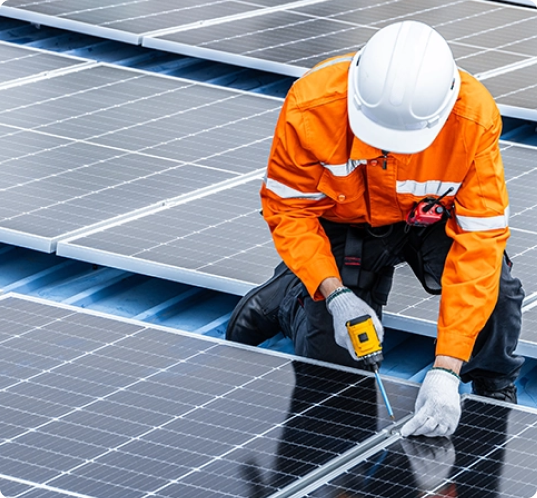
HVHZ-rated solar racking on a Miami-Dade commercial building

Why choose AGT for commercial rooftop solar in Miami?

AGT is a Florida commercial solar contractor built specifically for high-wind, hurricane-prone conditions, which makes it a strong fit for Miami rooftops. Founded in 2007, AGT is 100% employee-owned, licensed, bonded, and insured (License CVC56792), and has installed more than 380 megawatts of rooftop and ground-mount solar. Its single-source model keeps Solar Design, Metal Fabrications, and Construction as in-house divisions, so one accountable team handles engineering through commissioning — no juggling subcontractors. AGT builds with wind-resistant design principles, high-quality materials, and strong roofing-manufacturer and FM Global Insurance relationships to protect warranties. From assessment to installation and long-term operations and maintenance, AGT delivers commercial rooftop solar in Miami engineered to last in Florida’s climate.

Ready to power your Miami property with solar?

Advanced Green Technologies designs, engineers, and installs commercial rooftop solar in Miami built for the Sunshine State’s climate. Request a free consultation and preliminary project assessment, and explore our Rooftop Solar Panel Installations solution and Miami service area to get started.

Frequently asked questions

1. Is Miami a good location for commercial rooftop solar?
Yes. Miami’s abundant sunshine makes rooftops highly productive, and on-site generation offsets high commercial electricity use while supporting sustainability goals.
2. Can commercial solar panels in Miami withstand a hurricane?
When properly engineered, yes. Systems here are designed to roughly 170–180 mph wind speeds using product-approved racking, PE-stamped calculations, and code-compliant attachment.
3. What is a Miami-Dade NOA?
A Notice of Acceptance is a local product approval confirming a component passed Miami-Dade’s HVHZ wind-resistance testing. A Florida Product Approval with HVHZ certification is an accepted statewide equivalent.
4. Will a rooftop solar system damage my commercial roof?
Not when designed correctly. AGT engineers attachment for load distribution and waterproofing, and works within roofing-manufacturer requirements to protect the membrane and warranty.
5. Does commercial rooftop solar in Miami qualify for tax incentives?
Eligible commercial projects can claim the federal Section 48E Investment Tax Credit and use MACRS depreciation. Deadlines and eligibility apply, so confirm current details with your CPA.
6. How long does a commercial rooftop solar installation in Miami take?
Timelines vary by system size, roof type, and municipal review. AGT scopes a realistic schedule during planning and phases work to minimize disruption to your operations.
7. What roof types work for commercial solar in Miami?
Flat commercial roofs are common candidates, using ballasted or mechanically attached racking. AGT assesses structural integrity and roof condition before recommending an approach.
8. Does AGT handle permitting and inspections?
Yes. AGT manages engineering, product approvals, permit applications, and inspection coordination across Miami-Dade’s municipal jurisdictions as part of its single-source service.